
The International Casinos Australians Actually Use — and the Cost of the Offshore Route
 Available in US
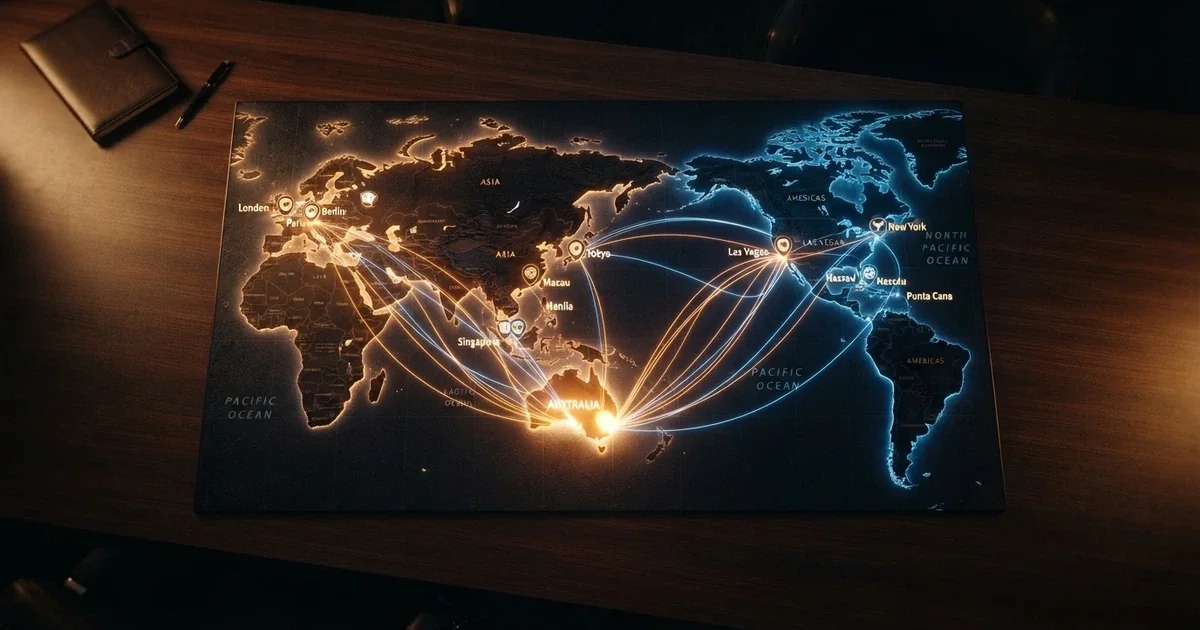
Every online casino an Australian player can reach from a phone or laptop sits outside Australia. None holds an Australian licence, because none can. The product is prohibited under federal law, and the country has no regulator willing to license it. The ten operators that Australian players reach in practice are listed and discussed below, but the legal and consumer-protection frame is the first thing to read, because it determines what every other number on the page is worth.
Data current as of 3 September 2026 and verified against the Australian Communications and Media Authority register and the Interactive Gambling Act 2001.
Table of Contents
- What “International Casino” Actually Means for Australian Players
- The International Casinos Australians Turn To — 2026 Ranking
- Why Every International Casino Is Legally Offshore — and What That Costs You
- Staying in Control When the Safety Net Is Gone
- No-Deposit Bonuses at International Casinos Are Rarely Free
- The Games You Can Play — and the RTPs Nobody Quotes
- How We Evaluated These International Casinos
- Your Offshore Casino Decision — What the Facts Actually Say
- Frequently Asked Questions
What “International Casino” Actually Means for Australian Players
The phrase “international casino” gets thrown around in Australia as if it described a category. It does not. What it actually describes is the only thing the country’s online casino market can contain: an offshore operator.
The Offshore Reality — No Licensed Online Casino Exists in Australia
Under the Interactive Gambling Act 2001, it is an offence to provide online casino games, online pokies and in-play sports betting to a person in Australia. The Act targets the provider, not the player — which is why individual Australians are not prosecuted for placing a bet offshore. The legal consequence of the prohibition is structural, not procedural: no licence for online casino exists anywhere in the country, not federally and not in any state or territory. The Northern Territory Racing and Wagering Commission, through Licensing NT, licenses online bookmakers; state regulators license land-based casinos like Crown and The Star. Neither regime extends to a website offering roulette or slots. The product exists in the market every day. The licence for it does not.
Calling a site “international” is a description of where it sits, not a marker of legitimacy. A Curaçao or Malta credential is not a passport to Australian players; it is a permission to operate under another country’s rules. Australia treats those providers as illegal to advertise to Australians, illegal to take credit-card money from Australians, and — once the new amendments take effect — illegal for Australian banks to send money to.
Why Australian Players Look to International Casinos
The pull is the gap. Licensed Australian wagering covers sports and racing, plus lotteries and keno. It does not cover casino games. A player who wants to spin a slot on a Wednesday night, or sit at a live-dealer blackjack table on a Sunday morning, has no Australian-licensed option. The Australian-licensed alternatives are sports betting, racing, the pokies room of a Crown or The Star property if they happen to be in Melbourne or Sydney, and the lotteries. That is the legal catalogue. The casino product sits outside it.
This is not a temporary gap waiting for legislation. The IGA has been in force since 2001, strengthened in 2017, and tightened again in 2026. The direction has been one way for twenty-five years. The product demand is real; the supply, by law, cannot meet it from inside Australia.
How Offshore Casinos Actually Work for Australian Players
Register. Deposit. Play. Withdraw. The mechanics are familiar. The difference is who is on the other end of the screen, and what recourse a player has if something goes wrong.
An Australian player creates an account, verifies an email address, and starts playing. KYC checks vary by operator — many offshore casinos request documents only at withdrawal, some not at all. Deposits can be made by debit card, by a few e-wallets that still process gambling transactions, and (despite the Australian ban on credit cards and crypto for licensed wagering) often by credit card or cryptocurrency at offshore sites. Withdrawals follow the same routes in reverse, sometimes with processing times that range from hours to weeks.
The piece missing from that familiar sequence is the safety net. ACMA does not adjudicate disputes with offshore operators. The Australian Consumer Law does not reach them. If a withdrawal is refused, or an account is closed with a balance on it, or the site simply disappears, the player has no Australian avenue of complaint. The offshore operator is also not connected to BetStop — Australia’s National Self-Exclusion Register — so a person who has self-excluded from Australian-licensed wagering can still deposit, lose and request credit at an offshore site. That is a real risk for anyone who has used BetStop or is thinking about it.
The site itself can also be blocked. The ACMA blocking programme has removed more than 1,564 illegal gambling and affiliate websites from Australian ISPs since November 2019 — the scale and mechanics are covered in the section on enforcement below.
Crypto, Cards and Payments — Getting Money In and Out
The payment picture is one of the sharpest contrasts between Australian-licensed wagering and the offshore world. Since 11 June 2024, credit cards, credit-related products and digital currency have been banned as payment methods for online wagering in Australia. The penalty for an operator that fails to enforce the ban is up to $247,500. The legal deposit routes for an Australian-licensed bookmaker are debit card, bank transfer, PayID and Osko, and BPAY, with identity verification required at sign-up.
Offshore casinos do not follow those rules. Many still take Visa and Mastercard credit cards. Most accept cryptocurrency — Bitcoin, Ethereum, USDT and the long tail of altcoins. The crypto route is partly a privacy play for the player and partly a regulatory arbitrage play for the operator, because it sits outside the Australian payment ban. From 1 January 2027, the picture tightens: the Interactive Gambling Amendment (Gambling Reform) Bill 2026, which passed Parliament on 19 August 2026, gives banks and payment providers express authority to block transactions to illegal gambling operators. A debit-card deposit at an offshore casino is, by then, a transaction an Australian bank can decline on legal grounds.
For a player, the practical implication is that the convenient deposit routes of 2026 may not work in 2027. The workarounds that exist — prepaid cards, third-party e-wallets, crypto — sit further from any consumer protection, including the bank’s. The closer to a normal Australian bank account the deposit looks, the more exposed to blocking it becomes.
Mobile Apps and Browser Play — Access from Australia
Most Australian players reach offshore casinos through a mobile browser rather than an app. The Apple App Store and Google Play do not carry offshore casino apps for the Australian market, and downloading an APK from a casino website is a separate decision that involves turning off the platform’s built-in safety prompts. Browser-based play is the norm — the same HTML5 lobby that loads on a desktop opens in a phone browser, with the same game library and the same login.
The other access question is reach. ACMA’s blocking programme has directed Australian ISPs to block more than a thousand illegal gambling and affiliate websites since November 2019. The blocks are DNS-level, and a determined player with technical knowledge can route around them — but the practical effect is that an offshore casino an Australian player could reach yesterday can be unreachable tomorrow. The access route is not a permanent feature of the experience.
The International Casinos Australians Turn To — 2026 Ranking
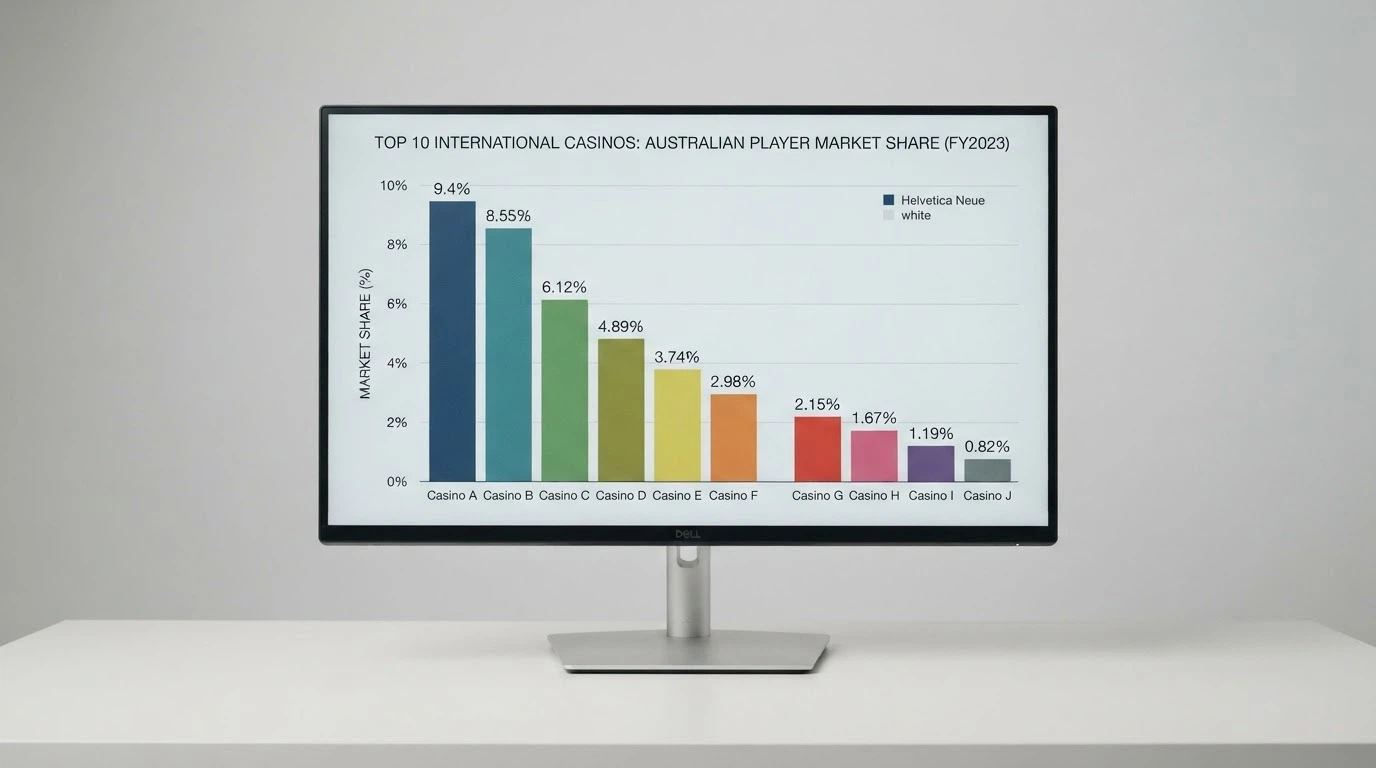
The table below ranks the ten operators with the largest tracked share of Australian online casino traffic. Market share and revenue figures come from publicly available traffic data, not from any Australian regulator — no Australian regulator endorses any of these operators. All ten sit outside Australia, and the right-hand column of the table is the same for every row.
| Operator | AU Market Share (%) | Tracked Revenue (AUD) | Legal Status in Australia |
|---|---|---|---|
| Rocket Play | 9.4 | $632.69M | Offshore — not AU-licensed |
| Skycrown | 8.55 | $436.07M | Offshore — not AU-licensed |
| Royal Reels | 2.51 | $243.99M | Offshore — not AU-licensed |
| WinSpirit | 1.55 | $110.3M | Offshore — not AU-licensed |
| Stake | 1.28 | $115.67M | Offshore — not AU-licensed |
| Rainbet | 1.28 | $83.13M | Offshore — not AU-licensed |
| Scream Casino | 0.99 | $94.87M | Offshore — not AU-licensed |
| FairGO | 0.8 | $69.11M | Offshore — not AU-licensed |
| Bizzo Casino | 0.57 | $51.38M | Offshore — not AU-licensed |
| Rocket Casino | 0.57 | $43.22M | Offshore — not AU-licensed |
The spread is wide. Rocket Play sits well clear of the rest at 9.4%, with $632.69M in tracked AU revenue. Skycrown holds 8.55% and $436.07M. Then a long tail of operators, each holding under 3% but collectively accounting for the majority of Australian offshore casino play. The figures track where Australian players actually land; they do not track quality, fairness, payout speed, or any measure a player can rely on.
Rocket Play
Rocket Play is the largest offshore casino in Australia by tracked traffic, with 9.4% market share and $632.69M in tracked AU revenue. That places it ahead of every Australian-licensed wagering operator except SportsBet — a different product entirely. The brand has invested in reaching Australian players rather than treating them as a sideline; the traffic share reflects that.
The position is the data point that matters here. A meaningful slice of Australian offshore play flows through Rocket Play. What the figure does not say is anything about bonus terms, payout speed, game fairness, or customer service quality — those details are not in the public market-share dataset this ranking draws on, and a player who weighs them should verify them on the operator’s site rather than assuming scale brings them. For a player choosing by traffic alone, Rocket Play is the largest draw in the offshore market. The trade-off is the standard offshore trade-off: there is no Australian regulator behind the cashier.
Skycrown
Skycrown holds the second-largest share at 8.55%, with $436.07M in tracked AU revenue. The scale is similar to Rocket Play’s in order of magnitude — both are nine-figure Australian operations — but the gap is real, with Rocket Play running roughly 45% ahead on revenue. Skycrown has been visited at scale by Australian players long enough to accumulate that revenue base.
The verdict is the volume verdict: Skycrown is the second-biggest offshore destination for Australian players, and for a player who reads the licence and terms pages before depositing, it is a comparable position to Rocket Play with a slightly thinner pool of Australians behind it.
Royal Reels
Royal Reels is the third operator on the list, with 2.51% market share and $243.99M in tracked AU revenue. The drop from Skycrown to Royal Reels is steep — under a third of the share — but Royal Reels still clears the nine-figure revenue mark. The Australian footprint is real, even at the third-tier share level. A mid-tier operator with substantial Australian traffic, sitting well behind the top two but well clear of the long tail.
Stake
Stake is the brand most Australian readers will recognise from the crypto gambling press. Its 1.28% market share and $115.67M tracked AU revenue put it in the middle of the top ten by share. Stake is commonly cited as Curaçao-licensed, though the specific licence credentials were not confirmed in this ranking’s source data. The brand’s reputation is built on crypto deposits and withdrawals, on a sportsbook that runs alongside the casino, and on a publicly visible edge — Stake publishes its house edge on roulette and several other games, which is unusual for the offshore market.
The clearest match on the list for a crypto-first player who wants an operator that names its edge. For everyone else, the position is mid-tier with a distinct audience.
Rainbet
Rainbet sits at 1.28% market share — the same number as Stake — but on a smaller revenue base of $83.13M in tracked AU revenue. The lower revenue against the same share suggests Rainbet runs lighter per-player volume, or a slightly different mix of stake sizes, than Stake. The share figure says it has Australian players; the revenue figure says those players are spending less per head than at the brands above.
Scream Casino
Scream Casino sits at 0.99% market share and $94.87M in tracked AU revenue. That is a smaller share than Rainbet but a higher revenue base — which is the same pattern Stake shows against Royal Reels, just at a different scale. The brand has Australian players who are spending more per head than the share alone would predict. A smaller mid-tier brand with above-average spend per Australian player, and the combination of share and revenue is a useful tell about who is using it.
FairGO
FairGO is the most explicitly Australian-facing operator on the list, with 0.8% market share and $69.11M in tracked AU revenue. The brand name, the AUD-default presentation, and the explicit targeting of Australian players set FairGO apart from the other nine. The targeting is itself a legal question — an offshore casino that markets directly to Australians is doing the precise thing the IGA’s prohibition was tightened to discourage.
For a player who values AUD-native presentation and Australian-friendly customer support, FairGO is the brand built for that brief — at the cost of being the brand an Australian regulator is most likely to be looking at.
Bizzo Casino
Bizzo Casino holds 0.57% market share and $51.38M in tracked AU revenue. That puts it in the lower tier of the top ten. A smaller offshore brand with a real Australian footprint, sitting at the bottom of the top ten.
Rocket Casino
Rocket Casino sits at 0.57% market share and $43.22M in tracked AU revenue — the same share as Bizzo Casino but on a smaller revenue base, making it the smallest operator in the top ten by tracked Australian dollars. Rocket Casino is not the same operator as Rocket Play, despite the shared name element. The two brands are separate entities tracked separately in the source data, and a player looking for one is not automatically looking at the other. The lowest-revenue operator in the top ten, and the brand most easily confused with the largest. Worth verifying the URL before signing up.
WinSpirit
WinSpirit rounds out the top ten with 1.55% market share and $110.3M in tracked AU revenue. That puts it ahead of Stake and Rainbet on share, even though it appears last in this ranking’s prose order. The market-share data orders the long tail of mid-tier brands unevenly across the source list; WinSpirit’s share would put it fourth on a strict ranking. A mid-tier operator that, on share alone, would sit above several of the brands listed before it. The traffic figure is the case for treating it as comparable to Stake rather than to Bizzo or Rocket Casino.
Why Every International Casino Is Legally Offshore — and What That Costs You
The offshore status of every operator above is not an accident of the market. It is the legal shape the market has in Australia. The table below sets out, feature by feature, what an Australian player gives up when they move from Australian-licensed wagering to an offshore casino.
| Player Protection Feature | AU-Licensed Wagering | Offshore International Casino |
|---|---|---|
| Legal to provide to Australians | Yes | No |
| Regulator oversight | Yes — state or territory regulator | No Australian regulator |
| BetStop coverage | Yes — connected to the National Self-Exclusion Register | No — not connected |
| Payment method regulated by Australian law | Yes — credit and crypto banned since June 2024 | No |
| Withdrawal guaranteed by Australian consumer law | Yes | No |
| ACMA complaint resolution | Yes | No |
Read down the right-hand column and the picture is the same: every cell says no, or has no Australian counterpart. The left-hand column is the standard an Australian-licensed wagering operator is held to. The gap between the two is what an offshore player trades away for access to the casino product.
The Interactive Gambling Act 2001 — What It Actually Prohibits
The Interactive Gambling Act 2001 is the federal statute at the centre of all of this. It prohibits the provision of online casino games, online pokies and in-play sports betting to persons in Australia. The prohibited list is precise: casino games, pokies, in-play betting once a sporting event has started. The permitted list is also precise: pre-event wagering on sports and racing, lotteries, keno. The 2017 amendments closed several offshore loopholes and gave the Australian Communications and Media Authority the powers it now uses to investigate, warn, fine and direct ISPs to block illegal services.
The Act targets the provider, not the player. An Australian who places a bet at an offshore casino does not face prosecution. The provider does. That asymmetry matters because it shifts the enforcement burden onto the offshore operator — and explains why ACMA’s enforcement takes the form of site blocking and provider fines rather than player penalties. It does not change the legal status of the product. Online casino remains prohibited. There is no licence available, in any state or territory, for an online casino. The Northern Territory Racing and Wagering Commission, through Licensing NT, licenses online bookmakers — that is wagering, not casino. State regulators license land-based casinos like Crown and The Star — that is bricks and mortar, not the web. Neither licence is the one an offshore casino is operating under.
ACMA Enforcement — Site Blocking, Fines and Market Withdrawals
Enforcement works through four levers. ACMA investigates complaints, issues formal warnings, refers matters for civil penalty proceedings, and directs Australian ISPs to block illegal services at the DNS level. Since November 2019, ACMA has directed the blocking of 1,564 illegal gambling and affiliate websites. Since the 2017 enforcement powers came in, more than 225 illegal services have withdrawn from the Australian market entirely — a withdrawal that is sometimes voluntary, more often the result of sustained blocking pressure that makes the Australian player base unreachable.
The penalty scale for breaches is real. The Interactive Gambling Amendment (Credit and Other Measures) Act 2023, which came into force on 11 June 2024, sets a penalty of up to $247,500 for an operator that fails to enforce the credit-and-crypto payment ban for online wagering. That figure is a per-breach figure, not a one-off. For the offshore operator, the risk profile is ACMA warning, formal investigation, civil penalty proceedings, ISP blocking, and eventual withdrawal from the Australian market. The sequence has played out more than 225 times since 2017.
For a player, the practical effect of enforcement is that an offshore casino that is reachable today can be unreachable next month. The DNS-level blocking does not require a court order for each new site — ACMA adds to the list as new illegal operations appear. A balance on deposit at the moment of a block is a balance the player has no Australian avenue to recover.
What You Lose Playing Offshore — No BetStop, No Recourse, No Guarantee
The consumer-protection gap is the structural cost of the offshore route, and it is wider than most players realise on first deposit. The protections that exist for an Australian using an Australian-licensed wagering operator do not all apply offshore, and the ones that do not matter most are the ones a player is least likely to think about until they need them.
BetStop does not reach offshore casinos. The National Self-Exclusion Register — described in the section on staying in control — binds Australian-licensed wagering services only. Offshore casinos are not connected to the register and are not bound by it. A person who has self-excluded from Australian wagering can still open an account at an offshore casino, deposit and play. The protection that works inside Australia stops at the border.
There is no ACMA complaint resolution for offshore play. ACMA investigates illegal providers; it does not adjudicate player disputes. A refused withdrawal, a closed account, an unexplained bonus confiscation — these are matters the offshore operator’s own terms and conditions govern, with no Australian oversight of how those terms are applied.
The Australian Consumer Law does not reach offshore operators. Guarantees about acceptable quality, refunds for services not provided, and unfair contract term protections are all Australian Consumer Law remedies that apply to Australian businesses and to foreign businesses supplying Australian consumers. An offshore casino is, in practice, outside the Australian courts’ easy reach — and even where a claim is theoretically possible, the cost of pursuing it across jurisdictions exceeds the value of most player balances.
The site can be blocked while a player has a balance on it. ACMA adds to its blocking list as it identifies new illegal operations. A player who deposits at an offshore casino on Monday and finds the site blocked on Friday has a balance that is not reachable through any Australian dispute resolution route.
Payment recourse disappears. A debit-card deposit at an Australian-licensed wagering operator is a transaction the player’s bank can help reverse under the ePayments Code if something goes wrong. A credit card or crypto deposit at an offshore casino is not — and from 1 January 2027, it is a transaction the bank may decline on legal grounds in the first place.
The 2026 Reforms — What Changes from January 2027
The Interactive Gambling Amendment (Gambling Reform) Bill 2026 passed Parliament on 19 August 2026. Its measures commence on 1 January 2027. The reforms touch four areas that matter directly to anyone playing at an offshore casino.
On payments, banks and payment providers gain express authority to block transactions to illegal gambling operators. That means a debit-card transaction to an offshore casino is one an Australian bank can decline at the source, not after the fact. The change is the single biggest tightening of the offshore route since the IGA’s 2017 strengthening. A player who relies on the convenient deposit routes of 2026 is using routes that may simply not work in 2027.
On advertising, no more than three wagering ads per hour will be permitted between 6:00 am and 8:30 pm, with a live-sport blackout from 15 minutes before a live event until 5 minutes after. Radio ads will be barred during school commute and drop-off times. Broadcasting sporting odds during live sport is banned outright. Online wagering ads will only be served to logged-in, over-18 users who have not opted out. Ads inside sports venues and on player uniforms are prohibited.
On promotion, athletes, celebrities and influencers are barred from promoting wagering products. Direct marketing of inducements — the welcome offer, the deposit match, the free-spins bundle — is prohibited for 14 days after a customer signs up and for three months after a person deregisters from BetStop, and indefinitely for any customer identified as at-risk. An offshore casino advertising a welcome bonus to an Australian is already breaking the prohibition; the new rules tighten the perimeter that surrounds the licensed market.
On the register, BetStop’s operations are strengthened, including the three-month post-deregistration cooling-off on marketing. The register itself — covered in the section on staying in control — is unchanged in principle, but the regulatory weight behind it is heavier.
For an offshore player, the practical summary is: fewer legal ways to deposit, fewer legal ways to be advertised to, and a regulator with more tools. None of this changes the prohibition that already exists. It narrows the routes around it.
Staying in Control When the Safety Net Is Gone
The offshore reality is the legal one. The responsible-gambling one is downstream of it. Australia’s harm-minimisation infrastructure is built around Australian-licensed wagering, and the offshore casinos are not part of it. What exists at the offshore site is what each operator chooses to build, and what exists in Australia is the help an Australian player can reach regardless of where they have been playing.

Deposit Limits, Time-Outs and Self-Exclusion — What Offshore Casinos Offer
Most reputable offshore casinos offer deposit limits, session time-outs and account-level self-exclusion. The mechanics are familiar: a player sets a daily, weekly or monthly deposit ceiling; takes a 24-hour, 7-day or 30-day break; or self-excludes for a longer period or permanently. The features are typically reachable from the responsible-gambling or player-protection section of the account menu, and most major offshore operators publish a self-exclusion policy that mirrors the AU-licensed equivalent in spirit.
The difference is enforceability. Australian-licensed wagering operators are required to honour their deposit limits, report breaches, and connect to BetStop. Offshore operators are bound only by their own terms and conditions, by the licence conditions of whichever jurisdiction issued their credential (commonly Curaçao or Malta), and by whatever commercial pressure the payment provider or affiliate network applies. A player who sets a deposit limit and then sees it ignored has no Australian regulator to complain to. A player who self-excludes at an offshore site and then sees marketing email arrive two weeks later has no Australian spam regulator to complain to. The tools exist. The accountability behind them is thinner.
BetStop is the clearest example of the gap. The National Self-Exclusion Register binds Australian-licensed wagering services only. As at 31 July 2026, the register held 67,480 registrations and 41,290 active exclusions, with 78% of registrants under 40 and 38% choosing lifetime exclusion. A BetStop registration excludes a person from every Australian-licensed online and phone wagering service simultaneously. It does not exclude them from any offshore casino. The offshore casino will, in fact, keep taking a self-excluded person’s money. That is the literal gap the offshore route opens in Australia’s harm-minimisation architecture.
The practical advice for anyone who has self-excluded through BetStop or is thinking about doing so: treat offshore casinos as a separate decision. The protection that worked inside Australia does not follow the player across the border.
Where to Get Help — Australian Support Services That Actually Work
The help infrastructure an Australian can reach regardless of where they have been playing is solid. It sits outside any casino’s terms and conditions, and it is staffed around the clock.
The National Gambling Helpline is 1800 858 858 — free, confidential, and staffed 24 hours a day, seven days a week. The same service runs an online chat and counselling platform through Gambling Help Online, at gamblinghelponline.org.au. The service is funded by the Australian government and the state and territory governments, and it is independent of every casino operator on the list above.
The scale of the need is well-documented. The Australian Institute of Health and Welfare’s most recent problem-gambling prevalence survey puts problem gambling among Australian adults at approximately 2.1%, which is roughly 430,000 people. High-risk gambling sits at 1.8%. These figures cover the population, not the offshore subset, but they describe the demand side of the help services an Australian can reach.
BetStop itself remains a real protection for the Australian-licensed wagering market. The 67,480 registrations and 41,290 active exclusions as at 31 July 2026 represent a meaningful uptake. The fact that 78% of registrants were under 40, and 38% chose lifetime exclusion, tells its own story about who is using the register and how serious the decisions are when they get made.
For a player at an offshore casino, the steps are the same as for anyone else: if the play has stopped being fun, the helpline is the next call. The offshore operator will not make it for them.
No-Deposit Bonuses at International Casinos Are Rarely Free
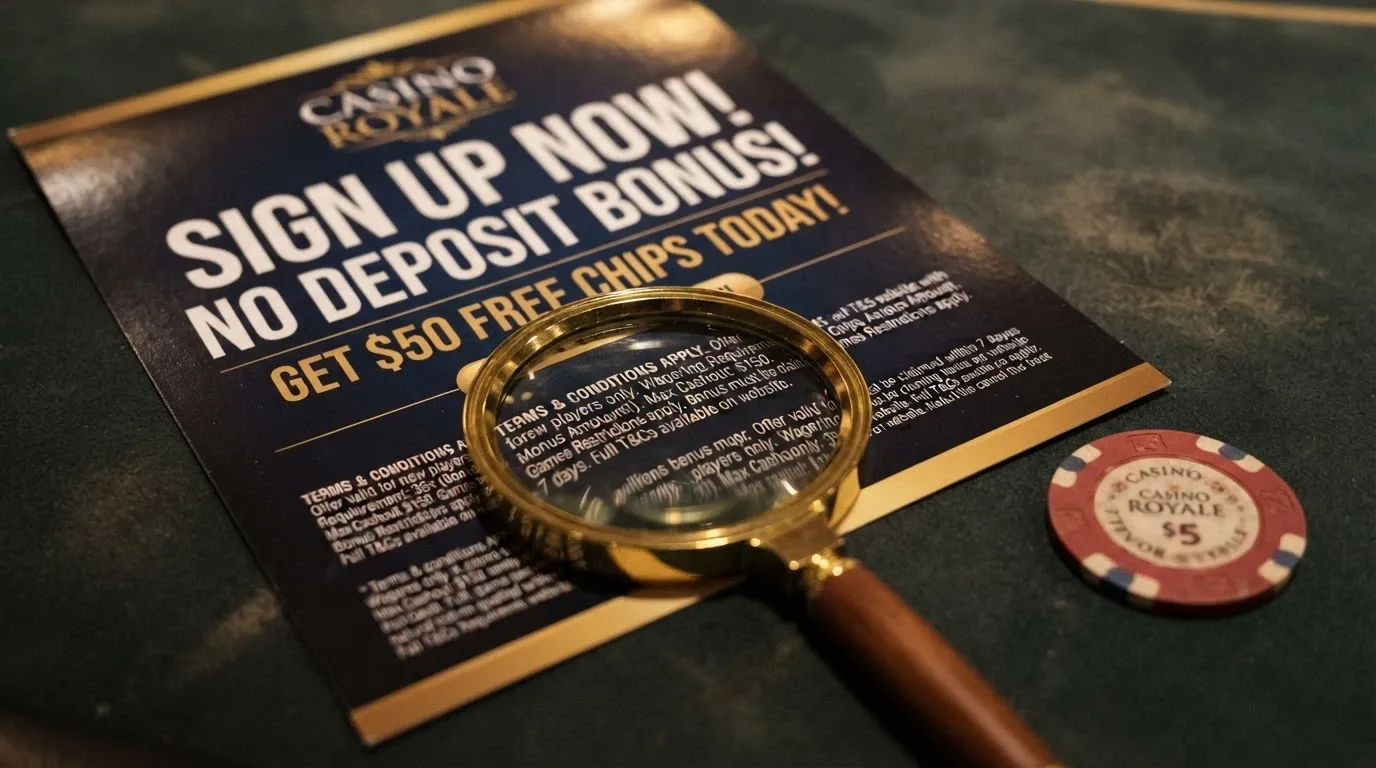
The “no-deposit bonus” is the most aggressively marketed offer in the offshore casino market. It is also the offer most likely to mislead a player who reads the banner and not the terms. The mechanics are worth walking through before any Australian player signs up for one.
The No-Deposit Offer — What It Promises and What It Costs
A no-deposit bonus is exactly what the name says: a small credit, or a bundle of free spins, granted without the player making a deposit. The amounts are modest by design — ten or twenty dollars in bonus credit, twenty to fifty free spins on a named slot — because the offer’s job is to get the player through registration and into the lobby. The credit is “free” only in the sense that it does not require a deposit. It is not free in the sense of having no cost. The cost sits in the terms.
Three terms govern every no-deposit bonus. A wagering requirement: the bonus amount, plus any winnings generated from it, must be wagered a stated number of times before withdrawal — typically 30x to 60x the bonus for offshore casinos, and the higher end is more common than the lower. A maximum cashout cap: even after the wagering is complete, only a stated amount — often $100 to $200 — can actually be withdrawn, with the rest forfeited. A short validity window: the bonus typically expires in 7 to 14 days, and missing the window means the bonus, the winnings, and any associated balance disappear.
Do the arithmetic on a representative case. A $20 no-deposit bonus at 50x wagering requires $1,000 of playthrough before withdrawal. At a typical slot RTP of around 96%, the expected house edge on that $1,000 is roughly $40 — which is twice the bonus amount itself. The bonus is, in expectation, already lost before the player has spun the first spin. The maximum cashout cap then takes the winnings that survived the wagering and caps them at a fixed figure. The marketing says “free”. The terms say something closer to a paid trial with a low ceiling.
The specific no-deposit bonus terms for each operator in the ranking above were not confirmed in this ranking’s source data. The structure described here is the standard structure across the offshore market; operators vary the specific multiples, caps and validity windows, but the shape is consistent.
Welcome Packages and Multi-Offer Deals — Reading the Fine Print
The welcome package is the larger cousin of the no-deposit bonus. A typical offshore welcome package spans the first two to four deposits, with a percentage match on each — 100% on the first deposit up to a stated maximum, 50% on the second, 25% on the third and fourth, often with a free-spins bundle attached to each. The headline is the total package value, which can run into the thousands of dollars in bonus credit plus several hundred free spins.
The terms apply the same three constraints as the no-deposit bonus, with two additions. Wagering requirements typically run 35x to 50x the combined bonus and deposit amount, which is a heavier burden than the no-deposit bonus alone. The free-spin winnings usually carry their own wagering requirement and their own maximum cashout cap. Game-weighting rules apply — slots typically contribute 100% to wagering, table games often 10% or 0%. Validity windows range from 7 to 30 days per stage of the package.
The arithmetic on a representative case: a $500 welcome package at 40x the bonus amount requires $20,000 of playthrough before withdrawal. At a 96% slot RTP, the expected house edge on $20,000 of spins is roughly $800. Net against the $500 bonus, the expected player outcome is around -$300 — the bonus is, in expectation, a $300 cost rather than a $500 benefit. The marketing says “free money up to $500”. The mathematics say the player is, in expectation, $300 worse off than if they had never claimed the bonus.
The advice that fits every welcome package is the same: read the wagering multiple, the maximum cashout cap, the game weighting and the validity window before depositing. If any of those terms is missing from the offer page, that itself is information.
The Games You Can Play — and the RTPs Nobody Quotes
The product gap is the reason offshore casinos exist for Australian players. What sits behind the lobby is the standard international online casino catalogue: thousands of pokies and slots, multiple roulette variants, a full live-dealer floor of blackjack, baccarat and game-show titles, and a long tail of video poker, scratch cards and speciality games. The library is wide. The transparency around it is thinner.

Pokies and Online Slots — The Biggest Library Offshore
Slots are the bulk of any offshore casino lobby. The variety runs from classic three-reel fruit machines through five-reel video slots with bonus rounds, megaways mechanics, cluster pays, and progressive jackpots that pool across networks of casinos. Game providers range from long-established studios to smaller suppliers that ship a handful of titles each year. The catalogue at a major offshore casino runs into the thousands of games; at the largest operators, it runs into the tens of thousands.
The Australian pokie culture shapes what players click first. Australians call them pokies, not slots, and the preference runs to high-volatility titles with big bonus-round potential — the Hold and Spin style, the bonus-buy feature, the megaways format with thousands of ways to win. Offshore lobbies cater to that preference, with the high-volatility titles surfaced in the “Popular” and “New” tabs and the lower-volatility classic slots sitting further down. Progressive jackpots are common, and several offshore networks pool jackpots across dozens of casinos to push prize tiers into the seven-figure range.
The provider names for the specific operators in this ranking were not confirmed in the public data this article draws on. The structural point — that the slot library is wide, that progressive jackpots are common, and that the high-volatility titles favoured by Australian players are well represented — applies across the offshore market.
Roulette and Live Dealer Tables
Roulette is the second pillar of the offshore casino lobby, and the live-dealer format is what most players reach for once they move past the slots. The standard variants are European roulette (single zero, 2.7% house edge), American roulette (double zero, 5.26% house edge) and French roulette (single zero with la partage or en prison rules, which can halve the house edge on even-money bets). The European and French variants are the player-friendlier options; the American variant is the one most easily found on the floor but the worst of the three to play.
The live-dealer format streams a real dealer from a real studio, with bets placed online and outcomes decided by a physical wheel or a physical deck of cards. The social dimension is the selling point — there is a chat function, there is a real human dealing, there is a rhythm to the play that software-roulette cannot match. The standard live tables cover blackjack, baccarat and roulette, with side bets and variant rules layered on top. Game-show titles — wheel-of-fortune formats, dice games, crash-style games with a live host — have grown rapidly and now occupy a significant share of the live lobby at the larger operators.
The streaming quality at the major live studios is high, with multiple camera angles, real-time statistics, and bet-behind features that let a player wager on another player’s hand. The one thing the live format does not change is the house edge. The European roulette wheel on a live table has the same 2.7% edge as the European roulette wheel on a software table. The atmosphere is the only thing that improves.
RTP, Volatility and Why Game Data Is Hard to Verify Offshore
RTP — return to player — is the percentage of all wagered money a slot or table game returns to players over a very large number of plays. A 96% RTP slot returns $0.96 of every $1 wagered, in expectation, over millions of spins. The remaining 4% is the house edge. Volatility is a separate concept: a high-volatility slot pays out less often but in larger chunks; a low-volatility slot pays out more often but in smaller chunks. The RTP is the long-term average; the volatility is the shape of the path to it.
The verification problem is that offshore casinos are not subject to Australian testing standards. In Australia, the testing regime is state-based and varies by jurisdiction; at the federal level, ACMA’s role is regulatory enforcement, not game testing. The independent testing houses — labs that audit game fairness for licensed operators — do their work in jurisdictions outside Australia. A reputable offshore casino may publish an RTP figure supplied by the game provider; a less reputable one may publish nothing. Either way, the player has limited ability to verify the figure independently.
The practical effect is that RTP and volatility claims at offshore casinos should be treated as guidance, not as audited facts. The game providers with the strongest reputations tend to publish consistent RTPs across multiple operators, which gives some cross-check; smaller providers and white-label games do not. For a player who cares about RTP — and the differential between a 94% and a 97% slot is meaningful over thousands of spins — the safest assumption is that the higher-RTP games from the better-known providers are what the published figure says, and that everything else is opaque.
Game-specific RTP and volatility data for the operators in this ranking were not confirmed from the public data this article draws on. The general principle — that offshore game data is harder to verify than licensed-market game data — applies across the ranking.
How We Evaluated These International Casinos
The ranking above is built on three inputs. The BLASK BRANDS-2 market-share dataset, which tracks Australian gambling traffic across operators and gives a snapshot of where Australian players actually land. The Australian Communications and Media Authority’s public register and enforcement record, which sets the legal frame around every operator named. The Interactive Gambling Act 2001 and its 2017 and 2026 amendments, which determine what is and is not licensable inside Australia. No additional weightings, scorecards, or editorial multipliers have been applied to the ranking — the order is the order of the market-share data, with no other criterion layered on top.

The legal-status column in the operator table is the same for every row, and that is the point. No operator in the top ten holds an Australian online casino licence. None can. Online casino is prohibited under the Interactive Gambling Act 2001, and no Australian state or territory issues licences for it. The right-hand column of the table is, accordingly, a description of the legal reality rather than a comparison between rows.
Several specific operator details were not confirmed in this ranking’s source data. The licence jurisdiction for each operator (commonly Curaçao or Malta, but unverified at the licence-number level for any of the ten), current bonus structures, wagering requirements, game counts, and game provider lists were not confirmed for any of the operators above. The ranking reflects where Australian players land, not where the best terms are. A player who weighs bonus terms heavily should treat this ranking as a starting point and verify the terms directly on each operator’s site.
The legal and responsible-gambling context is drawn from the same primary sources: ACMA’s published enforcement figures, the text of the IGA and its amendments, the Australian Institute of Health and Welfare’s gambling prevalence data, and Gambling Help Online’s published service details. No figures have been rounded, scaled or extrapolated from partial sources.
Your Offshore Casino Decision — What the Facts Actually Say
The facts on this page point in one direction. Online casino is prohibited in Australia. Every casino an Australian player can reach is an offshore operator. The product exists in the market because the demand is real and the supply, by law, cannot meet it from inside Australia. The offshore route is the only route. That does not make it a clean one.

The cost of the offshore route is the loss of every Australian consumer protection. No BetStop coverage. No ACMA complaint resolution. No Australian Consumer Law guarantee on withdrawals. No guarantee that the site will be reachable tomorrow. No guarantee that a welcome bonus’s wagering requirements will be honoured as published. From January 2027, no guarantee that the bank will process the deposit at all. The trade is access to the casino product, in exchange for every safety net that applies to the rest of Australian gambling.
That trade is the reader’s to make. The page does not make it for them. What it does say is what the trade contains. The casino product is real and the libraries are wide. The protection gap is also real, and the reforms taking effect from January 2027 narrow the routes around it rather than widen them. A player who reads this page and decides to play offshore is making an informed decision; a player who reads this page and decides the protection gap is too wide is making an equally informed one.
The practical checklist, in the order it matters:
- Verify the licence jurisdiction on the operator’s site. A Curaçao or Malta credential is not an Australian one.
- Read the bonus terms before depositing — wagering multiple, maximum cashout, game weighting, validity window.
- Set a deposit limit on the day of first deposit, not after the first sign of overspend.
- If BetStop is relevant — if there has been a self-exclusion registration, or one is being considered — understand that the offshore casino is not connected to the register.
- Use a payment method that does not rely on a credit card or a crypto route that depends on the offshore operator’s continued willingness to process withdrawals.
- Keep the National Gambling Helpline number (1800 858 858) and Gambling Help Online (gamblinghelponline.org.au) accessible regardless of where the play happens.
The honest framing of the offshore casino market in Australia is not that it is illegitimate in the casual sense — millions of Australians use it — and it is not that it is grey. It is prohibited. The product exists because demand exists, and the route to it is offshore because no Australian licence can be issued. A reader who treats that as the starting point for every other decision on this page is reading the market as it actually is.
Frequently Asked Questions
Is it legal to play at international online casinos from Australia?
It is not illegal for the player. The Interactive Gambling Act 2001 prohibits the provider, and individual Australians are not prosecuted for using offshore sites. The legal exposure sits with the operator. The trade-off for the player is the consumer-protection gap: no BetStop, no Australian regulator for disputes, no Australian Consumer Law guarantee on withdrawals.
Are my winnings from international casinos taxable in Australia?
No, not for ordinary punters. Under section 6-5 of the ITAA 1997, betting and gambling winnings are not assessable income, and losses are not deductible under section 8-1. No Australian case has held the winnings of an ordinary punter assessable. The operator side is a separate matter — wagering operators pay tax where the customer is, typically 10–15% of net revenue.
What happens if an international casino refuses to pay out my winnings?
There is no Australian regulator to appeal to. ACMA investigates illegal providers; it does not adjudicate player disputes. The Australian Consumer Law does not reach offshore operators in practice, and cross-jurisdiction claims are rarely cost-effective. Realistic options are the operator’s own dispute process, the licence-issuing jurisdiction’s complaints body, a chargeback through the card issuer for debit-card deposits, or — for crypto — nothing at all.
Does BetStop cover international or offshore casino sites?
No. BetStop binds Australian-licensed wagering services only — offshore casinos are not connected and not bound. As at 31 July 2026, the register held 67,480 registrations and 41,290 active exclusions. A self-excluded person can still open an account, deposit, and play at an offshore casino. The protection stops at the border.
What is the safest way to deposit and withdraw at an international casino from Australia?
There is no Australian-law-protected deposit route. The closest equivalent is a debit card through an Australian bank, which gives chargeback rights under the ePayments Code. Credit cards and crypto are technically usable at offshore sites but offer less recourse. From 1 January 2027, Australian banks gain express authority to block transactions to illegal gambling operators — even debit cards may not be available.
Published by the Bitcoin Casinos Australia team.