
Real Money Pokies on Android in Australia in : The Honest Guide to an Offshore Market
Current as of $$ and verified against the ACMA register, the Curaçao Gaming Control Board and the Malta Gaming Authority public licence registers.

A clean, careful number sits behind every claim on this page. The headline finding is the one an Australian Android user needs before doing anything else: there is no Australian-licensed real-money pokies app. None. Every operator this page ranks is offshore. That is the starting point, not a footnote, and the rest of the page is built on it.
Current as of 18 October 2026 and verified against the ACMA register, the Curaçao Gaming Control Board, and the Malta Gaming Authority public licence registers.
The market that exists for an Australian who wants to stake cash on a pokie from an Android phone in is entirely built on offshore operators running under Curaçao or Malta licences, accepting deposits in Australian dollars (sometimes), and serving games through HTML5 in Chrome rather than through anything in the Google Play Store. The Google Play Store does not host real-money casino apps in Australia. That is a platform policy, not an accident, and the way around it is well-defined: browser, APK, or progressive web app. All three deliver the same game, and all three sit outside the Australian regulatory perimeter.
So the practical shape of the market in is this: a player with an Android phone, a debit card or a PayID, and a search for “pokies” will land on a list of offshore sites within minutes. The same player has no recourse to BetStop, no Australian consumer protection, and no guarantee the site will still be reachable next week. The reason to write a guide at all is that the player is going to find those sites anyway. The job of this page is to make the trip cheaper, less surprising, and a little safer.
Table of Contents
- There’s No Pokies App on Google Play — Here’s What You Actually Use in CY
- Aristocrat on Android: The Pokies Australians Actually Search For
- Best Real-Money Pokies Sites for Android in CY: 10 Offshore Operators Compared
- Rocket Play
- SkyCrown
- Royal Reels
- WinSpirit
- Fair Go Casino
- Bizzo Casino
- Stake
- Rainbet
- Rocket Casino
- Scream Casino
- No, Android Pokies Aren’t Licensed in Australia — Here’s What the Law Actually Says
- When Pokies Stop Being Fun: Real Help for Australian Players in CY
- How We Chose These Android Pokies Operators: Our CY Methodology
- Your Money, Your Android, Your Call: What to Actually Do Next
- Frequently Asked Questions
There’s No Pokies App on Google Play — Here’s What You Actually Use in
Google Play has not stocked a real-money casino app for Australian players in years, and it is not about to start. The store’s content policy excludes real-money gambling apps in regions where the operator does not hold a local licence, and no operator holds one in Australia because the IGA makes it unlawful to provide one. That policy is the reason every pokies app a real-money Australian player has ever used was reached through a browser, a sideloaded APK, or a home-screen shortcut. None of those three is an “app” in the Play Store sense, and none of them needs to be.
The Play Store gap is a deliberate feature of the Australian framework, not a bug. It funnels every player into one of three access routes, and the rest of this section is about which route is which, what each one costs in practice, and which one most Australian players end up on. The three routes work the same way under the hood — every one of them runs the same HTML5 game files served by the same offshore operator — and they differ only in the shape of the door.
APK vs Browser vs PWA: The Three Ways You Actually Play
An APK is what an Android phone would install if the game came from the Play Store; sideloaded, it functions the same way. The player goes to the operator’s own site, taps a download link, allows installs from unknown sources for that one app, and ends up with a real-money casino app living on their phone. It uses 50–150 MB of storage, depending on the operator and the number of embedded games. It runs faster than a browser in some benchmarks because the game assets are already on the device. It also needs to be updated by the player — the operator pushes a new APK when a game changes, and a stale APK is a broken APK.

The browser route is the one most Australian players actually use. Open Chrome, navigate to the operator’s site, log in, play. The game runs in HTML5 — the same standard that runs webmail and Google Docs — and the operator pushes updates server-side, so the player never has to download anything. Storage used: zero. Update burden: none. The trade-off is that the game is loaded over the network on each session, which on a slow connection can mean a few seconds of buffering at the start of a bonus round. On any reasonable Australian 4G or 5G connection, it does not.
A PWA, or progressive web app, is the middle path. The player visits the operator’s site in Chrome, taps “Add to Home Screen,” and gets an icon on the Android desktop that opens the site in a chromeless window. It feels like an app — no URL bar, no browser chrome — but the underlying delivery is still HTML5 over the network. No storage cost beyond a few kilobytes of metadata. No install friction beyond the home-screen tap. No APK to update. Most operators have quietly added PWA support without making a fuss about it, because it gives the player the perceived stability of an app with none of the distribution problems.
Which route wins for most Australians is the browser, and it is not close. The HTML5 standard runs pokies at full quality in Chrome and Firefox across both Android and iOS, so a player who switches phones does not lose access. A downloaded APK ties the player to a specific version of a specific app on a specific device. The only honest case for the APK is a player on a slow rural connection who values the cached game assets enough to trade 100 MB of storage for a faster session start. The case for a PWA is a player who wants the home-screen icon and is happy to give up nothing. The case for the browser is everyone else.
Free Pokies vs Real Money: What Actually Changes When You Stake Cash
The games themselves do not change. The HTML5 file the operator serves in demo mode is the same HTML5 file the player spins for cash. The return-to-player (RTP) percentage, the volatility, the bonus triggers, the jackpot mechanics — all of these are properties of the game engine and do not shift when a player toggles from demo to real money. The same Aristocrat title, Indian Dreaming, returns 98.99% of wagers to players over the long run whether the wager is fake credits or real AUD. That figure does not move.
What does change is the pressure. Demo mode is what the player uses to learn a title, to test a strategy, to kill five minutes on a bus. Real money is the same game with a bankroll attached, and the cost of a session is no longer abstract. The math is unchanged. The way the player feels about the math is not. This is the part the marketing copy never mentions, and the part a guide like this one is for.
The other thing that changes is access. Offshore operators typically let anyone open a pokie in demo mode — no account, no deposit, no email. Real-money play, on the other hand, is gated behind account creation, identity verification, and a deposit. That gate is not optional. The operator needs to know who is depositing and where the winnings go, and the player cannot skip it. Some operators also gate bonus features — free-spin rounds, jackpot entries — behind a real-money account, which means the demo is not always a faithful preview of the full game. The pragmatic move is to use demo mode to find a title whose mechanics the player enjoys, then create an account only on the operator that serves that title with the terms the player can clear.
The Aristocrat titles — the Australian-heavyweight pokies that dominate the conversation below — are HTML5 builds that run on Android and iOS without any app download, instant-play through the browser. The same is true of the bulk of the offshore library. The access question collapses for the player, in practice, into “do I have a Chrome browser and a verified account on a licensed offshore site.” If yes, the player can play. Everything else is a complication of the operator’s choice, not a technical barrier.
No Download, No Problem: Why HTML5 Killed the Casino App
The downloadable Android casino app is an artefact of the Flash era. A decade ago, the only way to run a pokie on a phone was to bundle the game files into a native app — the browser could not handle the animations, the audio, or the random number generation at the speed an operator needed. The APK existed because the web could not do the job. The web caught up. HTML5, supported by every modern Android browser, runs pokies at full quality, and the server-side update model means the operator can ship a new game or a new feature without the player lifting a finger.
The result is that the downloadable casino app is, for an Australian player in , strictly worse than the browser. It costs storage. It costs update time. It costs a side-load permission. It buys nothing the browser does not already provide. The operators know this, which is why the APK is offered as one option among three and not pushed as the default. The few operators that still market an APK are selling a 2014 user experience to a player.
Aristocrat on Android: The Pokies Australians Actually Search For
Aristocrat Leisure is an Australian slot manufacturer, headquartered in Sydney, with a back catalogue that lives in the cultural memory of the country the way IGT’s does in parts of the United States. The titles that dominate Australian mobile pokies search volume are almost all Aristocrat titles, and the three that show up most often are Indian Dreaming, Queen of the Nile, and Big Red. Each was originally built for land-based play, and each has been ported to HTML5 for online distribution — which is what puts them on an Australian Android screen in without a single download.
The reason these three dominate the conversation is partly nostalgia and partly arithmetic. Indian Dreaming in particular sits at the very top of the Aristocrat RTP table — 98.99% — which is a long way above the 95-ish percent the rest of the field sits at and a long way above what most non-Aristocrat online pokies return. Players who search by name are often players who have already heard that number, or who remember the title from a pub in Sydney and want to find the online version. Either way, the search behaviour points at the same three titles, and the data the player finds when they arrive reinforces the search.
Indian Dreaming, Queen of the Nile & Big Red: The Aristocrat Heavyweights
Indian Dreaming is the Aristocrat outlier. Five reels, 243 ways to win, medium volatility, and a 98.99% return to player — the highest of the five titles this section compares, and one of the highest in the Aristocrat catalogue. The maximum win is 4,500 times the stake, and the headline 9,000-coin jackpot is what the marketing copy leads with. The 243-ways structure means a win lands on roughly four of every ten spins at a flat bet level, which is what gives the game its reputation for being “loose” — a term the industry uses for a title that returns more frequently than its peers, and one a careful player will treat as a description of the experience, not a guarantee of profit.
Queen of the Nile is the Egyptian-themed 5-reel, 25-payline title that has been the Aristocrat flagship for two decades. RTP sits in a 94.88–95.9% range across sources — the gap reflects different jurisdictional builds rather than two different games — and the free-spin round is what players remember: 15 free spins with all wins tripled. The 3x multiplier during the bonus round is what makes the math of the game interesting, because a 3x multiplier on a 95% RTP base game is functionally a different title than the base game itself. The maximum win is 3,000x the stake.
Big Red is the cult favourite. Five reels, five paylines, an outback theme, and a 97.04% RTP that puts it second on the Aristocrat table behind only Indian Dreaming. The volatility is medium, the maximum win is 2,500x the stake, and the game is built for players who like a smaller number of larger wins rather than the steady drip of a 243-ways title. The five-payline structure means a long losing streak is more common than on Indian Dreaming, and a single big win is more satisfying when it lands. Players who describe Big Red as their “favourite pokie” are almost always players who remember one specific session where the game paid out, the way players remember poker hands.
These three titles share two features that explain their dominance on Australian Android screens. They are old enough that nostalgia has had time to set in, and they are HTML5-ported, which means they run on the browser route described above without any install. A player who has spent twenty years walking past Indian Dreaming machines in Australian pubs does not need to learn a new interface to find the online version. The interface is the same.

Aristocrat RTPs Side by Side: Which Title Returns the Most
| Title | RTP | Volatility | Provider | Max Win |
|---|---|---|---|---|
| Indian Dreaming | 98.99% | Medium | Aristocrat | 4,500x |
| Big Red | 97.04% | Medium | Aristocrat | 2,500x |
| Choy Sun Doa | 97.3% | Medium-High | Aristocrat | 1,000x |
| Queen of the Nile II | 95% | Medium | Aristocrat | 3,000x |
| Queen of the Nile | 94.88–95.9% | Medium | Aristocrat | 3,000x |
The spread between Indian Dreaming and the rest of the table is the headline. A 4-percentage-point RTP gap is the difference between a pokie that returns roughly A$98.99 for every A$100 wagered over the long run and one that returns A$94.88. Over a session of a few hundred spins at A$1 a spin, that gap is the difference between a few dollars of expected loss and a few tens of dollars of expected loss. It does not change which spins win or lose — the outcomes are independent draws from a random distribution — but it changes the long-run cost of playing the title.
Choy Sun Doa sits a little oddly in the table: the 97.3% RTP would put it second on most ranking pages, but the medium-high volatility means a session is more likely to feel like a loss even when the long-run return is favourable. Queen of the Nile II is the sequel to Queen of the Nile, and the headline change is a four-tier free-spin package — 5 spins at 10x multiplier, 10 spins at 5x, 15 spins at 3x, or 20 spins at 2x. The RTP is lower than the original, but the bonus round offers more variety. Players who care about the bonus round mechanics tend to prefer the sequel; players who care about the base-game RTP tend to prefer the original.
Free Aristocrat Play: Try Every Title Before You Stake
Most offshore operators that carry Aristocrat titles let the player open them in demo mode without registering, depositing, or downloading anything. The player visits the site in Chrome, searches for the title, and opens it. No account, no email, no payment method. The full game is playable with virtual credits, and the experience is a faithful preview of what real-money play looks like — the only difference is the denomination of the wager.
The limits of demo mode are worth being honest about. The RTP is the same, but the bonus features on some operators are gated behind a verified real-money account, which means the player testing Indian Dreaming in demo mode may not see the free-spin round that drives the most memorable wins. The bonus mechanics, when they appear, are functionally identical between demo and real money. The player’s read of the game’s volatility — how often it pays, how big the wins are when they land — is the read that carries over.
The practical move is to use demo mode to find one or two Aristocrat titles whose mechanics the player enjoys, then create an account on a licensed offshore operator that carries those titles with terms the player can clear. The bonus terms on the operator matter more than the title choice once the player is in real-money mode, because the wagering requirement is what determines the cost of clearing a welcome offer. The next section is about that calculation.
Best Real-Money Pokies Sites for Android in : 10 Offshore Operators Compared
The comparison that follows ranks ten offshore operators accessible from an Australian Android phone in . Every one of them is offshore. No brand in this list holds an Australian online casino licence, and none can — the IGA makes the licence unlawful to issue. The table is a starting point, not a recommendation, and the operator write-ups that follow are descriptions of what each one offers and what each one costs the player who signs up.

The ranking is built on three things in order: licence quality, bonus fairness, and game library breadth. Licence quality puts Curaçao and Malta at the top of the field, with Curaçao as the offshore standard and Malta as a rarer and more protective option. Bonus fairness is measured by the wagering multiple and the cashout cap, both of which are stated explicitly in the table. Library breadth is the number of pokies and the number of providers, where research confirms a figure. Where research does not confirm a figure, the cell shows an em dash rather than a guess.
| Operator | Licence | Welcome Bonus (A$) | Wagering | Game Providers |
|---|---|---|---|---|
| Rocket Play | Curaçao (OGL/2024/1307/0748) | Up to €1,000 + 100 FS | 40x | Pragmatic Play, NetEnt, others |
| SkyCrown | Curaçao | Up to A$8,000 + 400 FS | 40x | SoftSwiss aggregator (multiple) |
| Royal Reels | Curaçao | Up to A$2,500 + 50 FS | 35x | 40+ providers, 5,400+ pokies |
| WinSpirit | Curaçao Antillephone N.V. (8048/JAZ2014-053) | 100% match + FS | 40x | 60+ providers |
| Fair Go Casino | Curaçao | Up to A$1,000 (A$200 × 5) | 30x | RealTime Gaming (RTG) |
| Bizzo Casino | Curaçao | Up to €400 + 150 FS | 40x | SoftSwiss aggregator |
| Stake | Curaçao (Medium Rare N.V.) | Reload/rakeback model | — | Pragmatic Play, Evolution, Hacksaw |
| Rainbet | MGA | 600% across multiple reloads | 40x | — |
| Rocket Casino | Curaçao | — | — | — |
| Scream Casino | Curaçao | — | — | — |
The table is a snapshot, and a snapshot is what the player gets. Several cells in the right-hand columns show em dashes because the source material did not confirm a figure this round, and the page does not invent one to fill the gap. The operator write-ups below describe what the player can verify, what the terms cost, and what to check before signing up.
What Makes an Offshore Pokies Operator Worth Your Trust
The first filter is the licence. Curaçao is the standard offshore licence in the iGaming market — it is what the vast majority of operators accessible from Australia hold, and it carries baseline player-protection obligations but limited dispute-resolution teeth. The Curaçao Gaming Control Board issues the licence, lists it on a public register, and is the body a player contacts if an operator refuses a withdrawal. The register is searchable by licence number, which is why the write-ups below name the licence number where research confirmed one. MGA is the rarer tier — the Malta Gaming Authority issues fewer licences, requires more operator capital, runs a stricter compliance regime, and offers a more accessible dispute resolution process for players. The presence of an MGA licence on an offshore site is a differentiator, not a guarantee, and the only one in the table here is Rainbet.
The second filter is the bonus terms. Every welcome offer in the table carries a wagering multiple — the number of times the bonus must be turned over before it converts to withdrawable cash. A 40x multiple on a A$1,000 bonus means A$40,000 in wagering before any winnings can be withdrawn. A 30x multiple on the same bonus is A$30,000. The difference is a 25% higher real cost of the bonus for the same headline number, and the player who reads the small print before depositing is the player who does not get caught out. The cashout cap is the second number to read — an offer with a 40x wagering requirement and a A$5,000 cashout cap is a different proposition from the same offer with no cap.
The third filter is the game provider. Pragmatic Play, NetEnt, Evolution, and Hacksaw are established studios whose games are independently tested for fairness by labs like eCOGRA, GLI, and iTech Labs. A library heavy on these names is a library of audited games. A library with no named providers — or with a long tail of unknown studios — is a library where the player is trusting the operator to certify its own games. The third filter is not foolproof, but it is the only one the player can apply without a regulator’s help.
The payment method is the final tell, and the next section is about why.
The Bonus Showdown: Welcome Offers Across 10 Offshore Operators
The welcome offer is the first thing a marketing site leads with, and the last thing a careful player should sign up for. A headline A$8,000 bonus looks impressive next to a headline A$200 one, and the actual value of the two offers is rarely proportional to the headline. The wagering multiple, the cashout cap, the game contribution percentage, and the time limit all shape what the offer is actually worth to the player who claims it. The bonus showdown in this section is a worked example, not a recommendation, and the calculation is the kind a player can re-run on any offer with a different set of numbers.
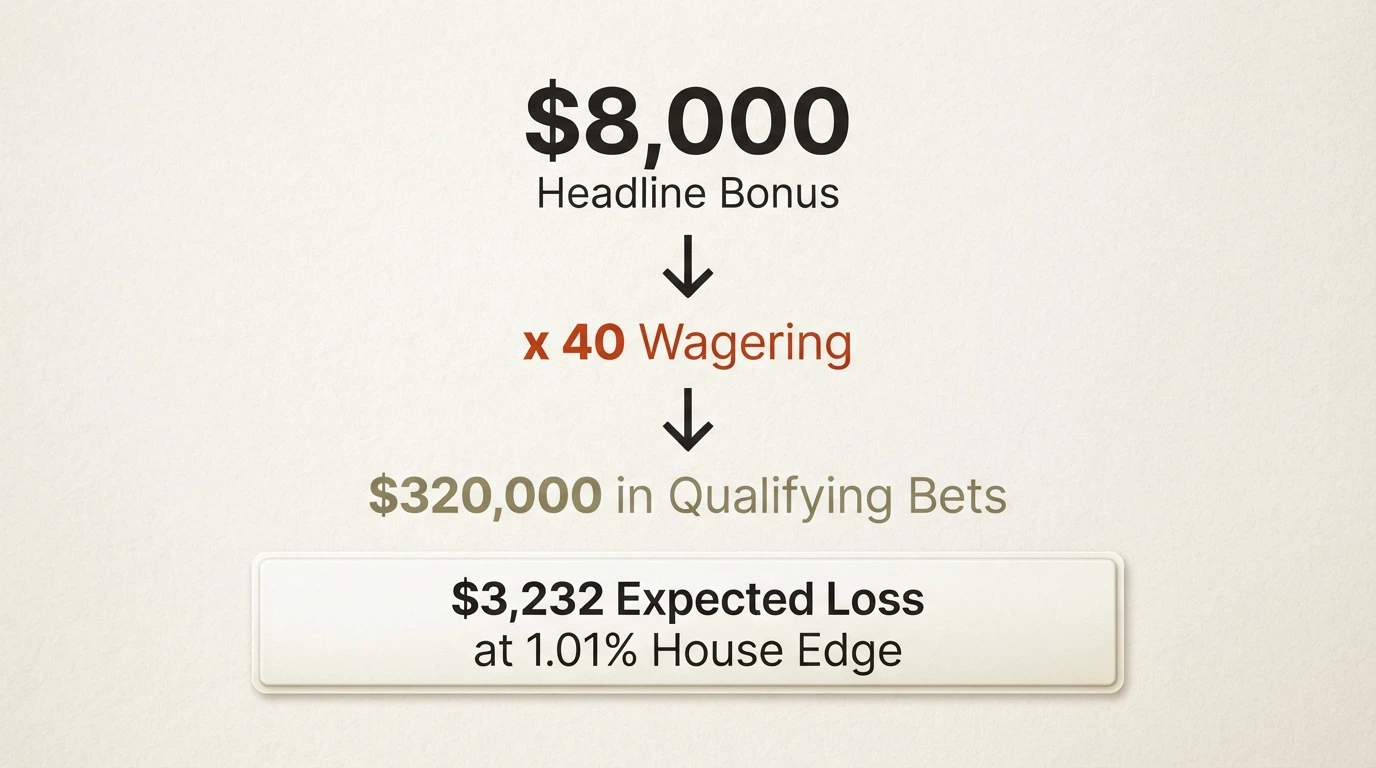
Take the Rocket Play welcome offer: 100% up to €1,000 + 100 free spins, 40x wagering on the bonus, 14-day validity. A player depositing the maximum €1,000 receives €1,000 in bonus funds, which must be turned over 40 times before it converts to withdrawable cash. That is €40,000 in wagering across two weeks — roughly €2,857 a day, or A$4,800 a day at recent exchange rates. The player who treats the offer as a way to try the operator’s games with house money has a reasonable chance of clearing it; the player who treats it as a path to a payout is in for a longer grind than the marketing copy suggests.
The expected cost of the welcome bonus, on a pure statistical basis, is the required turnover multiplied by the house edge. On Indian Dreaming at 98.99% RTP, the house edge is 1.01% — a remarkably small number that reflects the title’s outlier return rate. Multiply €40,000 by 1.01% and the expected loss is €404 across the clear-down period. That is the statistical cost of the offer, not the guaranteed cost, and it assumes every euro of the wagering requirement is played on Indian Dreaming. A different title at 95% RTP would multiply that figure by roughly five, to around €2,000. The choice of game during the clear-down is the single largest cost lever the player controls.
The SkyCrown offer sits at the other end of the scale. A$8,000 across four deposits, 400 free spins, 40x wagering, and a A$5,000 cashout cap on each part. The headline is the largest in the table, and the A$5,000 cap is what makes the A$8,000 number read differently once a player thinks it through. Even a player who clears the full bonus cannot withdraw more than A$5,000 from each of the four parts — a cumulative ceiling of A$20,000, which sounds generous until the player realises that the A$8,000 was a maximum bonus amount, not a guaranteed one, and the per-part cap is the binding constraint. The free spins add a further constraint: A$300 max win per part.
The Fair Go offer is the lowest-wagering one in the table. 30x on deposit + bonus combined, across five deposits of up to A$200 each, with no maximum cashout on the deposit bonus. The headline A$1,000 total is small against the A$8,000 number at SkyCrown, but the wagering is a quarter lower, the cashout cap is absent on the deposit bonus, and the structure is honest about what it is. The no-deposit free chip — A$15 with 60x wagering and a A$180 max cashout — is the most accessible deposit-free entry in the set, and the only one that does not hide a punitive multiple inside a small headline number.
Stake does not run a traditional welcome offer at all, and that is the most important sentence in this section for any player considering it. The operator’s model is reload offers and rakeback — a percentage of losses returned to the player on a rolling basis. For a player who wagers consistently and in volume, the rakeback model is more valuable than a fixed welcome offer. For a player who deposits once, plays a session, and withdraws, the model is empty. The decision depends on the player’s own pattern, and the player who fits Stake’s model is the player who already knows they fit it.
The Payment Tell: What Your Deposit Method Says About the Site You’re Using
Australia banned credit cards, credit-related products, and cryptocurrency as payment for online wagering on 11 June 2024. The ban applies to operators licensed in Australia. An offshore site that accepts a credit card or a Bitcoin deposit from an Australian player is, by definition, operating outside the Australian regulatory framework — and the player who deposits using those methods is the one feeding the payment system the regulator cannot reach.
The legal deposit routes for licensed Australian wagering are debit card, bank transfer, PayID/Osko, and BPAY. The dual-use methods — the ones an offshore site will also accept — are PayID, BPAY, and debit card, which makes them uninformative as a tell on their own. The player who wants to use a tell has to look for the methods that no licensed Australian operator would touch: credit card and crypto. A site offering either is, without further investigation, offshore. A site offering only PayID, BPAY, and debit card might be licensed or might be offshore — the payment menu alone does not decide it, but the absence of credit card and crypto is consistent with the licensed framework and the presence of either is not.
The minimum deposit on most offshore sites is A$10 via PayID or crypto, with withdrawals processed within 24 hours. The processing speed is a function of the payment method and the operator’s own queue, and the player who has not tested a withdrawal before depositing in volume is the player most likely to discover a slow withdrawal the hard way. The reasonable move is a small first deposit, a small first withdrawal, and a confirmation that the operator pays out before any larger commitment.
From 1 January 2027, Australian banks and payment providers gain express authority to block transactions to illegal gambling operators. The 2027 reform gives the banking system a tool the ACMA’s DNS blocking cannot reach — the ability to stop a payment at the rail rather than a domain at the resolver. The player who plans to keep using offshore sites in 2027 should plan for some payment methods to stop working, and should not be surprised when a PayID deposit declines without explanation.
Rocket Play
Rocket Play is a Curaçao-licensed operator run by Scores55 Tech B.V. under licence OGL/2024/1307/0748, and the Curaçao Gaming Control Board’s public register confirms the licence is current. The welcome offer is a 100% match up to €1,000 on the first deposit, plus 100 free spins, with a 200% match up to €1,000 on the second deposit — one of the more aggressive second-deposit offers in the table. The wagering is 40x on the bonus, the validity is 14 days, and the minimum deposit is €20 or A$25.
The no-deposit offer is a 20-free-spin package on Book of Pyramids, available to players who complete third-party review verification. The wagering is 40x and the maximum winnings are capped at A$85, which is a tight ceiling against the headline “free spins” framing. The cap is the number a player reads before signing up; the headline is the number the marketing copy leads with. A careful player reads both.
The game library is broad — Pragmatic Play, NetEnt, and a long tail of other providers across thousands of titles. The breadth means a player with a preferred studio will almost certainly find it here. The depth on any individual title is harder to verify without an account.
Rocket Play is worth the time of a player who has read the bonus terms, accepts a 40x wagering grind, and is happy with a Curaçao licence. The licence is verifiable on the regulator’s register, the offer is honest about its cost, and the no-deposit entry point is a real way to test the site before committing funds.
SkyCrown
SkyCrown’s welcome package is the largest headline in the table: A$8,000 plus 400 free spins across four deposits, with each deposit requiring a minimum of A$30 to A$50. The wagering is 40x on both the bonus and the free spins, and the cashout cap is A$5,000 per part — A$20,000 cumulative across the four parts. The free spins carry a separate cap of A$300 maximum win per part.
The cap structure is the offer’s defining feature. A player who clears the full A$8,000 bonus and hits a hot streak on the free spins is still limited to A$5,000 of withdrawable cash from each deposit’s portion. A player who reads the headline and not the cap will overestimate the offer by a factor of four on a good day. A player who reads the cap and not the headline will underestimate the offer by a factor of less than one. The truth is somewhere in the middle, and the middle is what the wagering calculation in the previous section reaches.
The game library runs on the SoftSwiss aggregator, which is a common platform for mid-sized offshore operators. The aggregator model means SkyCrown can offer thousands of games from dozens of providers without integrating each one directly, and the player gets the breadth at the cost of a uniform interface. The library includes the major studios whose names a careful player looks for.
SkyCrown is worth the time of a player with the bankroll to clear four deposit bonuses and the patience to read the per-part cashout cap. The licence is Curaçao, the wagering is standard for the market, and the headline number is real — but it is real in the way a headline is real: the figure is the maximum, not the typical outcome, and the cap is the binding constraint more often than the bonus is.
Royal Reels
Royal Reels carries the largest pokies library in the table: 5,400+ titles from 40+ providers, accessible through the browser route described in the section on access methods. The welcome pack is a three-deposit structure with a total of A$2,500 plus 50 free spins, wagering 35x on the bonus — the second-lowest wagering in the table after Fair Go’s 30x. The free spins are played at a A$0.20 stake, which is the only spin value in the table that the source material confirmed this round.
The no-deposit offer is a A$10 bonus after phone verification, which is a smaller number than Fair Go’s A$15 but the same kind of structure: a small cash credit to test the site before committing a deposit. The 10-tier VIP program is the long-term retention mechanism, and a player who wagers consistently will move through the tiers and into better terms; a player who deposits once and withdraws will not.
The max bet during the bonus clear-down is A$5 per spin, which is a number a player needs to know because exceeding it during wagering can void the bonus. The wagering calculation that turns A$2,500 of bonus into withdrawable cash is A$87,500 in qualifying bets, which is the kind of number that explains why most welcome bonuses are not, in practice, withdrawn.
Royal Reels is worth the time of a player who wagers in volume and will move through the VIP tiers. The library is the broadest in the table, the wagering is below market, and the no-deposit entry point is real if small. A player who deposits once and leaves will not capture the long-term value the operator is built to deliver.
WinSpirit
WinSpirit is operated by Complete Technologies N.V. under a Curaçao Antillephone N.V. licence (8048/JAZ2014-053), which is a sub-licence structure common in the Curaçao market — the Antillephone N.V. master licence is one of four master licences the Curaçao Gaming Control Board authorises, and the sub-licence number is verifiable on Antillephone’s own public register. The welcome bonus is a 100% match plus free spins, with the exact cap not confirmed this round; the wagering is 40x on the bonus, and the maximum bet during wagering is A$7.50.
The game library runs across 60+ providers, which is the second-largest provider count in the table after Royal Reels. The breadth is the offer’s primary feature for a player who wants a single operator to cover the Aristocrat titles, the Pragmatic Play catalogue, and a long tail of smaller studios. The bonus terms are standard for the Curaçao market, and the licence is the more verifiable kind.
WinSpirit is a solid choice for a player who values library breadth and a verifiable sub-licence. The 40x wagering is the market standard, the A$7.50 max bet is a number the player reads before clearing, and the Curacao Antillephone structure is a step up in verifiability from a bare Curaçao claim with no number attached.
Fair Go Casino
Fair Go is the lowest-wagering operator in the table. The welcome bonus is structured as 100% up to A$200 on each of five deposits, for a total headline of A$1,000, with 30x wagering on the deposit and bonus combined. The minimum deposit is A$20, and there is no maximum cashout on the deposit bonus — a structural feature that distinguishes Fair Go from the rest of the field, where cashout caps are the norm.
The no-deposit offer is a A$15 free chip with 60x wagering and a A$180 max cashout. The chip is genuinely deposit-free — no payment method required, no verification beyond a basic account — and the A$180 ceiling is a hard one. The 60x wagering on a A$15 chip means A$900 in qualifying bets before any win converts, which is a heavy grind against a small headline. A player who treats the chip as a way to test the site and not as a path to a payout is reading the terms correctly.
The game library is RealTime Gaming (RTG) exclusive, which is a narrower catalogue than the multi-provider aggregators but a deeper one on the titles it carries. RTG has been a fixture of the offshore market for two decades, and the studio’s pokies are familiar to anyone who has spent time on a non-AU licensed casino. The player who values the studio’s particular mechanics — its bonus triggers, its volatility profile, its jackpot structure — will find them here. The player who wants the full Aristocrat catalogue will not.
Fair Go is ideal for a player who values the lowest wagering in the set and is comfortable with an RTG-only library. The no-cashout-cap on the deposit bonus is the structural feature the marketing copy does not lead with, and the no-deposit chip is the most accessible entry point in the table for a player who wants to test the site before committing a card.
Bizzo Casino
Bizzo runs on the SoftSwiss aggregator, which is the same platform several other operators in the table share, and the library is large as a result. The welcome bonus is up to €400 plus 150 free spins, with 40x wagering, a minimum deposit of roughly €20–€25, and a Curaçao licence. The offer is region-dependent, which means an Australian player logging in may see a different headline than a player logging in from another market — a structural feature of the SoftSwiss platform that the operator’s own terms page describes.
The 150 free spins is the largest free-spin count in the table, and the headline draws the eye. The wagering on the free spins is 40x, which is the same as the bonus, and the cashout cap is not confirmed this round — a gap the player reads as a check-before-signing item rather than a free pass.
Bizzo is another option for a player who values a large free-spin count and is willing to check the region-specific terms before depositing. The SoftSwiss platform is a known quantity in the market, the library is broad, and the licence is Curaçao. The terms a player sees on the Australian version of the site are the terms that bind the deposit.
Stake
Stake does not run a traditional welcome bonus, and that absence is the most important fact in its row of the table. The operator is licensed in Curaçao under Medium Rare N.V., the game providers include Pragmatic Play, Evolution, and Hacksaw, and the deposit and withdrawal model is crypto-first — a structural feature that places Stake outside the Australian regulatory framework on payment methods alone, since crypto has been banned for AU-licensed online wagering since 11 June 2024.
The model that replaces the welcome bonus is reload offers and rakeback — a percentage of the house edge returned to the player on a rolling basis. The percentage is not published as a single number; it varies by game, by player volume, and by the operator’s own promotional calendar. A high-volume player who wagers consistently captures meaningful rakeback over a month of play. A player who deposits once, plays a session, and withdraws captures nothing.
Stake is worth the time of a player who wagers in volume, who is comfortable with crypto as a deposit and withdrawal method, and who understands that the rakeback model is structured for the player who stays rather than the player who arrives. The absence of a welcome offer is not a gap in the offering; it is the offering. A player who reads “no welcome bonus” as a missing feature has misread the operator’s model.
Rainbet
Rainbet carries the only MGA licence in the table, which is the single most important line in this row. The Malta Gaming Authority issues fewer licences than the Curaçao Gaming Control Board, requires more operator capital, and runs a stricter compliance regime — including a more accessible dispute resolution process for players who cannot withdraw. The MGA licence is a differentiator, and the only operator in the table that holds one is Rainbet.
The welcome bonus is a 600% match spread across multiple reloads, with 40x wagering on the bonus. The 600% headline is the largest in the table by a factor of more than two, and it draws the eye the way a SkyCrown-style headline does. The wagering calculation is the next step. A 600% match on a A$100 deposit is A$600 of bonus funds, which at 40x wagering is A$24,000 in qualifying bets — a heavy grind against a modest headline. The multiple reloads structure spreads the bonus across several deposits, which extends the grind and the commitment.
Rainbet appeals to a player who values the MGA licence over the Curaçao standard and is willing to clear a heavy wagering requirement to access it. The dispute resolution pathway through the MGA is the structural feature the marketing copy does not lead with, and the 600% headline is the structural feature the marketing copy does. A player who ranks these two in the right order has read the licence terms.
Rocket Casino
Rocket Casino holds a Curaçao licence, and that is the only verifiable line in this row. The welcome bonus, the wagering multiple, the game providers, the free-spin count, and the deposit terms were not confirmed this round. The operator’s own site is the source a player consults for current terms, and the player who signs up without that consultation is the one who discovers the missing numbers in the small print.
The honest description of Rocket Casino for an Australian player in is: a Curaçao-licensed operator whose current terms the player must check on the operator’s own site before depositing. The licence is the minimum verifiable fact, and the rest is a check the player does at the moment of decision rather than a check the page does on the player’s behalf.
Rocket Casino is worth the time of a player who has checked the current terms on the operator’s own site and is satisfied with what the check returns. A player who has not checked is gambling on a number they have not read, which is a different kind of gamble than the one the operator is offering.
Scream Casino
Scream Casino, like Rocket Casino, holds a Curaçao licence and the rest of the row is unconfirmed this round. The licence is the minimum verifiable fact, and the operator’s own site is the source a player consults for current welcome bonus, wagering, game providers, and free-spin terms.
The same caveat applies: a player who has checked the current terms and is satisfied with what the check returns has a basis for signing up. A player who has not checked is acting on the licence alone, which is one signal and not a complete picture.
Scream Casino is worth the time of a player who treats the operator as one option among several and verifies the terms before committing. The Curaçao licence places it in the same regulatory tier as the other Curaçao-licensed operators in the table, and the differentiator is the terms the operator is running this month, not the licence the operator holds in the abstract.
No, Android Pokies Aren’t Licensed in Australia — Here’s What the Law Actually Says
The Interactive Gambling Act 2001 makes it an offence to provide an interactive gambling service to a person in Australia, where the service includes online casino games and online pokies. The 2017 amendment to the Act gave the Australian Communications and Media Authority the power to issue blocking requests to internet service providers, and the enforcement record since 2017 is the one Australian players can read for themselves. There is no Australian licence for online pokies. Not at the federal level, not in any state, not in any territory. The product is prohibited, and the prohibition has been in place for a quarter of a century.
The reason the prohibition matters for an Android user in is that every pokies app a player finds through a search is operating outside the Australian framework. The site may be licensed in Curaçao, in Malta, in the Philippines, or in any other jurisdiction that issues interactive gambling licences. The site is not licensed in Australia, because the licence does not exist. The site is accessible from Australia because the internet does not stop at the border, and the site accepts Australian players because the player base is large enough to be worth serving.
The Interactive Gambling Act 2001: No Online Pokies Licence Exists
The Interactive Gambling Act 2001 prohibits the provision of online casino games and online pokies to persons in Australia. The 2017 amendment strengthened enforcement and gave the ACMA the blocking powers described in the next section. What the Act does not prohibit is wagering on sports and racing placed before the event, lotteries, and keno — products that are licensed at the state and territory level, with the Northern Territory Racing and Wagering Commission acting as the de facto national licensor through Licensing NT.
The distinction between “wagering” and “casino games” is the one most Australian players meet first. A punter at a TAB, a Sportsbet account holder, or a Ladbrokes customer is using a licensed Australian wagering provider. An account holder on any of the ten operators in this page’s table is using an offshore casino, and the legal framework around that account is the framework of the operator’s own licence jurisdiction, not the Australian Consumer Law. The player is not prosecuted under the IGA — the Act targets the provider, not the person using the service — but the player also has no recourse to Australian regulators if a withdrawal is refused, a bonus is voided, or a site disappears.
The state and territory licensing system covers wagering only. Each state has its own regulator, and the products licensed vary by jurisdiction. The Northern Territory’s licensing regime is the most permissive, and the major corporate bookmakers — Sportsbet, Ladbrokes Australia, Bet365 Australia — hold Northern Territory licences. Online pokies sit outside every state and territory framework because the federal prohibition pre-empts the state level entirely. There is no path to an Australian-licensed online pokie through a state regulator because the federal Act forbids the state from issuing one.
ACMA’s Block List: 1,751 Sites Blocked — and Why New Ones Keep Appearing
The ACMA has blocked 1,751 illegal gambling and affiliate marketing websites since November 2019, when the first blocking request was issued under the 2017 amendment. Over 230 unlicensed services have exited the Australian market since enforcement strengthened in 2017. The block list is the public record of the regulator’s enforcement, and it is the most concrete data point an Australian player has on the size of the offshore market the regulator is working against.
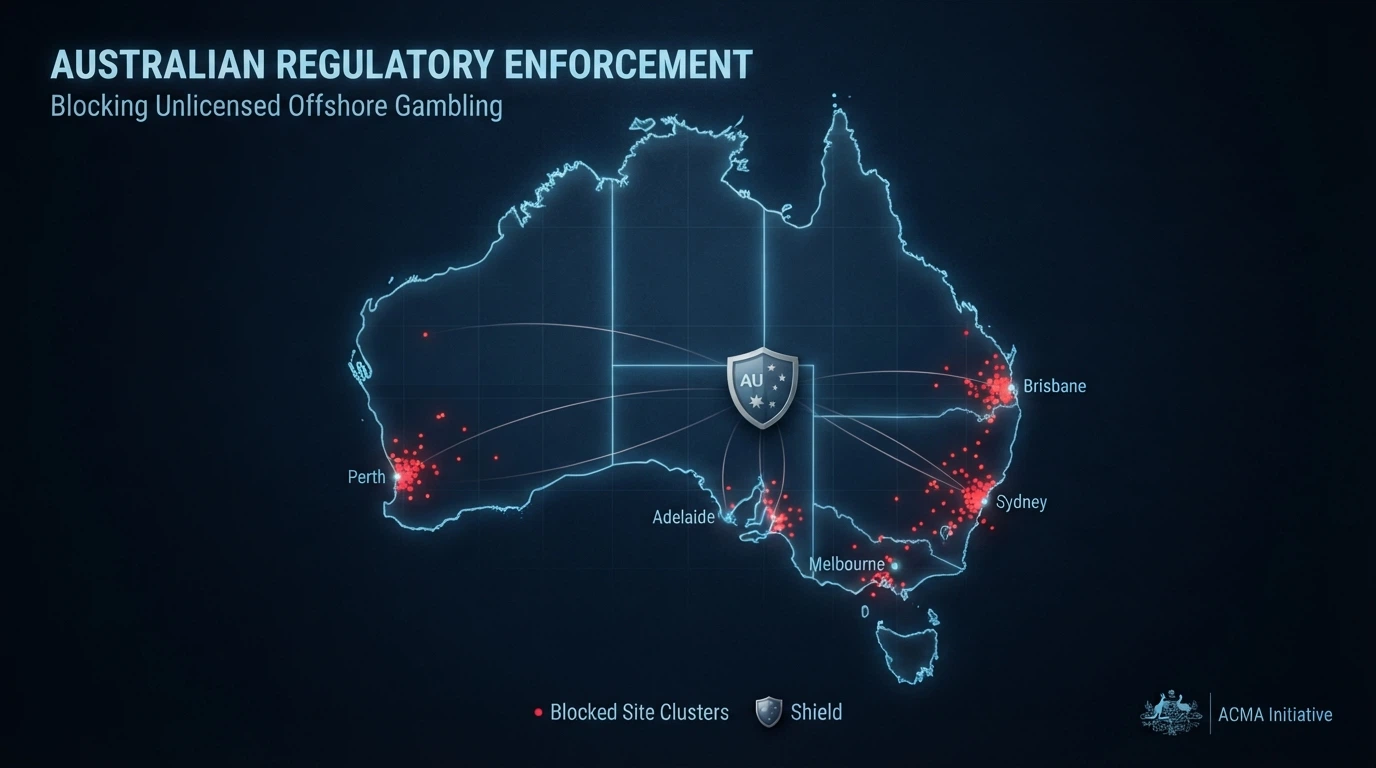
The blocking works at the DNS level. The ACMA asks Australian internet service providers to refuse to resolve the domain names on the block list, and a player who tries to visit a blocked site sees an error page rather than the site itself. The mechanism is effective against a domain that stays put, and ineffective against a domain that moves. Blocked sites reappear under new names within hours, the same operators run mirror domains in parallel, and the block list grows by the month. The ACMA’s enforcement record is a record of the cat-and-mouse game, and the cat is winning individual rounds without winning the war.
A block on a domain the player is using mid-session does not have a legal consequence for the player. The site is unavailable. The account, if one exists, still exists. The balance, if there is one, is on the operator’s server. The player can usually reach the operator’s mirror or new domain within a session or two, and the operator’s customer support typically emails registered players when a domain moves. The legal exposure for the player is none; the practical exposure is the inconvenience of a site the player has bookmarked no longer loading.
What the 2026–2027 Gambling Reforms Change for Pokies Players
The Interactive Gambling Amendment (Gambling Reform) Bill 2026 was introduced to Parliament on 2 July 2026 and passed the House on 18 August and the Senate on 19 August 2026. The substantive measures — Schedules 1 through 4 — commence on 1 January 2027. The four reform pillars are: a national wagering advertising opt-out register called AdStop, administered by ACMA; a prohibition on marketing inducements to new customers for 14 days from sign-up and 90 days after deregistering from BetStop; a ban on wagering advertising during live sport from 15 minutes before a game until 5 minutes after it ends, between 5:00 am and 8:30 pm; and a cap of three wagering ads per hour on broadcast. Athletes, celebrities, and influencers are barred from promoting wagering, and wagering ads are prohibited in sports venues and on uniforms.
The credit card and crypto payment ban has been in force since 11 June 2024, and from 1 January 2027 banks and payment providers gain express authority to block transactions to illegal gambling operators. The bank-blocking authority is the reform that reaches the closest to the offshore sites this page covers, because it operates on the payment rail rather than the domain name. A player who has been using a debit card or PayID to fund an offshore account may find the deposit declines in 2027 without explanation, and the explanation is the bank exercising the new authority.
None of the 2027 measures reach an offshore casino. The AdStop register, the inducement ban, the ad cap, the live-sport blackout, and the bank-blocking authority are all aimed at the licensed Australian wagering market. The offshore sites this page covers are outside the licensed market by definition, and the reforms that tighten the licensed market tighten the contrast between it and the offshore one. The player who values the protections the reforms introduce is the player who has decided the licensed market is where they wager; the player who has decided the offshore market is where they play pokies is in a different regulatory universe, and the 2027 reforms do not change that.
When Pokies Stop Being Fun: Real Help for Australian Players in
The prevalence numbers are the reason this section exists. 2.9% of the Australian adult population — 622,000 people — are classified as problem gamblers on the PGSI scale, up from 1.7% before COVID and 1.9% in 2022–23. 51% of those people are under 35. 15.1% of adults — 3.32 million — are experiencing some form of gambling harm. Risky gambling has almost doubled since the COVID lockdowns, from 13.7% to 19.4%. Online participation has reached 56.1% of those who gambled. These are not numbers that describe a marginal population. They describe a country where a large minority of adults are putting money into a product that returns less than they wager, and where a substantial fraction of those adults are putting in more than they can afford to lose.
The offshore market this page covers carries a specific harm that the licensed market does not. BetStop does not reach the offshore operators in the table. The Australian consumer protection framework does not reach them. The dispute resolution pathways do not reach them. A player who develops a problem on an offshore site has fewer institutional supports than a player who develops the same problem on a licensed Australian wagering account, and the offshore site’s incentive to assist the player is purely reputational rather than regulatory.
622,000 Problem Gamblers: The Numbers Australia Can’t Ignore
The Roy Morgan research that produces the 2.9% figure is the same data source that tracked the 1.7% pre-COVID number, the 1.9% 2022–23 number, and the 2.4% 2023–24 number. The trajectory is up, the slope is steep, and the 51% under-35 figure tells a player who is under 35 that they are in the demographic where the problem is concentrated. The 15.1% experiencing harm figure — 3.32 million people — is broader than the PGSI classification, and it includes people whose own gambling or someone else’s gambling is causing damage that does not meet the PGSI threshold for “problem” gambling.
Risky gambling on the PGSI scale climbed to 19.4% in 2025, up from 13.7% the year before. The ANU POLIS Centre for Social Policy Research, which produces this figure, attributes the rise to the post-COVID normalisation of online gambling and the proliferation of offshore sites. Online participation reaching 56.1% in 2025 is the denominator that makes the risky-gambling figure meaningful: more Australians are gambling online, and the share of them gambling in a way that puts them at risk has grown faster than the share gambling at all.
The honest read of these numbers is that a substantial minority of Australian adults who pick up an Android phone and search for a pokies app are doing so in a population where the same behaviour is causing measurable harm to a measurable number of people. The page cannot say “this will not happen to you” because the data does not support that claim. What the page can do is name the tools that exist for the player who decides the behaviour is causing harm.
BetStop: How Australia’s Self-Exclusion Register Works — and Where It Doesn’t
BetStop is the National Self-Exclusion Register, live since 21 August 2023, administered by the ACMA. A single registration excludes the player from all approximately 190 licensed wagering providers in Australia — sportsbooks, racebooks, and the licensed products the state and territory regulators cover. Self-exclusion periods range from three months to a lifetime. As of Q2 FY 2025-2026, 54,859 people had registered, and 35,135 exclusions were active.
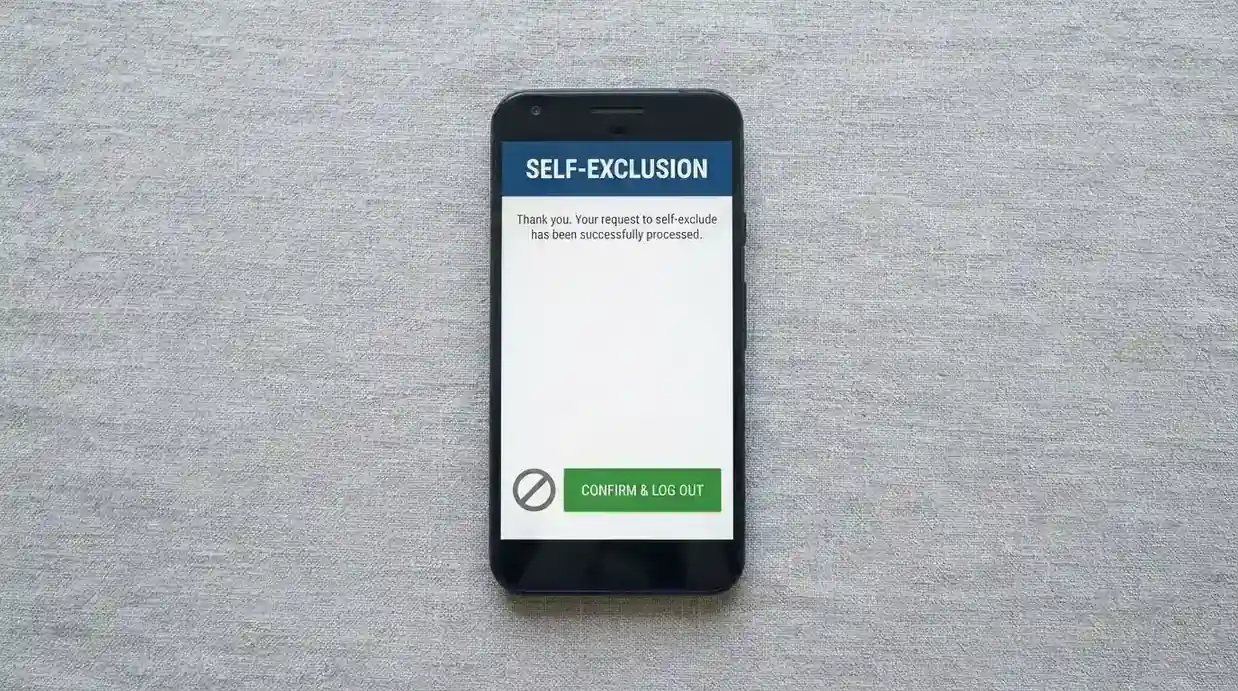
The outcomes data is striking. 77% of BetStop registrants surveyed reported better overall quality of life. 79% reported improved mental health. 96% either stopped betting completely (81%) or decreased their betting (15%). The numbers are the strongest case for the register’s effectiveness, and the strongest case for the player who has decided they need a tool to use it.
The limitation is the one this page has to state clearly. BetStop binds Australian-licensed wagering services. An offshore casino is not connected to the register. A player who has registered with BetStop and then opens an account with one of the ten operators in this page’s table is not prevented from doing so by the registration, because the offshore operator does not check the Australian register and is not required to. The BetStop registration covers the licensed Australian market, and the licensed Australian market does not include online pokies. A player who has decided to stop gambling on pokies has decided to stop gambling on a product that BetStop does not reach, and the only tool the register offers the pokies player is the indirect one of excluding the player from the licensed Australian market and removing the licensed alternatives the player might otherwise have used.
The awareness gap is the other number worth reading. Only 33.5% of Australian wagerers know BetStop exists. Only 26.5% of Australian adults overall are aware of it. The Australian Institute of Family Studies’ Dr Kei Sakata has put the point plainly: BetStop is not reaching those most at risk. The player reading this page who did not know BetStop existed before opening it is the majority of Australian adults, and the player who decides to register is the one in three who has heard of it.
1800 858 858: The Help That’s There When You Need It
The National Gambling Helpline is 1800 858 858. It is free, confidential, and staffed 24 hours a day, every day. The companion service is Gambling Help Online at gamblinghelponline.org.au, which offers online chat and counselling, and self-assessment tools a player can use to gauge where their own gambling sits on the harm spectrum.
The practical self-help steps a player can take on an Australian licensed wagering account — deposit limits, session time-outs, take-a-break features, activity statements — are operator-level tools, and they are the right tools for the licensed market. On an offshore site, the same tools may or may not exist, and the player who relies on them is the player who has checked that the operator offers them and enforces them. The offshore operators in this page’s table are not required to offer any of them, and the player who treats the licensed-market tools as a baseline is the player who has done the check.
The harder reality is that the help that reaches an offshore player is the help the player asks for. BetStop does not reach offshore sites. The ACMA’s block list does not reach the player mid-session. The licensed operator’s deposit limits are not on the page. The helpline, the online chat, and the counselling service are the supports that do not depend on which site the player is using, and the number to save is 1800 858 858.
How We Chose These Android Pokies Operators: Our Methodology
The evaluation framework behind this page’s ranking has three inputs: licence verifiability, bonus terms, and game library breadth. The licence is checked against the public register of the regulator that issued it — the Curaçao Gaming Control Board for the Curaçao-licensed operators, the Malta Gaming Authority for Rainbet, and the ACMA’s public register for the verification of the offshore status. The bonus terms are taken from the operator’s own published terms page where research confirmed a figure this round, and from third-party review sites where research did not. The game library is described by provider count where research confirmed a number and by aggregator name where the library runs through a platform like SoftSwiss.
The ranking is built on the three inputs in order. Licence quality is the primary filter, and the only operator in the table that holds an MGA licence ranks first on the licence dimension by default. The Curaçao-licensed operators are not ranked against each other on licence, because the Curaçao licence does not differentiate them — the differentiation comes from the bonus terms and the library. Bonus fairness is measured by the wagering multiple and the cashout cap, and the operator with the lowest wagering and the most generous cashout structure ranks highest on the dimension. Library breadth is the number of providers and titles where research confirmed a figure, and the operator with the broadest confirmed library ranks highest.
The methodology has a limitation that the page owes the reader. Every operator in the table is offshore. There is no Australian-licensed comparator because no Australian-licensed online pokies operator exists. The “best of” in the title is the best of the offshore market, not the best of the market Australia licenses, and the player’s decision is the decision between the offshore options and the alternative of not playing. The methodology does not rank the alternative of not playing, because the alternative of not playing is not an operator. It is the absence of an operator, and a guide like this one describes what is there, not what is not.
Your Money, Your Android, Your Call: What to Actually Do Next
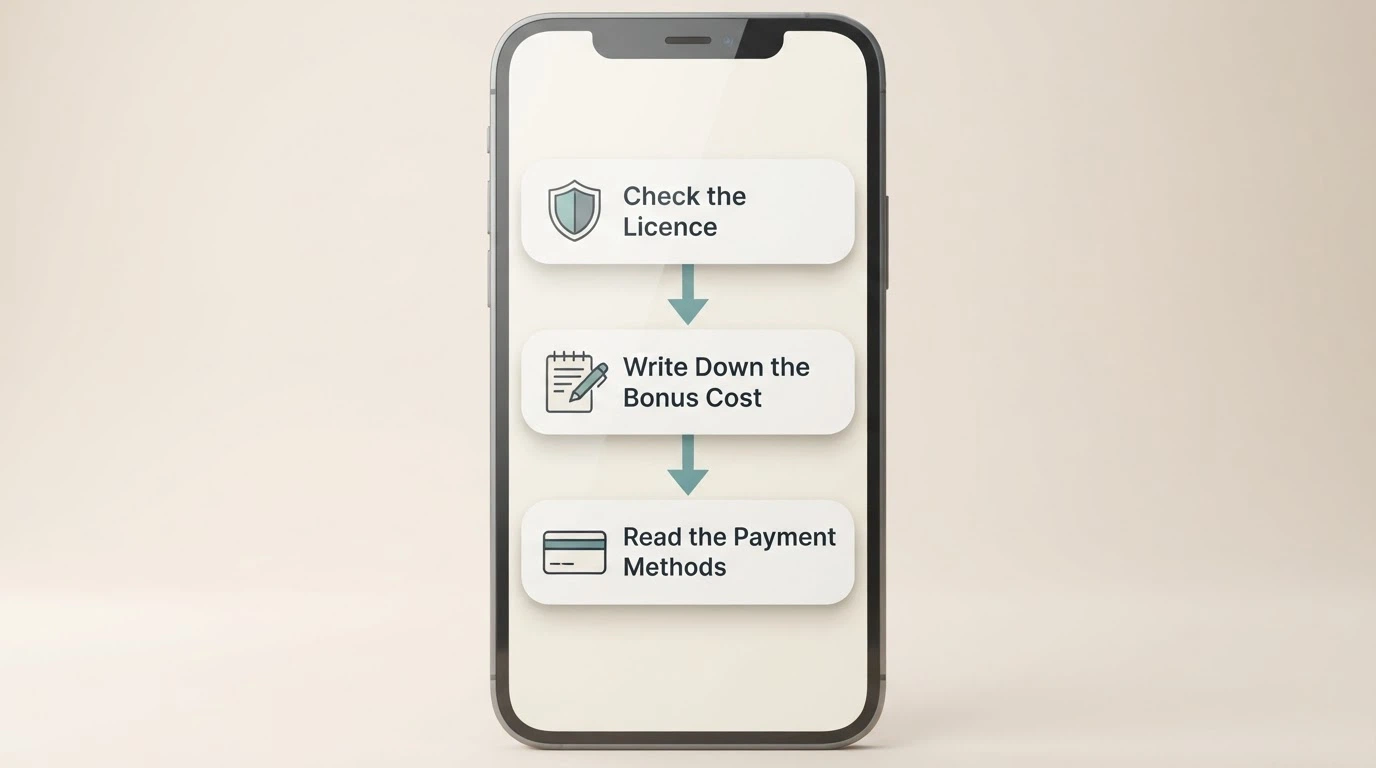
The page’s verdict, distilled into a decision framework, is this: every option is offshore; the player chooses between the offshore options on the criteria the page has surfaced. The three questions to ask before depositing are the licence check, the bonus-cost calculation, and the payment-method tell. The licence check is whether the regulator that issued the licence has the operator on a public register, and the player who checks the register before depositing is the player who has done the only verification the offshore market allows. The bonus-cost calculation is the wagering multiple times the bonus, multiplied by the house edge of the chosen game, and the player who runs the calculation before claiming is the player who has read the small print. The payment-method tell is whether the site accepts credit card or crypto, and the player who sees either method knows the site is operating outside the Australian framework without further investigation.
The harm-minimisation check runs in parallel. Have I set a loss limit before opening the account? Do I know that BetStop does not reach this operator? Do I have the helpline number saved? A player who answers yes to all three has done the harm check the page recommends. A player who answers no to any of them has work to do before the deposit, not after.
No operator on this page is endorsed. The decision framework this article builds is the recommendation, and the player’s own check against the criteria is the only endorsement that matters. The market is what it is — offshore, lightly regulated, and accessible from an Android phone in — and the player who plays on those terms with eyes open is the player who has read the page. The player who plays without the check is gambling on a number they have not read, and the next section is the helpline for the player who decides the check came too late.
Frequently Asked Questions
Can Australian Banks Stop Me Depositing Into a Pokies App?
From 1 January 2027, Australian banks and payment providers gain express authority to block transactions to illegal gambling operators. Until then, the bank-blocking tool is not in the regulator’s kit, and a player who deposits via PayID or debit card is relying on the bank’s own policies. A site accepting credit card or crypto is operating outside the AU framework, and a deposit decline from a bank is a possibility at any time, not a certainty.
How Do I Play Pokies on My Android Phone for Real Money?
Open Chrome, navigate to a licensed offshore operator, create an account, complete identity verification, and deposit via PayID, BPAY, debit card, or another method the operator accepts. There is no Australian-licensed pokies app. Every real-money option is offshore, and the Google Play Store does not host them. Demo mode on most operators is open without an account, but real-money play requires verification and a deposit.
Is It Safe to Download a Pokies APK on Android?
A downloaded APK uses 50–150 MB of storage and needs manual updates when the operator pushes a new version. The game itself runs at the same quality in the browser, and the browser route is the one most Australian players use. The APK is a legitimate delivery method from the operator’s own site, but it is not the default, and the storage cost is real. The safety question is about the operator’s licence, not the download mechanism — a licensed operator’s APK is the same risk profile as the same operator’s browser site.
What Payment Methods Do Australian-Facing Pokies Apps Accept?
Offshore operators accessible from Australia commonly accept PayID, BPAY, Neosurf, Visa/Mastercard, and cryptocurrency. Licensed Australian wagering operators accept debit card, bank transfer, PayID/Osko, and BPAY. Credit cards and crypto are banned for AU-licensed online wagering since 11 June 2024, so a site accepting either is operating outside the Australian framework. Minimum deposits start from A$10 via PayID, and withdrawals typically process within 24 hours.
Do Offshore Pokies Apps Accept PayID or Crypto Deposits From Australia?
Yes on both. PayID is a dual-use method — licensed and offshore operators accept it — and the payment method alone does not decide whether a site is offshore. Crypto is the cleaner tell: a site accepting Bitcoin or other cryptocurrency from an Australian player is offshore, because crypto is banned for AU-licensed online wagering. The minimum deposit on most offshore sites via PayID is A$10, and crypto deposits vary by the operator’s own policy.
What Are the Wagering Requirements on Pokies Welcome Bonuses?
The wagering requirements across the operators in this page’s table range from 30x to 40x. Fair Go Casino is the lowest at 30x on the deposit bonus. Most other operators sit at 40x on the bonus. A 40x wagering requirement on a A$1,000 bonus is A$40,000 in qualifying bets before the bonus converts to withdrawable cash. The free-spin wagering is usually the same as the bonus, and the cashout cap on the bonus is the binding constraint on what the player can withdraw after clearing.