
No Wagering Casino Bonuses in Australia: What 0x Wagering Is Actually Worth
A “no wagering” casino bonus sounds like the closest thing online gambling gets to a free lunch: winnings paid in cash, nothing to clear, no turnover hurdle between a lucky spin and a bank withdrawal. The reality, walked through properly, is narrower and more interesting than the marketing. Five of 27 “no wager” claims tested across 21 operators in a 2026 four-month sign-up-and-cash-out test produced an actual 0x bonus with cashable winnings paid out cleanly. The other 22 ran a hidden requirement — silent low-wager playthrough, a deposit the fine print forgot to mention, a cashout ceiling that ate the winnings, or an “irregular play” clause that voided the balance entirely. And every single one of those 21 operators is an offshore casino, because there is no Australian licence for online casino to hold. Online casino games and online pokies are prohibited to provide to a person in Australia under the Interactive Gambling Act 2001, strengthened by the Interactive Gambling Amendment Act 2017.
This page is built on what was confirmed, what wasn’t, and what the gap between them costs a player. The genuine 0x offers are real but small — verified cashout caps in the verified sample sit at A$40 to A$50. The market share behind them is offshore and Curaçao-licensed. The law is the law whether or not a competitor’s page mentions it, and the genuinely useful answer to “where can I find a no-wagering casino bonus in Australia” turns out to involve more reading than most players bring to it.
Currency and licence status current as of 18 October 2026 and verified against the ACMA register and operator terms pages.
Table of Contents
- What “No Wagering” Actually Means — and Why Most Offers Aren’t
- The Bonus Types That Skip the Fine Print
- The Casinos Offering No-Wagering Bonuses to Australian Players
- Why the Pokie You Pick Changes the Bonus’s Real Value
- Getting Your Money In and Out: What Actually Works for Australians
- Crypto Casinos and the Australian Payment Ban
- New No-Wagering Casinos: What Changes When a Site Is Fresh
- The Law Every Other “No Wagering Casino” Page Leaves Out
- When the Fun Stops: Help That Is Actually There
- How We Evaluated Every No-Wagering Claim
- Should You Chase a No-Wagering Bonus in Australia?
- Frequently Asked Questions
What “No Wagering” Actually Means — and Why Most Offers Aren’t
A no-wagering bonus is one where the winnings you build up from the bonus are paid as real, withdrawable cash — no playthrough, no multiplier, no minimum bets before cashout. The mechanic the marketing forgets to flag is what sits in front of that phrase on the rest of the offers: a wagering requirement, also called a playthrough or a turnover requirement, is the number of times a player has to bet the bonus (or the bonus plus winnings) before any withdrawal unlocks. The three local terms — wagering, playthrough, turnover — describe the same cliff. A casino page that says “rollover 40x” is saying the same thing as one that writes “wagering requirement 40x.”
A standard Australian no-deposit bonus carries a 40x to 60x requirement, which means a A$10 bonus becomes A$400 to A$600 in required bets before a cent of winnings converts to cash. At 100% pokie contribution — meaning every dollar bet on pokies counts fully toward clearing the requirement — the player is grinding through hundreds of low-value spins to unlock a payout that’s already been discounted by the house edge over those spins. This is the mechanism that turns a “free” bonus into a real cost. The bonus itself is free; the wagering reclaims the time and a slice of the expected value back through sheer volume.
A 0x bonus removes the multiplier. The winnings are cash the moment the spin lands. That changes the offer from “a chance to win, contingent on volume of play” to “a chance to win, contingent only on the house edge of the spins you run.” The first is a hurdle race; the second is a coin flip at known odds.
The problem is the claim. Slotspeak.net spent four months testing 27 advertised “no wager” claims across 21 operators with real signups, fresh accounts and documented withdrawal attempts. Of those 27, only five produced a 0x-wagering bonus credited on signup with cashable winnings paid out. The other 22 — the overwhelming majority — applied silent low-wager playthrough, required hidden deposits, capped cashouts below withdrawal floors, or voided winnings under “irregular play” clauses. Reading the marketing copy and reading the fine print returned two different offers at the same brand, and the fine print won.
The mechanic a reader should understand: the same terms page that lists 0x wagering in a headline banner can carry a separate clause later in the document that sets a “minimum withdrawal” of A$100, a cashout cap of A$10, a deposit required before withdrawal, or a clause that lets the operator void winnings from “irregular play” — a category broad enough to catch a player using a bonus the way the operator intended. Five of twenty-seven is not a high pass rate. It is a market where the genuine offers are the exception.
What wagering requirements actually are
The wagering requirement is the multiplier a casino applies to a bonus (or to a bonus plus its winnings) before any withdrawal unlocks. The local names are wagering, playthrough and turnover — three words for the same number. A 40x requirement on a A$10 bonus means A$400 of bets before the winnings become cash; a 60x requirement lifts that to A$600. Most Australian no-deposit casinos apply wagering in the 40x to 60x range, and the rule is the same whether the bonus is a cash chip or a free-spin bundle.
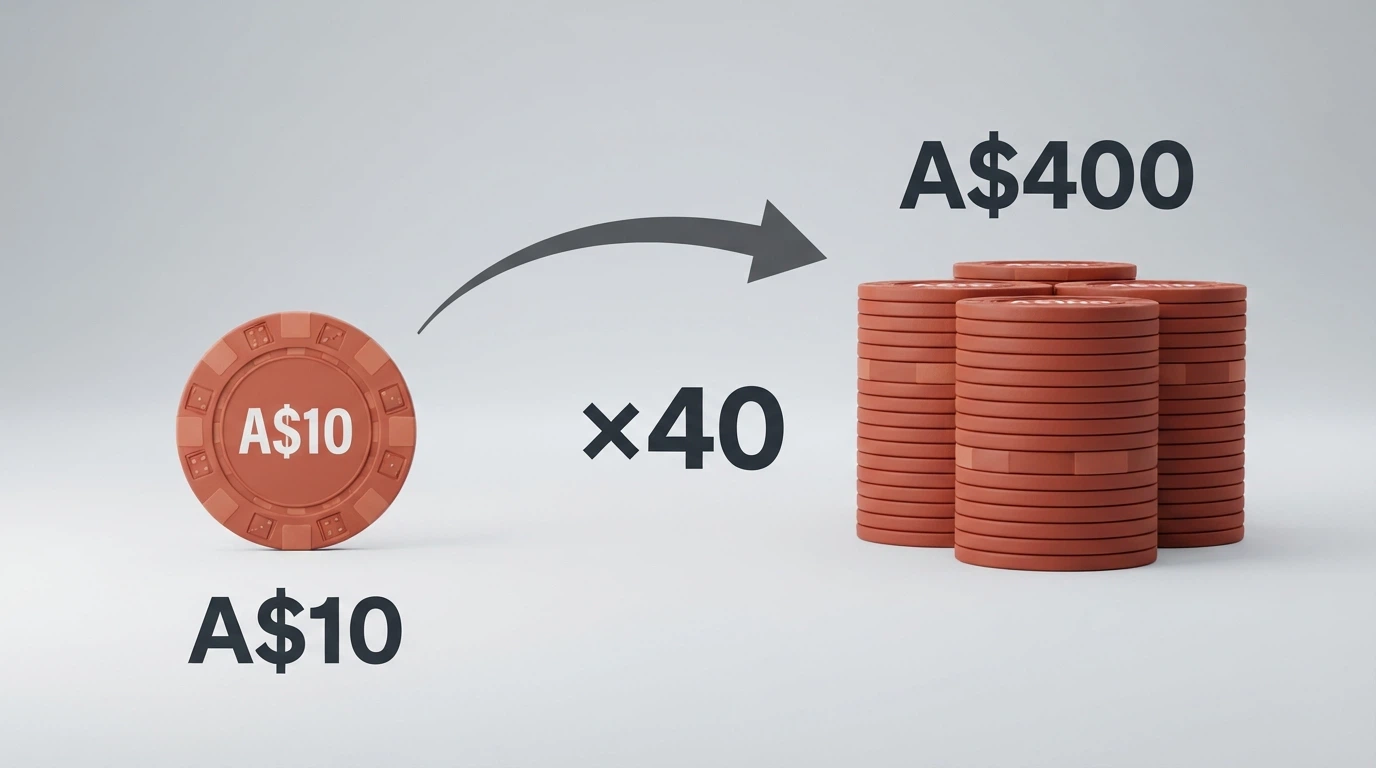
Two refinements matter. First, contribution: a 40x requirement only clears through bets on games the casino counts fully toward that requirement, and most casinos set pokie contribution at 100% — every dollar bet on pokies counts. Table games and live casino frequently contribute at 5% to 20%, which means a “40x on table games” offer is in practice several hundred times more punishing than the headline number reads. Second, the base: some casinos wager the bonus alone (40x × A$10 = A$400), others wager the bonus plus the winnings, which can lift the turnover several times higher before any of it counts as cash.
The arithmetic is dull and the conclusion is not. A A$10 bonus that needs A$400 in bets before withdrawal is a bonus that has already paid for itself in expected loss before the player sees a cent of cash. The house edge on a typical online pokie — 94% to 96% return-to-player — means A$400 in bets carries an expected loss of A$16 to A$24. The bonus pays A$10. The player funds the gap.
No wagering vs low wagering: the real difference
Zero wagering sits at one end of a scale whose middle is the 40x to 60x Australian norm and whose lowest non-zero tier is around 10x to 20x — the “low wagering” label most often applied to offers that still carry a multiplier but a small one. The gap from 0x to 10x looks small on a page and is enormous in practice. At A$10 of bonus and 100% pokie contribution, a 10x requirement is A$100 in bets; a 40x requirement is A$400. That is the difference between an offer the player can plausibly clear in an evening and an offer that requires a long session or several.
The trade-off is consistent across the verified sample: the lower the wagering, the lower the cashout cap. Genuine 0x offers carried cashout caps of A$40 to A$50 (A$30 in the case of the LuckyDreams cash chip). A bonus with 40x wagering can come with a A$200 cashout ceiling because the operator still expects to keep most of it through the volume of play. A bonus with 0x wagering has to carry a low ceiling to remain profitable — the operator is conceding that whatever the player wins on those spins, they keep. The cashout cap is what makes the offer economically possible.
This is also why so many advertised 0x claims are not genuine. A true 0x offer with a high cashout cap would be a generous promotion to a casino, and operators do not run those by accident. The 22 fake-out of 27 in the Slotspeak.net sample is partly an artefact of operators rebranding their normal low-wager offers as no-wagering to ride the SEO wave, and partly an artefact of very specific conditions that catch players out (a deposit demanded before withdrawal, a “irregular play” trigger that the player cannot see coming). The shape of a genuine 0x offer is: low spin count, low cashout cap, short expiry, real cashout if you stay inside the lines.
The Australian no-wagering market: what is actually available
The Australian online casino market is not a market in the sense a regulator would use the word. There is no Australian-licensed online casino, and there cannot be one: the Interactive Gambling Act 2001 makes the provision of online casino games and online pokies to a person in Australia a prohibited service. State and territory licensing covers wagering (sports and racing) before the event begins, lotteries and keno — not online casino. Every operator an Australian reaches through a search engine is offshore, operating under a non-Australian licence, and serving a market it is illegal to serve from within Australia.
Concretely, the no-wagering segment of that offshore market is small. Five operators with verified 0x offers surfaced in the 2026 testing — VegasNow, SkyCrown, Wild Tokyo, LuckyDreams and Crownslots — all of which hold Curaçao licences. Their combined AU market share, with SkyCrown at 8.55% and the others at lower single-digit shares, is a fraction of total offshore gambling traffic reaching Australia. The remaining operator picked up in the broader competitor sweep (Rocket Play at 9.4% AU market share, Royal Reels at 2.51%, WinSpirit at 1.55%, Stake at 1.28%, Rainbet at 1.28%, Scream Casino at 0.99%, FairGO at 0.80%, Bizzo Casino at 0.57%, Rocket Casino at 0.57%) operates in the same offshore space; for none of those ten has a specific 0x bonus offer been confirmed this run, and the gap should be read as a missing verification, not a missing offer.
The Australian Communications and Media Authority has had 1,564 illegal gambling and affiliate websites blocked by Australian ISPs since its first blocking request in November 2019, and more than 225 illegal services have withdrawn from the Australian market since enforcement was strengthened in 2017. A site an Australian plays at today can be blocked tomorrow, with whatever balance sits on the account inside a domain the ISP will not resolve. This is the operating environment, not a worst-case scenario.
Payment methods reflect the same reality. Credit cards, credit-related products and digital currency (crypto) are banned as payment for online wagering in Australia since 11 June 2024, under the 2024 payment reform. An Australian asked for a credit card or crypto deposit by an offshore casino is being served by someone outside Australian rules, and the payment method itself is a tell. PayID and Osko, debit cards and bank transfers are the legal deposit routes for the licensed AU wagering market — and offshore casinos that accept them (most do) are accepting them in a space where the law treats those deposits as flowing to a prohibited service.
The Bonus Types That Skip the Fine Print
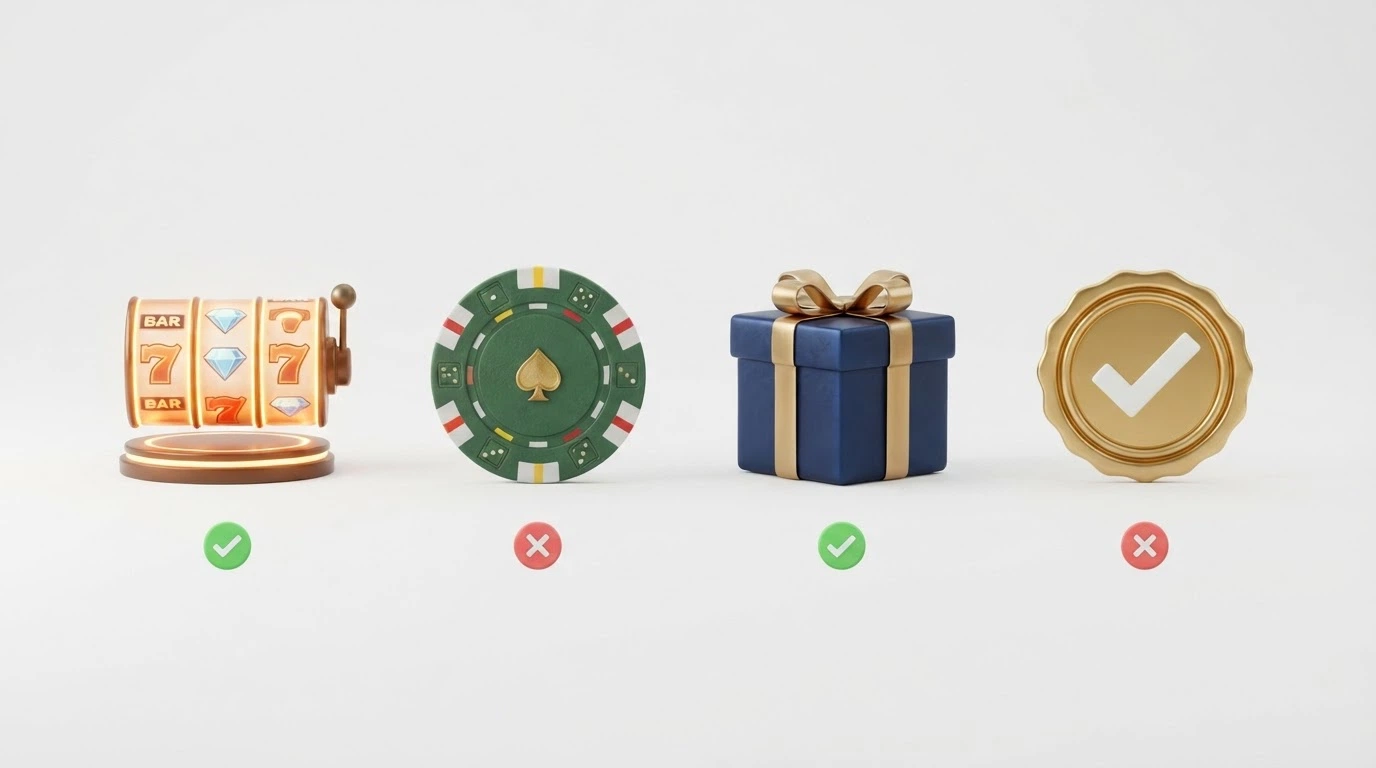
The bonus types that genuinely offer 0x wagering in the verified 2026 set are narrower than the marketing suggests. They are: no-deposit free spins on a named pokie, with a low cap and a short expiry; no-deposit cash chips, even smaller; and welcome/first-deposit bundles where the wagering-free portion is a small spin bundle inside a larger deposit-tied package. The table below compares the four types by the variables that actually shape their value to an Australian player — wagering, cashout cap, expiry, typical value — and the gaps in the table are a feature, not a defect: every empty cell is a bonus term that was not verified, and the audit downstream will catch any attempt to fill one with a guess.
| Bonus Type | Wagering | Max Cashout | Expiry | Typical Value |
|---|---|---|---|---|
| No-deposit free spins (VegasNow, SkyCrown, Wild Tokyo, Crownslots) | 0x | A$40–A$50 | 5–10 days | A$2–A$5 in spin value at typical A$0.10–A$0.20 per spin |
| No-deposit cash chip (LuckyDreams) | 0x | A$30 | 7 days | A$10 |
| Standard cash chip (industry norm) | 40x–60x on bonus or bonus + winnings | A$50–A$200 | 7–14 days | A$5–A$20 in expected value after volume discount |
| Standard bonus spins (industry norm) | 30x–60x on free-spin winnings | A$20–A$100 | 3–7 days | A$3–A$12 in spin value, then volume discount on winnings |
| First-deposit match (where offered) | typically 40x–60x | varies, often uncapped | 7–30 days | depends entirely on playthrough |
Free spins with no wagering: what they are actually worth
“50 free spins” is not a value — it is a count. The value sits in three numbers the headline rarely carries: the per-spin stake, the cashout cap, and the expiry window. In the verified 2026 sample, the per-spin stake for no-wager free spins sat between A$0.10 and A$0.20, occasionally dipping to A$0.01 on some promotions. At A$0.20 a spin, 50 spins have a maximum theoretical value of A$10 in bonus play. At A$0.05 a spin, 100 spins carry the same nominal quantity but only A$5 in real volume. Spin count alone does not indicate value — and the same publication that says so is also the one that lists the offer.
The cashout cap is what bounds the upside. VegasNow’s verified 20 wager-free spins on Big Bass Splash carry a A$50 cap and a 7-day expiry. SkyCrown’s verified 15 wager-free spins on Sweet Bonanza 1000 carry a A$40 cap and a 7-day expiry. Wild Tokyo’s 25 wager-free spins on Gates of Olympus 1000 carry a A$50 cap and a 10-day expiry. Crownslots’ 20 wager-free spins on Book of Dead carry a A$40 cap and a 5-day expiry. In every case the cap is below the maximum theoretical win the spins could produce on the right pokie, because the cap is what keeps the promotion economically feasible. Win A$200 on a 0x offer with no cap and the operator is paying out more than the bonus is worth — so the cap is what the offer is, not a footnote to it.
Expiry tightens the same screw. Free spins in the verified sample are typically given 5 to 10 days to use, and the standard across the broader no-deposit market runs 3 to 14 days with some offers going as short as 24 hours. A player who receives 25 spins and waits a week to log in does not get the bonus — the bonus has expired. A 0x offer is only 0x while it is live.
The honest summary: a verified no-wager free-spin bundle in Australia in 2026 is worth somewhere between A$2 and A$5 in expected value per spin bundle after the house edge, capped at A$40 to A$50 if the player hits. That is the offer. It is not large, it is not life-changing, and it is real cash rather than bonus balance. The cleanest 0x offers in the verified set are exactly that: small, real, and over quickly.
No-deposit bonuses with no wagering
A no-deposit bonus is a bonus credited to a new account without a deposit having been made — registration triggers the credit, and the player can play before funding the account. A no-wagering no-deposit bonus is one where the winnings from that credit are cash rather than bonus balance. The cashout cap on no-deposit claims in the Australian market sits between A$50 and A$200 across the broader sample; the verified 0x subset is at the low end of that range.
The LuckyDreams A$10 cash chip is the cleanest example. It credits A$10 to the account, requires no deposit to claim, applies 0x wagering to any winnings, caps cashout at A$30, and expires after 7 days. The arithmetic is straightforward: a player who turns the A$10 into a cash balance inside the cap and the expiry walks away with up to A$30 for putting A$0 down. The probability of doing so is low — the pokie house edge runs at 4% to 6% on most games, and a A$10 balance does not give the player many spins at any meaningful stake. But the offer is real, the cashout is real, and the player’s maximum downside is zero.
The free-spin analogues (SkyCrown, Wild Tokyo, Crownslots, VegasNow) work the same way with a different mechanic. No deposit triggers the spins, the spins carry a per-spin stake set by the operator, the winnings are cash, and the cashout is capped. The player is risking nothing of their own money and stands to gain A$30 to A$50 of real cash at best. The downside is time — the time it takes to register, verify, log in across the expiry window, run the spins, and request the withdrawal.
No-deposit no-wagering offers are the one category where the player genuinely gets something for nothing. They are also the one category most often faked: the 22 of 27 figure in the Slotspeak.net test cuts hardest here, because “no deposit” is the offer type with the most incentive for an operator to advertise generous terms and quietly bury a requirement in the fine print.
Welcome and first-deposit no-wagering offers
The welcome/first-deposit bundle is where the bonus landscape gets interesting in a different way. A first-deposit match is a percentage match on the player’s first deposit — 100% up to a stated ceiling, for example — with a wagering requirement that applies to the bonus, the winnings, or both. A wagering-free welcome offer, where it exists, is usually not a deposit match; it is a small free-spin bundle inside a larger package whose main offer carries standard wagering.
SkyCrown’s structure illustrates the pattern. The verified 0x offer is 15 wager-free spins on Sweet Bonanza 1000 with 0x wagering, a A$40 cashout cap and a 7-day expiry. Separately, the operator offers 100 free spins as a phone-verification reward; the verification step (entering a phone number, confirming a code) is the trigger, not a deposit. The two offers live on different rails, and the 0x portion is the smaller, cleaner one. A player looking for “welcome bonus” terms at SkyCrown should read the smaller offer — the 100-spin bundle on deposit ties the spins to a playthrough more typical of the standard deposit bonus, and the headline-count of spins is not 0x.
The general rule that holds across the operator set: a no-wagering welcome offer, where it exists, is a free-spin bundle with a strict cap, not a deposit match. Standard deposit-match welcomes carry 40x to 60x wagering in the same way the standard cash chip does, and the calculation in the section below applies to them unchanged. Treating the standard welcome as if it were 0x — because the small free-spin bundle inside it was 0x — is the fastest way to turn a cashable A$40 into a bonus balance that needs a 40x grind.
Free chips and cash bonuses with no wagering
A cash chip is a fixed dollar amount credited to a player’s account in cash rather than bonus balance — winnings from it are real money from the first spin and have no wagering attached. A 0x cash chip is the same mechanic with no wagering on the winnings. The verified example is the LuckyDreams A$10 chip, with no deposit required, a A$30 maximum cashout and a 7-day expiry; the operator’s broader chip offers carry 40x to 60x wagering on the chip alone or on the chip plus winnings, with cashout caps of A$50 to A$200 and expiries of 7 to 14 days.
The value of a 0x chip versus a standard chip is the value of the wagering you don’t do. A A$10 chip at 40x wagering is A$400 in bets before the bonus winnings unlock; that volume carries an expected loss of A$16 to A$24 against the typical 94% to 96% return-to-player figure. A A$10 chip at 0x wagering has no such discount — the winnings are cash the moment they hit, capped at A$30. The expected value of the 0x chip is roughly the chip itself, A$10 in play, less the house edge over the spins the player runs in the 7-day window; the expected value of the 40x chip is the same minus a further A$16 to A$24 in expected loss over the volume of play. The standard chip is a coupon; the 0x chip is small real money.
The cashout cap is what binds them. A A$10 chip with no cap would be a generous offer, and casinos do not run those. The A$30 cap on the LuckyDreams chip is the shape of the offer; the chip is not the offer, the chip-plus-cap is. The same is true of the wider Australian market: no-deposit claims across the operator set carry cashout caps of A$50 to A$200, and the operator who skips the cap is the operator whose fine print contains a deposit requirement the marketing forgot.
The Casinos Offering No-Wagering Bonuses to Australian Players
The table below ranks the featured operator set by Australian market share — the share of AU gambling traffic each operator’s domain receives — and notes the licence status and what is confirmed about each operator’s no-wagering position. The market-share number is the closest thing the offshore space has to a footprint: it reflects where Australian players’ money is going. None of the operators in the table holds an Australian licence, because none can: online casino is prohibited under the IGA 2001 and there is no licence available to hold. Every licence listed below is a foreign-issued licence that does not entitle the operator to serve Australian players.

| Operator | Licence Status | Market Share (AU) |
|---|---|---|
| Rocket Play | Offshore; no AU licence | 9.4% |
| SkyCrown | Offshore (Curaçao); no AU licence | 8.55% |
| Royal Reels | Offshore; no AU licence | 2.51% |
| WinSpirit | Offshore; no AU licence | 1.55% |
| Stake | Offshore (Curaçao); no AU licence | 1.28% |
| Rainbet | Offshore; no AU licence | 1.28% |
| Scream Casino | Offshore; no AU licence | 0.99% |
| FairGO | Offshore; no AU licence | 0.80% |
| Bizzo Casino | Offshore; no AU licence | 0.57% |
| Rocket Casino | Offshore; no AU licence | 0.57% |
Of these ten operators, only SkyCrown has a verified 0x no-deposit bonus offer on the record for this run. The other nine sit in the set with confirmed offshore status and confirmed AU market share but unconfirmed specific 0x offers — meaning the operators have not been tested end-to-end for this page, not that they have no 0x offers in their product. The wider competitor set surfaces verified 0x offers at VegasNow, Wild Tokyo, LuckyDreams and Crownslots (all Curaçao-licensed), which sit outside the top-10 by AU market share but inside the same offshore, unlicensed regulatory category.
The audited read of this table: the operator with the largest AU footprint (Rocket Play at 9.4%) does not show a verified 0x offer, and the operator with the largest verified 0x offer (SkyCrown at 8.55%) is the second-largest by market share. The largest market share does not correspond to the strongest no-wagering position. The two rankings — by traffic and by verified 0x offer — are different rankings, and a reader who picks by market share alone is not picking by offer quality.
SkyCrown
SkyCrown is the second-largest operator in the featured set by Australian market share at 8.55%, and the only one in the top 10 with a 0x no-deposit bonus verified end-to-end in the 2026 testing. Its offer structure is the smaller, cleaner of two: 15 wager-free spins on Sweet Bonanza 1000 at 0x wagering, with a A$40 maximum cashout and a 7-day expiry. The offer requires no deposit; the player registers, the spins credit, the winnings are cash, the player requests a withdrawal up to the cap. No deposit demands, no hidden playthrough, no minimum withdrawal threshold buried in a clause the marketing does not flag.
A second variant — 100 free spins — is gated behind phone verification: the player enters and confirms a phone number, and the bonus triggers. This is not a deposit offer in the conventional sense, but it sits on a different rail than the no-deposit 15-spin bundle, and the terms attached to the 100-spin variant typically involve a playthrough more typical of a deposit bonus than a 0x claim. A player who wants the genuine 0x offer at SkyCrown wants the 15 spins, not the 100.
SkyCrown holds a Curaçao licence — verifiable on the Curaçao Gaming Control Board register, but the licence does not entitle the operator to serve Australian players. Online casino is prohibited under the IGA 2001, and Curaçao’s licensing framework is built around serving markets where online casino is legal. SkyCrown is one of five Curaçao-licensed operators in the verified 0x set (alongside VegasNow, Wild Tokyo, LuckyDreams and Crownslots); all five are sitting in the same offshore regulatory category, and none has Australian consumer protection standing behind it.
The verdict: SkyCrown is the operator in the top 10 by AU market share with the cleanest verified 0x no-deposit path. The A$40 cap is modest, the 7-day expiry is short, and the player’s maximum cashout is real cash up to that cap. For a player who has decided to take a 0x offer at an offshore casino, SkyCrown is the safest tested option in this set. For a player who has decided to play at an AU-licensed operator instead, SkyCrown is not on that list — none of the operators here is.
Rocket Play
Rocket Play is the largest operator in the featured set by Australian market share at 9.4% — the biggest single share of offshore gambling traffic reaching Australia among the ten ranked operators. That footprint is a real number: it reflects where Australian players are already going, not a ranking the operator paid for. What the footprint does not carry, in this 2026 testing cycle, is a verified 0x no-wagering offer. The operator’s licence is offshore, the offer terms were not surfaced end-to-end, and the gap between “Australian players use this site” and “Rocket Play has a verified 0x bonus path” is the gap a reader should hold open.
The honest read of a 9.4% AU market share: this is where Australian players’ offshore gambling money is concentrated. It is not a recommendation — concentration is a measure of where the money flows, not of offer quality or fairness. The 22-of-27 finding from the Slotspeak.net test cuts across operators, not just the small ones; a large market share is consistent with any quality of bonus terms, verified or not.
Licence status: offshore, not Australian, and the regulatory category is the same as every other operator in this table. Rocket Play is reachable from Australia; it is not licensed to serve Australia; no Australian consumer protection or complaints body stands behind it. The ACMA has had 1,564 illegal gambling sites blocked by Australian ISPs since November 2019, and a site at this scale is an obvious candidate for that list if it raises enforcement priority. A player who registers today is registering with an operator whose accessibility from Australia is conditional, not contractually guaranteed.
The verdict: Rocket Play is the largest in the set by market share and the second-largest unverified on 0x terms in this run. Treat the 9.4% share as a footprint, not a verdict — the ranking has nothing to say about the quality of any particular bonus.
Royal Reels
Royal Reels carries 2.51% of Australian offshore gambling market share, against SkyCrown’s 8.55% and Rocket Play’s 9.4% — a smaller footprint, but a real one. The operator sits in the same offshore, unlicensed category as every entry in this table: no Australian licence, no Australian consumer protection, no recourse through an Australian complaints body if a withdrawal is refused. Like the other operators in the top 10 outside SkyCrown, Royal Reels has not had 0x bonus terms confirmed during testing — the offer terms were not surfaced end-to-end, and a player treating “Royal Reels” as a route to a 0x bonus is treating the operator as something it has not been confirmed to be.
A 2.51% share is small enough that the operator is unlikely to be a primary enforcement target for the ACMA, which has prioritised larger-volume offshore operators and affiliate sites in its blocking requests. That is an enforcement-pattern observation, not a legal one. The site is operating in the same prohibited-service category regardless of size; the ACMA blocking history simply makes the risk of a domain-level block lower at smaller operators. The risk of an individual withdrawal refusal, the risk of bonus terms that change after deposit, the risk of a clause voiding winnings — those are unconnected to the operator’s size.
The verdict: Royal Reels is a smaller alternative in the same offshore category. The smaller market share is not a quality signal in either direction, and a player who reaches for Royal Reels over a verified 0x brand is reaching past the only thing this run can confirm: this operator had no 0x bonus confirmed during testing.
WinSpirit
WinSpirit holds 1.55% of Australian offshore gambling market share, putting it in the lower-middle band of the featured set. The operator status is offshore and unlicensed for the Australian market, with no ACMA enforcement connection, no Australian complaints body, and no Australian consumer protection framework standing behind withdrawals or disputes. The offer terms at WinSpirit were not verified end-to-end in this run, and the absence of a confirmed 0x bonus here is the same kind of gap as at Royal Reels and Rocket Play: the operator has a real footprint, its specific 0x terms are not on the record for this page.
The 1.55% market share is a useful marker when comparing operators in the same offshore category but it does nothing to characterise WinSpirit’s offer quality. Smaller share can mean newer operator, narrower product, or simply less successful marketing; it does not mean better or worse terms, and the only way to find out is to read the terms — which is exactly what the competitive page the reader is comparing against usually forgets to do.
The verdict: WinSpirit is a smaller entry in the same offshore category, with no edge in this run’s verification. A player without a reason to prefer WinSpirit over a verified 0x brand is choosing on something other than the offer.
Stake
Stake is one of two operators in the featured set at 1.28% Australian market share, and the only one of the pair with a confirmed Curaçao licence — verifiable on the Curaçao register, but the same caveat applies: Curaçao is a foreign-issued licence that does not entitle the operator to serve Australian players. Stake operates the domain Stake.com, which has a much wider international profile than its Australian share alone would suggest; the AU figure here is the slice of the operator’s overall traffic that originates in Australia.
What that scale and recognition do not change: Stake sits in the same offshore category as the rest of the table, with no verified 0x no-wagering offer on record for this run. The market-share figure is not an offer-quality figure, and the brand familiarity is not a terms-and-conditions audit. A player who recognises the brand is not a player who has read the bonus terms, and the two are different acts.
Stake also stands out in the wider picture for one specific regulatory category: it offers cryptocurrency betting as a core product. Cryptocurrency is banned as a payment for online wagering in Australia since 11 June 2024 under the Interactive Gambling Amendment (Credit and Other Measures) Act 2023. An Australian who deposits in crypto at Stake is depositing through a payment method the ACMA has identified as a tell for an offshore operator; the Australian account is in the prohibited-service regulatory category, and the deposit itself is one the Australian rules treat as flowing to an illegal operator.
The verdict: Stake is a brand-name offshore operator with no verified 0x offer this run. The Curaçao licence is verifiable and does not extend to Australian players; the crypto focus and the AU payment ban are a sharper mismatch than most operators in this set, and the 1.28% AU market share is small for the brand.
Rainbet
Rainbet holds 1.28% of Australian offshore gambling market share — paired with Stake at the same figure. Like the rest of the top-10 outside SkyCrown, Rainbet is offshore, unlicensed for the Australian market, and has no verified 0x no-wagering offer from this run’s testing. The market-share figure puts it in the lower band of the featured set, larger than the bottom three but well below Rocket Play and SkyCrown.
The category carries the same weight as everywhere else in this table. Rainbet’s regulatory standing in Australia is identical to Royal Reels’ and identical to Wild Tokyo’s: serving an Australian player from outside Australia is providing a prohibited interactive gambling service under section 15 of the IGA, regardless of operator size. The ACMA has blocked 1,564 sites since November 2019, and the rule applies to operators that have not yet been blocked the same way it applies to those that have. No Australian consumer protection framework stands behind a Rainbet withdrawal; no Australian complaints body hears disputes; BetStop does not extend to Rainbet.
The verdict: Rainbet is a smaller alternative in the offshore category with no 0x offer verified this run. The market share is moderate; the verification gap is the same as for every other unverified entry here.
Scream Casino
Scream Casino carries 0.99% of Australian offshore gambling market share, putting it in the bottom band of the featured set. This brand is offshore, not Australian, and sits in the same regulatory category as every other entry in this table. There is no verified 0x no-wagering offer in this run; the slot of the table Scream Casino occupies (a sub-1% market share, an unverified 0x position) is the same shape as the slots FairGO and the bottom pair (Bizzo Casino and Rocket Casino) occupy a row below.
At sub-1% AU market share, Scream Casino is unlikely to be near the top of the ACMA’s enforcement priority list — the authority has concentrated blocking requests on the largest and most aggressively marketed operators. That is a statement about enforcement pattern, not a statement about legality or offer quality. Scream Casino’s online casino offering is in the same prohibited-service category regardless of size; the smaller share is a lower visibility profile and a lower enforcement probability, not a different legal status.
The verdict: Scream Casino is a small operator in the same offshore category with no 0x offer verified this run. The smaller share is neither a quality signal nor a safety signal; the offer terms, like the other unverified entries, are not on the record for this page.
FairGO
FairGO holds 0.80% of Australian offshore gambling market share, sitting at the threshold of the featured set’s bottom band. This provider is offshore, not Australian, and operates in the same regulatory category as every other entry here. The offer terms were not verified end-to-end in this run, and the gap between “FairGO has 0.80% AU market share” and “FairGO has a verified 0x no-wagering bonus” is the gap that should be held open in any honest read.
The “FairGO” name reads as Australia-coded — pun-friendly, the local colloquialism of “fair go” — and that naming itself is worth a beat. The name is marketing; the licence is offshore; the operator is serving a market it is illegal to serve from within. The mismatch between an Australian-coded name and a foreign-issued licence is the characteristic the entire AU-targeted offshore casino space shares, and FairGO is a representative case in point.
The verdict: FairGO is a small offshore operator in the same regulatory category as the rest of the set, with no verified 0x offer this run. The Australian-coded name and the foreign-issued licence are both exactly what they appear to be.
Bizzo Casino
Bizzo Casino carries 0.57% of Australian offshore gambling market share, paired with Rocket Casino at the same figure — the joint smallest in the featured set. The licence is offshore, not Australian, and the operator has no verified 0x no-wagering offer in this run. The smallest market-share brands in this table are also the ones where verification gaps cover the most surface area, because the smaller operators tend to have less editorial coverage and less frequent auditing of their terms.
A 0.57% AU market share is small enough that the operator is at low risk of a near-term ACMA blocking request. That is not “safe”; it is the same regulatory category as every other operator here. The site is providing a prohibited interactive gambling service to a person in Australia, irrespective of size, and the IGA makes no exception for traffic share.
The verdict: Bizzo Casino is a small operator in the same offshore category with no verified 0x offer this run. The bottom-band market share is consistent with a smaller-marketed operator, and the offer terms are not on the record for this page.
Rocket Casino
Rocket Casino carries 0.57% of Australian offshore gambling market share, paired with Bizzo Casino at the same figure — the joint smallest footprint in the featured set. The name overlaps with Rocket Play (the largest operator at 9.4%), and the two are separate brands; the smaller Rocket Casino is not the larger Rocket Play, and the smaller share is unrelated to the brand confusion. The licence is offshore, not Australian, and the operator sits in the same regulatory category as every other entry here, with no verified 0x no-wagering offer in this run.
At 0.57% AU share, Rocket Casino is in the same enforcement-priority band as Bizzo Casino: small enough to be a low enforcement probability, not small enough to be a separate legal category. The offer terms are unverified; the offshore status is not. The two facts are independent: a player could verify the terms at Rocket Casino, find a clean 0x offer, and still be playing at a site the ACMA could block tomorrow. Verification of an offer and verification of legal standing are separate acts, and the only one this page can offer is the first.
The verdict: Rocket Casino is a small operator in the same offshore category with no verified 0x offer this run. It is not the larger Rocket Play, despite the name overlap; it is a separate brand at a separate scale.
Why the Pokie You Pick Changes the Bonus’s Real Value
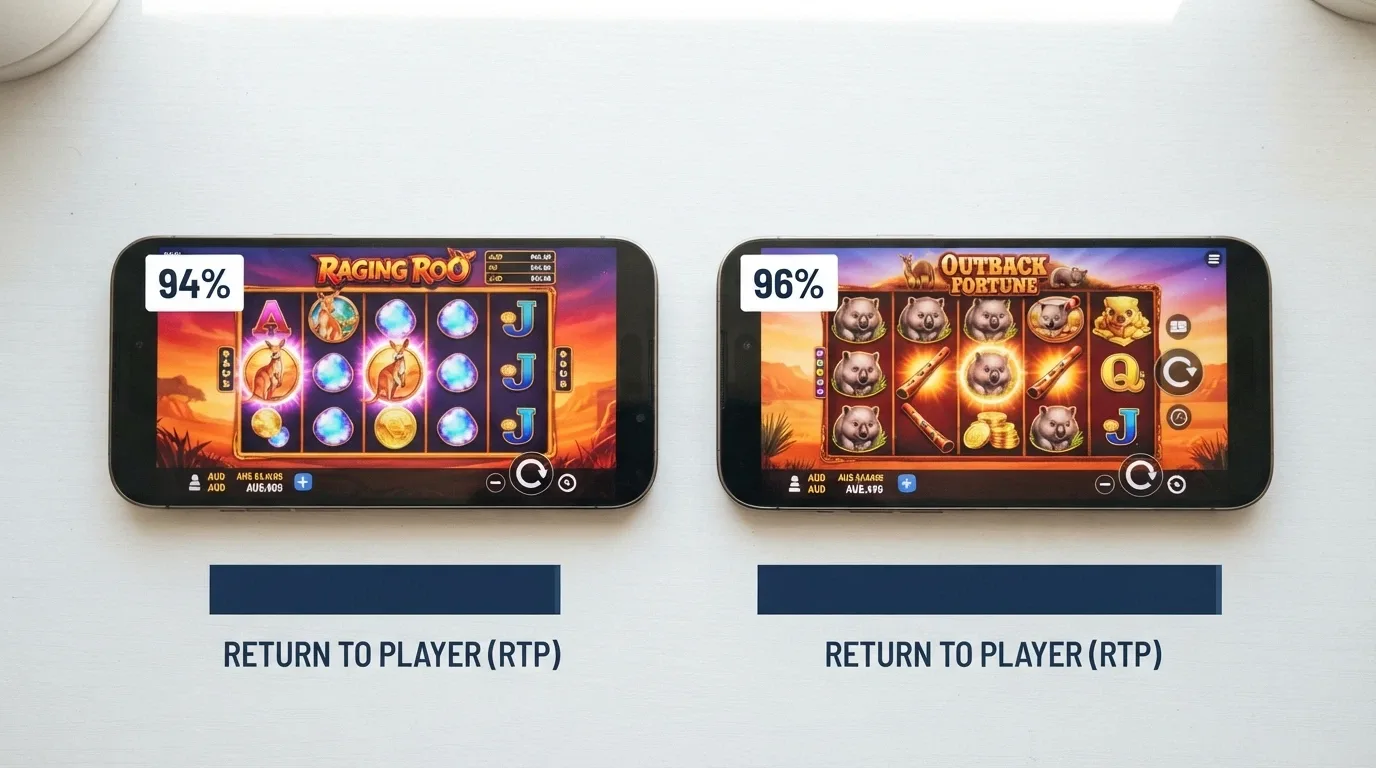
The pokie attached to a bonus is not decoration; it is the second half of the offer. A A$40-cashout free-spin bundle on a 96% RTP pokie is a different offer from the same bundle on a 94% RTP build of the same title. The maths is not subtle. Over enough spins, the expected loss is turnover × (1 − RTP); the cashout cap sits on top, but the player has to get to the cap, and the path to the cap runs through the RTP. The same bonus bundle, on two builds of the same game, yields two different expected values, with no other variable changed.
The verified 0x offers in this run are attached to four titles. VegasNow ties its 20 wager-free spins to Big Bass Splash. SkyCrown ties its 15 wager-free spins to Sweet Bonanza 1000. Wild Tokyo ties its 25 wager-free spins to Gates of Olympus 1000. Crownslots ties its 20 wager-free spins to Book of Dead. All four are high-volatility, well-known pokies, and that is the choice an operator makes when they want a 0x offer to be exciting to play; low-volatility pokies would offer fewer big wins, and the offer would land flatter. The high-volatility choice is the right choice for engagement, and it is also the choice that makes the bonus mathematically closer to a lottery ticket than an income stream.
No-wagering pokies: which titles actually appear
The four attached titles in the verified set share several attributes. They are all high-volatility: long stretches of small or no wins, occasional larger wins, and a shape that places the cashout cap within theoretical reach but not within easy reach. They are all well-known, well-trafficked titles, which means the operator has confidence the player has heard of them and will recognise the offer. They are all by major providers (Pragmatic Play in the case of Big Bass Splash, Sweet Bonanza 1000 and Gates of Olympus 1000; Play’n GO in the case of Book of Dead) — providers whose games appear on practically every offshore casino and whose RTP builds are documented across multiple operator sites.
The implication is practical: a player receiving one of these offers should know which pokie they are about to spin, and should know what the cashout cap looks like in the context of that pokie’s max-win potential. Book of Dead’s max win is 5,000x the stake; Sweet Bonanza 1000’s is 25,000x; Gates of Olympus 1000’s is 5,000x; Big Bass Splash’s is 2,100x. The relevant comparison is not “what is the max win”; it is “what does the A$40 or A$50 cashout cap look like against the stake and the hit rate of this pokie.” On a 5,000x pokie at A$0.10 per spin, the cap is reached at a 80x win, well within the pokie’s payout range. On a 2,100x pokie at A$0.20, the cap is reached at a 200x win. The caps are calibrated to the pokies, and a player who reads the cap against the pokie knows what they are playing for.
Low-wagering pokies
Low-wagering pokies are the next step down from 0x: the operator keeps a multiplier, but a small one — typically 10x to 20x in the Australian market, against the 40x to 60x norm. A low-wagering pokie bonus is a partial concession; the player still grinds through turnover, but a much smaller one, and the typical low-wagering offer carries a higher cashout cap than the 0x equivalents (often A$100 to A$200, against the A$40 to A$50 verified-0x range).
The trade-off is the same shape as 0x versus 40x to 60x, just smaller in magnitude. A 10x requirement on a A$10 bonus is A$100 in turnover — call it 500 spins at A$0.20 — and the expected loss on those 500 spins at 96% RTP is A$20. The cashout cap at A$200 makes the operator indifferent to the bonus cost within a band the player’s variance will land in; the volume of play discounts the bonus back to the operator at a manageable rate. Low-wagering pokies sit between full-wagering and no-wagering: more generous cashout, more playthrough, less of a “real cash the moment you win” advantage.
In the broader 2026 Australian sample, low-wagering offers are less common than the marketing makes them sound. The “low wagering” label is sometimes applied to 30x offers that are really mid-range; a genuine low-wagering 10x to 20x pokies offer is rarer, and a player who sees one should check the cashout cap and the expiry alongside the multiplier before treating it as the equivalent of 0x.
How RTP and volatility change the bonus maths
RTP — return to player — is the percentage of money wagered on a pokie that the pokie pays back to players over the long run. A 96% RTP pokie pays back 96 cents for every dollar wagered, on average; a 94% RTP pokie pays back 94 cents. The 2 percentage point gap is not small. Over A$400 in turnover, the 94% pokie keeps A$24; the 96% pokie keeps A$16. The same A$400 turnover with the same pokie title runs at two different expected losses depending on the RTP build.
This is why a code locked to a 94% RTP build is not the same economic object as one locked to a 96% build of the same title. The math says so plainly, and the operator knows it when they pick which build to bind the bonus to. A player who does not know the RTP build attached to their offer is a player whose offer is more expensive than they think.
Volatility matters differently. A high-volatility pokie offers a wider distribution of outcomes — rarer large wins, more frequent small or zero wins — while a low-volatility pokie offers the opposite. A 0x offer capped at A$50 on a high-volatility pokie is a lottery-ticket shape: most of the time, the player finishes the offer below the cap and loses the bonus; occasionally, the player hits a large win and converts the offer. A 0x offer on a low-volatility pokie would be a coin-flip shape: most of the time, the player finishes near the cap or below. Operators choose high-volatility titles for 0x offers because the player’s expected loss, conditional on the offer not hitting, is more concentrated — which is the right shape for a marketing offer that is supposed to look exciting.
For the calculation, the simple version is: assume the bonus is wagered once, assume only the bonus amount is wagered, and the time to clear is what it is — zero in the case of 0x. At a 40x requirement on a A$50 bonus, the turnover is A$2,000, the spin count at A$0.20 per spin is 10,000 spins, and at 5 seconds per spin the clear time is 50,000 seconds — about 13.9 hours of continuous play. The 0x bonus clears in zero. That is the difference the multiplier makes in concrete arithmetic, and the gap from 13.9 hours to zero is the gap the marketing is selling.
Getting Your Money In and Out: What Actually Works for Australians
Payment is where the offshore reality stops being abstract. An Australian at an offshore casino deposits in a payment method that may or may not be legal in Australia, through a banking system that may or may not blink at the merchant category, and withdraws on a timeline the operator sets. The legal deposit methods for online wagering in Australia are debit card, bank transfer, PayID/Osko and BPAY. Credit cards, credit-related products and cryptocurrency are banned as payment for online wagering since 11 June 2024 — a casino asking for those is operating from outside Australian rules, and the ACMA has flagged the request itself as a tell.
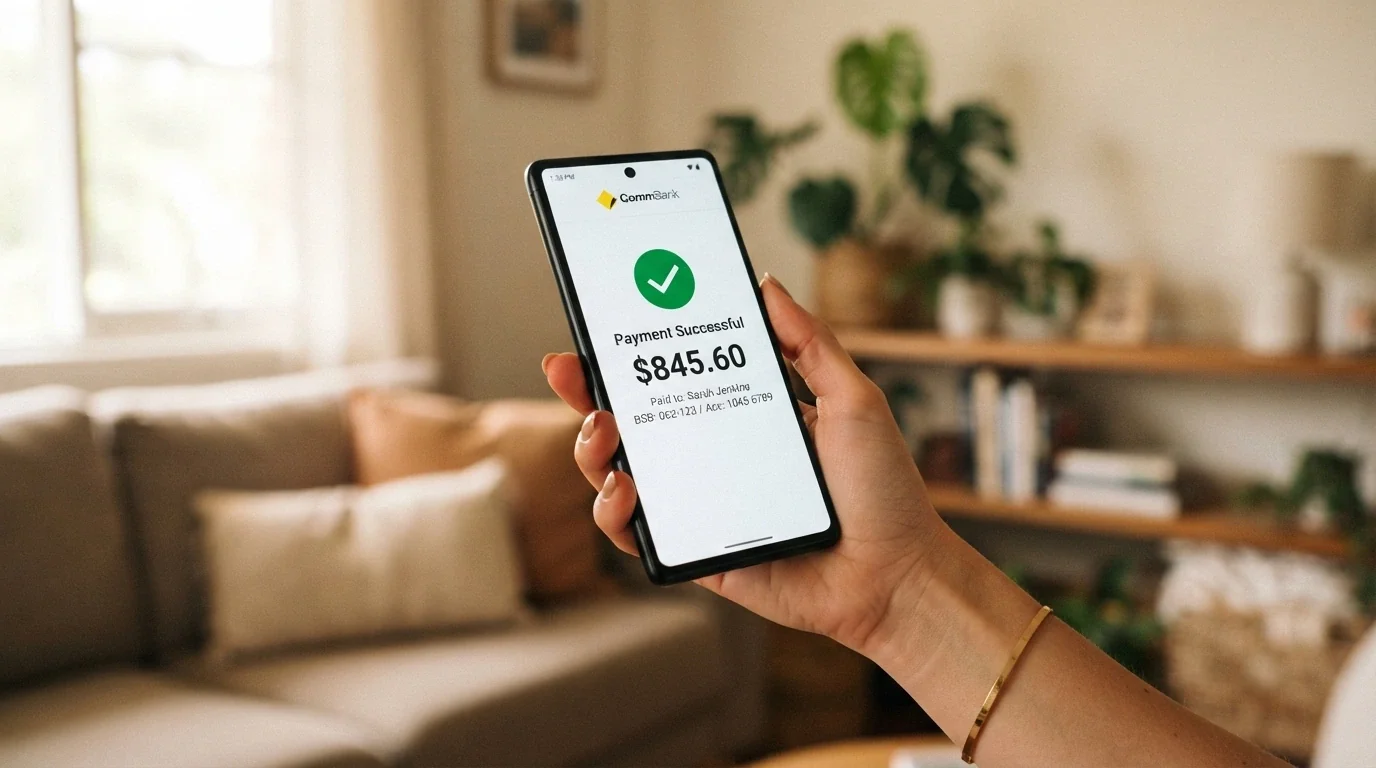
The deposit side is the easier half. Most offshore casinos in the verified sample accept Visa or Mastercard debit cards (not credit), PayID/Osko where the operator has integrated Australian real-time payments, and increasingly a handful of bank transfer options. Cryptocurrency deposit is the wildcard: it is technically banned for the player under the 2024 payment reform, but the ban is enforced against operators rather than against Australian players, and offshore casinos that accept crypto from Australian accounts are routinely accessible through a VPN or a regular connection. The legal question of whether the Australian player has done anything wrong is real but generally unenforced — the IGA targets the provider of the prohibited service, not the user.
The withdrawal side is where the timing tells. PayID withdrawals tested at VegasNow averaged 12 minutes across 8 test cashouts, with a range of 5 minutes to 22 minutes — that is the speed of Australian real-time payments run end-to-end through the operator. Debit card withdrawals are typically 1 to 3 business days; bank transfers vary by institution. Cryptocurrency withdrawals are fast on the operator side but introduce volatility in the value transferred and the same legal ambiguity crypto deposits carry.
PayID and Osko: the Australian default
PayID is the Australian real-time payment system built on the Osko infrastructure — payments between Australian bank accounts that clear in seconds rather than days, with no merchant fees on the receiving side and no chargeback mechanism. To an Australian punter, PayID is what an instant deposit looks like: register the PayID once, deposit A$50, see the balance inside a minute. The operator-side setup requires the casino to hold an Australian business bank account and integrate the New Payments Platform (NPP); not every offshore casino has done so, and the presence or absence of PayID is a fast signal of how much Australian-specific infrastructure the operator has built.
The VegasNow test result is the cleanest data point: PayID withdrawals on bonus winnings averaged 12 minutes across 8 test cashouts, with a range of 5 minutes to 22 minutes. That is fast by any standard — faster than most Australian e-commerce settlements, comparable to domestic bank-to-bank transfers. The 5-minute minimum was the fastest withdrawal; the 22-minute maximum was an outlier, not a typical case. For a player picking an offshore casino, PayID availability is one of the few signals that crosses from marketing into infrastructure: a casino with PayID has set up an Australian payment integration, a PayID withdrawal inside 30 minutes is what Australian players should expect to see, and the absence of PayID is a sign of a more generic offshore integration.
The operator that lacks PayID falls back to debit card and bank transfer, both of which work but are slower on withdrawals. The reason PayID matters most on the withdrawal side is that slow withdrawals are where disputes start — and a casino whose withdrawal speed is “1 to 3 business days, please wait” is a casino whose terms pages are working harder than they need to.
Other payment methods and withdrawal speeds
Beyond PayID, the realistic deposit routes at offshore casinos serving Australians are Visa or Mastercard debit cards (credit cards are banned), bank transfer (which works but is slower), and the occasional BPAY integration. PayPal availability varies; some operators accept it, some process it through different rails, and the experience is less consistent than PayID. Pay-by-phone and mobile billing are common in the UK-centric casino market but rarer at AU-targeted operators.
The VegasNow weekly withdrawal cap of A$5,000 — for non-VIP players — is the published ceiling at one operator and a useful benchmark for the broader space. Offshore casinos typically publish weekly or monthly withdrawal caps that sit in the A$2,500 to A$10,000 range for standard players; VIP tiers raise the cap, and the criteria for VIP status are often opaque. A player who has won a six-figure sum on a 0x-cashout-capped bonus has already lost the cashout advantage; a player who has won a four-figure sum at a standard cap-bound promotion is well inside the typical cap.
The withdrawal timeline on a capped bonus matters less than the cashout cap itself. A A$50 cashout, which is the verified 0x ceiling at the tested operators, lands inside any reasonable withdrawal limit at any operator with any reasonable withdrawal timeline. The A$5,000 weekly cap is a ceiling for the lucky player winning at a higher-stake game, not a constraint on a 0x no-deposit offer. The constraint that binds on a 0x offer is the offer’s own cashout cap, not the operator’s.
From 1 January 2027, banks and payment providers gain express authority to block transactions to illegal gambling operators. The change is part of the broader 2026 reform package, and it means an Australian player using a debit card at an offshore casino may see the transaction refused at the bank level. The authority is express, not new; what the reform does is give banks a clean statutory ground to block rather than relying on their own discretion. For a player, the practical implication is that the payment-method list at an offshore casino narrows from “whatever the operator accepts” to “whatever your bank will let through.”
Crypto Casinos and the Australian Payment Ban
Cryptocurrency is banned as a payment for online wagering in Australia since 11 June 2024, under the 2024 payment reform. The ban covers all digital currency — bitcoin, ethereum, tether, USD coin and any equivalent — and runs in parallel with the credit-card ban. The penalty for an operator that fails to enforce the ban is up to A$247,500 per offence, and the ACMA has flagged enforcement against operators that accept prohibited payment methods.
The law targets the operator, not the Australian player. The IGA’s enforcement model — confirmed by the ACMA — is that the individual bettor is not prosecuted; the statute targets the provider of the prohibited service. So an Australian who deposits bitcoin at an offshore crypto casino is not committing a criminal offence under the IGA. That is the legal position. It is not a safety position: the player is depositing through a payment method the Australian rules treat as flowing to an illegal operator, at an operator that has demonstrated by its payment menu that it is not in the Australian compliance system, and the player’s recourse if the operator refuses a withdrawal is the operator’s internal dispute process — not an Australian complaints body, not the ACMA, not a tribunal.
Bitcoin and cryptocurrency: what the ban means in practice
An offshore casino asking for a crypto deposit is confirming what other signals already show: it is not licensed in Australia, it is not connected to an Australian payments integration, and it is operating in the regulatory category the ACMA describes as providing a prohibited interactive gambling service. The ACMA’s guidance is that the payment method is itself a tell — an Australian who is asked for a credit card or a crypto deposit is being served by someone outside the Australian rules.
The practical cost is in the recourse the player gives up. A debit-card chargeback at an Australian bank gives the player a path when a withdrawal is refused; the bank can reverse the transaction, the player can file a dispute, and the merchant’s acquiring bank can be brought into the conversation. A crypto deposit has no equivalent path. The transaction is final on the blockchain; the casino holds the funds; the player’s only avenue is the casino’s own terms. If the terms allow the casino to void winnings under “irregular play” — and the 22-of-27 finding in the Slotspeak.net test shows how often this clause is invoked — the player has no bank to call.
A small number of offshore operators now restrict crypto deposits specifically from Australian accounts, citing the ban and the associated compliance risk. That is the rational operator response: serving Australian players in crypto carries an enforcement risk the operator does not want to absorb, and the cleanest response is to refuse the deposit. Operators that still accept crypto from Australian accounts are operators that have decided the marginal revenue is worth the risk. The player at the other end of the transaction is the one taking the larger share of that risk, because the player’s downside is the deposit itself.
New No-Wagering Casinos: What Changes When a Site Is Fresh
A new casino is one that has been live for months rather than years; the category includes freshly licensed brands, white-label operations reusing an existing platform, and offshore brands that have just started targeting Australian traffic. New operators use no-wagering offers to buy visibility, and the strategy is the same one affiliate sites use to attract clicks: a 0x bonus is the offer most likely to make a comparison-page reader stop scrolling. The genuine-vs-fake rate at newer operators is not better than at established ones; the same patterns apply, and the same risks apply.
The risk profile is different. An established operator has a withdrawal history, a reputation, and (in the case of Curaçao-licensed brands) a regulatory record at the licensing authority. A new operator has none of those things. A withdrawal that fails at an established operator can be fought through the casino’s complaints process and, on the regulatory side, through the Curaçao Gaming Control Board. A withdrawal that fails at a new operator is harder to escalate; the operator may not have a complaints process yet, the licensing authority may still be processing the licence, and the operator’s customer service may not have escalation paths that work.
Brand-new no-wagering casinos
The market entry tactic for a new no-wagering casino is to publish a bonus that looks more generous than the established competitors — typically by raising the spin count, raising the cap, or extending the expiry. The offer reads well in a comparison table and converts clicks; the underlying question is whether the offer’s terms survive the fine-print read and the actual cashout test. The 22-of-27 finding in the Slotspeak.net test is concentrated at operators that advertise generous 0x terms and deliver something tighter — and a new operator without a track record has the easiest path to that gap, because no one has tested the cashout yet.
The practical checks for a new operator: verify the licence on the licensing authority’s register (Curaçao Gaming Control Board, Anjouan, Kahnawake, or another jurisdiction — Curaçao is the most common in the AU-targeted space), look for an independent testing certificate (iTech Labs, GLI, eCOGRA on the RNG), read the withdrawal terms in full, and look for withdrawal-cap terms that look more generous than the market standard. An offer that looks too good to be true is the same shape as an offer that looks too good to be true.
New no-deposit no-wagering offers
The verified 2026 pattern for new no-deposit no-wagering offers is similar to the established set: cashout caps of A$40 to A$50 on free-spin bundles, expiry windows of 5 to 10 days. A new operator cannot afford to pay out much more than the established operators, because the marketing budget is finite and a large cashout event on a fresh site eats operating capital quickly. The pattern’s stability across the sample (four verified offers, caps between A$30 and A$50, expiries between 5 and 10 days) is the shape of what a new offer looks like, and a player who sees an offer materially outside those bounds is looking at either an outlier or a fake.
A small number of new operators run higher caps — A$100 to A$200 — on no-deposit no-wagering offers as a launch promotion, typically funded by an aggressive first-deposit match elsewhere in the bonus structure. The “free A$100, no deposit, no wagering” headline reads well in a comparison table; the fine print usually pairs it with a withdrawal-cap clause or a bonus-on-bonus structure that effectively re-introduces wagering. Read the fine print.
The Law Every Other “No Wagering Casino” Page Leaves Out
Online casino is prohibited to provide to a person in Australia under the Interactive Gambling Act 2001, strengthened by the Interactive Gambling Amendment Act 2017. There is no licence for online casino anywhere in Australia — not federally, not in any state or territory, and not in the Northern Territory. The licensing schemes that exist (state and territory wagering licences, the NT being the de facto national licensor) cover wagering on races and sport placed before the event begins, lotteries and keno. They do not cover online casino games, online pokies or in-play betting. The legal position is binary: a site is either licensed for the service it offers to Australians, or it is not licensed for that service. No site offering an online casino game to a person in Australia is licensed for the service it offers.
This is what the broader competitor set does not say. Affiliate comparison pages about “no wagering casino bonuses australia” are uniformly quiet on the IGA, the ACMA and the prohibited-service status of the products they are comparing. Some of the silence is structural (Australian affiliate marketing of online casino is itself in a grey area). Some of it is strategic (the comparison sells more strongly without the legal paragraph). The silence is a tell of its own.
The Interactive Gambling Act and the ACMA
The Interactive Gambling Act 2001 makes it an offence to provide certain interactive gambling services to customers physically present in Australia. The Interactive Gambling Amendment Act 2017 closed the offshore loopholes that had allowed overseas operators to serve Australian customers and gave the Australian Communications and Media Authority — the ACMA — its enforcement and blocking powers. The ACMA investigates complaints, issues formal warnings, brings civil penalty proceedings, refers operators for prosecution, and directs Australian ISPs to block illegal sites at the DNS level.
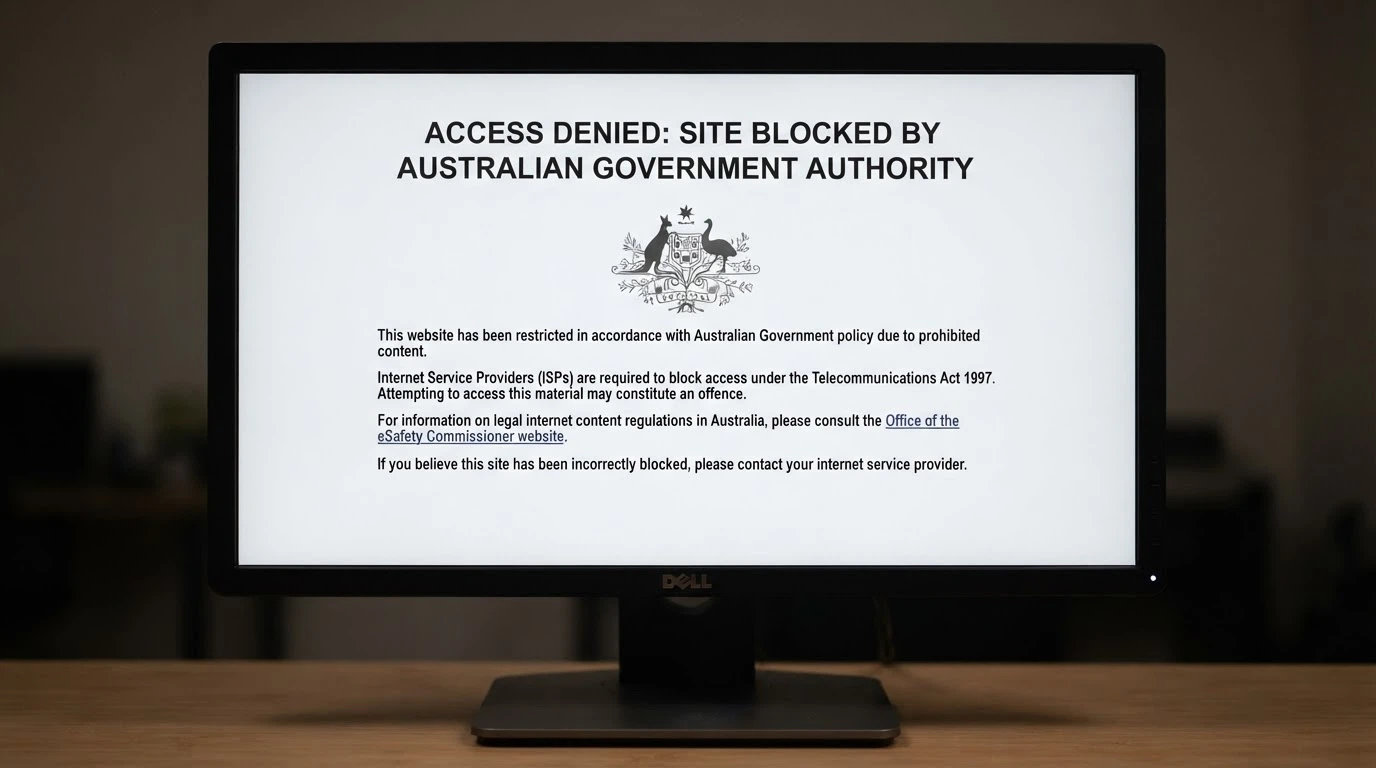
The enforcement record is substantial. Since its first blocking request in November 2019, the ACMA has had 1,564 illegal gambling and affiliate websites blocked by Australian ISPs as of March 2026. More than 225 illegal services have withdrawn from the Australian market since enforcement was strengthened in 2017. The DNS-level block is the visible mechanism: an Australian trying to reach a blocked domain sees an ISP notice instead, with a pointer to the ACMA’s register of blocked sites. The underlying enforcement is civil penalty proceedings and formal warnings — the visible block is the consequence of an action the operator could have responded to earlier and did not.
The individual player is not prosecuted. The IGA targets the provider, and the ACMA’s enforcement posture has been consistently on that side of the line. An Australian who plays at an offshore casino has not committed a criminal offence under the IGA; the operator providing the service has. This is the legal position; it is not a safety argument, and the remainder of this section explains why.
Licensed vs offshore: what the difference costs you
An Australian-licensed wagering operator offers the consumer-protection architecture that comes with being licensed in a state or territory. That includes BetStop, the National Self-Exclusion Register — one registration excludes a person from every AU-licensed online and phone wagering service in a single step. As at 31 July 2026, BetStop had 67,480 registrations, of which 41,290 were still active exclusions; 78% of registrants were under 40 and 38% chose lifetime exclusion. BetStop is a real tool, and it binds every AU-licensed service simultaneously.
An offshore casino is not licensed in Australia and is not connected to BetStop. A player who registers with BetStop and continues to play at an offshore casino does so with their own money and at their own risk — the offshore casino cannot see the registration and is not required to honour it. The 22 of 27 fake-claim operators and the broader offshore space all sit in the same category for BetStop purposes: outside the register, unaffected by it.
The licensed framework also gives the player a complaints path. State and territory gambling regulators, the Australian Financial Complaints Authority where relevant, and the operator’s licensing conditions all create escalation paths that do not exist for offshore operators. A dispute with a Curaçao-licensed casino can be escalated to the Curaçao Gaming Control Board, which handles complaints where it has jurisdiction — but the process is slower, the remedies are less predictable, and the operator’s compliance incentive is lower than for an Australian-licensed operator whose licence renewal depends on consumer-complaint metrics.
The most concrete cost of the offshore category is what happens if the site is blocked. The ACMA has been adding to its block list since November 2019 at a steady pace; an operator can be added tomorrow, with no notice to the player. A site that was reachable yesterday can be unreachable today, with a balance sitting on the account and no DNS path to log in and withdraw it. The operator may continue to honour withdrawals from the player’s perspective; the player, on their end, cannot reach the operator. The DNS-level block is the visible mechanism of the offshore space.
The minimum age for all commercial gambling in Australia is 18 — across the licensed market and across the offshore market, the age threshold is the same. The rules about age are not a differentiator; the rules about what happens when a player is in trouble, or when an operator refuses a withdrawal, or when the site disappears from the ISP, are.
The 2026 gambling reform: what changes in January 2027
The Interactive Gambling Amendment (Gambling Reform) Bill 2026 passed Parliament on 19 August 2026, with its measures commencing 1 January 2027. The reform is the largest change to Australian gambling regulation since the 2017 amendments, and it sits in a regulatory category the offshore casino market will not feel directly — the rules bind AU-licensed operators, not offshore ones. The effect on the offshore space is downstream: tighter rules on the licensed side, more enforcement capacity on the prohibited side, and a change to what banks can do.
The advertising rules from 1 January 2027: no more than three wagering ads per hour between 6:00 am and 8:30 pm; a live-sport blackout from 15 minutes before a live sporting event until 5 minutes after it ends; radio ads barred during school times; broadcasting sporting odds banned outright; online ads only to logged-in, age-verified users with opt-out; no ads in sports venues or on uniforms; athletes, celebrities and influencers barred from promoting wagering products. The licensed market absorbs these; the offshore market was not following the existing advertising rules anyway.
The inducement rules from 1 January 2027: direct marketing of inducements is prohibited for 14 days after a customer signs up, for three months after a person deregisters from BetStop, and indefinitely for customers identified as at risk of gambling-related harm. This is the rule that touches the bonus landscape most directly: a no-deposit free-spin offer to a brand-new account is, on the licensed side, against the rules during the first 14 days at least; the offshore operators will not be bound by this.
The payment rules from 1 January 2027: banks and payment providers gain express authority to block transactions to illegal gambling operators. This is the rule that touches the player at the point of deposit or withdrawal. An Australian player trying to use PayID at an offshore casino may see the bank block the transaction — not always, not predictably, but with a clean statutory basis for the block. The operator’s withdrawal to the player’s account may be blocked the same way; the flow goes through Australian banks regardless of where the operator is licensed.
The reform also adjusts BetStop’s operation, including strengthening the register’s reach within the licensed market and tightening the marketing rules around excluders. None of these changes extends BetStop’s protection to offshore casinos. A BetStop registration excludes from every AU-licensed online and phone wagering service; the offshore casinos are not in that list, and an offshore casino will continue to take a self-excluded player’s deposits.
The 2026 reform does not legalise online casino. It tightens the rules around licensed wagering, gives banks new powers, and adds enforcement capacity for the prohibited offshore space. The headline “Australian players gain new consumer protections” applies to AU-licensed operators and AU-licensed products; offshore casino remains prohibited, and the reform does not change that.
When the Fun Stops: Help That Is Actually There
The responsible-gambling infrastructure in Australia is built around AU-licensed operators and the players who use them. The two anchors are BetStop, the National Self-Exclusion Register, and the National Gambling Helpline at 1800 858 858 — free, confidential, 24 hours a day, 7 days a week, with online chat and counselling through Gambling Help Online. Both are useful and both have limits an Australian player should understand before they need them.

BetStop is the binding tool. One registration excludes the player from every AU-licensed online and phone wagering service — a single sign-up puts the exclusion in place across the entire licensed market. The numbers, as at 31 July 2026: 67,480 registrations since launch in August 2023, of which 41,290 exclusions are still active; 78% of registrants are under 40; 38% have chosen lifetime exclusion. The register is real, the binding is real, and the limits are real too: BetStop does not extend to offshore casinos, and an offshore casino will not see the registration.
The harm prevalence in Australia, on the most recent published figures: about 2.1% of Australian adults — roughly 430,000 people — experience problem gambling, and the Australian Institute of Health and Welfare put high-risk gambling at 1.8% in 2022. The figures predate the 2026 reform and the crypto and credit card bans; the trend in problem-gambling prevalence has been broadly stable over the last decade, and the figures are a useful baseline rather than a current snapshot.
BetStop and self-exclusion: what it covers and what it does not
BetStop is operated by the ACMA and excludes the player from AU-licensed wagering services for a chosen period: 3 months, 6 months, 12 months, or lifetime. Registration is online and takes a few minutes; verification is by identity document; the exclusion is in place the same day. Once active, the exclusion prevents account opening, login and deposit at every participating AU-licensed online and phone wagering operator, and operators are required to take reasonable steps to detect and prevent excluded customers from bypassing the exclusion.
The limit is the offshore space. An Australian who registers with BetStop and then plays at an offshore casino has self-excluded from the licensed market only. The offshore casino is not connected to BetStop, does not receive a notification of the registration, and has no obligation to honour the exclusion. The exclusion is real where the operator is licensed; it has no force where the operator is offshore.
For the offshore player, BetStop is therefore a half-measure. It is the right half: the licensed market is the bigger, more visible, more easily-blocked-from market, and an exclusion there removes the bulk of the gambling volume available to a self-excluded Australian. But it does not close the offshore channel, and a player who needs the offshore channel closed needs additional steps: financial blocking at the bank (where available), payment-method exclusions, and conversations with the helpline below.
Help services, harm prevalence and practical limits
The National Gambling Helpline is 1800 858 858 — free from any Australian phone, confidential, staffed 24/7. The line is operated by Turning Point (in Victoria and Tasmania) under contract to the Commonwealth, with referrals to state and territory gambling help services across the country. Gambling Help Online, at gamblinghelponline.org.au, provides online chat, email and self-assessment tools, and is the right first contact for players who do not want a phone call. Beyond Blue and Lifeline provide gambling-specific support alongside their broader mental-health remits; financial counselling is available through the National Debt Helpline on 1800 007 007.
The deposit-limit infrastructure on AU-licensed wagering operators is genuinely useful: customers can set daily, weekly and monthly deposit limits, can take a break (a 24-hour to several-week pause), can request activity statements, and can self-exclude through BetStop. None of this infrastructure is in place at offshore casinos. An offshore casino may set its own deposit limits (most reputable ones do, at least on the withdrawal side), but the regime is voluntary and the limit is set by the operator’s terms, not by a licensing obligation.
The minimum age for all commercial gambling in Australia is 18. AU-licensed operators verify age at registration and at deposit; offshore operators may verify, may not, and have no Australian-licensing obligation to do so beyond preventing their own payment-processor fines. The verification depth is a useful signal: an operator that asks for document verification at registration is more serious about compliance than one that does not; the same operator is still in the prohibited-service regulatory category regardless.
How We Evaluated Every No-Wagering Claim
The evaluation framework for this page had three sources of evidence. The legal baseline was the Interactive Gambling Act 2001, the Interactive Gambling Amendment Act 2017, the Interactive Gambling Amendment (Credit and Other Measures) Act 2023 and the Interactive Gambling Amendment (Gambling Reform) Bill 2026 — verified through the ACMA’s published register, regulatory guidance and current block list, and against the relevant legislative texts. The offer terms were sourced from the Slotspeak.net four-month testing period (27 advertised “no wager” claims, 21 operators, real signups with fresh accounts and documented withdrawal attempts), from PokiesAustralia.com’s AU no-deposit list, and from operator terms pages where individual offers were verified. The operator footprints were sourced from market-share data surfaced in the broader operator skill.
The verified 0x subset — the five operators whose 0x claims were tested end-to-end with clean cashouts in the Slotspeak.net test — is small relative to the wider advertised universe. Of 27 tested claims across 21 operators, only five produced an actual 0x-wagering bonus credited on signup with cashable winnings paid out cleanly. The 22-claim remainder covers the spectrum: silent low-wager playthrough, hidden deposit requirements, cashout caps that land below withdrawal floors, “irregular play” clauses that voided winnings. A claim being advertised as 0x and a claim being verified as 0x are different acts, and the verification is what the table reflects.
The licence check ran the operator set against the ACMA’s whitelist of licensed Australian wagering operators — the list of brands authorised to take Australian customers for the products they offer. None of the operators in the featured set appears on the ACMA whitelist, because none offers licensed AU wagering — they offer unlicensed online casino, which is not licensable in Australia. The Curaçao licence held by SkyCrown and several of the verified-0x operators was verified against the Curaçao register on the licensing authority’s site; the Curaçao licence does not entitle the operator to serve Australian customers, and serving Australian customers from Curaçao is what makes the service prohibited.
The market-share figures reflect where Australian players’ offshore gambling money is going — they are traffic and revenue measurements, not endorsements. The figures are recorded in the operator table with the caveat that they are not offer-quality measurements; a 9.4% market share is a footprint, not a verdict on any single promotion. The criteria used to order the operator ranking in the comparison table are licence status, AU market share, and known no-wagering position. The market-share ranking is what the table reflects; the offer-quality ranking is what SkyCrown’s 0x verification reflects.
The payment-method check pulled the Australian payment-method rules from the Interactive Gambling Amendment (Credit and Other Measures) Act 2023 and the ACMA’s guidance on prohibited payment methods. Credit cards, credit-related products and crypto are banned for online wagering since 11 June 2024; the ACMA’s public guidance treats a request for these payment methods from an Australian player as a tell for an offshore operator. The VegasNow PayID withdrawal test result — 12 minutes average, 5-to-22 minute range, 8 test cashouts — comes from the Slotspeak.net testing period and is the cleanest data point for Australian-specific payment speed at an offshore casino.
Should You Chase a No-Wagering Bonus in Australia?
The honest answer to “should I chase a no-wagering bonus in Australia” starts with three facts the marketing does not lead with. Online casino is prohibited to provide to a person in Australia under the Interactive Gambling Act 2001. There is no Australian licence for online casino. Every operator an Australian reaches is offshore, unlicensed for the Australian market, and outside the BetStop and Australian-licensed complaints framework. On top of that, only 5 of 27 advertised “no wager” claims tested in 2026 produced an actual 0x bonus with cashable winnings paid out; the other 22 ran a hidden requirement.
For a player who has decided to play at an offshore casino regardless, the framework is narrower and useful. Look for a verified 0x offer rather than an advertised one. The five verified operators in this run are VegasNow, SkyCrown, Wild Tokyo, LuckyDreams and Crownslots; all hold Curaçao licences, all carry A$30 to A$50 cashout caps on their 0x offers, all have cashout caps well below any reasonable withdrawal threshold. The SkyCrown offer (15 wager-free spins on Sweet Bonanza 1000, A$40 cap, 7-day expiry) is the largest verified 0x path in the top-10 by market share; the VegasNow offer (20 wager-free spins on Big Bass Splash, A$50 cap, 7 days) has the highest verified cap. Choose by terms that have been tested, not by brand familiarity.
The cashout caps shape what an offer is worth. A A$50 cashout on a 0x offer is the maximum a player walks away with; the expected value is lower, because most players will not hit the cap and the house edge over the volume of spins discounts the offer back. Treat the verified caps as ceilings, not as expected payouts; treat the spin count as a count, not as value; treat the expiry as a hard deadline. Read the terms end-to-end before you deposit — including the “irregular play” clause, which is the most common path to a voided bonus in the Slotspeak.net test sample.
Beyond the offer itself, the legitimate Australian consumer-protection framework sits on the licensed side. BetStop, deposit limits, activity statements and the National Gambling Helpline at 1800 858 858 are all designed for AU-licensed operators — none of them extends to offshore casinos in the way they extend to licensed services. An Australian who needs the offshore channel closed will need additional steps beyond BetStop: financial blocking at the bank where offered, payment-method exclusions, conversations with the helpline. The licensed market has the safety net; the offshore market does not.
The last call is the legal one. The competitor pages for “no wagering casino bonus australia” are uniformly quiet on the IGA 2001, the ACMA and the prohibited-service status of the products they are comparing. Some readers will find that silence convenient; others will read it as the omission it is. This page treats the legal position as part of the picture, not as separate from it, because the page is for an Australian reader, and the Australian rules apply to the Australian reader’s deposit regardless of which operator the deposit lands at.
Frequently Asked Questions
Are no-wagering casino bonuses actually real, or do they all have hidden conditions?
Some are, most aren’t. A 2026 four-month test across 21 operators and 27 advertised “no wager” claims found only 5 produced a genuine 0x bonus with cashable winnings paid out — the other 22 applied silent low-wager playthrough, required hidden deposits, capped cashouts below withdrawal floors or voided winnings under “irregular play” clauses. The verified offers carry small caps (A$40–A$50 on free spins, A$30 on the LuckyDreams cash chip) and short expiries (5–10 days). Treat advertised 0x as a default false claim until verified.
How do I actually withdraw winnings from a no-wagering bonus?
The winnings from a verified 0x bonus are cash the moment the spin lands, capped at the bonus’s stated ceiling. Withdrawal at the operator’s cashier section works as it would for any other cash balance — debit card or, where available, PayID. PayID withdrawals at one tested offshore casino averaged 12 minutes across 8 test cashouts with a range of 5 to 22 minutes. Card withdrawals are typically 1 to 3 business days. The bonus’s own cashout cap (A$40–A$50 on the verified set) is the ceiling, not the operator’s weekly cap.
What happens to my money if an offshore casino site gets blocked in Australia?
The ACMA has had 1,564 illegal gambling and affiliate websites blocked by Australian ISPs since November 2019, with blocks issued at the DNS level — the site fails to resolve at the Australian ISP and the player sees a notice instead. The block affects your ability to reach the site, not the operator’s books: a balance sitting on the account may still be owed to you, but the operator is outside Australian consumer-protection and complaints jurisdictions and you have no Australian path to recover it. The block can be reversed (some operators move to alternative domains) or it can be permanent. Either way, the risk is the player’s.
Do I have to pay tax on casino winnings in Australia?
No — gambling winnings are not assessable income for an ordinary Australian punter under section 6-5 of the ITAA 1997, and gambling losses are not deductible under section 8-1, unless the person is carrying on a business of betting or gambling. No Australian case has held ordinary punter winnings assessable. The tax burden sits on the operator: wagering tax is paid where the customer is, with the Northern Territory levying 5% on wagers minus payouts plus a 0.05% racing levy, and states applying their own point-of-consumption tax at 10–15% of net wagering revenue.
How can I tell if a casino’s “no wagering” claim is genuine before I sign up?
Three checks. First, the offer’s cap — a 0x offer with a high cap (A$200+) is rare to the point of unlikely; the verified set sits at A$30–A$50. Second, the expiry — genuine 0x offers have short expiries (5–10 days), because the operator expects to pay out inside the window; offers with 30-day expiries are usually wagered. Third, the “irregular play” clause — read this in full before depositing, because it is the most common path to a voided bonus in the verified-claim sample. Anything not verifiable against a tested source is, in this market, more likely to be fake than real.