
Australian No-Deposit Bonus Casinos: The Numbers Behind the Marketing
A no-deposit bonus lets you play pokies without putting your own money on the line — register an account, verify your phone, and the casino credits you with free spins or a free chip before you deposit a cent. The two forms work differently. Free spins lock you into a named pokie at a fixed stake; free chips let you pick a game but carry heavier wagering on the bonus amount. Both arrive with a clock running and a ceiling that turns a big win into a modest withdrawal. And every operator offering these deals to Australian players sits offshore. The Interactive Gambling Act 2001 prohibits online casino entirely; no Australian licence exists for the product. What follows ranks the operators actually serving Australian sign-ups, reads the terms the marketing buries, and shows what the bonus really costs in statistical terms.

Data current as of 18 October 2026, verified against the ACMA register and operator terms pages.
Table of Contents
- Your 2026 No-Deposit Bonus: Free Spins, Real Money, and the Catch
- The Best No-Deposit Bonus Casinos for Australian Players in 2026
- Skycrown
- Royal Reels
- Fair Go Casino
- RocketPlay
- Bizzo Casino
- WinSpirit
- Rocket Casino
- Stake
- Rainbet
- Scream Casino
- No Australian Casino Licence Exists — Here’s What That Means for Your Bonus
- Why Your 2026 No-Deposit Bonus Is Smaller Than It Looks
- Getting Paid: The Payment Methods That Actually Work for Australian Players
- Bitcoin Bonuses and No-KYC Casinos: Anonymity Has a Price
- The Pokies That Give Your No-Deposit Bonus the Best Run
- What Offshore Casinos Will Not Tell You About Player Protection
- New No-Deposit Casinos in 2026: Fresh Brands, Familiar Risks
- How We Evaluated These No-Deposit Bonus Casinos
- Your No-Deposit Bonus Is a Trial, Not a Payday — Treat It That Way
- Frequently Asked Questions
Your 2026 No-Deposit Bonus: Free Spins, Real Money, and the Catch
Three numbers describe almost every no-deposit bonus an Australian player will see in 2026: the bonus size, the wagering requirement, and the maximum cashout. A free-spins package of 20 to 100 spins arrives with a 3-to-14-day expiry and a withdrawal ceiling of AU$50 to AU$100. A free chip of AU$10 to AU$20 carries wagering of 40x to 60x on the bonus amount alone, and a cap that varies by operator. Above 50x the requirement is practically unclearable; the player wagers their way through the bonus before reaching a withdrawal point. At 30x to 35x, the requirement is reasonable — a player who picks the right pokie has a real chance of cashing out.
The mechanic is the same at every operator, because the offshore market converges on roughly the same term sheet. What differs is the title locked to your free spins, the size of the chip, the games that count toward wagering, and whether the operator runs an Australian-facing payment rail that actually settles quickly. This section opens each of those levers. The ranking table that follows puts ten operators side by side.
There is also a fact that frames everything in this guide, and it is worth stating before the names start. The Interactive Gambling Act 2001 prohibits online casino entirely in Australia. No federal or state licence exists for the product. Every casino offering a no-deposit bonus to Australian players is operating offshore, under a Curacao or other non-Australian licence, and is not regulated by the ACMA. The player is not the target of that law — but every protection an Australian-licensed wagering operator must offer, from BetStop self-exclusion to deposit limits, is unavailable at an offshore casino. That gap is the subject of a later section; it sits beside every operator write-up below.
What a No-Deposit Bonus Actually Is
A no-deposit bonus is a marketing credit the casino extends without requiring a deposit. Two structures dominate the Australian-facing offshore market. A free spins package allocates a fixed number of spins — typically 20 to 100 — on a named pokie at a fixed stake, with any winnings returned as bonus funds subject to wagering. A free chip assigns a dollar value — typically AU$10 to AU$20 — that the player can wager on eligible games, again subject to wagering on the bonus amount before any withdrawal.
The mechanic differs from a deposit-match welcome offer in one important way. A welcome bonus requires a real-money deposit to activate, then matches a percentage of that deposit in bonus funds. A no-deposit bonus skips the deposit step entirely. The credit lands in the bonus balance the moment the player completes registration and phone verification. The casino uses this as an acquisition tool because a registered account is more valuable than the cost of the credit — which, at typical house edge rates, runs the casino AU$16 to AU$40 in expected turnover losses per player.
That acquisition framing is also why no-deposit bonuses carry stricter terms than deposit bonuses. The casino is paying the player to try the site, and the wagering requirement, cashout cap and expiry window are designed to recover that cost plus a margin. A player who treats the bonus as a profit engine is playing against the wrong model.
Free Spins vs Free Chip: Which One Gives You More
Free spins lock you to one pokie. Free chips let you choose. Each structure has its own term sheet, and the better one depends on how you play.
Free spins typically offer 20 to 100 spins on a named title, with a withdrawal ceiling of AU$50 to AU$100 and an expiry window of 3 to 14 days. The wagering requirement sits on the winnings — the spin stake is fixed and the casino controls it, so there is no leverage on the bonus amount itself. The pokie matters. A free-spins package on Blood Suckers at 98.00% RTP and the same package on Big Bass Bonanza at 96.71% RTP clear at different rates and end at different expected balances. The difference is small per spin but compounds across the wagering requirement.
Free chips carry dollar values that look modest — AU$10 to AU$20 — but the wagering requirement applies to the bonus amount, not the winnings. A AU$20 chip at 40x means AU$800 in turnover before any withdrawal. Pokies contribute 100% toward clearing; table games and live casino contribute 0–20%, so a chip player who wanders into blackjack is grinding at quarter-speed or not at all.
Which structure leaves more withdrawable cash? The free spins package limits the stake but caps the wagering multiplier on a fixed spin count; the free chip offers more flexibility but applies the multiplier to the bonus amount. For the same house edge of 3–5%, the free spins package gives the player a defined upper bound and the chip gives them open-ended leverage against their own bankroll. Most Australian players default to free spins for that reason. The wagering lands on what the casino hands back, not on what it hands over.
How You Claim a No-Deposit Bonus — Step by Step
- Register an account at the operator — typically an email, password and date of birth. The minimum age for all commercial gambling in Australia is 18, and the offshore casino applies the same floor even though it is not legally required to.
- Verify your phone number by entering the SMS code the operator sends at registration. Skycrown, Royal Reels and the other featured brands use phone verification as the activation trigger — without it, the bonus does not credit.
- The bonus lands in your account balance as soon as verification clears. Free spins appear on a named pokie and activate the first time you open it; free chips appear as a separate bonus balance visible alongside your empty real-money balance.
- The expiry clock starts immediately. Free-spins packages typically carry 3–14 days; free chips run on a similar window. Any bonus funds or winnings not cleared by the deadline are void.
- Read the terms before you spin. The wagering requirement, the cashout cap, the eligible games, and the per-spin stake cap are all stated in the bonus terms page, and each one changes the math of clearing the bonus.
The Best No-Deposit Bonus Casinos for Australian Players in 2026
Ten operators are reviewed in this guide. Six offer a confirmed no-deposit bonus at the time of review; the other four carry deposit-match welcome offers, rakeback models, or no Australian-facing promotion at all. The ranking below sorts by no-deposit value first — lower wagering, higher cashout cap, broader game eligibility — then by provider depth. Where a value is unconfirmed, the cell reads as an em dash; the absence is the information.

The table covers only the columns research carries. Wagering on the no-deposit bonus is given where the operator states it; game providers are named where the operator’s library has been verified. Max cashout, value per spin and the RTP of the bonus slot are out of scope for this comparison — those vary by offer, by activation method and by the specific pokie the operator has locked to the free spins.
| Operator | No-Deposit Bonus | Wagering on NDB | Game Providers |
|---|---|---|---|
| Skycrown | 100 free spins (phone verification) | 30x winnings | 50+ (Pragmatic Play, NetEnt, Microgaming, Play’n GO, BGaming, Hacksaw, Nolimit City) |
| Royal Reels | AU$10 free chip (phone verification) | 30x bonus | 40+ (Pragmatic Play, NetEnt, BGaming) |
| Fair Go Casino | A$15 free chip | 60x bonus | RealTime Gaming |
| RocketPlay | — | — | Multiple (Pragmatic Play, NetEnt likely) |
| Bizzo Casino | 100 free spins (Big Bass Bonanza) | 40x winnings | Pragmatic Play, BGaming |
| WinSpirit | 100 free spins (Sweet Bonanza) | 40x winnings | Pragmatic Play (multiple) |
| Rocket Casino | 100 free spins (Starburst) | 45x winnings | NetEnt (multiple) |
| Stake | — | — | Multiple (proprietary + third-party) |
| Rainbet | — | — | Multiple |
| Scream Casino | — | — | — |
Three patterns stand out across the ten operators. The first is that the lowest no-deposit wagering (30x) comes from Royal Reels and the highest (60x) from Fair Go — a 30-point spread that determines whether the bonus is realistic to clear. The second is that the rarer terms belong to the smaller libraries. WinSpirit offers no max cashout limit, but its game roster is not the deepest. The third is that the four operators without a confirmed no-deposit bonus are not equivalent to the six that carry one. RocketPlay runs a clean deposit-match offer with a defined ceiling; Stake is blocked by ACMA and effectively unreachable; Rainbet runs a rakeback model that does not produce a traditional no-deposit bonus; Scream Casino is a newer entrant whose terms have not been confirmed at the time of review.
The ranking above is built on what research has confirmed. Each operator write-up below addresses the offer, the wagering and the library, and ends on a verdict that takes a position on who the brand suits.
Skycrown
Skycrown is the largest game library in this set — over 10,400 titles from more than 50 providers, including Pragmatic Play, NetEnt, Microgaming, Play’n GO, BGaming, Hacksaw Gaming and Nolimit City. The no-deposit offer is 100 free spins credited through phone verification, with 30x wagering on the winnings. The bonus applies to selected pokies; the specific title was not confirmed at review.
The welcome package sits behind the no-deposit credit. A first deposit of AU$20 or more unlocks 100% up to AU$500 plus a 50% reload up to AU$500 on the second deposit, with 30x wagering on the bonus amount. The full premium package — AU$8,000 matched plus 400 free spins — carries 40x on the bonus instead. The choice matters because the lower wagering on the smaller match is easier to clear, but the premium tier quadruples the matched amount at the cost of higher playthrough.
Payout speed is where Skycrown separates itself. An independent test of an AU$180 PayID withdrawal cleared to the nominated Australian bank account in 2 hours and 29 minutes — well under the three-hour benchmark. PayID support is not universal across offshore casinos, and Skycrown’s investment in the rail is the strongest indicator in the set that the operator treats Australian players as a real market rather than a tolerated afterthought.
Verdict: the biggest library and the fastest PayID in the set, with a no-deposit offer that sits at the friendlier end of the market range.
Royal Reels
Royal Reels runs the lowest no-deposit wagering in this set: 30x on an AU$10 free chip credited after phone verification. The chip is small by chip standards — AU$10 against the AU$15 to AU$20 range elsewhere — but the multiplier halves the turnover needed, from AU$800 at 40x to AU$300 at 30x on the bonus alone. The operator is licensed in Curacao through Digibrite S.R.L., the standard offshore licence structure for Australian-facing brands, and offers no Australian regulatory recourse.
The welcome pack is structured across three deposits rather than two. First deposit: 100% up to A$500; second: 75% up to A$750; third: 100% up to A$1,250 — total bonus potential A$2,500 plus 50 free spins. Wagering is 35x on the bonus only, with an A$5 per-spin cap during clear-down. That per-spin cap is the operator’s way of preventing a single big win from doing all the wagering work; it is a standard term in this market and worth knowing about before you start.
The library sits at 5,400+ pokies from 40+ providers, including Pragmatic Play, NetEnt and BGaming. That is roughly half Skycrown’s count, but it is a workable library for clearing a no-deposit bonus — the relevant titles for bonus play are well represented.
Verdict: the cleanest no-deposit offer in the set. The AU$10 chip with 30x wagering is the rare case where the maths is genuinely friendly to the player.
Fair Go Casino
Fair Go runs on a single provider — RealTime Gaming — which is both its selling point and its constraint. The no-deposit offer is a A$15 free chip with 60x wagering and an AU$180 max cashout. The 60x multiplier is the heaviest in the set; the AU$180 cashout cap is the highest.
The asymmetry is the story. At 60x, the AU$15 chip requires AU$900 in turnover before withdrawal — the highest turnover burden in this guide. But the AU$180 ceiling is also the most generous ceiling among the no-deposit offers in the set, and the deposit bonus that follows has no max cashout limit at all. That is a meaningful differentiator: a deposit match at Fair Go can be cleared and the winnings withdrawn in full, where most competitors cap the deposit bonus payout as well.
The five-deposit welcome package totals A$1,000 across five 100% matches up to A$200 each, with 30x wagering on combined deposit + bonus. The structure is slower to build than a two- or three-deposit pack but rewards patient players.
The RTG-only library is the trade-off. Cash Bandits 3 at 97.00% RTP is a strong clearing title; the broader NetEnt and Pragmatic Play catalogues that the other featured operators carry are simply not available here.
Verdict: for players who play RTG pokies specifically and want the highest no-deposit cashout cap in the set, Fair Go fits — if they are willing to grind through 60x wagering. For everyone else, the chip is heavy and the library narrow.
RocketPlay
RocketPlay has no confirmed no-deposit bonus at the time of this review. What it does offer is a clean deposit-match welcome: 100% up to AU$200 plus 50 free spins, with 30x wagering on the bonus amount, 30 days of validity from the first deposit, and an AU$500 maximum cashout from the bonus.
The deposit-match welcome is structured differently from a no-deposit offer in one critical way. The player funds the account with their own money, then the casino matches a percentage of that deposit in bonus funds. Wagering applies to the bonus amount only at 30x, which means a AU$200 deposit plus AU$200 bonus requires AU$6,000 in turnover before withdrawal. The AU$500 ceiling applies to bonus-derived winnings only; real-money balance withdrawals are unaffected.
The 30-day validity window is longer than the typical 14 days offered on a no-deposit bonus, which gives the player more time to clear the requirement. This is the value of a deposit match over a no-deposit chip: the player has a bankroll, the casino has extended the clock, and the math is more forgiving at lower wagering multipliers.
Game provider mix was not fully confirmed at review; Pragmatic Play and NetEnt are likely but not locked. The library depth is comparable to the mid-tier offshore operators, and the AU$500 max cashout is below the no-deposit caps at Fair Go but well above most competitor caps.
Verdict: a straightforward match for players who have already decided to deposit. Not the operator for players specifically chasing a no-deposit offer.
Bizzo Casino
Bizzo’s no-deposit offer is 100 free spins on Big Bass Bonanza, a Pragmatic Play fishing-themed pokie with an RTP of 96.71% and high volatility. Wagering is 40x on the winnings — middle of the market, same multiplier as Skycrown’s premium welcome tier.
Big Bass Bonanza is one of the most-played pokies in the Australian-facing offshore market, and the operator choice is deliberate. The title’s high volatility means the bonus clearing is bumpy: long stretches of small returns punctuated by occasional feature rounds where the multiplier can swing the balance. A 100-spin package on a high-volatility pokie carries a different statistical shape from the same 100 spins on a low-volatility title like Starburst — the average outcome is similar at 96.71% RTP, but the variance is much wider. A player who hits the bonus game early has a real shot at clearing the wagering in one session; a player who doesn’t may run out the clock.
The Pragmatic Play and BGaming provider mix is standard for this segment. Game variety outside the named pokie is wide; the welcome package behind the no-deposit offer was not confirmed at review.
Verdict: Big Bass Bonanza is the right title for clearing bonus play, and the 40x wagering is ordinary. The high volatility is the real risk — and the real upside.
WinSpirit
WinSpirit’s no-deposit offer is 100 free spins on Sweet Bonanza, with 40x wagering on winnings and no maximum cashout limit. The absence of a withdrawal ceiling is the rarest term in this set — every other operator caps the no-deposit payout, and most sit at AU$50 to AU$100.
Sweet Bonanza is a Pragmatic Play cluster-pays pokie with an RTP of 96.51%. The cluster mechanic pays for groups of matching symbols anywhere on the reels, which produces a different hit pattern from the standard payline structure. A 100-spin package on a 96.51% RTP title at 40x wagering carries an expected loss of about AU$12.50 per AU$50 of bonus — within the standard market range. The no-cap structure changes the upside. A streak on Sweet Bonanza’s tumbling reels can produce a 50x to 100x line hit, and without a withdrawal cap the player keeps what the bonus generates rather than being clipped at AU$50 or AU$100.
The provider mix confirms Pragmatic Play; the broader library was not verified at review. The welcome package behind the no-deposit offer was also not confirmed.
Verdict: the standout for players willing to play the bonus through a single pokie and chasing a meaningful payout ceiling. The 40x wagering is ordinary; the no-cap structure is the differentiator.
Rocket Casino
Rocket Casino’s no-deposit offer is 100 free spins on Starburst, with 45x wagering on winnings. Starburst is a NetEnt staple — low volatility, an RTP of 96.08%, and a hit pattern that produces small wins frequently.
The combination is deliberate. Low volatility and 45x wagering is the operator’s way of giving the player a long run on the bonus. The small, frequent wins keep the balance alive long enough to attempt the wagering requirement, even if the average outcome is below the typical 96.5% market RTP. A 100-spin package on Starburst at 96.08% RTP statistically loses about AU$15.70 of every AU$100 wagered — a touch worse than the average — but the low volatility smooths the ride.
NetEnt powers the library. The welcome package behind the no-deposit offer was not confirmed at review.
Verdict: the right pick for players who want a steady, low-volatility clearing run. The 45x wagering is on the higher end of the market range, but Starburst’s payout structure makes it workable.
Stake
Stake.com is officially blocked by the Australian Communications and Media Authority under the Interactive Gambling Act 2001. Australian ISPs have been ordered to prevent access to the site; the domain does not load without a VPN or alternative routing. For Australian players, this is effectively a closed door.
The platform runs a rakeback model rather than a traditional bonus structure. Players receive a percentage of the house edge back as a rebate, calculated over their wagering volume rather than tied to a single promotion. There is no no-deposit bonus and no deposit match in the conventional sense; the entire reward mechanism is on volume.
Stake.com.au is a separate Australian stock trading service with no gambling relationship. The naming collision is a known confusion point; the trading platform and the offshore casino share a brand name but not a business.
Verdict: blocked by ACMA and effectively unreachable from Australia. A reader who came looking for Stake gets the same answer the regulator has been giving since the block was issued: not from here.
Rainbet
Rainbet runs a rakeback model similar to Stake’s — a percentage of house edge returned to the player over wagering volume, rather than a traditional no-deposit or deposit-match bonus. No standard no-deposit offer is confirmed at review.
Rainbet is officially restricted in Australia under the Interactive Gambling Act 2001. As with Stake, Australian ISPs are expected to block access, and any Australian player reaching the site does so outside the regulated framework. The brand is not on the ACMA whitelist because no such whitelist exists for online casino — the IGA prohibits the product entirely.
The provider mix and the library depth were not fully verified at review. Welcome package terms were also not confirmed.
Verdict: in the same category as Stake — a brand operating offshore, restricted domestically, and offering no Australian-facing promotion that warrants deeper analysis here. The rakeback model favours high-volume players over casual users, and the absence of a no-deposit bonus means there is nothing to evaluate on the page’s main metric.
Scream Casino
Scream Casino is a newer offshore entrant. The no-deposit offer is not confirmed at the time of this review; welcome package terms, wagering multipliers and game provider mix are also not verified.
The standard advice applies. A player considering a newer offshore brand should check for the licence — typically Curacao for Australian-facing operators, occasionally Malta — and read the bonus terms page before registering. The points to verify are the wagering multiplier (above 50x is practically unclearable), the max cashout cap, the eligible games list, and the per-spin stake cap during clear-down. Payment methods are the other red flag: a site accepting credit cards or crypto is operating outside Australian rules, because both have been banned as payment for online wagering since 11 June 2024.
A new operator also carries a track-record problem. Established brands in this set have at least one independent withdrawal test (Skycrown’s AU$180 PayID cleared in 2 hours and 29 minutes); newer brands do not. The ACMA has blocked 1,564 sites since November 2019, and new sites are added to the block list continuously. There is no guarantee a brand that exists today is reachable tomorrow.
Verdict: a watchlist entry rather than a confirmed option. Register only after reading the terms, and assume the brand could be blocked by ACMA before any withdrawal clears.
No Australian Casino Licence Exists — Here’s What That Means for Your Bonus
Online casino is prohibited in Australia. The Interactive Gambling Act 2001 makes it an offence to provide an online casino, online pokies or in-play sports betting to a person physically in Australia, and there is no licence for the product anywhere in the country — not federally, not in any state or territory. Every casino offering a no-deposit bonus to an Australian player is operating offshore under a non-Australian licence, and the Australian Communications and Media Authority enforces the prohibition.
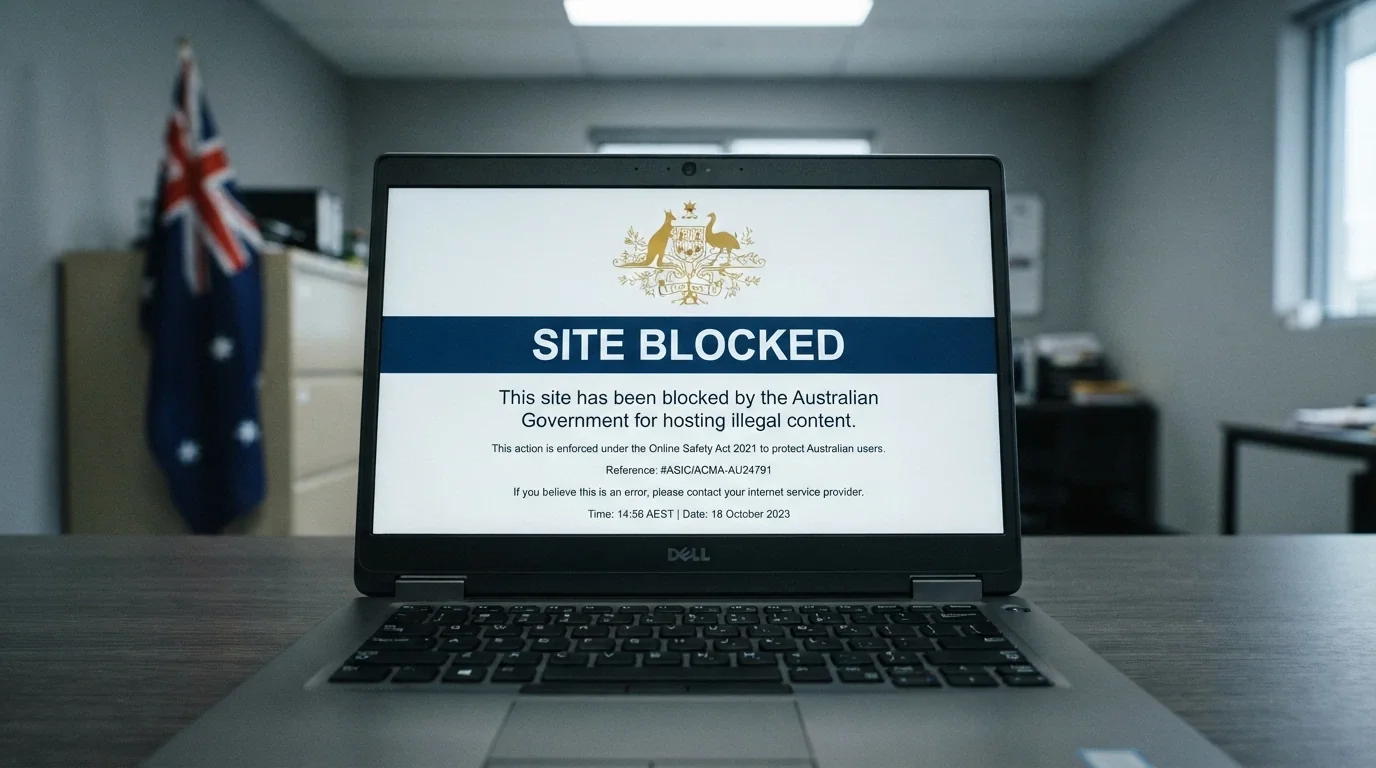
This is the structural fact behind every name in this guide. It is not a footnote; it is the reason the offshore route is the only route. A licensed Australian wagering operator can take bets on racing and sport before the event starts, on lotteries, and on keno (until 1 January 2027). It cannot offer online casino games. The product you are looking for does not have a domestic version.
The numbers put a shape to the prohibition. Since the first blocking request in November 2019, the ACMA has directed Australian ISPs to block 1,564 illegal gambling and affiliate websites; more than 225 services have withdrawn from the Australian market since enforcement was strengthened in 2017. The credit-card and crypto payment ban, in force since 11 June 2024, removed the easiest funding routes for Australian players at offshore operators. And from 1 January 2027, the Interactive Gambling Amendment (Gambling Reform) Bill 2026 — passed by Parliament on 19 August 2026 — layers advertising restrictions, inducement bans, and bank blocking powers on top of the existing prohibition.
What you lose at an offshore site is the substance of this section. Licensed wagering operators in Australia must offer the ten measures of the National Consumer Protection Framework: identity verification, no line of credit, restricted incentives, deposit limits, activity statements, BetStop self-exclusion, and the rest. Offshore casinos are not connected to any of them. The site can be blocked tomorrow with your balance still on it, and there is no Australian body to complain to if the operator refuses to pay.
The Interactive Gambling Act: What It Prohibits and Why
The Interactive Gambling Act 2001 is the federal statute that makes online casino illegal in Australia. It prohibits the provision of online casino games, online pokies and in-play sports betting to a person in Australia. The provider is the target: it is an offence to offer the service, not to use it. The Act was amended in 2017 to close offshore loopholes and give the Australian Communications and Media Authority the enforcement and blocking powers it now uses. It was amended again in 2023 to ban credit cards and crypto as payment for online wagering. The 2026 Gambling Reform Bill layers additional restrictions on top of the existing framework.
No federal or state licence exists for online casino. A state or territory can license an operator to take wagers on racing and sport, on lotteries, and on keno (until 1 January 2027). It cannot license an online casino. The licensed wagering market — Sportsbet, bet365, Ladbrokes, the TAB brands — is real and active, but it does not offer what this guide is about. The land-based casinos (Crown, The Star) are state-licensed and operate physical premises; they are a contrast to the offshore online product, not a substitute.
The minimum age for all commercial gambling in Australia is 18, including at offshore casinos even though they are not legally required to enforce it. The Act targets the provider, not the player. An Australian who gambles at an offshore casino is not prosecuted. But that is the only thing the player keeps.
ACMA Enforcement: 1,564 Blocked Sites and Counting
The ACMA’s enforcement powers fall into two categories: blocking illegal services at the ISP level, and withdrawing them from the Australian market altogether. Since the first blocking request in November 2019, the regulator has had 1,564 illegal gambling and affiliate websites blocked by Australian ISPs as of March 2026. More than 225 services have withdrawn from the Australian market since 2017, either because the ACMA’s investigation made continued operation untenable or because the operator chose to leave rather than fight.
The credit-card and crypto payment ban, in force since 11 June 2024, sits beside the blocking regime. Credit cards, credit-related products and digital currency are banned as payment for online wagering under the Interactive Gambling Amendment (Credit and Other Measures) Act 2023; penalties for non-compliance reach $247,500. The payment ban was designed for licensed wagering operators, where it works as intended — every licensed brand in Australia accepts PayID, debit card, bank transfer and BPAY, and refuses credit and crypto. At offshore casinos, the ban does not bind the operator, but it serves as a signal: a site asking for credit card or crypto is operating outside Australian rules, because no Australian-licensed operator would accept either method.
The blocking list is dynamic. New sites are added continuously; the total grows monthly. A reader who finds an offshore casino not in this guide can assume the ACMA is either already looking at it or about to.
The 2026 Gambling Reform: What Changes From January 2027
The Interactive Gambling Amendment (Gambling Reform) Bill 2026 was introduced on 2 July 2026 and passed Parliament on 19 August 2026. Its measures commence on 1 January 2027 — most of the public-facing restrictions take effect from that date. The Bill is the federal government’s response to a decade of pressure on wagering advertising and inducements, and it tightens every lever available without changing the underlying prohibition.
The advertising restrictions start the day. From 1 January 2027, no more than three wagering ads per hour can run between 6:00 am and 8:30 pm; a live-sport blackout runs from 15 minutes before a live event until 5 minutes after it ends. Athletes, celebrities and influencers are barred from promoting wagering products. Radio wagering ads are barred during school drop-off and pick-up times. Broadcasting sporting odds is banned outright. Online wagering ads can only be shown to logged-in, age-confirmed users who have not opted out.
The inducement rules are where the no-deposit bonus category collides with reform. Direct marketing of inducements is prohibited for 14 days after a customer signs up, for three months after a person deregisters from BetStop, and indefinitely for customers identified as at risk. The 14-day rule effectively bans the kind of welcome-offer bombardment that licensed wagering operators have used as a customer-acquisition tool — and offshore casinos face the same marketing restrictions when targeting Australian customers. Banks and payment providers gain express authority to block transactions to illegal gambling operators from the same date, which is the enforcement mechanism the credit-card ban never quite managed.
Online keno and foreign-matched lotteries are also banned from 1 January 2027. The licensed wagering market shrinks in product scope as the offshore market gets harder to reach.
Offshore vs Licensed: The Protections You Lose
Australian-licensed wagering operators must offer the ten measures of the National Consumer Protection Framework for Online Wagering. Identity verification, no line of credit, restricted incentives, deposit limits, activity statements, BetStop self-exclusion — these are conditions of holding an Australian licence, and the state and territory regulators enforce them. Offshore casinos offering no-deposit bonuses to Australian players are not bound by any of them.
BetStop, the National Self-Exclusion Register, has been live since 21 August 2023. As of 31 March 2026, 59,830 Australians had registered to self-exclude from every Australian-licensed online and phone wagering service; 37,247 of those exclusions are currently active. Seventy-eight per cent of registrants were under 40, and 38 per cent chose lifetime exclusion. None of those exclusions bind an offshore casino. A self-excluded Australian can register at an offshore operator today and the system will not stop them.
The other measures are equally unavailable. Deposit limits cannot be set at an offshore site because the operator is not required to honour them. Activity statements — the periodic statements of time and money spent — are not generated. Identity verification at an offshore casino is an anti-fraud check, not a consumer-protection gate. Complaints to the ACMA about an offshore operator’s refused withdrawal will be noted, but the regulator cannot compel payment from an unlicensed entity.
This is the most concrete harm of the offshore route. The licensed system is incomplete — online casino is prohibited, not regulated — and the offshore alternative offers none of the protections the licensed system would have provided if the product were licensable.
Why Your 2026 No-Deposit Bonus Is Smaller Than It Looks
Three terms on the bonus page shrink every no-deposit offer before you spin a reel: the wagering requirement, the max cashout cap, and the expiry window. Read together, they turn a AU$100 win into a AU$50 withdrawal, an AU$800 turnover bill, and a 7-day clock to clear it.
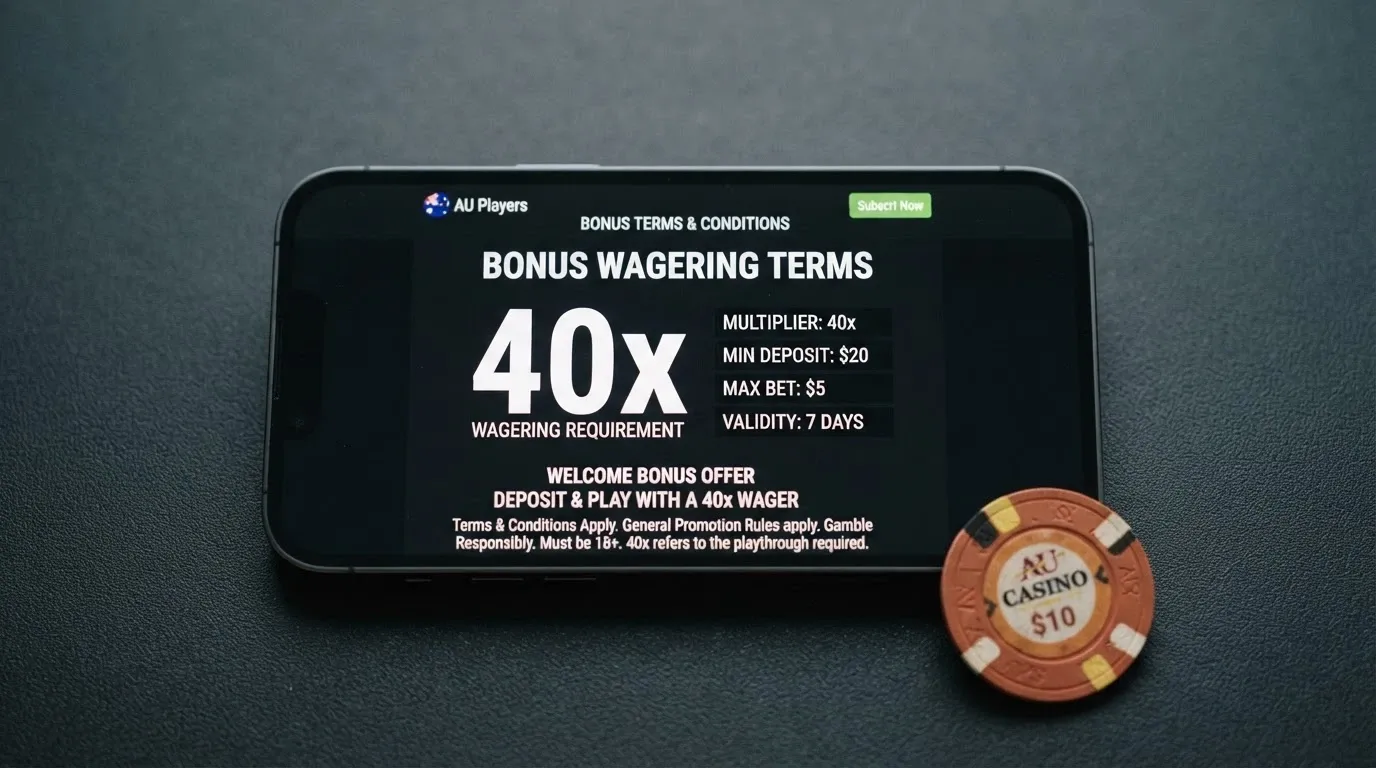
The standard market range is the baseline. Wagering requirements on Australian no-deposit bonuses in 2026 run from 30x to 60x. Anything in the 30x–35x band is reasonable; anything above 50x is practically unclearable, because the turnover required exceeds the bonus’s expected value by a factor the player cannot recover at standard pokie RTPs. Max cashout caps sit at AU$50 to AU$200, with free-spins packages typically at the lower end and free chips potentially higher. Expiry windows are 3 to 14 days, with the free chip and the free spins package both subject to the same clock.
The cost of those terms in real money is the subject of this section. The next subsections walk through each term in turn, and the calculation below shows what a typical AU$20 chip actually costs in statistical terms.
Wagering Requirements: The 30x–60x That Decides Whether You Cash Out
The wagering requirement is the multiplier that determines how much you must bet before any of the bonus balance converts to withdrawable cash. A 30x multiplier on a AU$20 free chip means AU$600 in turnover before withdrawal. A 40x multiplier means AU$800. A 60x multiplier — Fair Go’s level — means AU$1,200.
The formula varies by offer type. On a free chip, the multiplier applies to the bonus amount only: a AU$20 chip at 40x is AU$800 in bets. On a free spins package, the multiplier typically applies to the winnings: 100 spins returning AU$50 in bonus funds at 30x is AU$1,500 in turnover. The two structures are not directly comparable, but the underlying principle is the same — the wagering requirement is the turnover the casino needs before letting you withdraw, and the casino sets it at a level where the expected house edge covers the bonus plus a margin.
Game contribution rates layer on top. Pokies contribute 100% toward clearing the wagering requirement, which is why every no-deposit bonus in this set is locked to a pokie or a pokie-only game set. Table games and live casino contribute 0–20%, so a player who wanders into blackjack with a free chip is grinding at a fraction of the speed. The eligible games list in the bonus terms page is worth checking before the first spin.
The cost in statistical terms works out as follows. Assuming only the AU$20 bonus amount is wagered — which is how a free chip operates — required turnover is AU$20 × 40 = AU$800. At a typical 96.5% RTP (Pragmatic Play’s market standard), the expected loss on AU$800 of turnover is AU$800 × (1 − 0.965) = AU$28, which is AU$8 more than the AU$20 bonus itself. On a 95% RTP pokie at the lower end of the range, the same turnover carries an expected loss of AU$40, double the bonus. On a 98% RTP title like Blood Suckers at the upper end, the expected loss drops to AU$16 — under the bonus value, so the player keeps the chip on average. This is a statistical estimate over many spins under the stated assumptions, not a guaranteed outcome for any single player; the player may win more or less than the expected loss on any given session, but the long-run average is what the calculation describes.
The multiplier, the RTP and the house edge are the three numbers that determine whether the bonus is a small gift or a small loss in statistical terms. The lower the RTP, the more the bonus costs; the higher the RTP, the closer to break-even.
Max Cashout Caps: Why Your AU$100 Win Becomes AU$50
The max cashout cap is the ceiling on what you can withdraw from bonus-derived winnings, regardless of how much you win. A typical free-spins package in this set caps at AU$50 to AU$100; a free chip can carry a higher cap (Fair Go is at AU$180); WinSpirit has no max cashout at all — the rarest term in the set.
The cap interacts with the wagering requirement in a way that often catches players out. The wagering requirement determines how much you must bet before any withdrawal is allowed. The cap determines the maximum you can withdraw once you have cleared it. A player who hits a 50x line hit on a free-spins package and clears the 30x wagering will still see their withdrawal clipped at the AU$50 to AU$100 cap — the win is real, but the operator’s terms convert it into a smaller number.
The cap exists because the casino’s marketing math depends on it. The acquisition cost of a no-deposit bonus is the expected house edge on the turnover the player generates while clearing the wagering requirement, plus a margin. Without a cap, a player who hits a single big win could exceed that cost and turn the bonus into a loss for the operator. The cap rebalances the math: the casino’s offer is generous enough to attract registrations and constrained enough to remain profitable on average.
For a player evaluating a no-deposit bonus, the cap matters less than the wagering requirement in most cases, because most players never reach the cap. A AU$50 cashout from a 30x wagering requirement is the more common outcome than a AU$200 cashout from the same bonus. But for the player who does hit the cap, the term is the difference between a real payout and a marketing-shaped disappointment.
Bonus Expiry and Game Eligibility: The Traps That Void Your Winnings
The expiry window is the third term on the bonus page, and it is the one players most often miss. A no-deposit bonus expires in 3 to 14 days from activation. The clock starts the moment the bonus credits, not when you first open the pokie. A player who registers on a Friday, verifies on Monday, and tries to play on Wednesday has already burned half the window.
The expiry interacts with the wagering requirement at the lower end of the window. A 3-day expiry on a 30x free chip means AU$600 in turnover over 72 hours — AU$200 per day, or about AU$8 per hour if the player can sustain an 8-hour session. Most players cannot sustain that pace, and the bonus voids before the wagering clears. A 14-day expiry on the same bonus means AU$43 in turnover per day, which is workable for any casual player.
Game eligibility is the second trap. The bonus terms page lists the games that contribute toward clearing the wagering requirement and the games that do not. Free-spins packages are locked to one named pokie — Big Bass Bonanza at Bizzo, Starburst at Rocket Casino, Sweet Bonanza at WinSpirit. Free chips allow broader game choice but typically restrict the eligible list to pokies, with table games and live casino contributing 0–20% or not at all. A player who picks a non-eligible game with a free chip active is grinding at quarter-speed or zero.
The third trap is the per-spin stake cap. Some operators cap the per-spin wager during clear-down (Royal Reels at A$5 per spin, for example), which prevents the player from making large bets to clear the wagering quickly. The cap exists for the same reason the cashout cap exists: to keep the bonus within the operator’s expected margin.
These three terms — expiry, eligibility and stake cap — are the standard fare of the offshore no-deposit bonus page. Reading them is part of claiming the bonus responsibly.
Getting Paid: The Payment Methods That Actually Work for Australian Players
PayID is the fastest withdrawal route for Australian players at offshore casinos that support it. An independent test of an AU$180 withdrawal at Skycrown cleared to a nominated Australian bank account in 2 hours and 29 minutes — the only published withdrawal benchmark in this guide’s set. PayID uses the Osko payment rail operated by Australia’s New Payments Platform, which settles payments between Australian bank accounts in near real time, and the offshore casino support layer is what determines whether the operator can deliver that speed.

For Australian-licensed wagering, PayID is one of the standard deposit and withdrawal methods. For offshore casinos, support is uneven — Skycrown and a handful of others carry the rail, while most require a bank transfer fallback that takes 1–3 business days.
Credit cards and crypto are banned as payment for online wagering under the 2024 ban. The ban binds Australian-licensed operators directly; offshore operators are not bound but their acceptance of either method is a signal that the site is operating outside Australian rules. The payment method is itself a tell — a site asking for credit card or crypto is not following the framework that protects Australian players at licensed brands.
PayID and Osko: The Fastest Route for Australian Players
- PayID links a bank account to a recognisable identifier — a phone number, email or ABN — and uses the Osko payment rail for instant settlement between Australian banks. Withdrawals are typically processed within minutes of the operator’s approval.
- Skycrown’s AU$180 PayID withdrawal cleared in 2 hours and 29 minutes during independent testing, the only published benchmark for an Australian-facing offshore operator in this set.
- Offshore casino support for PayID is uneven. Skycrown and a small number of operators carry the rail; most require a bank transfer fallback, which takes 1–3 business days.
- PayID deposits at offshore casinos are typically processed immediately. Withdrawals require the operator’s internal approval queue, which is the variable that determines end-to-end speed.
- PayID is the legal alternative to credit cards and crypto, both of which are banned for Australian-licensed wagering. The presence of PayID support at an offshore casino indicates the operator has invested in Australian-facing payment infrastructure rather than relying on the banned methods.
E-Wallets, Bank Transfer and Crypto: The Full Payment Landscape
Beyond PayID, the offshore casino payment landscape splits into three tiers. E-wallets — Skrill, Neteller, ecoPayz, MiFinity — are widely supported at offshore operators and offer faster settlement than bank transfer, but they typically charge fees on currency conversion and may not be available in every market segment. Some operators exclude e-wallet deposits from bonus eligibility, so a player funding with Skrill may find the welcome offer does not credit.
Bank transfer is the universal fallback. Every offshore casino in this set supports it; settlement is 1–3 business days, depending on the operator’s processing queue and the banks involved. The cost is the time lag, not the fee — most operators absorb the wire cost on the player’s behalf.
Crypto occupies a regulatory grey zone. Bitcoin, Ethereum and stablecoins are accepted at most offshore casinos, and the operators value the speed and the absence of bank intermediation. The Australian rules ban crypto as payment for online wagering at licensed operators, effective from 11 June 2024. Offshore casinos are not bound by that ban, and a site accepting crypto is operating outside Australian rules. The same is true of credit cards. The payment method is the tell.
For Australian players specifically, the cleanest offshore route is PayID where supported, bank transfer as the fallback, and crypto only if the player has decided to operate fully outside the Australian regulatory framework.
Bitcoin Bonuses and No-KYC Casinos: Anonymity Has a Price
Crypto no-deposit bonuses and no-KYC casinos overlap on one premise: skip identity verification, fund with Bitcoin or stablecoin, and the casino processes the bonus without ever collecting your name or address. The pitch is speed and privacy; the cost is every consumer protection that depends on knowing who the player is.
A standard no-KYC casino at the Australian-facing end of the offshore market asks for an email and a wallet address, credits the bonus, and settles withdrawals back to the same wallet. There is no ID check, no proof of address, no phone verification. The player remains anonymous to the casino, and the casino remains anonymous to the Australian regulator.
The framework that protects Australian-licensed players depends on identity verification at every step. BetStop self-exclusion works because the operator knows who the player is and can block their access. Deposit limits work because the system can track cumulative spend. Activity statements work because the operator has a verified identity to issue them to. None of these mechanisms can function without ID verification, and a no-KYC casino has none of them by design.
That is the trade-off. The player who chooses anonymity gets faster signup and fewer data points shared with the operator; the player also gives up every protection that the licensed system offers.
What You Trade Away at a No-KYC Casino
At an Australian-licensed wagering operator, identity verification triggers the National Consumer Protection Framework. The operator confirms the player’s age and identity at registration, applies deposit limits at the customer’s election, generates activity statements every month, connects the account to BetStop if the customer has registered, and enforces take-a-break and self-exclusion when the customer asks. None of these mechanisms require the player’s consent to function; they are conditions of holding an Australian licence.
At a no-KYC offshore casino, none of these mechanisms exist. The player has not verified their identity, so the operator cannot apply deposit limits because there is no verified account to apply them to. The player has not connected to BetStop, so a self-exclusion does not transfer. The operator has no obligation to generate activity statements because no Australian regulator requires them to. And if the operator refuses a withdrawal, there is no Australian complaints body to escalate to — the ACMA can note the complaint but cannot compel payment from an unlicensed entity.
The crypto funding layer compounds the problem. A no-KYC casino that pays in Bitcoin can be blocked by Australian ISPs and continue operating under a different domain, with no recourse for the player whose withdrawal was in flight. The site can be blocked overnight with a balance on it, and the balance is at the operator’s discretion.
The trade is real. Faster signup, less data shared with the operator, no ID check. In exchange: no BetStop coverage, no deposit limits, no activity statements, no complaints recourse, and no guarantee the withdrawal clears if the site is blocked or the operator changes its terms. For most Australian players, the trade is unfavourable.
The Pokies That Give Your No-Deposit Bonus the Best Run
The pokie you choose to clear a no-deposit bonus matters as much as the bonus itself. A 30x wagering requirement on a 98.00% RTP title behaves differently from the same requirement on an 88.12% progressive jackpot, and the difference compounds across the hundreds or thousands of dollars in turnover the bonus requires. This section ranks the titles that research has confirmed at the RTP and volatility level, and explains why the provider matters as much as the title.

The table covers the titles that have a confirmed RTP, provider and (where available) volatility rating. Eleven titles make the list; six carry an official volatility classification. The list is not exhaustive — offshore casinos carry thousands of pokies — but it covers the titles a player is most likely to encounter on a no-deposit bonus at the featured operators.
| Pokie | RTP | Provider | Volatility |
|---|---|---|---|
| Blood Suckers | 98.00% | NetEnt | Low |
| Cash Bandits 3 | 97.00% | RTG | — |
| Big Bass Bonanza | 96.71% | Pragmatic Play | High |
| Sweet Bonanza | 96.51% | Pragmatic Play | Cluster pays |
| Reactoonz | 96.51% | Play’n GO | — |
| Gates of Olympus 1000 | 96.50% | Pragmatic Play | High |
| Book of Dead | 96.21% | Play’n GO | High |
| Starburst | 96.08% | NetEnt | Low |
| Wolf Gold | 96.01% | Pragmatic Play | — |
| Bonanza Megaways | 96.00% | Big Time Gaming | — |
| Elvis Frog in Vegas | 96.00% | BGaming | — |
| Mega Moolah | 88.12% | Microgaming | Progressive jackpot |
Two patterns stand out. The first is that NetEnt’s low-volatility titles — Blood Suckers and Starburst — sit at opposite ends of the RTP spectrum but share the volatility profile that makes them workable clearing titles. The second is that Pragmatic Play dominates the AU-facing offshore market, with six of the twelve titles and a standard RTP of 96.5%. The company’s flagship titles — Big Bass Bonanza, Sweet Bonanza, Gates of Olympus 1000 — are the ones most likely to be locked to a no-deposit free-spins package. Mega Moolah is the outlier — its 88.12% RTP reflects the progressive jackpot contribution, and it is the wrong choice for bonus clearing despite its brand recognition.
RTP and Volatility: The Two Numbers That Decide Your Bonus’s Fate
RTP — return to player — is the long-run percentage of wagers a pokie returns to players. A pokie with 96.5% RTP returns AU$96.50 for every AU$100 wagered, on average, over millions of spins. The 3.5% the pokie keeps is the house edge. Across the pokies in this set, the RTP range runs from 88.12% (Mega Moolah, with its progressive contribution) to 98.00% (Blood Suckers). The standard market RTP at the featured operators is 96.5%, which is Pragmatic Play’s house setting.
Volatility is the second number, and it determines the shape of the ride. Low-volatility pokies produce small, frequent wins; high-volatility pokies produce rare, large wins. For bonus clearing, low volatility is the friendlier profile because the wagering requirement runs over hundreds or thousands of dollars in turnover, and a steady drip of small returns keeps the bonus balance alive long enough to clear it. High volatility is the opposite. Long stretches of nothing punctuated by occasional features. A high-volatility run that catches a bonus game can clear the wagering in one session; a run that doesn’t will burn through the bonus balance without reaching the withdrawal point.
Blood Suckers at 98.00% RTP and low volatility is the best clearing title in the set. Mega Moolah at 88.12% RTP is the worst, despite its brand recognition. The pokies in between are workable; the choice depends on whether the player prefers the steady ride (Starburst, Blood Suckers, Reactoonz) or the bumpy ride (Big Bass Bonanza, Gates of Olympus 1000, Book of Dead).
Provider by Provider: Pragmatic Play, NetEnt, RTG and the Rest
Pragmatic Play is the most prolific provider in the Australian-facing offshore market, with six of the twelve confirmed-RTP titles in this section and a standard RTP of 96.5%. The company’s pokies — Big Bass Bonanza, Sweet Bonanza, Gates of Olympus 1000, Wolf Gold — dominate the free-spins packages offered to Australian players. The standard RTP setting means the player’s expected loss per AU$100 wagered is AU$3.50, and the high-volatility flags on three of the four titles means the variance is wider than the NetEnt low-volatility comparison.
NetEnt supplies the low-volatility clearing titles. Starburst (96.08%) and Blood Suckers (98.00%) are the two pokies where the RTP and the volatility profile align for bonus play — high enough RTP to keep the expected loss manageable, low enough volatility to keep the bonus balance alive across a long wagering run. Rocket Casino’s 100 free spins on Starburst and the broader NetEnt presence at Skycrown both reflect the operator preference for these titles on no-deposit packages.
RTG (RealTime Gaming) is Fair Go Casino’s sole provider. Cash Bandits 3 at 97.00% RTP is the standout; the broader RTG catalogue is smaller and less varied than Pragmatic Play or NetEnt, but it is consistent. Play’n GO contributes Book of Dead (96.21%, high volatility) and Reactoonz (96.51%); BGaming adds Elvis Frog in Vegas (96.00%); Big Time Gaming contributes Bonanza Megaways (96.00%); Microgaming’s Mega Moolah (88.12%) is the progressive outlier.
Money Train 4 from Relax Gaming carries the highest max-win in the AU-facing offshore market at 100,000x the stake — a number that sounds spectacular but is irrelevant to no-deposit bonus clearing, where the wagering requirement and the cashout cap combine to clip the upside well before 100,000x comes into play.
What Offshore Casinos Will Not Tell You About Player Protection
Licensed Australian wagering operators must offer a set of consumer protections: identity verification, deposit limits, activity statements, BetStop self-exclusion, take-a-break, and a complaints process through the operator and the state regulator. Offshore casinos are not required to offer any of them. The harm data that drives the regulatory framework shows why that matters.

The numbers are large. Approximately 3.29 million Australians are affected annually by their own or another person’s gambling, including about 1.97 million adults with at-risk or problem gambling (Journal of Gambling Studies, 2026). Roy Morgan’s March 2026 measure is sharper: 15.1% of the Australian adult population — about 3.32 million people — are experiencing some level of harm from gambling. About 2.1% of adults — roughly 430,000 — experience problem gambling specifically. Australians lose approximately $25 billion on legal gambling each year. The annual health loss associated with gambling harm in Australian adults is estimated at over 400,000 Years Lived with Disability.
Offshore casinos sit outside every safeguard in this list. They are not bound by the National Consumer Protection Framework; they are not connected to BetStop; they cannot be compelled by the ACMA to pay a disputed withdrawal; and they are not subject to Australian consumer law. A self-excluded Australian can register at an offshore casino and start playing within minutes. A player who hits a dispute at an offshore operator has no Australian body to escalate to.
The Tools Australian-Licensed Operators Must Offer
The National Consumer Protection Framework for Online Wagering is the ten-measure framework that every Australian-licensed wagering operator must implement. Identity verification is the first: the operator confirms the customer’s age and identity before allowing real-money play, using document verification and database checks. No line of credit: the operator cannot lend money to a customer for wagering. Restricted incentives: the operator cannot offer inducements that target at-risk customers or that breach the inducement rules under the 2026 Reform. Deposit limits: the customer can set daily, weekly or monthly deposit caps, and the operator must honour them. Activity statements: the operator issues monthly statements of time and money wagered. Take-a-break: the customer can pause their account for a defined period. BetStop self-exclusion: the customer can register for exclusion from every Australian-licensed wagering service at once.
For Australians who gamble at offshore casinos, none of these tools apply. There is no BetStop coverage because no offshore casino is connected to the register. There is no mandated deposit limit because no Australian regulator requires it. There is no activity statement because no operator is obliged to generate one. The framework is the licensed market’s answer to the harm data in the next subsection, and it does not reach beyond the licensed market.
The help that does reach any Australian, regardless of where they gamble, is the National Gambling Helpline at 1800 858 858 (free, confidential, 24/7), Gambling Help Online at gamblinghelponline.org.au, and SHARC at 1300 660 068 for friends and family affected. Healthdirect publishes gambling addiction resources at healthdirect.gov.au/gambling-addiction. These services are funded by the Australian government and do not depend on whether the caller is gambling at a licensed or offshore operator.
Harm by the Numbers: What Gambling Costs Australia
The prevalence data shapes the regulatory framework. Approximately 3.29 million Australians are affected annually by gambling harm — a figure that includes both the people who gamble problematically and the family members, partners and friends affected by their gambling (Journal of Gambling Studies, 2026). Roy Morgan’s March 2026 measurement puts 15.1% of the adult population — about 3.32 million people — at some level of harm. About 2.1% of adults experience problem gambling specifically (about 430,000 people), and the AIHW’s earlier 2022 figure put high-risk gambling at 1.8%. Among those who gamble, 46% are classified as being at some risk of harm according to the Problem Gambling Severity Index.
The economic cost is the headline number most often cited. Australians lose approximately $25 billion on legal forms of gambling each year (AIHW, cited by DSS). The health cost is less often cited: over 400,000 Years Lived with Disability annually, from gambling harm in adults.
BetStop data tells the same story from a different angle. As of 31 March 2026, 59,830 Australians had registered to self-exclude from every Australian-licensed wagering service; 37,247 of those exclusions are currently active. Seventy-eight per cent of registrants were under 40 at registration, and 38 per cent chose lifetime exclusion. None of these exclusions cover offshore casinos.
The offshore route is not the cause of the harm data — most gambling harm occurs at the licensed end of the market. But the offshore route is the place where every safeguard that addresses the harm does not reach. A self-excluded Australian can register at an offshore casino today and the register will not stop them. A player who hits the limits set on their licensed account can move offshore and start fresh. The 1,564 sites ACMA has blocked and the 225+ services that have withdrawn are the regulator’s response to that gap. They are not a substitute for the protections a licensed operator must offer.
New No-Deposit Casinos in 2026: Fresh Brands, Familiar Risks
New offshore casinos launch every month, and the ones that target Australian players tend to open with the most aggressive no-deposit offer they can afford. A 50 free spins package from a brand with no withdrawal track record is not the same product as a 50 free spins package from an operator that has cleared 50,000 withdrawals. The legal reality is identical, but the consumer reality is not.
The reason new casinos offer competitive no-deposit bonuses is straightforward. Acquisition cost is the lever they have. A new operator has no brand recognition, no game provider relationships locked in, and no player base to draw from. The no-deposit bonus is the marketing channel that costs the operator the expected house edge on the turnover the player generates, and that cost is bearable as long as some percentage of registered players convert to depositing customers. For an established operator, the same bonus is incremental marketing; for a new operator, it is the entire funnel.
The trade-off is the track record. A new casino has no published payout time, no verified game provider mix, no independent test of a withdrawal. The ACMA has blocked 1,564 sites since November 2019, and new sites are added to the block list continuously. There is no guarantee a brand that exists today is reachable next month.
New Brands vs Established Operators: The Trade-Off
A new no-deposit casino may offer a richer bonus than an established one. The reason is acquisition economics: the new operator needs the registered account, and it is willing to pay a higher acquisition cost to get one. The trade is that the player carries the risk of an unproven operator.
The first thing to check is the licence. Australian-facing offshore operators typically hold a Curacao licence, occasionally a Malta Gaming Authority licence. The licence does not give the player any Australian recourse, but it does indicate the operator has submitted to at least one regulatory framework and is subject to that framework’s dispute resolution process.
The second thing to check is the game provider mix. The operators in this guide — Skycrown, Royal Reels, Fair Go — all name their providers explicitly. A new casino that hides its provider list is harder to evaluate, because the RTP and volatility of the locked pokie depend on the provider.
The third thing to check is the payment method. Credit card and crypto are banned for Australian-licensed wagering; a site accepting either is operating outside Australian rules. PayID support is a positive signal for Australian-facing operators; its absence suggests the operator has not invested in the local payment rail.
The fourth thing to check is the bonus terms page itself. Wagering above 50x is practically unclearable; max cashout at AU$50–AU$100 is standard; expiry at 3–14 days is the norm. If the terms fall outside those bands, the player should ask why before registering.
Scream Casino in this guide is the newer entrant without a confirmed NDB. The advice above applies: register only after reading the terms, and assume the brand could be blocked by ACMA before any withdrawal clears. The legal reality is identical to every other operator in this guide — every offshore casino is unlicensed in Australia — but the consumer reality is shaped by track record.
How We Evaluated These No-Deposit Bonus Casinos
This guide is built on a single set of decisions. The operators reviewed are the ten listed in the ranking table; the criteria for ranking are no-deposit bonus value (wagering fairness, cashout caps, game eligibility), game provider depth, and withdrawal infrastructure. The legal context is the ACMA enforcement record and the IGA prohibition on online casino.
The sources consulted are the operator’s own terms pages, the ACMA’s published register of blocked services and the BetStop quarterly statistics, the Federal Register of Legislation for the credit-card and crypto payment ban, the Parliament of Australia record for the 2026 Reform Bill, and the published RTP and volatility data for the named pokies. Each operator was checked against the ACMA’s enforcement record; none holds an Australian online casino licence because no such licence can exist.
Where research did not confirm a specific figure, the cell reads as an em dash. The absence is information: a bonus term that is not stated in the operator’s own materials is not assumed, and a game provider that is not named is not invented. The em dash is the honest reading of an unverified cell.
The page is descriptive, not promotional. Each operator write-up ends on a verdict — what this brand is worth to which reader — and the verdict rotates across the set rather than repeating the same closing line. The ranking is built to be useful to a player comparing options, not to advertise any specific operator.
Your No-Deposit Bonus Is a Trial, Not a Payday — Treat It That Way
The numbers in this guide point to one conclusion. A AU$20 free chip at 40x wagering costs AU$800 in turnover before any withdrawal. At a typical 96.5% RTP, that AU$800 in turnover carries an expected loss of AU$28 — AU$8 more than the bonus itself, which means the player is statistically losing the entire bonus and a little extra before any cashout cap is reached. The cap then clips the upside. Even on a run where the wagering clears and the bonus generates a real win, the AU$50 to AU$200 ceiling turns the payout into a smaller number than the win.

Treat the no-deposit bonus as a trial. The casino is paying you to test the site — the game roster, the payout speed, the customer service, the bonus terms page itself. The trial costs the casino AU$16 to AU$40 in expected turnover losses per player; the casino’s business model assumes that some percentage of trial players convert to depositing customers. You, the player, get a free look at a brand you have not played at before, with no deposit required to see what the site is like.
Three things to do before claiming any no-deposit bonus. Read the terms page for the wagering requirement, the cashout cap, the eligible games list and the expiry window. Check the payment method — PayID and bank transfer are the legal routes for Australian-licensed wagering, and a site accepting credit cards or crypto is operating outside Australian rules. Know the cap. The AU$50 to AU$200 ceiling on no-deposit bonus winnings is the number that determines whether the trial ends in a withdrawal or a void.
The smartest no-deposit bonus play is the one where you treat the bonus as a demo. The smartest outcome is the one where you learn something about the operator — payout speed, game library, terms page clarity — that informs your next decision. The dumbest play is the one where you chase a cashout the math says is unlikely to arrive.
If gambling stops being fun, the National Gambling Helpline at 1800 858 858 is free, confidential and 24/7. Gambling Help Online at gamblinghelponline.org.au runs online chat. SHARC at 1300 660 068 supports friends and family. BetStop at betstop.gov.au registers self-exclusion from every Australian-licensed wagering service, though not from offshore casinos. The help exists; the gap between the help and the offshore market is the gap this guide has tried to make visible.
Frequently Asked Questions
Do I need a bonus code to claim a no-deposit offer?
Almost never, at the operators reviewed in this guide. The bonus credits automatically once you finish account registration and verify your phone number, which is the standard activation gate across Skycrown, Royal Reels and the other featured brands. A code is occasionally issued through email or affiliate channels, but the default path is no code at all.
Why do offshore casinos offer no-deposit bonuses to Australian players?
Acquisition economics. A no-deposit bonus costs the casino roughly AU$16 to AU$40 in expected turnover losses per player at typical house edge rates and brings in a registered account that may convert to a depositing customer worth hundreds or thousands. The Australian market is competitive, the IGA prohibits licensed alternatives, and offshore operators compete on bonus generosity.
What protections do I lose by playing at an offshore casino instead of a licensed one?
All of them. Offshore casinos do not connect to BetStop, so a self-excluded Australian can still sign up. There is no ACMA complaints recourse, no mandated deposit limit, no activity statement, no guarantee of payout if the operator refuses. The site can be blocked overnight with a balance on it.
Can I use PayID to withdraw no-deposit bonus winnings?
At the operators that support PayID for Australian players, yes — Skycrown’s AU$180 withdrawal cleared in 2 hours and 29 minutes during independent testing. PayID is one of the legal payment routes for Australian-licensed wagering. Offshore casino support is uneven, and most operators fall back to bank transfer, which is slower.
What is the maximum amount I can withdraw from a no-deposit bonus?
Typically AU$50 to AU$200 across the featured operators. Free spins usually cap at the lower end (AU$50 to AU$100); free chips can carry higher caps, with Fair Go at AU$180. WinSpirit is the exception — no max cashout limit on its no-deposit winnings. Whatever the cap, most players never reach it.