
No-Deposit Free Spins in 2026: The Real Cost of “Free” for Australian Players
Current as of 18 October 2026 · Licence claims verified against operator sites and review sources

No-deposit free spins are the most heavily advertised offer in the Australian-facing online casino market, and the one most often misunderstood. A punter signs up, gets 20 or 50 or 100 spins on a named pokie, wins a small amount, then discovers the wagering requirement, the cashout cap, the expiry window and the eligible-game list. The marketing word is “free.” The mechanism is something else.
This page works through what an Australian player actually receives when an offshore casino offers no-deposit free spins, why those offers are shaped the way they are, and what the gap between the headline and the small print costs. Every operator ranked here is offshore — Curaçao-licensed, in most cases — because no Australian licence exists for online casino under the Interactive Gambling Act 2001. That is not a regulatory footnote; it is the architecture of the entire market, and it shapes everything from how you pay to where you go for help.
The numbers below are not projections. They come from operator bonus terms, regulatory records, and the kind of arithmetic anyone can redo on the back of an envelope. Where a figure is missing, the table says so rather than guessing — and the gap is often the point.
Table of Contents
- No-Deposit Free Spins in Australia: What They Are and Why They Exist
- Free Pokies Are Everywhere — But You Are Playing in a Sandbox
- No-Deposit Free Spins: The Small Print Behind a “Free” Bonus
- When Free Spins Turn Real: Playing for Actual Money
- Our 2026 Operator Review: Who Actually Offers No-Deposit Free Spins
- Why Your Bonus Terms Matter More Than the Spin Count
- How You Pay (and Get Paid) Decides Your Offshore Experience
- Free Spins on Your Phone: Mobile Play in 2026
- The Legal Reality: Every Operator on This Page Is Offshore
- Where to Get Help When the Spins Stop
- How We Selected and Ranked These Operators
- No-Deposit Free Spins in 2026: Worth Your Time or a Trap?
- Frequently Asked Questions
No-Deposit Free Spins in Australia: What They Are and Why They Exist
A no-deposit free spin is exactly what the name says: a spin on a pokie the casino funds, with no deposit required from the player. The player registers an account, sometimes verifies a phone number, and the spins land automatically or after a single click. Anything won is bonus money, not cash, and converting it to withdrawable cash is where the offer’s real character shows.
Typical terms across the AU-facing market in 2026: 10 to 50 spins at A$0.10 per spin, 40x to 60x wagering on the winnings, a maximum cashout cap of A$50 to A$200, and a validity window of 3 to 14 days. A 20-spin offer at A$0.10 is worth A$2.00 in nominal face value before any conditions. The cashout cap is usually a multiple of that face value, and the wagering requirement is the bridge between winning the spins and walking away with anything.
Why do offshore casinos bother? Acquisition. The Australian market is closed by law to licensed online casino product, but the demand is not closed to offshore supply. Free spins cost the operator a fraction of a cent per spin in expected value, and the player who claims 20 free spins has crossed the most expensive threshold in the funnel: account creation. The offer is a hook with a price, and the price is on the back of the page in the wagering and cap terms.
Australian law sits in the background of every one of these offers. The Interactive Gambling Act 2001, strengthened by the 2017 amendments, prohibits online casino games — including online pokies — to people in Australia. No licence for online casino exists in any Australian jurisdiction, federally or at state and territory level. The Act targets the provider, not the player: individual punters are not prosecuted, and have not been since the prohibition came in. The offshore operator, however, is breaking Australian law by serving the market. That is the legal frame every operator on this page sits inside.
The No-Deposit Free Spins Landscape: How the Offer Actually Works
Mechanically, claiming a no-deposit free-spin offer runs through four stages. Each one costs the player a little freedom; the offer’s value shrinks at each step.
Registration. The player signs up with an email address, a username, a password. Some operators (SkyCrown, for example) trigger the spins on phone verification rather than account creation — a step that costs the player a mobile number and a one-time code. Royal Reels auto-credits an A$10 cash chip on email confirmation. Either way, the account exists and is identified.
Spin credit. The spins land — usually on a single named pokie, occasionally on a small list. Aztec Clusters at SkyCrown, Book of Pyramids at Rocket Play, Grand Buffalo Hold and Win or Merge Up 2 at Bizzo. The eligible-game list is the operator’s choice, not the player’s, and it almost always excludes the highest-RTP games in the lobby. Pokies contribute 100% towards wagering; table games contribute 5% to 10%; live casino is generally excluded. The single-title restriction is not an accident: it concentrates play on a game the operator has priced.
Wagering. Whatever the spins produce becomes bonus money subject to a wagering requirement. Forty times the winnings at the lower end of the market, sixty times at the upper end. A A$2.00 win on 20 spins with 40x wagering means A$80 of qualifying play before any of it is cash. Pokies count fully; everything else is throttled. The maximum bet is commonly A$5 per spin while a bonus is active — exceed it and the bonus is at risk of being voided.
Cashing out. If wagering is complete and the bonus balance is still under the cashout cap — A$50 to A$200 at most AU-facing no-deposit offers — the player can request a withdrawal. The cap is the line that decides whether the offer was worth claiming. A A$150 win on a A$50 cap produces A$50; a A$30 win on the same cap is paid in full. The cap is also the reason a 100-spin offer at A$0.10 with a A$50 cap is not ten times better than a 10-spin offer at the same terms.
Online Casino Sites vs Land-Based Venues: What Australian Players Actually Access
The state-licensed casino in Australia — Crown Melbourne, The Star Sydney, Crown Perth, Crown Resorts’ other properties — is not the licence under which any online casino operates. Those venues are licensed for table games, pokies and entertainment on a physical floor, under state-level gaming regulators. An online casino cannot piggy-back on a Crown or Star licence to offer online pokies to Australians, because the underlying activity — online casino gambling — is not a licensable activity in any Australian state or territory.
What fills the gap is offshore supply. Curaçao, in particular, is the dominant licensing jurisdiction for the brands that reach Australian players. A Curaçao licence is a business licence issued by the Curaçao Gaming Control Board; it does not provide any consumer protection to Australian customers, and it does not connect the operator to Australian harm-minimisation infrastructure like BetStop. The operator may run a legitimate business under its home jurisdiction’s rules; it is still serving a market where its product is prohibited.
The ACMA — the federal regulator that enforces the online prohibition — has directed Australian ISPs to block 1,564 illegal gambling and affiliate websites as at March 2026, and more than 225 illegal services have withdrawn from the Australian market since enforcement was strengthened in 2017. A blocked site does not pay out a pending balance. A withdrawn service may leave one in a queue that never clears. The legal reality is not abstract; it is a withdrawal risk sitting inside every offer on this page.
Free Pokies Are Everywhere — But You Are Playing in a Sandbox
Free-play pokies — the demo mode available on most modern slot sites — are not gambling. No real money is wagered, no real money is won, and the activity is not regulated as interactive gambling under the IGA because no real-money wager is placed. The experience is the pokie exactly as it runs in real-money mode, minus the financial consequence.

This is genuinely useful. A player who wants to know whether Book of Dead’s free-spin feature plays the way it looks on a thumbnail can find out in a browser tab, with no account and no deposit. The mechanic, the volatility, the bonus-round cadence — all of it is testable. The thing that is not testable is what happens when a real wager meets a real result. Demo mode is a sandbox; real-money play is the same sandbox with a price on the door.
Operators offer free-play mode because it works. A player who spends twenty minutes on a pokie in demo is closer to depositing than one who has never seen the game. The conversion funnel is the reason every major provider — NetEnt, Pragmatic Play, BGaming, Play’n GO — builds their games in a version that runs without a backend wager. The business model is acquisition, and free-play is its cheapest channel.
Free Online Pokies: Every Title, No Deposit, No Payout
The catalogue of free-play pokies is the same catalogue a real-money player sees, minus the games that operators restrict. BGaming, Pragmatic Play, NetEnt, Play’n GO, Nolimit City, Push Gaming — all the major studios release their games in demo. Some studios, like Hacksaw Gaming, were slower to embrace free-play, but the major AU-facing brands now carry demo modes for most of their libraries.
What demo mode delivers is the experience of the game. The reels spin, the bonus rounds trigger, the math model runs. What it does not deliver is the emotional texture of real money — the slowing heartbeat of a near-miss on a high-volatility title, the second-guessing of a bet size, the question of whether to cash out at A$87 or push for a round number. The sandbox is honest about what it is: a way to learn the rules, not the experience of playing under them.
A handful of titles dominate the no-deposit free-spin market, and the same names appear across the AU-facing offshore space. Starburst (NetEnt) sits at 96.09% RTP with low volatility — a flat, frequent-pays game that operators use to keep new players engaged. Book of Dead (Play’n GO) runs at 96.21% with high volatility and a 5,000x maximum win — bigger swings, longer dry patches, the more “exciting” choice. Sweet Bonanza (Pragmatic Play) carries 96.48% RTP at medium-high volatility with a 21,100x ceiling, which is what makes it Rainbet’s deposit-gated free-spin game: a single big hit pays for the campaign. Big Bass Bonanza (Pragmatic Play), at 96.71% with medium-high volatility, has a 2,100x max win and a 13% hit frequency — a win every 7.69 spins on average.
Free Slots with Bonus Spins: The Demo That Mimics a Real Bonus
The bonus-round mechanics in a free-play pokie match the real-money version exactly. A player who wants to see how Big Bass Bonanza’s free spins trigger — three, four, or five Golden Fish Scatters awarding 10, 15, or 20 spins, with the Fisherman Wild collecting fish cash values during the round — can find out in demo mode without risking a cent. The retrigger logic, the symbol weights, the scatter behaviour: all of it is the same code path.
What demo mode cannot replicate is the bonus the casino attaches to those spins. Real no-deposit free spins carry 40x to 60x wagering, a A$50 to A$200 cashout cap, and a 3-to-14-day expiry window. Demo spins have none of that. A player who lands the bonus round in demo mode walks away with whatever virtual credit is on screen and a clean slate. A real-money player lands the same bonus round, hits a A$40 win, and now has A$1,600 of qualifying wagering to clear before any of it is cash — and a cap that may lop the top off the final withdrawal.
The gap between the demo experience and the real-money experience is the page’s core finding about free-play: it teaches the game, not the offer.
No Download, No Registration: Instant-Play Free Pokies
Modern pokies run in HTML5 — a single codebase that renders in a desktop or mobile browser without a plugin, a download, or an installer. The AU-facing brands have built their platforms around instant-play. Bizzo’s library of 6,000+ games from 80+ studios loads in a browser tab, with the demo mode open by default for most titles. SkyCrown’s 10,400+ games work the same way. The player does not download a casino client; the player does not, in most cases, even register an account to try a pokie.
The trade-off is feature completeness. Instant-play runs the same RNG and the same math as a downloadable client — there is no functional difference in the outcome of a spin — but some operators build desktop-only features (tournament lobbies, multi-table layouts) that the mobile browser cannot replicate. For the player whose question is “does this pokie play the way I want,” instant-play is the answer. For the player who wants the full operator experience, a desktop browser still has the edge.
The Pokies Behind the Free Spins: RTPs That Actually Matter
The Return to Player percentage on a pokie is the long-run average of what the game returns to players as winnings, expressed against total wagered. A 96% RTP pokie returns A$96 for every A$100 wagered, on average, across millions of spins. The remaining A$4 is the house edge. The RTP does not predict any individual session, and it does not promise a win. It is the single best number for comparing one pokie to another, and it is the number that decides the expected cost of clearing a no-deposit free-spin bonus.
Volatility is the second axis. A low-volatility pokie pays out small amounts frequently; a high-volatility pokie pays out less often but in larger chunks. The same RTP on a low-volatility and a high-volatility game produces very different session experiences — and very different distributions of outcomes inside a 20-spin no-deposit bonus.
| Slot Title | RTP | Provider | Volatility |
|---|---|---|---|
| Starburst | 96.09% | NetEnt | Low |
| Book of Dead | 96.21% | Play’n GO | High |
| Sweet Bonanza | 96.48% | Pragmatic Play | Medium-high |
| Big Bass Bonanza | 96.71% | Pragmatic Play | Medium-high |
The four titles above are the ones that recur across the AU-facing no-deposit market. Their RTPs cluster tightly in the 96% to 97% band, but their volatility profiles differ. A 20-spin bonus on Starburst is likely to produce several small wins; the same bonus on Book of Dead is more likely to produce a single modest result or nothing at all, with a small chance of a meaningful hit. The expected value of the spins is similar. The path to that expected value is not.
No-Deposit Free Spins: The Small Print Behind a “Free” Bonus
A no-deposit free-spin offer is shaped by four binding constraints, and the spin count is the least important of them. Per-spin value, wagering scope, cashout cap and expiry window decide what an offer is actually worth, and most of them work against the player once the bonus is claimed.
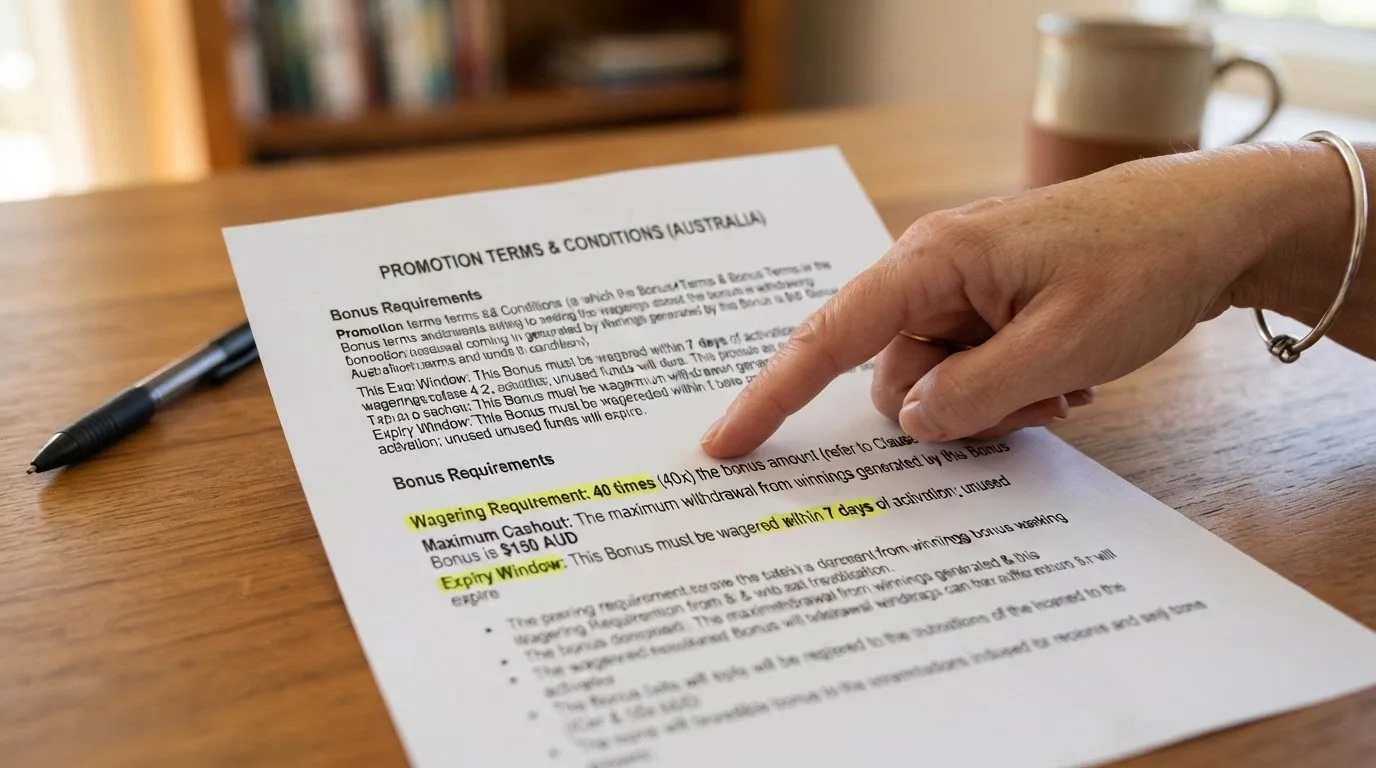
Per-spin value is the smallest lever. A A$0.10 spin and a A$0.20 spin look similar on a 20-spin offer (A$2.00 versus A$4.00 nominal), and the wagering requirement is applied to winnings, not to the per-spin value, so the difference compounds only if the player wins. Wagering scope — which games count, and at what percentage — is where the bonus architecture tightens. Pokies count 100%; table games 5% to 10%; live casino 0%. A player who tries to clear a bonus at blackjack will discover, halfway through, that 90% of their wagering does not count. The cashout cap is the most visible constraint: a A$50 cap on a bonus that produced A$200 in winnings pays A$50, and the remaining A$150 evaporates. Expiry closes the window: 3 to 14 days is the market range, and a player who does not clear wagering in that time forfeits the bonus and everything earned on it.
The shape of the typical offer is the shape the market has settled on because it works. The operator’s expected loss on a 20-spin no-deposit bonus is small, the cashout cap bounds the upside, and the wagering requirement means the average player will forfeit the bonus before reaching withdrawal. The player who beats the offer beats a structure designed to be hard to beat.
Casino No-Deposit Offers: Free Spins vs Free Chips
Two forms of no-deposit bonus exist in the AU-facing market, and they behave differently.
Free spins are the more common. The casino credits a fixed number of spins on a named pokie, and whatever they produce is bonus money subject to wagering. Royal Reels’ A$10 no-deposit offer is a free chip — a cash credit, not spins — that lands in the bonus balance on email confirmation with 40x wagering, a A$50 maximum cashout, and 7 days to clear. The chip is more flexible than spins (it can be played on any eligible game rather than a single pokie) but the wagering structure is the same.
Fair Go offers a three-way menu: a A$50 free chip, a A$31 free chip, or 20 no-deposit free spins — all at 60x wagering, which is the highest multiple in the featured set. The 60x figure is what makes those offers the worst-value confirmed no-deposit deals in the ranking. A A$50 chip at 60x wagering means A$3,000 of qualifying play before any of it is cash, against a A$180 maximum cashout. The implied edge on the bonus alone, before the pokie’s house edge, is substantial.
Free chip offers typically carry 40x to 60x wagering, A$50 to A$200 cashout caps, and 7-to-14-day expiry. The figures track the free-spin market closely because the underlying economics are the same: the operator is funding a small bonus, the player has to clear it under tight conditions, and the cashout cap bounds the operator’s exposure.
Pokies No-Deposit: Which Titles You Can Actually Spin
The single-title restriction on most no-deposit free-spin offers is not a limitation of the casino’s platform; it is a deliberate choice. SkyCrown’s 100 NDB spins run on Aztec Clusters. Rocket Play’s 20 review-verified NDB spins run on Book of Pyramids, a BGaming title. Bizzo allocates its 20 NDB spins across Grand Buffalo Hold and Win and Merge Up 2, both BGaming. Fair Go’s welcome free spins run on Cash Bandits 2, an RTG title.
The eligible-game list is the operator’s way of controlling the expected cost of the bonus. A high-RTP, low-volatility pokie is more likely to produce a steady stream of small wins that, after wagering, approach the cashout cap. A high-volatility pokie is more likely to produce a long run of zeroes followed by an occasional large hit. Operators choose games whose math models fit the bonus architecture they are funding, and that is almost never the highest-RTP title in the lobby.
For the player, the implication is structural. The expected value of a no-deposit free-spin bonus is a function of the pokie it runs on, and the pokie is not negotiable. A player who would prefer 20 spins on Book of Dead at 96.21% RTP will not get them at an operator that has chosen a different title for the bonus.
Best No-Deposit Offers: What Separates a Decent Deal from a dud
A 50-spin offer at 60x wagering is not five times better than a 10-spin offer at 25x. The 50-spin deal has a larger nominal face value (A$5.00 versus A$1.00 at A$0.10/spin) but a higher wagering multiple and, usually, a tighter cashout cap. The interaction of the four binding constraints — spin count, per-spin value, wagering multiple, cashout cap, expiry — is what decides the comparison, and the headline spin count is the least informative of the five.
SkyCrown’s 100 NDB spins at 25x to 40x wagering is the standout in the featured set, partly because the wagering multiple is at the lower end of the market and partly because the spin count is at the upper end. Fair Go’s 20 NDB spins at 60x wagering, by contrast, requires substantially more qualifying play for a smaller nominal bonus. The wagering is the lever that does the work. A 25x bonus on a A$2.00 win is A$50 of turnover; a 60x bonus on the same win is A$120. Both clear the same cashout cap; the player has spent twice the bankroll to get there.
Expiry matters at the margin. A 3-day window on Bizzo’s 20 NDB spins, with 7 days to wager after activation, leaves a tight schedule. A 14-day window on a competing offer gives the player room to play selectively. Neither window is generous, but the 3-day activation requirement on Bizzo is the shortest in the set and worth flagging.
When Free Spins Turn Real: Playing for Actual Money
A no-deposit free-spin offer is the marketing end of the funnel. The deposit-match free-spin offer — the welcome package that follows the first deposit — is the commercial end. The terms change substantially between the two, and the difference is what makes the deposit route better value for any player who intends to deposit anyway.
Deposit-match free spins typically offer 30x to 40x wagering (versus 40x to 60x for NDB), higher spin counts (100 to 1,000, versus 10 to 50 for NDB), and cashout caps up to A$5,000 (versus A$50 to A$200 for NDB). The offer is the operator’s bid for the player’s first deposit, and the bid is calibrated to clear a much higher expected value than the NDB. SkyCrown’s welcome package — A$8,000 plus 400 free spins across four deposits, with 40x wagering on the bonus and 30x on free-spin winnings — is a four-tier commitment that runs across the player’s first month. Royal Reels’ first-deposit match is 100% up to A$500 with 35x wagering on the bonus only and a A$2,500 maximum cashout, with 30 days to clear.
The structural difference is wagering on the bonus versus wagering on the bonus and deposit combined. Where the operator applies wagering to both, the effective stake is roughly four times higher than wagering on the bonus alone: a A$100 deposit with a A$100 bonus at 35x wagering on both means A$7,000 of qualifying play, versus A$3,500 if wagering applies to the bonus only. The wording of the bonus terms — “wagering on bonus and deposit” versus “wagering on bonus only” — is the single most important line on the page.
Real-Money Pokies: The Deposit-Driven Experience
The transition from no-deposit to real-money play is not a change in the games. The pokie library is the same; the eligible-game list expands; the bet-sizing decisions become real. What changes is the size of the wager, the length of the session, and the consequence of a bad run.
At a no-deposit level, a player is wagering the casino’s money at A$0.10 a spin, with a cashout cap that bounds the upside. At a real-money level, the same player might be wagering A$0.50 to A$2.00 a spin on their own funds, with a deposit limit and no immediate cap on winnings. The bet-sizing strategy under bonus terms is constrained by the A$5 max-bet rule (and similar caps), but the player has more discretion about which games to play, how long to play, and when to stop.
Deposit-match free spins are where the two experiences overlap. SkyCrown’s 400 welcome spins run across four deposits, on different BGaming titles per tier, with separate 30x wagering on free-spin winnings. The player is wagering a mix of deposit and bonus funds, with a cap on how much can be won from the spin portion of the bonus. The discipline is to clear the free-spin wagering efficiently and move on, rather than to chase the bonus back into a long session.
Our 2026 Operator Review: Who Actually Offers No-Deposit Free Spins
Ten operators reach Australian players with online casino or wagering product. Five carry a confirmed no-deposit free-spin offer. Two more carry deposit-gated free spins with no confirmed NDB route. Two more have no confirmed bonus terms of any kind this run. One is a licensed Australian wagering operator with no casino product at all.

| Operator | Offshore Licence | No-Deposit Offer | Wagering (NDB) | Max Cashout (NDB) | Eligible Game | Game Providers |
|---|---|---|---|---|---|---|
| SkyCrown | Curaçao | 100 NDB FS | 25x-40x | — | Aztec Clusters | 10,400+ games, multi-provider |
| Royal Reels | Curaçao | A$10 NDB cash chip | 40x | A$50 | N/A (cash chip) | Multi-provider (RTG and others) |
| Rocket Play | Curaçao | 20 NDB FS | 40x | ~A$85 | Book of Pyramids (BGaming) | BGaming, multi-provider |
| Bizzo Casino | Curaçao GCB + Kahnawake | 20 NDB FS | 40x | €50 | Grand Buffalo Hold and Win / Merge Up 2 (BGaming) | 6,000+ games, 80+ studios |
| Fair Go Casino | Curaçao | A$50 / A$31 chip or 20 NDB FS | 60x | A$180 | — | RTG (single provider) |
| Stake | Curaçao | — | — | — | — | Multi-provider, provably fair |
| Rainbet | Curaçao | — (deposit required) | 40x on FS winnings | — | Sweet Bonanza (Pragmatic Play) | Pragmatic Play, others |
| WinSpirit | Curaçao | — | — | — | — | Multi-provider |
| Scream Casino | Curaçao | — | — | — | — | Multi-provider |
| Neds | NTRWC / Licensing NT | N/A (no casino product) | N/A | N/A | N/A | Wagering only |
Every operator on this list except Neds is offshore. Neds is the only brand that holds an Australian wagering licence, and it offers sports and racing only — no casino, no pokies, no free spins. The split between the table’s left and right halves is the split in the AU-facing market: the licensed wagering side has no product the reader is looking for, and the offshore casino side has the product but no Australian licence.
The empty cells in the Stake, WinSpirit and Scream Casino rows reflect what was confirmed, not what is offered. All three are Curaçao-licensed, multi-provider platforms that reach Australian players; none of them had a confirmed no-deposit free-spin offer available in the source materials this run. They are not zero-offer operators by design — they are zero-confirmation entries, and the gap is the point.
SkyCrown: 100 No-Deposit Free Spins With Phone Verification
SkyCrown’s 100 no-deposit free-spin offer is the largest in the featured set, and the only one that runs on a phone-verification trigger rather than account creation. The player registers, verifies a mobile number, and the 100 spins land on Aztec Clusters. Wagering on winnings is 25x to 40x — at the lower end of the market, and the only operator to span that range. The estimated cashout cap sits around A$100 at A$0.10 per spin on 100 spins, though the operator’s published cap was not confirmed in the source materials this run.
The library behind the bonus is the largest in the ranking. SkyCrown’s platform carries 10,400+ games from a multi-provider stack, with demo mode available on most titles. The welcome package that follows the first deposit is A$8,000 plus 400 free spins across four deposits, with 40x wagering on bonus funds and 30x on free-spin winnings, a A$20 minimum deposit, A$5 maximum bet, and 14-day validity per tier. The NDB offer is the front door; the welcome package is the house.
For a player who wants the maximum spin count at the minimum wagering multiple in the featured set, SkyCrown is the standout. For a player who is comparing welcome packages rather than NDB terms, the A$8,000 plus 400 free-spins welcome is the strongest deposit offer in the ranking.
Royal Reels: A$10 Cash Bonus, No Deposit Needed
Royal Reels takes a different approach. The no-deposit offer is not free spins — it is an A$10 cash chip, credited automatically on email confirmation, with 40x wagering, a A$50 maximum cashout, a 7-day expiry, and a A$5 maximum bet per spin. The player does not have to claim; the bonus is in the account when registration completes.
The cash-chip structure is more flexible than a free-spin bonus. The A$10 can be played on any eligible game (rather than a single named pokie), the wagering applies to the bonus amount rather than the winnings, and the cashout cap is set at five times the face value. A player who runs the A$10 to A$50 through the wagering and clears the 40x playthrough — A$2,000 of qualifying play on pokies — can withdraw the A$50. The clock is 7 days.
The first-deposit package is 100% up to A$500 with 35x wagering on the bonus only, a A$2,500 maximum cashout, and 30-day validity. The 35x-on-bonus-only structure is friendlier than the bonus-and-deposit wagering at several competitors: a A$500 deposit with a A$500 bonus at 35x on both means A$17,500 of qualifying play; the same scenario at 35x on bonus only is A$8,750. Royal Reels is the standout on bonus-only wagering among the smaller AU-facing brands.
Rocket Play: 20 No-Deposit Spins With Split Delivery
Rocket Play runs two free-spin tracks. The first is the no-deposit offer: 20 free spins on Book of Pyramids (BGaming) for verified third-party reviewers, with 40x wagering and maximum winnings of approximately A$85. The second is the welcome package: 100 free spins on Aztec Magic (BGaming), delivered as 20 per day over 5 days, with 40x wagering on free-spin winnings (separate from the deposit match wager), a A$300 maximum win, and 24-hour validity on each batch.
The split delivery is the structural feature. Twenty spins drop every day for five days; each batch has its own 24-hour window. A player who does not use a batch within 24 hours loses it. The discipline is to log in every day and play the 20 spins before they expire — a model that keeps the player returning to the platform and gives the operator five touch points to push the deposit match.
The NDB track is more conventional: 20 spins, single title, 40x wagering, ~A$85 cap. It is a smaller offer than SkyCrown’s 100 spins, with comparable wagering. The value is in the daily-batch welcome structure for a player who intends to deposit.
Bizzo Casino: 20 No-Deposit Spins Across Two Titles
Bizzo is the only operator in the featured set licensed by two regulators: Curaçao Gaming Control Board and the Kahnawake Gaming Commission. Twin licensing does not change the product, but it adds a second jurisdictional layer to the operator’s compliance — a player with a dispute has two regulators to approach, in theory.
The no-deposit offer is 20 free spins across two BGaming titles — Grand Buffalo Hold and Win and Merge Up 2 — with 40x wagering on the bonus amount, a maximum cashout of €50, a 3-day activation window, and 7 days to wager after activation. The activation window is the tightest in the featured set: 3 days to claim, then 7 days to clear. A player who registers on a Friday and does not log in until Monday has lost the bonus.
The platform behind the bonus is substantial. Bizzo’s library runs to 6,000+ games from 80+ studios, with mobile-compatible play across the catalogue. The welcome package is 100% up to €100 plus 100 free spins on the first deposit, then 50% up to €300 plus 50 free spins on the second, with 40x wagering on the bonus only and a €5 maximum bet. A player who deposits €100 on day one and €300 on day two has €400 in matched bonus funds, 150 free spins, and a clearly bounded 40x playthrough on the bonus side.
For a player who wants a multi-jurisdiction licensee with a wide provider list and a small but well-priced NDB offer, Bizzo fits. The 3-day activation window is the friction point.
Fair Go Casino: Multiple No-Deposit Options at 60x Wagering
Fair Go offers the most no-deposit options in the featured set: a A$50 free chip, a A$31 free chip, or 20 no-deposit free spins — all at 60x wagering. The 60x multiple is the highest in the ranking, and the A$180 cashout cap on the A$50 chip is the largest nominal cap on a free-chip NDB. The two figures move in opposite directions: the higher cap attracts a player who wants a bigger withdrawal ceiling, and the higher wagering cuts the expected value of getting there.
A A$50 chip at 60x wagering means A$3,000 of qualifying play before any of it is cash. Against a 96% RTP pokie, the expected loss on that turnover is A$120 — well over the A$180 cap, which is why the cap exists. The player who clears the wagering and lands a bonus balance above A$180 walks away with A$180; the player whose balance sits below the cap walks away with whatever is there.
The platform is an RTG single-provider casino — a smaller library than the multi-provider operators and a different feel. The welcome package is the standout: 300% up to A$3,000 plus 50 free spins on Cash Bandits 2, with no maximum cashout on the deposit bonus, a A$20 minimum deposit, and a A$10 maximum bet during the bonus. The “no maximum cashout” line is the rarest feature in the AU-facing market; it is the main reason a player who intends to deposit might choose Fair Go over a higher-RTP competitor. The NDB offer, however, is the worst-value confirmed deal in the ranking on a wagering-adjusted basis.
Stake: A Curaçao Giant With No Confirmed No-Deposit Offer
Stake is one of the largest Curaçao-licensed casino platforms globally, and it is present in the Australian market. The platform is multi-provider with provably fair games across its catalogue. It reaches Australian players; it operates on a Curaçao licence; it is a major offshore brand.
The no-deposit offer was not confirmed in the source materials this run. A player looking at Stake for a no-deposit free-spin deal cannot, on the basis of what was verified, point to a specific number of spins, a specific wagering multiple, or a specific cashout cap. Stake may run a NDB promotion in some markets at some times, but the terms for Australian players were not in the consulted set.
A player who wants Stake’s game catalogue and provably fair architecture is choosing the platform over a bonus. The no-deposit comparison is, for this run, a gap rather than a finding.
Rainbet: Deposit-Gated Free Spins on Sweet Bonanza
Rainbet is the only operator in the featured set whose free-spin offer is unambiguously deposit-gated. The first-deposit bonus carries a 40x wagering lock; the free spins are awarded on Sweet Bonanza (Pragmatic Play, 96.48% RTP); the minimum deposit is US$30; the maximum bet is 2% of the deposit amount.
There is no no-deposit route at Rainbet for Australian players. A player who wants the Sweet Bonanza free spins must deposit at least US$30 first. The 40x wagering on free-spin winnings is at the lower end of the deposit-match market, and Sweet Bonanza’s 21,100x maximum win is the largest single-spin ceiling in the ranking. The trade-off is a US$30 entry cost and a platform whose bonus architecture starts at the deposit line.
For a player who would deposit anyway, Rainbet’s free-spin offer is a reasonable choice. For a player looking for a no-deposit deal, Rainbet is not one.
WinSpirit: Offshore Operator, Terms Unconfirmed
WinSpirit is a Curaçao-licensed, multi-provider platform that reaches Australian players. The platform is accessible; the bonus terms for no-deposit free spins were not confirmed in the source materials this run. A player landing on WinSpirit’s site will see an offer, but the specific NDB terms — spin count, wagering, cashout cap, eligible game, expiry — were not in the consulted set.
A description that stopped at “Curaçao-licensed, multi-provider, AU-facing” would be the description that the verified information supports. Anything more specific than that is a guess the page is not making.
Scream Casino: Offshore Operator, Terms Unconfirmed
Scream Casino sits in the same category as WinSpirit: a Curaçao-licensed, multi-provider platform reaching Australian players, with bonus terms that were not confirmed in the source materials this run. The site is in the AU-facing market; the no-deposit free-spin offer, if one exists, was not verified.
The page does not fill the gap. A reader looking for Scream Casino’s NDB terms will not find them here; they will find the verification status.
Neds: Licensed Aussie Wagering — No Casino, No Pokies, No Free Spins
Neds is the outlier in the ranking and the only operator that does not belong to the offshore category. Neds holds a Northern Territory wagering licence, issued by the NTRWC and administered through Licensing NT, with terms running up to 20 years. The licence is real, the regulator is Australian, and the product is wagering — sports and racing only.
There is no casino product at Neds. No pokies, no free spins, no no-deposit offer of any kind. Neds’ market share in Australia is 2.25%, which puts it in the same conversation as the offshore brands by reach, but not by product. A reader looking for online casino free spins is not in Neds’ market; a reader looking for licensed Australian wagering is exactly where Neds sits.
Neds is included in this ranking to mark the boundary. The licensed AU wagering market exists; it is well-regulated; it does not contain the product the reader is searching for. The nine operators above the boundary are the only source of online pokies available to Australian players, and all of them are offshore.
Why Your Bonus Terms Matter More Than the Spin Count
A no-deposit free-spin offer is a four-dimensional contract. Spin count, per-spin value, wagering multiple, and cashout cap interact, and the interaction is what determines the realised value. A 100-spin offer at A$0.10 with 60x wagering and a A$50 cap is not ten times better than a 10-spin offer at the same terms; the difference is the nominal face value, and the realised value of both is bounded by the cap.
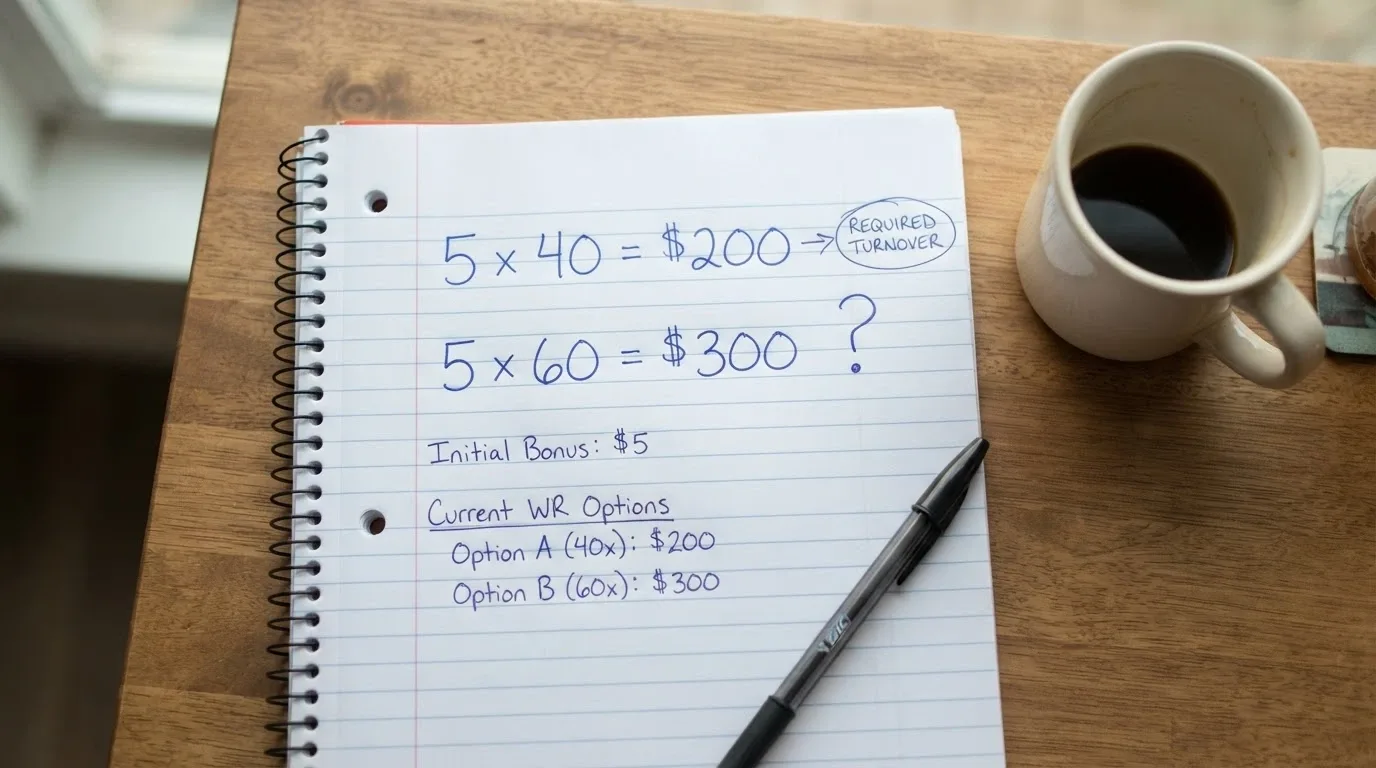
The standard mental model — “more spins is better” — fails on the page. The page’s data carries a different rule: the wagering multiple is the lever that does the work. A 20-spin offer at 25x wagering requires A$50 of qualifying play per A$2.00 in winnings; a 20-spin offer at 60x wagering requires A$120 per A$2.00. The first offer is not 2.4 times better; the player’s expected loss is 2.4 times lower, which is the same statement arrived at from the other side.
The cashout cap is the second lever. A A$50 cap on a bonus that produces A$200 in winnings pays A$50; a A$200 cap on the same bonus pays A$200. The cap is the only place where the operator can write a number that strictly limits the player’s upside. The wagering requirement controls how much of the bonus the player keeps; the cap controls how much of the kept bonus reaches the withdrawal page.
Expiry closes the third lever. A 3-day window forces a short, high-intensity session. A 14-day window allows the player to spread the play across multiple sessions and to play selectively on games with the right volatility profile. A player who has the discipline to play ten spins a day for 14 days will realise a different expected value from the player who burns 100 spins on day one and runs out of bonus balance by lunch.
Wagering Requirements: 40x, 60x and What They Actually Cost You
A 40x wagering requirement on a A$2.00 win means A$80 of qualifying play. On a 96% RTP pokie, the expected loss across A$80 of wagering is A$3.20 — 4% of turnover, which is the house edge. The player who walks into a 40x wagering requirement on a A$2.00 bonus is paying A$3.20 in expected loss to clear A$2.00 in winnings through to a capped withdrawal. The expected cost of clearing the bonus is larger than the bonus itself.
The figure gets worse at 60x. A$120 of qualifying play at 96% RTP means an expected loss of A$4.80 — 2.4 times the A$2.00 bonus. A A$50 chip at 60x (Fair Go’s structure) means A$3,000 of qualifying play and an expected loss of A$120 — close to the A$180 cashout cap, which is why the cap is set where it is. The math is not hidden; the math is the bonus.
Game contribution rates amplify the cost. Pokies count 100% toward wagering; table games count 5% to 10%; live casino is generally excluded. A player who tries to clear a A$2,000 wagering requirement at A$5 blackjack hands will find that only A$100 to A$200 of the wagering counts. The remainder does not move the bonus balance toward withdrawal. The A$5 maximum bet per spin rule (with active bonus) is the same kind of guardrail: exceed it and the bonus is at risk of being voided, and the wagering clock resets to zero.
Sign-Up Free Spins vs Deposit-Match Free Spins: The Terms Gap
The terms gap between no-deposit and deposit-match free spins is the single most useful comparison on this page, because it shows what a deposit actually buys.
A no-deposit free-spin offer: 10 to 50 spins at A$0.10 per spin, 40x to 60x wagering, A$50 to A$200 cashout cap, 3 to 14 days. A deposit-match free-spin offer: 100 to 1,000 spins, 30x to 40x wagering, caps up to A$5,000. The deposit offer is not twice as good in any single dimension; it is three to ten times better in every dimension, and the comparison compounds.
SkyCrown’s welcome package (A$8,000 plus 400 free spins across four deposits) is the upper end of the deposit-match market. Rocket Play’s 100 welcome free spins on Aztec Magic, delivered as 20 per day over five days with a A$300 maximum win, is a mid-market example. Royal Reels’ 100% up to A$500 first-deposit match is the smaller-scale version. Each of these is a different shape of deposit offer, and each one carries substantially better terms than the NDB offer at the same operator.
For a player who intends to deposit anyway, the deposit-match offer is the correct comparison point. The NDB offer is the comparison point for a player who does not intend to deposit — and that player is funding the operator’s customer acquisition in exchange for a bonus whose expected value is below its nominal face value.
How You Pay (and Get Paid) Decides Your Offshore Experience
The payment method on an online casino is a diagnostic, not just a transaction. The Australian rules say that credit cards, credit-related products, and digital currency (crypto) are banned as payment for online wagering. The ban took effect on 11 June 2024 under the Interactive Gambling Amendment (Credit and Other Measures) Act 2023, with penalties of up to A$247,500 for an operator that fails to enforce it. A site that accepts a credit card or a Bitcoin deposit from an Australian customer is operating outside Australian rules. It is also the rule the offshore market most visibly ignores: every Curaçao-licensed operator in the featured set accepts crypto, and most of them accept credit cards through offshore payment processors.
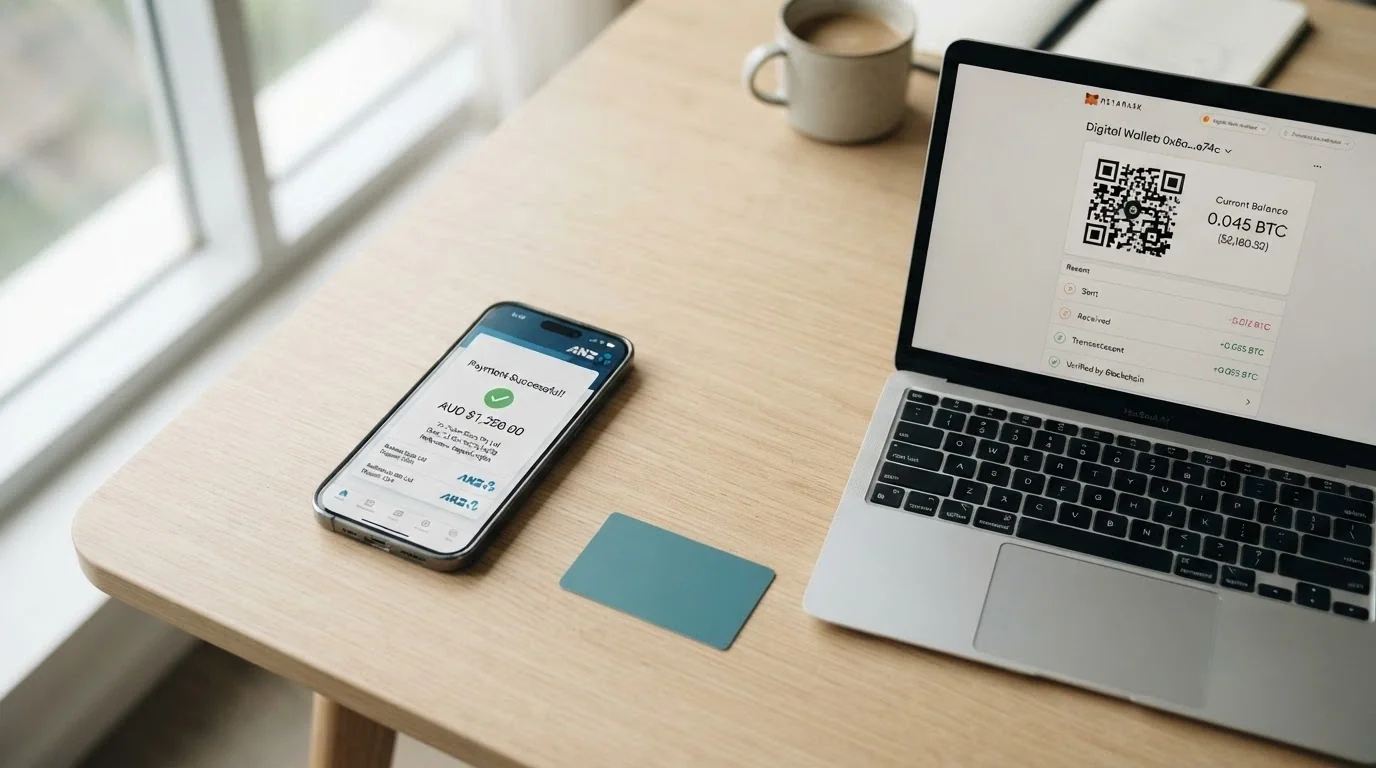
The legal deposit routes for licensed Australian wagering are debit cards, bank transfers, PayID/Osko and BPAY. PayID in particular is the fastest AUD rail — instant transfer from an Australian bank account to a merchant, with no card network fees and no chargeback rights at the card-issuer level. A player using PayID at a licensed bookmaker is using a payment method the regulator recognises. A player using PayID at an offshore casino is using a payment method that the casino accepts as a deposit rail but that sits outside the regulatory framework the casino is not in anyway.
From 1 January 2027, banks and payment providers gain express authority to block transactions to illegal gambling operators. The mechanism is the bank’s, not the regulator’s: a transaction to a flagged merchant can be declined at the bank level, before it reaches the casino. The change does not legalise offshore casino play; it gives banks a tool to refuse the transaction that funds it.
PayID, Crypto and No-KYC: The Payment Trade-Offs at Offshore Casinos
Three payment pathways show up at AU-facing offshore casinos. Each one trades something.
PayID and Osko are instant AUD rails between Australian bank accounts. A player depositing via PayID at an offshore casino is using a fast, cheap, traceable payment method — the bank knows where the money went, even if the casino is not in the regulatory framework. The deposit is fast (usually instant) and the withdrawal is typically 1 to 3 business days back to the same bank account. The trade-off is that the transaction is logged on the bank statement, and the bank may flag it under its own responsible-gambling policies or, from 2027, the payment-blocking rules.
Crypto deposits — Bitcoin, Ethereum, USDT and others — are the unregulated channel. The transaction is on a public ledger but the player is not identified to the casino in the same way they are with a bank transfer. Withdrawal can be faster (sometimes minutes) and the player can move funds between operators without going through a bank. The trade-off is that crypto is banned for licensed wagering, so a site accepting it is outside Australian rules by definition, and there is no chargeback path if the operator refuses a withdrawal. The transaction is irrevocable the moment it confirms on-chain.
No-KYC casinos are a third category. Some offshore operators allow play and withdrawal with minimal identity verification — an email address and a crypto wallet may be all that is required. The trade-off is speed against recourse: the player signs up and plays in minutes, and has no Australian consumer law to fall back on if the operator voids a win, delays a withdrawal, or disappears. The licensed AU market requires full KYC; the offshore no-KYC market exchanges the regulatory friction for the protection the regulation provided.
Free Spins on Your Phone: Mobile Play in 2026
Every operator in the featured set runs in a mobile browser. The HTML5 stack that powers the modern pokie catalogue is the same codebase on desktop and mobile; the platform detects the screen size and serves the appropriate layout. A player on a recent iPhone or Android device can claim, play, and clear a no-deposit free-spin bonus without a dedicated app.
The NDB mechanics work the same way. SkyCrown’s phone-verification trigger is a mobile-native flow — the player registers on a phone, the verification code is sent via SMS, the spins credit on the same device. Bizzo’s 6,000-game library is mobile-compatible across the catalogue. Rocket Play’s daily-batch welcome spins are designed for short mobile sessions. The full bonus architecture is browser-delivered, not app-delivered.
Dedicated casino apps are rare in the offshore AU market. The major AU-facing brands run on mobile browsers; the only consistent app presence is at the licensed bookmaker end of the market, where Sportsbet, bet365 and the other NT-licensed operators maintain iOS and Android apps for sports and racing. A player looking for a downloadable casino app from an offshore brand will not find one in most cases; the mobile browser is the product.
The Legal Reality: Every Operator on This Page Is Offshore
Online casino is prohibited in Australia. The Interactive Gambling Act 2001, as strengthened by the Interactive Gambling Amendment Act 2017, makes it illegal to provide online casino games — including online pokies — to people in Australia. The prohibition is federal, sits across every state and territory, and is enforced by the ACMA. There is no licence for online casino anywhere in the country. A page promising “the best licensed Australian online casinos” describes a product that does not exist.
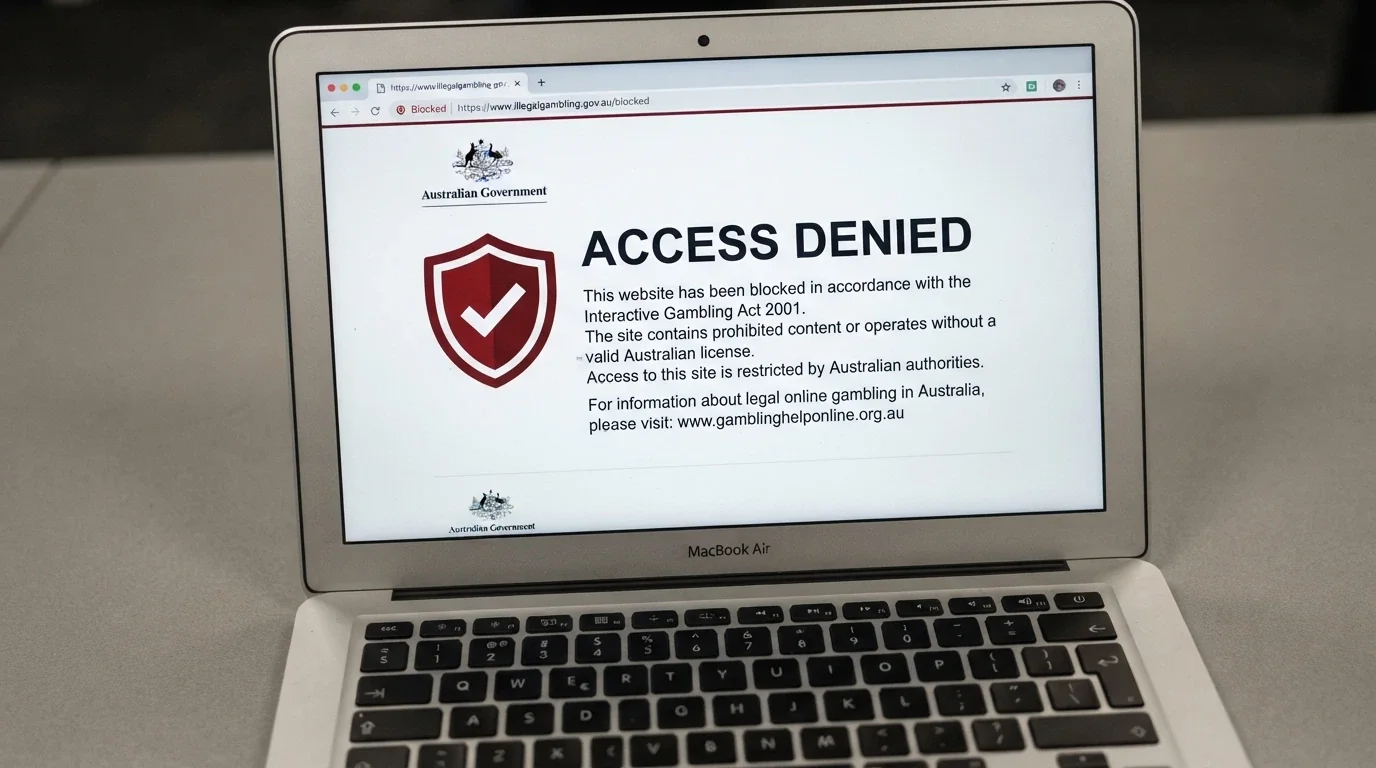
What is licensed is wagering on sport and racing, lotteries and keno. The Northern Territory Racing and Wagering Commission, administered through Licensing NT, is the de facto national licensor for online bookmakers; the major brands (Sportsbet, bet365, Ladbrokes, Neds, and around 50 others) hold NT licences with terms running up to 20 years. The minimum gambling age is 18. The product set is sports, racing and the wagering services that go with them — not casino, not pokies, not the product on this page.
The ACMA’s enforcement record is substantial. As at March 2026, the regulator has directed Australian ISPs to block 1,564 illegal gambling and affiliate websites, and more than 225 illegal services have withdrawn from the Australian market since 2017. The blocked-site list is updated regularly. A site that is not on the list today can be on it next month, and a player with a balance on the site at the moment of blocking has no guaranteed payout.
The individual player is not the target. The IGA targets the provider; players are not prosecuted, and have not been since the Act came in. The practical consequence is that the player carries the consumer-protection risk without the regulator’s protection: no Australian consumer law applies at an offshore casino, no BetStop coverage, no chargeback rights through the card network, and no ombudsman to appeal to if the operator refuses a withdrawal.
What the 2026 Reform Changes — and What It Does Not
The Interactive Gambling Amendment (Gambling Reform) Bill 2026 passed both Houses of Parliament on 19 August 2026. Its measures commence on 1 January 2027. The reform does not legalise online casino; it tightens the licensed wagering market and gives the regulator new tools.
From 1 January 2027, the reform introduces the AdStop register — a national opt-out from wagering advertising, administered by the ACMA. It prohibits marketing inducements to new customers for 14 days from account sign-up, and bars inducements for 90 days to individuals who deregister from BetStop. It caps wagering advertising on free-to-air television at three ads per hour between 6:00 am and 8:30 pm, with a complete blackout during live sport broadcasts within those hours (15 minutes before to 5 minutes after). It bars athletes, celebrities and influencers from promoting wagering products; bans the broadcasting of sporting odds outright; and bars radio wagering ads during school drop-off and pick-up times. Online ads may be shown only to logged-in, age-verified users who have been offered an opt-out. Direct marketing of inducements is prohibited indefinitely for customers identified as at risk of gambling-related harm.
Banks gain express authority to block transactions to illegal gambling operators from the same date. The mechanism is industry-side: a flagged merchant’s transactions can be declined at the bank level, before the funds reach the casino.
What the reform does not do is create an online casino licence. Online casino remains prohibited. The reform tightens the licensed wagering market; it does not open the offshore casino market to Australian regulation. Every operator on this page is offshore, and every operator on this page will be offshore on 1 January 2027 and after.
What Offshore Status Actually Means for Your Money
The legal status of an offshore casino is not abstract; it is a withdrawal risk and a consumer-protection gap that the player carries in full.
No Australian consumer law applies. The Australian Consumer Law, the ePayments Code, the Banking Code of Practice — none of them reach an offshore operator. A player who is denied a withdrawal, has a win voided, or has an account closed with a balance on it has no Australian regulator to complain to and no Australian court with straightforward jurisdiction over a Curaçao-licensed entity. The complaint path is the casino’s own customer support, the casino’s own internal dispute process, and (in theory) the Curaçao GCB — a regulator that does not have a consumer-resolution track record comparable to an Australian state gaming commission.
BetStop does not cover offshore play. The National Self-Exclusion Register, which held 54,859 registrations with 35,135 active exclusions as at 31 December 2025, binds approximately 150 Australian-licensed wagering providers. An offshore casino is not connected to BetStop and will continue to accept a self-excluded person’s money. The single most powerful harm-minimisation tool in the Australian framework does not reach the operators on this page.
The ACMA can block the site at any time. A blocked site does not pay out a pending balance. The mechanism is the ISP-level block, applied at the regulator’s direction; the site remains online for users in other jurisdictions, but the Australian player loses access. A player with A$200 in a withdrawal queue at a site that is added to the ACMA’s block list has no guaranteed path to that A$200.
The credit card and crypto ban is the clearest signal. A site that accepts credit cards or crypto from an Australian customer is operating outside Australian rules, by definition. The payment method is the diagnostic; the legal status follows from it.
Where to Get Help When the Spins Stop
Australian players have access to a free, confidential harm-minimisation infrastructure that the offshore market does not connect to. The numbers below are the same numbers that appear on every licensed wagering site in Australia; they belong to anyone who wants them, regardless of where they have been playing.
The National Gambling Helpline is 1800 858 858 — free, confidential, staffed 24 hours a day, seven days a week, with online chat and counselling available through Gambling Help Online at gamblinghelponline.org.au. The service is run by the Australian government and exists specifically for people whose gambling has become a problem, and for the people around them. A call costs nothing; a chat costs nothing; a session costs nothing.
BetStop is the National Self-Exclusion Register, live since 21 August 2023. A single registration excludes a person from every Australian-licensed online and phone wagering service at once. As at 31 December 2025, 54,859 people had registered and 35,135 active exclusions were in force. The limitation — and it is the one that matters for this page — is that BetStop binds licensed wagering providers only. An offshore casino is not connected, and a BetStop registration does not stop an offshore casino from accepting a self-excluded person’s deposits.
The harm data behind the help lines is the reason the help lines exist. Approximately 2.1% of Australian adults — roughly 430,000 people — experience problem gambling, and the AIHW put high-risk gambling at 1.8% in 2022. A model-based study estimates that approximately 3.29 million Australians aged 5 and over are affected annually by their own or another person’s gambling — about 1.97 million adults with at-risk or problem gambling and about 1.38 million affected others. The annual health loss associated with gambling-related harm in Australian adults is over 400,000 Years Lived with Disability. The ANUpoll survey in January 2025 found overall gambling participation at 58.8% but a rise in risky gambling (measured by the PGSI) from 13.7% in 2024 to 19.4% in 2025 — a year-on-year increase that runs against the participation trend.
Setting Limits, Self-Excluding and Knowing the Signs
The responsible-gambling tools at licensed AU operators include customer-set deposit limits, activity statements, take-a-break features and self-exclusion. The tools are operator-side; a player can set a weekly deposit limit, request a statement of play, or self-exclude for a defined period. The state-by-state rules differ, and there is no national statutory deposit ceiling, but the licensed operators are required to offer the tools and to act on them.
The offshore operators offer some of the same tools, on their own terms. A player at a Curaçao-licensed casino can usually set a deposit limit through the account settings; whether the limit is enforced, and whether it applies across multiple accounts at the same operator, varies. The deeper protection — the BetStop registration, the activity statement regulated under Australian consumer law, the ombudsman appeal — is not available offshore.
The signs of problematic play are well-documented and worth naming in plain terms. Gambling more than intended; chasing losses; borrowing to play; hiding gambling activity from family or friends; feeling anxious or irritable when not gambling; missing work or commitments to play. The list is not exhaustive, and a single sign is not a diagnosis — but a pattern of signs is the threshold at which the National Gambling Helpline becomes a useful call to make. The call is free; the conversation is confidential; the next step is the player’s to choose.
How We Selected and Ranked These Operators
The operators on this page come from the AU-facing offshore market — the brands that Australian players can actually reach and claim no-deposit free-spin offers from. The selection was sourced from major affiliate comparison sites and cross-checked against the operators’ own bonus terms pages. The ranking is not a popularity contest or a commercial arrangement; it is the order in which the verified NDB terms make sense to present, with the highest-spin-count, lowest-wagering, largest-cashout-cap offers at the top.
The criteria: presence of a confirmed NDB offer, wagering terms (lower is better), cashout cap (higher is better), eligible-game choice, game-provider depth, licence transparency, and the depth of the operator’s deposit-side package for the player who intends to deposit. Operators with no confirmed NDB terms (Stake, WinSpirit, Scream Casino) are included because they reach Australian players; they are marked as such rather than ranked on missing data.
There is no Australian casino licence register to check against, because no Australian casino licence exists. Operator licence details come from the operators’ own sites or from review sources; the Curaçao GCB register was not queried this run, and the dates of individual Curaçao licences were not surfaced. The ACMA’s enforcement record — 1,564 blocked sites as at March 2026, 225+ services withdrawn since 2017 — is the context against which offshore operator claims sit.
No-Deposit Free Spins in 2026: Worth Your Time or a Trap?
A no-deposit free-spin offer is a real, regulated-by-its-terms product that delivers a small, bounded experience. The offer is worth claiming if the player understands what is on the other side of the claim button: 40x to 60x wagering, a A$50 to A$200 cashout cap, a 3-to-14-day clock, and a single eligible pokie that the operator chose. The expected value of a 20-spin offer at A$0.10 with 40x wagering is small enough that the offer functions as a low-cost sample of the casino, not as a meaningful money-making opportunity. The marketing word is “free”; the architecture is “loss-limited acquisition.”
The risks are the ones the legal framework does not protect against. No Australian consumer law applies at an offshore casino. BetStop does not cover offshore play. The ACMA can block the site at any time, and a blocked site does not pay a pending balance. The credit card and crypto ban is a diagnostic: a site that accepts either is outside Australian rules. From 1 January 2027, the bank payment-blocking powers give Australian banks a tool to decline the transaction before it reaches the operator — which closes one route to the offshore market without changing the legal status of the market itself.
The harm data behind the help lines is the data the page does not editorialise. Approximately 3.29 million Australians are affected annually by their own or another’s gambling. The risky gambling rate rose to 19.4% in 2025. The annual health loss is over 400,000 Years Lived with Disability. These are the figures the National Gambling Helpline (1800 858 858) and Gambling Help Online (gamblinghelponline.org.au) exist to respond to.
The recommendation this page supports is the one the data supports. A no-deposit free-spin offer is a sample, not a strategy; the spin count is the least useful number on the offer page; the cashout cap is the line that decides what the offer is worth; the wagering multiple is the lever that decides the expected cost. The offshore route is the only route to online pokies for Australian players in 2026, and the route is exposed to legal, financial, and harm-minimisation risks the licensed market does not carry. The page’s job has been to set those numbers and risks on the table; the player’s job is to read them.
Frequently Asked Questions
How long do no-deposit free spins last before they expire?
Most no-deposit free-spin offers in the AU-facing market carry a 3 to 14-day validity from the moment the spins are credited. Bizzo’s 20 NDB spins are the tightest: 3 days to activate and 7 days to wager. Royal Reels’ A$10 cash chip runs 7 days. Rocket Play’s daily welcome batches run 24 hours per batch. The expiry clock starts when the spins hit the account, not when the player first uses them, and a batch that is not used in the window is forfeited.
Can I use no-deposit free spins on any pokie, or are they restricted to specific games?
Almost always restricted to a single named pokie or a small set of titles. SkyCrown’s 100 NDB spins run on Aztec Clusters. Rocket Play’s 20 NDB spins run on Book of Pyramids. Bizzo allocates its 20 NDB spins across Grand Buffalo Hold and Win and Merge Up 2. The operator chooses the eligible game to control the bonus’s expected cost; the player does not get to pick. A small number of offers, like Royal Reels’ A$10 cash chip, are playable on any eligible pokie rather than a single title.
Do I need to verify my identity before withdrawing no-deposit free spins winnings?
Yes. Every operator in the featured set requires KYC (a government ID, proof of address, and sometimes a payment-method verification) before a withdrawal is processed. The verification happens at the cashout step, not at the claim step, which means a player can claim and play the spins without KYC, but cannot withdraw the winnings without it. The offshore operators that skip KYC exist, but skipping KYC also means skipping the consumer-protection path the verification enables.
What is the difference between no-deposit free spins and deposit-match free spins?
No-deposit free spins are funded by the casino and require no deposit; they typically offer 10 to 50 spins, 40x to 60x wagering, and cashout caps of A$50 to A$200. Deposit-match free spins are awarded on top of a first deposit; they offer 100 to 1,000 spins, 30x to 40x wagering, and cashout caps up to A$5,000. The deposit route buys substantially better terms on every dimension. For a player who intends to deposit anyway, the deposit-match offer is the correct comparison; for a player who does not intend to deposit, the NDB offer is the only free-spin route in the market.
What wagering requirements apply to no-deposit free spins in Australia?
The market norm is 40x to 60x wagering on winnings. The lower end (25x to 40x) is rare; SkyCrown’s 25x to 40x range is the most player-friendly in the featured set. The upper end (60x) appears at Fair Go across all three NDB options. Pokies contribute 100% to wagering; table games 5% to 10%; live casino is generally excluded. The maximum bet is commonly A$5 per spin while a bonus is active, and exceeding it risks voiding the bonus.
Can I claim no-deposit free spins on my mobile phone?
Yes. Every operator in the featured set runs in a mobile browser, and the bonus claim flow is built for mobile. SkyCrown’s NDB offer is specifically a phone-verification trigger: register on a phone, verify the mobile number, and the 100 spins credit on the same device. Dedicated casino apps are rare in the AU-facing offshore market; the mobile browser is the standard delivery channel. A player on a recent iPhone or Android device can complete the full claim, play, and wagering flow without a desktop.
No-Wager Free Spins: Do They Exist for Australian Players?
Wager-free no-deposit free spins — offers where winnings land as cash, with no playthrough requirement — do not appear at any operator in the featured set this run. The market norm in the AU-facing offshore space is 40x to 60x wagering on winnings, and the no-deposit side of the market has not moved toward wager-free structures the way some deposit-match offers have.
The economics explain the absence. A wager-free no-deposit spin is a pure cost to the operator: every dollar won is a dollar the player can withdraw, with no turnover to fund it. At A$0.10 per spin and a 96% RTP, a 20-spin wager-free bonus costs the operator roughly A$0.08 in expected loss per player. That is small per player, but the conversion funnel is wide: 20 wager-free spins cost the operator nothing if the player does not claim, and the same A$0.08 if the player claims and wins nothing. The model breaks when the player wins and the cashout cap does not bound the operator’s exposure.
A wager-free structure survives where the operator caps the win (a A$5 max cashout, for example) and accepts the small expected loss as a customer acquisition cost. That variant exists at some deposit-match offers in the broader market, but it has not appeared in the AU-facing no-deposit segment this run. No checked operator currently offers a wager-free no-deposit free-spin deal.