
High-roller online casinos and the Australian reality in 2026
A page titled “best high roller casino with bonus australia” is, in one sense, an answer to a question that has no Australian answer. Online casino is prohibited in Australia. No licence exists, federally or in any state or territory, for the product a high roller is looking for. Every offshore casino that accepts an Australian player, accepts that player in violation of the Interactive Gambling Act 2001. This page names the ten offshore brands that capture the largest share of Australian tracked traffic, states plainly that each is unlicensed in Australia, and walks through what that means for someone weighing a large deposit against a bonus banner.

Data current as of 18 October 2026, verified against the ACMA register and Australian Communications and Media Authority public enforcement data.
Table of Contents
- The real state of high-roller online casino in Australia right now
- Where Australian high rollers actually play in 2026
- Why your high-roller bonus is almost never what the banner says
- Getting funds in and out when the product is banned
- The pokies and table games high rollers chase — and what the RTP really means
- Playing on your phone: apps, browsers and why the download matters
- The law that makes every casino on this page illegal
- When the stakes are high: responsible gambling tools that actually work in Australia
- How we selected and ranked every casino on this page
- What this means for your next move as an Australian player
- Frequently asked questions about high-roller online casino in Australia
The real state of high-roller online casino in Australia right now
The phrase “high roller online casino” sounds like a product category. In Australia it is not. The Interactive Gambling Act 2001, strengthened by the Interactive Gambling Amendment Act 2017, prohibits the supply of online casino games, online pokies and in-play sports betting to anyone physically in Australia. There is no licence for online casino anywhere in the country — not federally, not in any state or territory. The product the search query names does not have an Australian licence to be the best of.
A “high roller” is the colloquial term for a player who stakes large sums per spin or hand — typically thousands of dollars per round on table games, hundreds on individual slot spins, often chasing progressive jackpots or live-dealer VIP tables. The definition is informal and operator-dependent; what separates a high roller from a recreational punter is stake size, not the legality of the platform. The legal status does not change with the size of the deposit.
That leaves Australian high rollers with two very different worlds. The first is the land-based VIP floor — Crown Melbourne, The Star Sydney, The Star Gold Coast, Crown Perth — where high-limit rooms are state-licensed, regulated by state gambling authorities, and covered by Australian consumer law. The second is the offshore online lobby, where every operator on this page sits: Curaçao-licensed, Malta-licensed, or holding whatever thin permit the home jurisdiction issues, accepting Australian deposits without any Australian regulatory permission to do so.
This page compares the second world, because that is the only world the search query reaches. The comparison is honest about the framing: “best” here is a market-share ordering of offshore brands that capture Australian tracked traffic, not a regulatory endorsement and not a measure of safety. The IGA targets the provider, not the individual player — an Australian punter is not prosecuted for opening an account. But the protections that come with a licence in any other product category (consumer law, dispute resolution, financial recourse, self-exclusion coverage) are absent. The “best” of a banned product is still a banned product, and the rest of this page treats it that way.
Land-based VIP floors vs offshore casino lobbies: two different worlds
A Crown Melbourne baccarat lounge and a Rocket Play live-dealer table look superficially similar — felt, cards, high minimums. The regulatory architecture around them does not touch. Crown operates under a Victorian casino licence, supervised by the Victorian Gambling and Casino Control Commission, with KYC requirements enforced at the door, dispute resolution through Victorian consumer channels, and the player covered by Australian Consumer Law. An offshore live-dealer table operates under whatever licence the home jurisdiction granted — usually Curaçao — with no Australian regulatory reach, no enforceable KYC at the Australian end, and no dispute path that an Australian authority will back.
The land-based world is the one where high-stakes play is properly regulated in Australia. Crown, The Star and the smaller state-licensed venues run formal VIP programmes with comps, host relationships and pre-event arrangements. Those programmes do not migrate online, because the online product is illegal here. An Australian punter used to a host calling ahead to confirm a private table will find the offshore equivalent thinner, slower to resolve disputes, and outside any recourse if a withdrawal stalls.
This matters for the comparison because the offshore “high roller” experience is not a digital version of the Crown VIP floor. It is a different product, with different rules and no Australian backstop. The two worlds share a vocabulary and a stake range. They do not share a regulatory regime, a complaints body or a refund path.
What “best” actually means when no casino holds an Australian licence
A competing listicle that ranks offshore casinos for Australian players and leads with “the safest” or “the most trusted” is using language that does not survive contact with the law. There is no safest licensed option, because there is no licensed option. The honest comparison is on the inputs the page has: where Australian tracked traffic actually goes, what share each operator captures, what AU-tracked revenue the brand reports, and what the bonus structure looks like in qualitative terms.
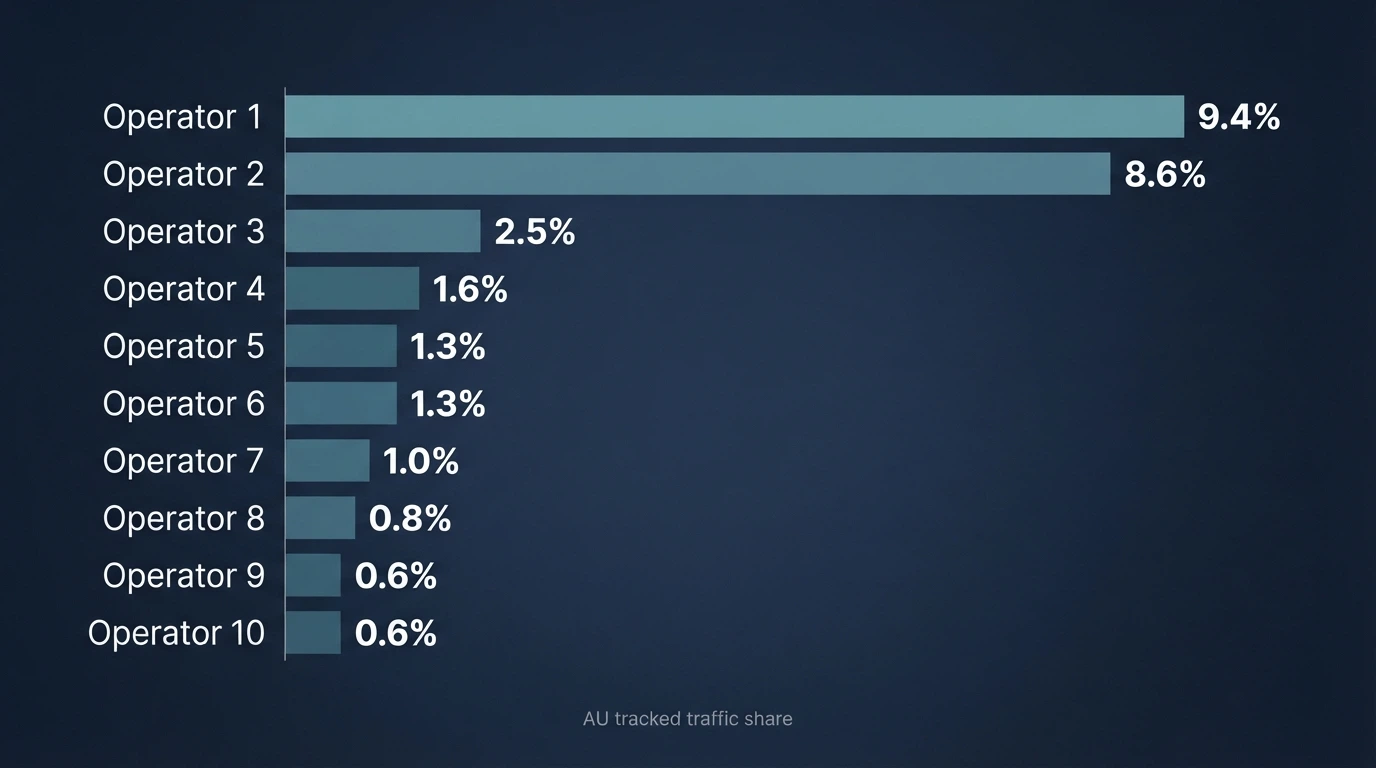
That is what this ranking does. Rocket Play at 9.4% of Australian tracked traffic is not “the best” because it is licensed — it is not. It is first in the ranking because more Australians tracked to its URL than to any other offshore brand in the period measured. Skycrown follows at 8.55%. The market-share order is a traffic proxy, not a quality verdict, and it does not change the legal status of any operator on the list.
The honesty gap in competing pages is this: they apply language from the licensed market (“regulated”, “trusted”, “secure”) to brands that are not licensed in Australia, and they let the reader infer a protection that does not exist. The payment method a casino requests is the cleanest tell. A request for credit card or crypto at a gambling site is, since 11 June 2024, both illegal at the Australian end and a signal that the operator is not playing by Australian rules. An operator that asks for a payment method Australia has banned is not the kind of operator that respects Australian consumer protection either.
The games high-stakes players actually seek out — and where they find them
Three formats dominate high-stakes play: online pokies (the Australian term for slot machines), progressive jackpot slots, and live-dealer table games. Blackjack, roulette and baccarat are the table staples at high limits, with live dealer bridging the gap between the felt floor and the online screen. Pokies carry the deepest Australian cultural footprint — they are the format Australians know from clubs, pubs and casinos — but online pokies are prohibited and exist only at offshore operators.
High rollers gravitate toward these formats for different reasons. Pokies and progressive jackpots offer the largest single-event payout per dollar staked, which is the appeal for someone willing to wager large sums on one outcome. Live-dealer tables offer the closest online approximation of the VIP floor experience — real cards, real dealers, the social texture of a casino. Each format has its own RTP profile, its own volatility and its own session cost; none of it is licensable in Australia, and the player has no recourse if an offshore operator refuses to pay a jackpot win.
Where Australian high rollers actually play in 2026
| Operator | AU Licence Status | AU Market Share | Revenue — AU Tracked |
|---|---|---|---|
| Rocket Play | Offshore — no AU licence | 9.4% | A$632.69M |
| Skycrown | Offshore — no AU licence | 8.55% | A$436.07M |
| Royal Reels | Offshore — no AU licence | 2.51% | A$243.99M |
| WinSpirit | Offshore — no AU licence | 1.55% | — |
| Stake | Offshore — no AU licence | 1.28% | A$115.67M |
| Rainbet | Offshore — no AU licence | 1.28% | — |
| Scream Casino | Offshore — no AU licence | 0.99% | — |
| FairGO | Offshore — no AU licence | 0.8% | A$69.11M |
| Bizzo Casino | Offshore — no AU licence | 0.57% | — |
| Rocket Casino | Offshore — no AU licence | 0.57% | — |
The table orders operators by share of Australian tracked traffic. Every one is offshore and unlicensed in Australia. The revenue column reflects what was carried at operator level from the tracking data; five operators in the lower half of the ranking did not have that figure broken out and are marked with a dash. The long tail — the 86.84% of Australian tracked traffic captured by brands below the tenth position — sits with hundreds of smaller offshore operators that this page does not name individually. The top ten take roughly a quarter of the measured traffic between them, and Rocket Play alone captures nearly one in ten AU visits.
Rocket Play
Rocket Play sits at the top of the AU tracked-traffic ranking with 9.4% of Australian visits and A$632.69M in tracked AU revenue. The brand operates offshore — no Australian licence exists for online casino, so the status is structural, not a Rocket Play choice. Its welcome bonus, in the shape most commonly described in the tracking period, is a deposit-matched package aimed at high-deposit players, with the match percentage and maximum bonus sized for larger first deposits rather than minimum-stake recreationals. Specific bonus figures were not refreshable for this run; what can be said is that the offer structure assumes a player willing to deposit in the high four figures or low five figures to clear the bonus in one move. The appeal for a high roller is the size of the matched amount. The risk is everything else on this page — no Australian recourse, offshore jurisdiction, a brand that may be ACMA-blocked at any time with a balance on it.
For someone comparing offshore options by scale alone, Rocket Play is the largest AU-tracked brand and the one most Australians already land on. For someone comparing by anything else — protection, dispute resolution, self-exclusion reach — Rocket Play scores no differently from any other name on this list, because none of them scores on those axes at all.
Skycrown
Skycrown ranks second at 8.55% of Australian tracked traffic and A$436.07M in AU revenue — a close runner to Rocket Play on both metrics. Like every other operator here, it holds no Australian licence. Its welcome offer follows the offshore high-roller pattern: a deposit match sized for a substantial first deposit, with terms typical of the Curaçao-licensed segment. The brand’s Australian footprint is heavy enough that it is one of the more visible names in the offshore space targeting AU players.
Skycrown is a reasonable second-place pick for a reader who wants a brand with material Australian traffic but does not want the largest player in the segment. The trade-off is the same: scale does not buy protection in this market, because protection is not for sale to an Australian player anywhere on this list.
Royal Reels
Royal Reels sits third at 2.51% of AU tracked traffic with A$243.99M in tracked AU revenue — a meaningful step below Rocket Play and Skycrown but still well ahead of the rest of the ranking. The brand operates offshore under a Curaçao-class licence and accepts Australian players without an Australian licence to do so. Its welcome structure follows the deposit-match pattern common to the offshore high-roller segment.
The mid-tier position in the ranking reflects a brand with established Australian traffic but not the dominance of the top two. A reader choosing Royal Reels over a smaller name below it is choosing scale, not safety; a reader choosing it over Rocket Play is choosing a slightly smaller pool of AU players, for reasons that may come down to interface, game selection or sheer personal preference.
WinSpirit
WinSpirit holds 1.55% of AU tracked traffic — a mid-tier position in the offshore set, with no operator-level revenue figure carried from the tracking data. The brand operates offshore, accepts Australian deposits without an Australian licence, and competes for the same high-roller segment as the rest of the ranking. Its offer shape, like the others, is a deposit-matched welcome package targeting larger first deposits.
The absence of an operator-level revenue figure is a tracking-data gap, not a market reality — the brand is active, AU traffic is measured and the position in the ranking reflects what was captured in the period. A reader comparing WinSpirit against Royal Reels at 2.51% is comparing two brands of broadly similar shape, where the differentiator is traffic volume rather than the underlying legal status, which is identical.
Stake
Stake takes 1.28% of AU tracked traffic with A$115.67M in tracked AU revenue — a globally recognised brand with a modest but material Australian footprint. Stake is best known for its crypto-native positioning in the global market, which is worth flagging: the brand’s association with crypto deposits is part of why Australian payment restrictions are relevant to it. Credit cards and crypto have been banned as payment for online wagering in Australia since 11 June 2024, so any Stake deposit route for an Australian player must use a method that sits inside the legal payment set — debit card, bank transfer, PayID/Osko or BPAY.
For a reader drawn to Stake because of its global brand recognition, the practical question is which deposit route the site offers an Australian player, and whether that route sits inside the Australian rules. A crypto-only deposit route would put the operator and the player both outside the law.
Rainbet
Rainbet sits at the same 1.28% AU market share as Stake — tied on traffic, without a broken-out revenue figure from the tracking data. The brand operates offshore, accepts Australian players without an Australian licence, and competes in the deposit-matched high-roller welcome space.
The tie with Stake on share is a tracking-data result, not a verdict on the brands being interchangeable. A reader choosing between the two is choosing on brand familiarity, interface or game catalogue, because the legal status, the protection available and the payment restrictions are identical for both.
Scream Casino
Scream Casino holds 0.99% of AU tracked traffic — just under 1% of measured Australian visits, with no operator-level revenue figure carried. The brand operates offshore, accepts Australian deposits and targets the same high-roller welcome segment as the rest of the ranking.
A reader comparing Scream Casino to a brand further up the ranking is comparing on marginal traffic-share differences. At this level of market share, the practical differences between operators come down to game catalogue, payment methods on offer and bonus structure — none of which is refreshable for this run.
FairGO
FairGO is an Australia-facing brand at 0.8% of AU tracked traffic with A$69.11M in tracked AU revenue — the smallest operator in the ranking with a carried revenue figure. The brand’s Australian-facing positioning is notable for the name: “FairGO” reads as a local brand even though it operates offshore and holds no Australian licence. The “Australia-friendly” branding is common across the offshore segment and is itself a signal: a brand that emphasises how Australian it is, while operating outside the Australian licensing system entirely, is marketing to the gap between what an Australian player wants and what the Australian regulator permits.
For a reader drawn to FairGO because of its Australian-facing presentation, the reality is the same as for every other operator on this page: offshore licence, no Australian consumer protection, no BetStop coverage, no recourse at the Australian end if a withdrawal stalls.
Bizzo Casino
Bizzo Casino holds 0.57% of AU tracked traffic — tied at the bottom of the ranking with Rocket Casino. The brand operates offshore, accepts Australian players without an Australian licence, and competes in the same deposit-match welcome segment. No operator-level revenue figure was carried from the tracking data.
The bottom of the ranking reflects smaller Australian traffic rather than any different legal status. Bizzo is offshore and unlicensed in Australia, exactly like Rocket Play at the top of the list.
Rocket Casino
Rocket Casino closes the ranking at 0.57% of AU tracked traffic, level with Bizzo. The brand operates offshore under the same unlicensed-in-Australia status as the rest. No operator-level revenue figure was carried. The “Rocket” naming overlap with Rocket Play is a brand-collision fact — two unrelated operators both targeting Australian traffic — not a corporate connection.
For a reader choosing between the two brands tied at the bottom of the ranking, the decision is on catalogue and offer shape rather than on protection, which is identical and identically absent.
Why your high-roller bonus is almost never what the banner says
An offshore casino welcome bonus, in its most aggressive form, is a deposit match large enough to make a five-figure deposit attractive to a high roller. A 100% match on a A$2,000 deposit delivers A$2,000 in bonus funds on top of the deposit; a 200% match on the same deposit delivers A$4,000. The banner number is the figure the brand wants the player to remember. The figure the player takes away, if any, is decided by terms the banner does not advertise: the wagering multiple, the game weighting, the time limit on clearing, and the maximum cashout cap.
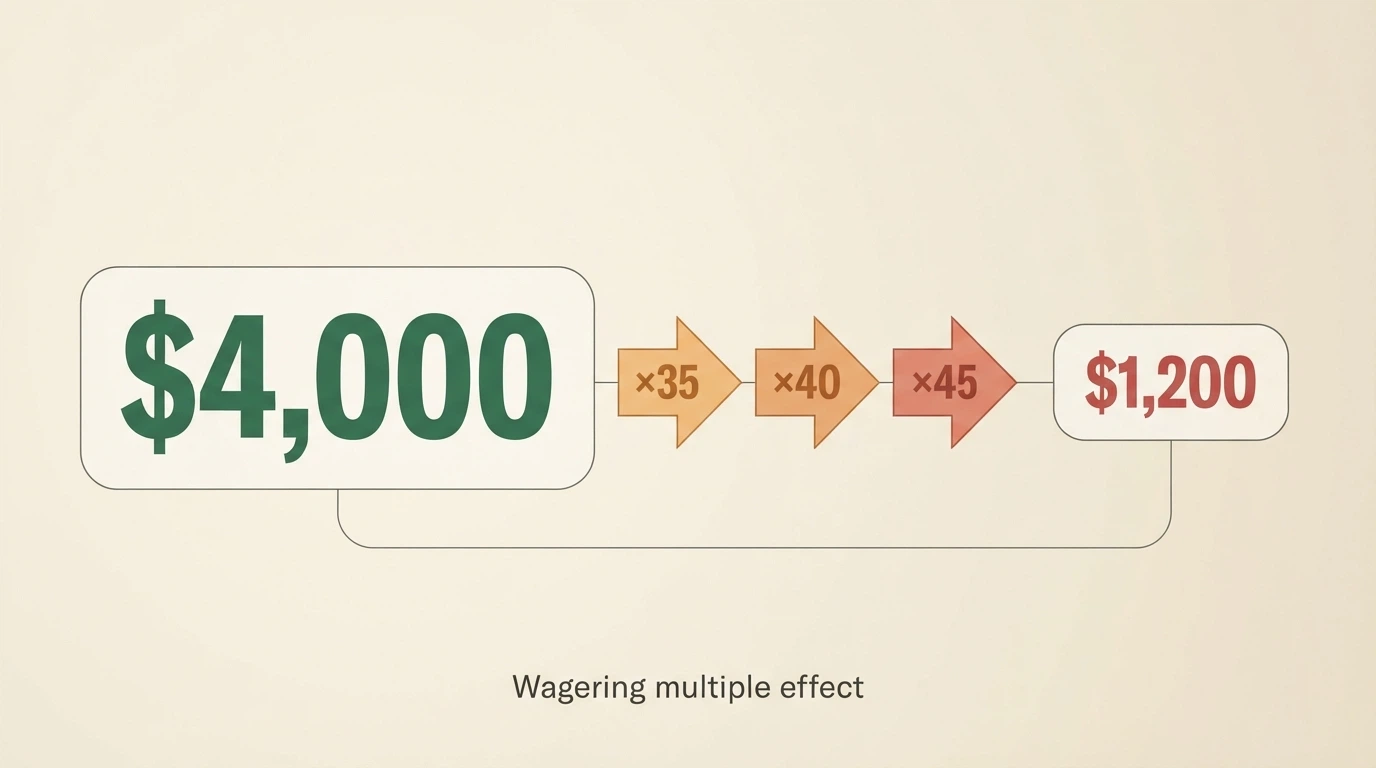
A high roller depositing large sums amplifies every part of this calculation. A 40x wagering multiple on a A$4,000 bonus means A$160,000 of qualifying turnover before the bonus converts to withdrawable cash. At a A$1 spin on a pokie counting 100% toward wagering, that is 160,000 spins. The expected house edge over those spins, at a typical pokie RTP of around 95–97%, is in the A$4,800 to A$8,000 range. The “free” A$4,000 bonus has a real cost of several thousand dollars before the player sees a cent of withdrawable funds.
This is not an argument against claiming bonuses. It is an argument for reading the terms, doing the arithmetic, and understanding that a high-roller welcome offer trades turnover for matched funds. The math is not hidden — the wagering multiple is published in the bonus terms. The marketing is.
Welcome bonuses: the headline figure vs the real cost of claiming it
A deposit-match welcome bonus is the dominant welcome structure in the offshore high-roller segment. The brand matches a percentage of the player’s first deposit, up to a ceiling, with the matched funds released as bonus money subject to wagering requirements. For a high roller, the appeal is straightforward: a larger deposit attracts a larger match, and the matched amount can be substantial in absolute terms.
The cost is straightforward too, and it is paid in turnover. A welcome bonus on a A$1,000 deposit with a 35x wagering multiple requires A$35,000 of qualifying play before the bonus funds are withdrawable. The qualifying play happens at the house edge, which on pokies is typically 3–5% of turnover. The expected loss on the qualifying turnover is therefore A$1,050 to A$1,750 on a A$35,000 playthrough. Against a A$1,000 bonus, that is a real cost somewhere between the bonus amount and 1.75x the bonus amount, depending on the exact RTP of the games chosen to clear it.
For a high roller, the math scales. The same welcome bonus structure on a A$5,000 deposit produces a matched bonus in the same shape and a turnover requirement proportionally larger, with the expected loss correspondingly higher. The offshore segment is aware of this — high-roller welcome bonuses are sized precisely to attract large deposits while keeping the wagering hurdle proportionate to the match.
No-deposit bonuses and free spins: what they actually deliver
No-deposit bonuses and free-spin bundles are acquisition tools, not retention tools. The brand offers a small bonus or a batch of free spins to a player who has not deposited, in exchange for the player opening an account and seeing the lobby. The wagering requirements are typically steep relative to the bonus size, and the maximum cashout cap is typically low — a few hundred dollars on a no-deposit bonus, even when the wagering multiple is cleared.
For a high roller, the structural mismatch is severe. A no-deposit bonus or a free-spin bundle is sized for someone depositing in the tens, not the thousands. A high-roller player claiming such an offer is paying the same time cost (KYC, account setup, the wagering playthrough) for a fraction of the value they would extract from a deposit-matched welcome package. None of the operators on this page are currently advertising a no-deposit offer with confirmed terms.
Free spins as part of a larger welcome package sit differently — a deposit match bundled with several hundred free spins on a featured pokie is a common high-roller welcome structure. The free-spin component has its own terms, typically with winnings from the spins subject to the same wagering multiple as the matched bonus.
Wagering requirements: the fine print that eats your balance
The wagering requirement is the single number that decides whether a bonus is worth claiming. It is expressed as a multiple of the bonus amount (and sometimes the deposit plus bonus combined), and it represents the total qualifying turnover before bonus funds convert to withdrawable cash.
Game weighting is the modifier that decides how much of each bet counts toward the requirement. Pokies count 100% on most offshore bonus terms; table games often count 10–20% or zero; live dealer may count a reduced percentage. A player who clears a pokies-only bonus by playing blackjack at a table-game weighting of 10% will need to wager ten times the stated turnover — the bonus does not clear on table play at face value.
For a high roller depositing in the thousands, the effective cost calculation is the wagering multiple times the bonus amount times the house edge of the games cleared, with the game weighting and the time limit on clearing as modifiers. Offshore bonus terms are not enforced by any Australian authority, which means disputes about whether a wagering requirement has been met are resolved by the operator’s own complaints process or the licensing jurisdiction it operates under — usually Curaçao, where enforcement against the operator is weak. The terms are published; the enforcement is thin.
Getting funds in and out when the product is banned
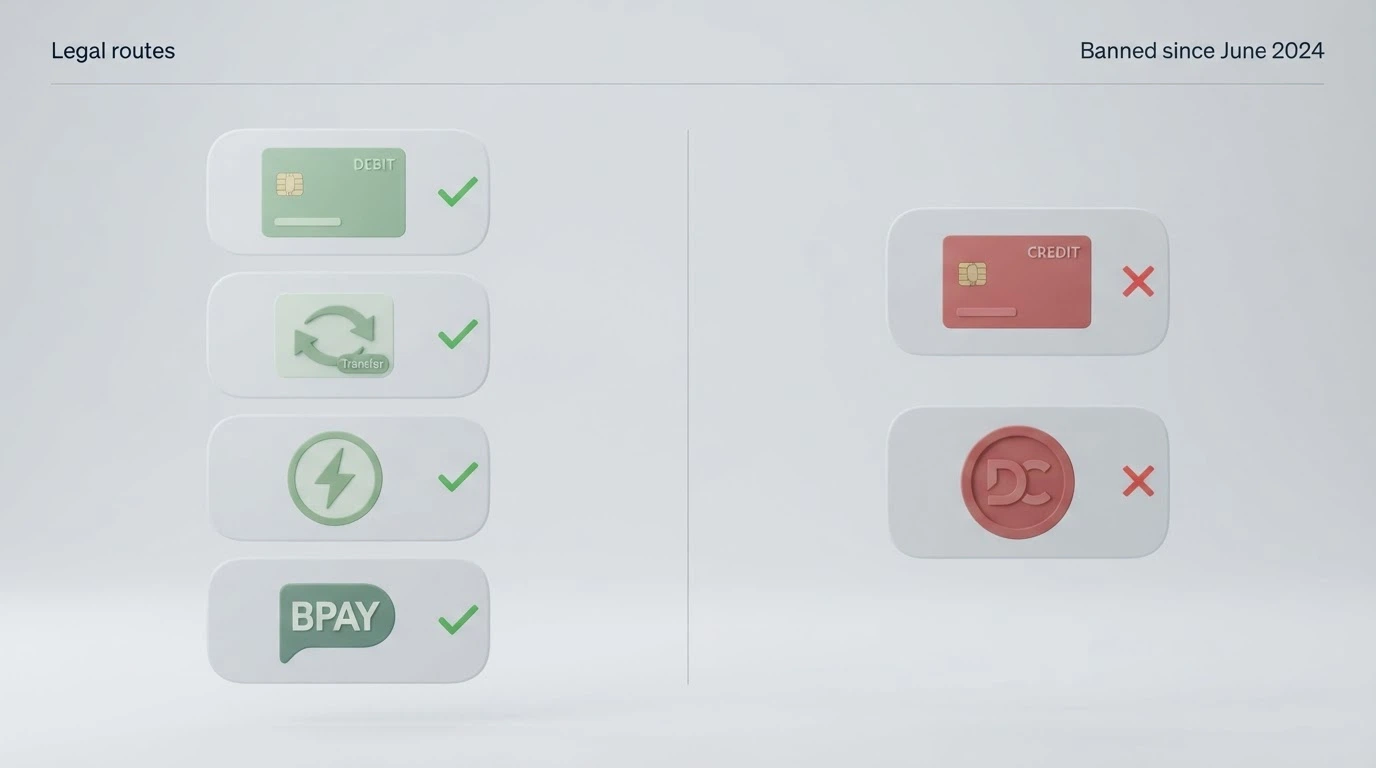
Depositing at an offshore casino from Australia is a payment-system problem as much as a legal one. The Interactive Gambling Amendment (Credit and Other Measures) Act 2023 banned credit cards, credit-related products and digital currency as payment for online wagering from 11 June 2024, with penalties of up to A$247,500 for operators that fail to enforce the ban. The legal deposit set for licensed wagering — debit card, bank transfer, PayID/Osko, BPAY — sits inside the Australian banking system and is the same set an offshore casino will accept if it wants to look compliant to an Australian player.
From 1 January 2027, that set narrows further. The 2026 reform gives banks and payment providers express authority to block transactions to illegal gambling operators. An Australian player depositing at an offshore casino via PayID in 2027 may find the transaction declined at the bank end. The payment infrastructure is closing around the offshore product, slowly and by design.
| Payment Method | Legal Status for AU Online Gambling | Notes |
|---|---|---|
| Debit card | Legal for licensed wagering; widely used offshore | Functional at most offshore casinos; bank may block from 1 Jan 2027 |
| Bank transfer | Legal for licensed wagering; widely used offshore | Slower than PayID; reliable for larger deposits |
| PayID / Osko | Legal for licensed wagering; widely used offshore | Near-instant; the method most likely to face 2027 bank blocks |
| BPAY | Legal for licensed wagering | Common at licensed operators; less common offshore |
| Credit card | Banned since 11 June 2024 | An operator still asking for credit cards is outside Australian rules |
| Cryptocurrency | Banned since 11 June 2024 | A crypto-only deposit route signals an offshore operator ignoring Australian law |
The table maps the legal status against the practical reality. An operator that asks for credit card or crypto is signalling its disregard for Australian rules — the payment method is the warning.
PayID, Osko and bank transfer: the legal deposit routes
PayID and Osko deliver near-instant deposits through the New Payments Platform, linking a mobile number or email to a bank account for transfers that settle in seconds. For an Australian player, PayID is the fastest legal deposit route to a licensed wagering account, and many offshore casinos accept PayID deposits from Australian players because the transaction settles inside the Australian banking system and looks like a normal bank transfer to the player’s bank.
Bank transfer is the slower alternative — same-day to two-day settlement, depending on the bank and the cut-off time, but reliable for deposits in the thousands or tens of thousands where PayID limits may apply. BPAY is the bill-payment-style option, common at licensed wagering operators and accepted by some offshore brands.
The 2027 reform targets this set at the bank end. From 1 January 2027, banks gain express authority to block transactions to illegal gambling operators. PayID is the method most exposed to that authority, because PayID transactions settle in seconds and a bank can decline them in real time. Bank transfers, which go through batch settlement, are also exposed but may take longer to block consistently. An Australian player using any of these methods in 2027 is betting the bank has not yet identified the destination as an illegal gambling operator.
Crypto and credit cards: why being asked for one is a red flag
Since 11 June 2024, credit cards, credit-related products and digital currency (crypto) have been banned as payment for online wagering in Australia. An operator that accepts a credit card deposit from an Australian player is breaking Australian law; an operator that accepts a crypto deposit from an Australian player is doing the same. The penalty for the operator is up to A$247,500 per breach.
For a player, the payment request is itself information. A crypto-only deposit route signals a brand that has not adjusted its payment stack for Australian regulation. A credit-card-accepting brand signals the same. Both signals point to an operator that is not respecting Australian rules, which is a reasonable prior on whether the same operator will respect Australian consumer protection, dispute resolution or self-exclusion — none of which it is required to do, and none of which it has any structural reason to do.
The practical risk is layered. A credit card deposit at an offshore casino is illegal at the Australian end and exposes the operator to enforcement. A crypto deposit is harder to reverse than a card transaction and offers no chargeback path. Both routes sit outside the 2027 bank-blocking authority, which applies to transactions inside the Australian banking system. Crypto in particular is the route that lets an offshore operator bypass Australian payment rules entirely.
The pokies and table games high rollers chase — and what the RTP really means
Three formats draw high-stakes play: online pokies, progressive jackpot slots, and live-dealer table games. Each has a different RTP profile, a different volatility profile and a different session-cost shape. None of them are licensable in Australia, so the player is choosing between offshore lobbies on their own judgement, with no Australian regulator’s RTP audit behind the game.

RTP — return to player — is the percentage of wagered money a game returns to players over a very large number of spins. A 96% RTP pokie returns A$96 of every A$100 wagered, in aggregate, over millions of spins. For any individual session the figure is meaningless; over thousands of spins it approaches the published number. Volatility is the spread of outcomes around that average — a high-volatility pokie delivers fewer wins with larger payouts, a low-volatility pokie delivers more wins with smaller payouts. A high roller with a large bankroll chasing large individual payouts prefers high volatility; a player with a smaller bankroll chasing session longevity prefers low volatility.
Pokies: Australia’s favourite gambling format, online and offshore
Australians call them pokies. Every venue machine in a club, pub or casino is a pokie; every online slot at an offshore casino is a pokie in the AU vocabulary. The format dominates Australian gambling because it is the format Australians have played in venues for decades, and the migration to online play follows the same cultural path.
Online pokies differ from venue machines in three ways that matter for a high roller. The RTP is published by the game provider, not enforced by any Australian regulator, so an offshore pokie’s published RTP is a claim rather than a measurement. The stake range is typically wider online, with high-roller-friendly titles offering A$10–A$50 per spin or higher. The volatility profile is broader, with offshore providers offering very high-volatility titles that venue machines in Australia are not allowed to offer at the same stake sizes.
For a high roller, the appeal is the combination of wide stake range and high volatility — a session of high-volatility spins at A$20+ per spin can produce life-changing single-spin payouts, and the bankroll cost is concentrated in a small number of large bets. The same math at a venue machine in Australia is not available at those stakes, because venue pokies in most states are capped at low maximum bets. The offshore lobby is where the high-stakes pokie session happens, which is why Australian high-roller traffic goes offshore at all.
Progressive jackpots and high-stakes slot machines
Progressive jackpots pool a fraction of every wager into a prize pool that grows until a player hits the triggering combination. The pool can reach seven figures across a network of players, and the appeal for a high roller is straightforward: a single spin on a A$20 wager can return A$1 million or more, which is not a payout any other casino product offers per-spin.
The trade-off is the base-game RTP. Progressive slots return a smaller percentage of wagers to the base game than non-progressive titles, because a portion of every wager funds the jackpot pool. A 92% RTP progressive slot with a A$2 million jackpot is a worse base-game bet than a 96% RTP non-progressive slot — the difference funds the prize the high roller is chasing. The math is not hidden; it is the structure of the product.
High-stakes slot machines as a separate category refers to titles with stake ranges that begin where recreational slots end — A$10+ per spin, often A$50 or A$100 max bet. These are the titles that match a high-roller bankroll. They cluster in the offshore lobby because Australian venue regulation caps maximum bets at much lower levels.
Free-play vs real-money: what the demo mode is actually for
Demo mode lets a player run a game with virtual credits — no deposit, no real-money risk, the full game mechanics exposed for testing. It is a useful tool for evaluating a pokie’s volatility, hit frequency, bonus round structure and visual feel before committing a bankroll. A high roller evaluating a new offshore casino can use demo mode to test the catalogue without the deposit.
Demo mode does not show what matters once real money is on the table. It does not show how the operator handles a withdrawal request. It does not show how the support team responds to a KYC query. It does not show whether the bonus terms are enforced the way they are published. It does not show whether the progressive jackpot is paid in full or capped. A demo session that runs cleanly tells the player the game works. It says nothing about the operator behind it.
For a high roller weighing an offshore casino, demo mode is a starting point — it answers “is this game worth my bankroll” — and nothing more. The question “is this operator worth my bankroll” requires a real deposit and a real withdrawal test, which is a test with real money at risk.
Playing on your phone: apps, browsers and why the download matters
Every offshore casino on this ranking is accessible on a mobile screen. The differences are in how that access works — browser-based play in Safari or Chrome, dedicated apps installed through the App Store or Google Play, or sideloaded apps and downloadable clients that bypass the official store review process.

The App Store and Google Play enforce content policies that prohibit real-money casino apps in many jurisdictions, including Australia. The official store review process rejects apps that offer real-money gambling to Australian users without an Australian licence. Offshore casino apps are therefore not present in the Australian App Store or Play Store, and an Australian player who wants a dedicated casino app on their phone installs it outside the official channels — a sideload on Android, an enterprise certificate install on iPhone, or a direct APK download.
Dedicated casino apps vs mobile browser play
Browser-based play in Safari or Chrome is the lowest-friction option. No install, no permissions, no footprint on the device beyond the browser cache. The casino site adapts to the mobile screen, the games load in HTML5, and the player closes the tab when done. Nothing persists on the device. Nothing asks for permission to access the camera, the contacts or the location.
A dedicated casino app asks for device access the store review process would have questioned. Push notifications to drive re-engagement. Background access to keep the session live. Storage access for game assets and account credentials. An app installed outside the official channels carries all of these permission requests without the store review that would have filtered the worst of them. The convenience of a home-screen icon trades against a permission footprint that a browser tab does not leave.
Download casinos: what you are actually installing
A downloadable casino client for desktop or mobile asks for execution privileges on the device. On Windows or Mac, that means a program that runs continuously, accesses the network, reads and writes local storage, and may request permissions the browser equivalent would not need. On mobile, a sideloaded app asks for system-level access that an App Store or Play Store install would have constrained.
The download model persists in the offshore segment because it gives the operator more control over the client environment — anti-fraud, session management, payment integration — than a browser tab allows. For the player, the trade-off is convenience against security surface. A download client from an offshore operator without an Australian licence is software from an unknown publisher asking for execution privileges on a personal device. The decision is the player’s, but the trade-off should be visible before the install begins.
The law that makes every casino on this page illegal
The Interactive Gambling Act 2001, strengthened by the Interactive Gambling Amendment Act 2017, makes it an offence to provide online casino games, online pokies and in-play sports betting to a person in Australia. There is no licence for online casino anywhere in the country — not federally, not in any state or territory. The product on this page is not legal to supply in Australia, which makes every operator on the list an operator that is breaking the law by accepting an Australian player.

The ACMA — Australian Communications and Media Authority — is the federal regulator that enforces this prohibition. ACMA investigates complaints, issues formal warnings, initiates civil penalty proceedings and directs Australian ISPs to block illegal gambling sites. Since its first blocking request in November 2019, ACMA has had 1,564 illegal gambling and affiliate websites blocked by Australian ISPs. More than 225 illegal services have withdrawn from the Australian market since enforcement was strengthened in 2017.
The individual player is not prosecuted under the IGA. The Act targets the provider, not the punter. An Australian who opens an account at an offshore casino is not breaking the law; the operator that accepts them is. This is not the same as saying the player is protected. They are not — they have no Australian consumer protection, no Australian dispute resolution, no Australian self-exclusion coverage. The IGA’s enforcement target is the right one; the side effect is that the player carries all the risk.
The Interactive Gambling Act 2001: what it bans and what it does not
The IGA draws a hard line. Prohibited products: online casino games, online pokies (slots), in-play betting on a sporting event once it has started. Licensable products: wagering on races and sport placed before the event begins, lotteries and keno, through operators licensed by a state or territory. The Northern Territory Racing and Wagering Commission (NTRWC), via Licensing NT, is the de facto national licensor for online bookmakers. Wagering licences run for terms of up to 20 years.
What the IGA does not ban is land-based casino gambling — Crown, The Star and other state-licensed venues operate legally in Australia. What the IGA does not cap is player stakes or deposits at the federal level, because the product those ceilings would govern is banned outright. What the IGA does cap is the payment method, through the 2023 amendment: credit cards, credit-related products and crypto are banned as payment for online wagering since 11 June 2024, with penalties of up to A$247,500 for non-enforcement.
The boundary matters because it tells the reader exactly where every operator on this page sits. Rocket Play, Skycrown, Royal Reels and the rest are all on the prohibited side of that line. The licensed side is wagering only — sports bookmakers, racing bookmakers, lotteries — and none of those products is what a high-roller casino bonus typically wraps.
The 2026 reforms: new advertising caps, bank blocks and what changes for players
The Interactive Gambling Amendment (Gambling Reform) Bill 2026 passed Parliament on 19 August 2026; its measures commence 1 January 2027. The reform package reshapes the Australian gambling landscape without making offshore casino legal. It tightens what licensed wagering operators can do, and it gives banks and payment providers the authority to act against transactions to illegal gambling operators.
| Reform Measure | Commencement Date | What It Means for Australian Players |
|---|---|---|
| Banks gain authority to block transactions to illegal gambling operators | 1 January 2027 | PayID, bank transfers and card payments to offshore casinos may be declined at the bank end |
| Max 3 wagering ads per hour (6am–8:30pm); live-sport blackout 15 min before to 5 min after event | 1 January 2027 | Licensed wagering operators face tighter ad windows; offshore casino advertising to Australians remains illegal under the IGA |
| Athletes, celebrities and influencers barred from promoting wagering products | 1 January 2027 | Endorsement-driven wagering marketing ceases; the change applies to licensed operators, not to offshore casino affiliates |
| Broadcasting sporting odds banned outright | 1 January 2027 | No on-air odds during sports broadcasts; affects licensed wagering operators and their broadcast partners |
| Direct marketing of inducements prohibited for 14 days post sign-up, 3 months post BetStop deregistration, indefinitely for at-risk customers | 1 January 2027 | Licensed operators face tight inducement windows; offshore casinos were already prohibited from this conduct under the IGA |
The reform does not legalise offshore casino. It makes offshore casino harder to fund from an Australian bank account, harder to advertise to, and harder to market inducements around. For a player already playing offshore, the practical change is the bank-blocking authority — a PayID deposit that worked in 2026 may be declined in 2027 if the bank has identified the destination as an illegal gambling operator.
When the stakes are high: responsible gambling tools that actually work in Australia
High-roller play carries elevated risk, and the tools that exist inside the Australian system are real and free. They are also limited in reach. BetStop, the National Self-Exclusion Register, binds Australian-licensed wagering services only — an offshore casino is not connected to it. The National Gambling Helpline (1800 858 858) is free, confidential and available 24/7; it does not need an offshore casino to cooperate to help a caller. Deposit limits and activity statements exist on licensed wagering accounts; they do not exist at offshore casinos.

About 2.1% of Australian adults — roughly 430,000 people — experience problem gambling. The Australian Institute of Health and Welfare put high-risk gambling at 1.8% in 2022. BetStop recorded 67,480 registrations as of 31 July 2026, with 41,290 exclusions still active. 78% of registrants were under 40; 38% chose lifetime exclusion. The register is a meaningful Australian harm-reduction tool for the wagering market it covers. It is not a tool for the offshore casino market, which is outside the Australian licensing system entirely.
Deposit limits, self-exclusion and where to get help right now
A reader in Australia who wants to take a concrete step today has these options, all of which are free:
- Customer-set deposit limits and activity statements on any Australian-licensed wagering account they hold; the limits differ between operators and jurisdictions but they are real tools backed by Australian consumer law.
- BetStop registration, which excludes the registrant from every Australian-licensed online and phone wagering service with one sign-up; the registration does not reach offshore casinos.
- The National Gambling Helpline on 1800 858 858, free, confidential and staffed 24/7, with online chat and counselling available through Gambling Help Online.
None of these tools reaches an offshore casino. A deposit limit set on a licensed wagering account does not cap deposits at an offshore brand. A BetStop registration does not stop an offshore casino from accepting the same person’s deposits. A call to the Helpline is confidential and will help, but it cannot reverse a withdrawal stall at an operator outside Australian jurisdiction.
How we selected and ranked every casino on this page
The ranking is by share of Australian tracked traffic, descending. The data source is AU tracked-traffic measurement covering the period the figures were drawn from; the regulatory framework is the Interactive Gambling Act 2001 and the ACMA’s public enforcement record. Operators were included if they appeared in the top ten of AU tracked traffic during the measurement period.
Ranking criteria, in order of weight applied:
- AU market share by tracked traffic (primary; orders the ranking from Rocket Play at 9.4% down to Rocket Casino and Bizzo Casino tied at 0.57%).
- AU tracked revenue where the figure was carried at operator level (secondary; revenue was available for Rocket Play, Skycrown, Royal Reels, Stake and FairGO, and absent at operator level for the remaining five).
What was not used as a ranking criterion: an Australian licence, because no Australian licence exists for the product; a safety or protection score, because no operator on the list provides Australian consumer protection; a bonus value score, because specific bonus figures, wagering multiples and game weightings were not refreshable for this run.
Limitations of the data are as follows: operator-specific bonus mechanics—including match percentages, wagering multiples, game weightings, maximum cashout caps, and free-spin values—could not be refreshed and are described qualitatively throughout the page. Similarly, per-game RTP figures were not refreshable and are not stated for individual titles. Finally, payment-method acceptance at operator level was not refreshable; the legal status of each payment method for Australian players is stated from the regulatory framework, rather than through operator-by-operator confirmation.
No operator paid for placement. No placement was offered. The ranking is a market-share ordering, not an endorsement.
What this means for your next move as an Australian player
Every operator on this page is offshore and unlicensed in Australia. The Interactive Gambling Act 2001 prohibits the supply of online casino to anyone in Australia, and the ACMA enforces that prohibition with ISP-level site blocking. The player is not prosecuted, but the player is not protected — no Australian consumer law, no Australian dispute resolution, no BetStop coverage, no recourse if a withdrawal stalls or a bonus is voided. The 2027 reform makes offshore play harder to fund by giving banks authority to block transactions to illegal gambling operators, but it does not change the legal status of the product.
A high-roller bonus at any of these operators trades turnover for matched funds, with the real cost paid in house edge over the wagering playthrough. A no-deposit bonus or free-spin bundle is sized for low-stakes acquisition, not high-stakes retention. A withdrawal dispute at an offshore casino has no Australian authority to back the player. The BetStop register and the National Gambling Helpline are real Australian tools; they do not reach offshore casinos.
The reader’s next move is a decision about risk, not a choice between licensed products. The page has laid out where Australian high-roller traffic goes, what the law says, what the bonuses really cost and what protections do not apply. The rest is the reader’s call.
Frequently asked questions about high-roller online casino in Australia
How do I actually deposit money at an offshore casino from Australia?
The functional deposit routes for an Australian player at an offshore casino are debit card, bank transfer, PayID/Osko and BPAY — the same legal payment set for licensed wagering in Australia. Credit cards and crypto have been banned as payment for online wagering since 11 June 2024, and an offshore operator that still requests either is signalling it is not playing by Australian rules. From 1 January 2027, banks gain authority to block transactions to illegal gambling operators, which means a PayID or bank transfer deposit at an offshore casino may be declined at the bank end. The legal routes work today; the question is how long the bank will let them through.
Is it safe to play at offshore casinos that accept Australians?
“Safe” is the wrong frame, because no Australian consumer protection applies. The protections that exist for an Australian player on a licensed wagering account — dispute resolution, financial recourse, BetStop coverage, ACMA oversight — do not exist at any offshore casino. ACMA has blocked 1,564 illegal gambling sites since November 2019, and the player has no guarantee the site they are on is not next on the block list with a balance still on it. The payment method the operator requests is itself a tell: a credit card or crypto request signals a brand outside the Australian rules. The IGA targets the provider, not the player — an Australian is not prosecuted for playing — but the player carries all the risk with no Australian backstop.
What happens if an offshore casino refuses to pay out my winnings?
No Australian authority can compel an offshore operator to pay. The operator holds an offshore licence (usually Curaçao), and the complaints mechanism in that jurisdiction is weak. The practical options are limited to the operator’s own internal disputes process, the licence jurisdiction’s complaint channel, and in some cases a payment dispute with the bank if the deposit was made by debit card or bank transfer. None of these paths is guaranteed, and none of them runs through an Australian consumer-protection body. An Australian player with a stuck withdrawal at an offshore casino has, in practical terms, whatever leverage their deposit method offers — which is more for a recent debit-card transaction, less for a PayID transfer, and nothing for crypto.
Does BetStop cover the offshore casinos Australians use?
No. BetStop — the National Self-Exclusion Register — binds Australian-licensed wagering services only. An offshore casino is not connected to the register, and registering with BetStop does not block access to or marketing from any offshore brand. BetStop recorded 67,480 registrations as of 31 July 2026, and the register is a meaningful harm-reduction tool for the wagering market it covers. The 2026 reform strengthens BetStop’s operation and bans direct marketing of inducements for three months after a person deregisters, but it does not extend the register’s reach offshore. An Australian player self-excluding from licensed wagering has still access to every offshore casino on this page.
Do I have to pay tax on casino winnings in Australia?
For the ordinary punter, no. Betting and gambling winnings are not assessable income for the player under section 6-5 of the ITAA 1997, and losses are not deductible under section 8-1. The narrow exception is for anyone carrying on a business of betting or gambling — assessed under ATO criteria in IT 2655 — which requires a level of systematic, profit-seeking activity that goes well beyond what an offshore casino punter does. No Australian case has held the winnings of an ordinary punter assessable. The practical position is that the ATO does not tax casual gambling winnings and does not allow casual gambling losses as a deduction; a high-roller player at an offshore casino pays no Australian tax on winnings and receives no Australian tax relief on losses.