
No-Deposit Free Spins on Australian Online Pokies: The Offer, the Maths, and the Law
“Free” is the most expensive word in online pokies marketing. A headline offer of 100 free spins sounds like A$100 of somebody else’s money in your account. By the time the wagering requirement has done its work, by the time the maximum cashout has clipped the win, and by the time the 72-hour expiry clock has run out on spins you forgot to use, the same headline number is often worth somewhere between A$10 and A$50 of withdrawable cash — and sometimes nothing at all.
This page goes behind that headline. It covers what “online pokies no-deposit free spins” actually means in Australian usage, how the offers work in practice, which offshore operators Australians are using this year, what the arithmetic turns 100 spins into at the cashout gate, and why the entire category sits inside a federal prohibition that no marketing page advertises.
Data accurate as of 18 October 2026; licence and enforcement status cross-referenced against ACMA registers and Australian federal legislation.
Table of Contents
- What “Online Pokies No-Deposit Free Spins” Actually Means — and What You’re Really Getting
- Why Your No-Deposit Free Spins Are Worth Less Than the Advertised Number
- The Offshore Pokies Operators Australians Are Using — and What Each One Offers in 2026
- Online Pokies Are Illegal in Australia — Here’s What the Law Actually Says
- How to Protect Yourself — Limits, Self-Exclusion and Where to Get Help
- How We Selected and Ranked These Operators
- What This Means for Your Next Pokies Session
- Frequently Asked Questions
What “Online Pokies No-Deposit Free Spins” Actually Means — and What You’re Really Getting
“Online pokies” is the Australian-English word for what the rest of the world calls slots, fruit machines or one-armed bandits. A pokie is a casino game with reels, paylines and a random-number generator that decides every spin. When Australians see “online pokies”, they mean slots played over the internet rather than the poker machines that sit in pubs and clubs from Sydney to Perth.
A no-deposit free-spins bonus is a registration offer from an online casino that credits a fixed number of spins to a new account without the player having to deposit first. The spins are usually locked to specific games, valued at the game’s minimum stake, and expiring somewhere between 24 and 72 hours after they are credited. Any winnings the spins generate are not paid out as cash — they become bonus money, which has to be wagered a stated multiple of times before it converts to a withdrawable balance.
The core tension sits inside those three words. “No deposit” is real — you do not pay to claim. “Free” is partial — you are not risking your own money to play. “Spins” is mechanical — they are spins, not cash. What you are really getting is a short, restricted window of play on the operator’s chosen game, where the winnings have to clear a turnover gate before they can be withdrawn.
What “online pokies” covers in Australian English
The word “pokies” comes from “poker machines”, the original trade name for the electromechanical slot games that landed in Australian clubs in the 1950s. Australians use it for both the land-based machines and for online slot games. Where an American site lists “slots” or a European site lists “fruit machines”, an Australian site lists “pokies”.
This carries into the legal vocabulary. The Interactive Gambling Act 2001 (IGA), the federal statute that governs online wagering, uses the international term “online casino games” and the more specific “electronic gaming” — the offshore sites Australians use call them pokies, and the law treats them as prohibited interactive gambling services regardless of the name.
The Australian gaming culture around pokies is unusual in scale. Australia has more poker machines per capita than almost any other country, and the land-based pokie is a fixture of pubs, clubs and casinos in every state and territory. Online pokies are the internet-facing cousin of that machine — same category of game, run from a server somewhere offshore rather than a cabinet in a club.
How a no-deposit free-spins bonus works — from claim to withdrawal
A no-deposit free-spins offer has a lifecycle with at least six distinct steps, each with its own gate.
The player registers an account, usually with an email address, a username and a password. Most no-deposit offers require at least a mobile phone number to be verified before the spins are credited — the verification message is the operator’s protection against players creating multiple accounts to claim repeatedly. Some operators also request photo ID at this stage, though for the no-deposit free-spins offer alone it is less common.
Once the verification is complete, the operator credits the spins to the account. They are almost always locked to a specific pokie — most commonly one of the Pragmatic Play titles that dominate Australian-facing sites, or one of the RealTime Gaming titles on RTG-powered casinos. The per-spin stake is set at the game’s minimum, usually A$0.10 or A$0.20.
The player runs through the spins inside the expiry window. Free spins typically expire within 24 to 72 hours of being credited. Anything not used in that window disappears from the account. Any winnings the spins generate are credited as bonus money rather than as cash.
The bonus money now has to clear the wagering requirement. The operator states a multiple — 30x, 40x, 50x, 60x — applied to the bonus winnings. At 35x on A$50 in winnings, the player has to wager A$1,750 in real-money play before the bonus converts to withdrawable cash. Most pokies contribute 100% of every A$1 wagered toward the requirement; progressive jackpot pokies contribute 0–10%; table games usually contribute 10%; live dealer games are almost always excluded.
Once the wagering is cleared, the bonus money converts to a withdrawable balance. The second gate now bites — the maximum cashout cap. No-deposit offers typically cap withdrawals at A$50 to A$200. Any winnings above the cap are retained by the casino.
Finally, the player requests a withdrawal through whatever payment method the operator accepts, with a processing time that varies from minutes (crypto, where accepted) to several business days (bank transfer).
The path from “claim” to “withdraw” passes through at least two gates that can shrink the headline number, and a clock that can erase the whole thing if the player forgets to use the spins.
How Australian online pokies differ from the global slot market
The defining structural difference between the Australian and the UK or European online pokies market is that no Australian online casino licence exists. None. Not federally, not in any state or territory. The Interactive Gambling Act 2001 prohibits the supply of online casino games — including online pokies — to persons in Australia, and no regulator issues a licence for the activity.
Every online pokie site accessible from Australia is therefore offshore. The operator is incorporated somewhere outside Australia, holds a licence from some other jurisdiction (most commonly Curaçao, but also Malta, the Isle of Man, or smaller Caribbean regulators), and accepts Australian players in a legal grey zone: it is illegal for the operator to target Australians, but the IGA targets the provider, not the player.
The consequence for the player is structural. There is no Australian consumer protection regime that reaches these operators. There is no ACMA recovery of disputed funds. The national self-exclusion register, BetStop, covers roughly 150 Australian-licensed wagering providers but does not connect to any offshore casino. If an offshore operator refuses a withdrawal, voids a win, or closes an account with a balance still on it, the player has no Australian remedy.
Since November 2019, the ACMA has had 1,564 illegal gambling and affiliate websites blocked at the ISP level, and more than 225 illegal services have withdrawn from the Australian market since the 2017 enforcement strengthening. Blocking is DNS-level — the page can disappear from an Australian connection overnight, including access to any balance still sitting in an account.
Why Your No-Deposit Free Spins Are Worth Less Than the Advertised Number
The headline number of a no-deposit free-spins offer is the spin count. The value the player actually keeps is the product of four terms that sit underneath it: the per-spin stake, the wagering requirement on the winnings, the maximum cashout cap, and the expiry window that determines whether any of it gets used at all.
How no-deposit free spins actually work — from claim to withdrawal
Account creation without a deposit is the literal definition of a no-deposit offer. The verification that follows it is the operator’s first protection. Phone verification — a one-time code sent by SMS to a mobile number — is now standard on most Australian-facing offers. The code confirms one player, one phone number, one claim. Some operators request photo ID at the claim stage as well; others delay that step until the first withdrawal.

The spin allocation is specific. The operator picks the eligible pokie or pokies, sets the per-spin stake at the game’s minimum, and credits the spins as a block. The player cannot choose a different pokie, cannot change the stake, and cannot split the spins across games. Everything happens on the operator’s chosen title.
After the spins are played, the bonus-winnings balance sits in the account with a wagering requirement attached. The clock is running — most operators set the bonus-fund validity at 7 to 30 days from credit. Inside that window, the player has to wager the requirement multiple on eligible games, with the 100%-on-pokies rule governing which games count and which do not.
If the wagering clears within the validity window, the balance converts. If it does not clear, the bonus balance and any associated winnings are forfeited.
Bonus spin counts: what 10, 25, 50, 100 or 150 free spins are worth in practice
The spin count is a play-time number, not a payout number. At A$0.10 per spin, 100 free spins are A$10 of stake value. At A$0.20 per spin, 100 free spins are A$20 of stake value. The winnings the player keeps are whatever the pokie’s RNG returns across those 100 spins — and the expected value of those winnings, before wagering, is below A$10 or A$20 because the house edge sits on every spin.
Take 100 free spins at A$0.10 on a pokie with a 96.71% RTP — Big Bass Bonanza’s maximum figure. The expected pre-wagering return on A$10 of stake is A$9.67. After a 35x wagering requirement on those winnings — assuming the player clears it without losing the bonus balance — the required turnover is around A$338. The expected loss on clearing that turnover at the same RTP is about A$11. The arithmetic is unflattering: a player runs through 100 free spins worth A$10 in stake, turns the winnings into A$338 of required play, and the house edge on that play takes more than the spin value back.
A larger spin count does not fix this. 150 free spins at A$0.10 is A$15 of stake value, expected pre-wagering return A$14.50, expected turnover at 35x roughly A$508, expected house-edge cost about A$17. The number of spins scales linearly with the stake value and the turnover, and the house edge scales linearly with both.
| Offer Type | Wagering Multiple | Typical Max Cashout |
|---|---|---|
| Standard spins | 30x–50x | A$50–A$200 |
| Reasonable benchmark | 30x–35x | A$100 |
| High-wagering offer | 50x–60x | A$100–A$150 |
Wagering requirements: the multiplier that decides whether you keep anything
The wagering requirement is the single most consequential term on any no-deposit offer. It is expressed as a multiplier applied to the bonus winnings — at 30x on A$50 in winnings, the player has to wager A$1,500 in real money before the bonus converts; at 60x, A$3,000.
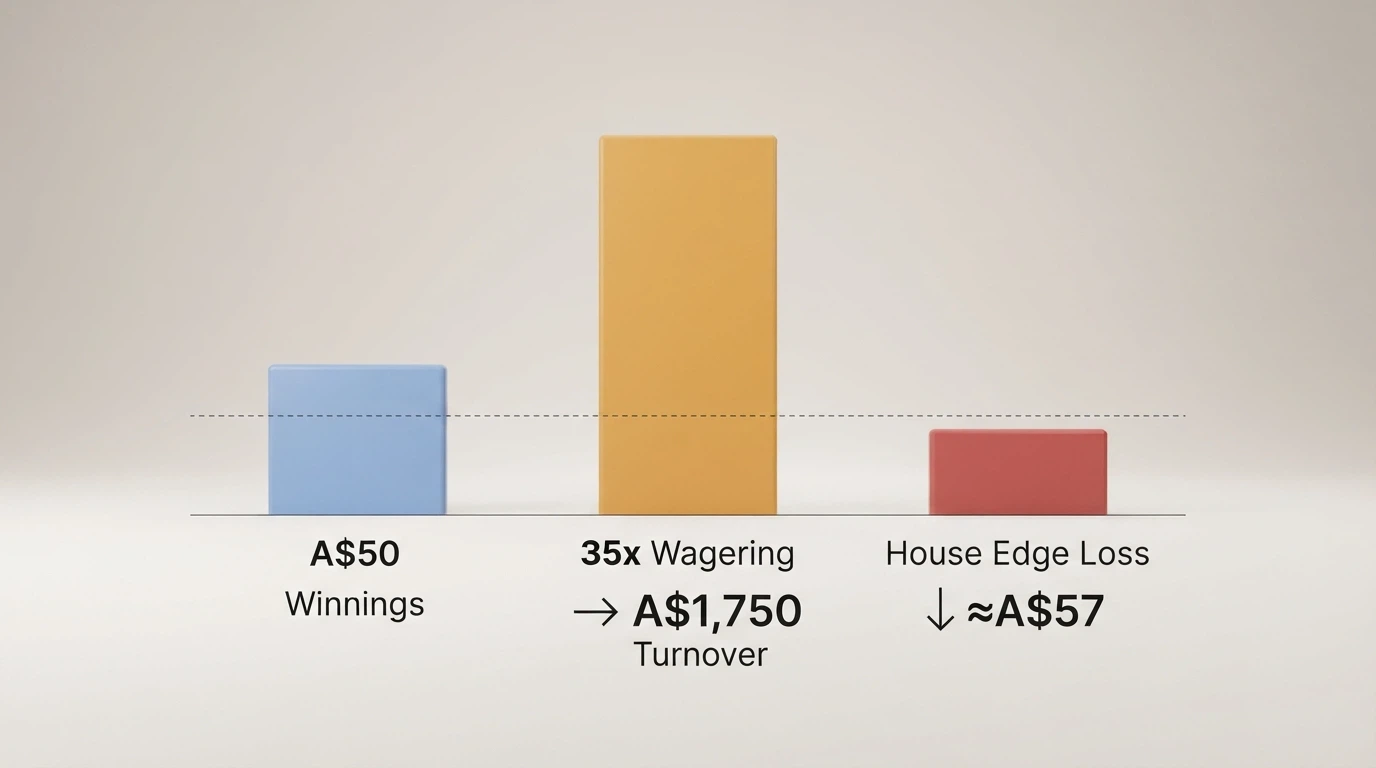
The current Australian-facing range runs from 30x to 60x, with most offers sitting between 30x and 50x. The reasonable benchmark is 30x to 35x — at that level, a player with average luck has a fighting chance of clearing the requirement and ending up with a balance the cashout cap will actually let them withdraw. Anything above 50x makes the offer practically unclearable for most players, because the expected house-edge loss over the required turnover is larger than the winnings the bonus started with.
Game contribution rates are the second half of the wagering picture. Standard video pokies contribute 100% of every A$1 wagered toward the requirement. Progressive jackpot pokies contribute 0% to 10% — almost always 0% on the major titles because the operator does not want a player clearing wagering by spinning the highest-volatility game in the lobby. Table games typically contribute 10%, sometimes less. Live dealer games are almost always excluded entirely.
A wagering requirement is therefore not just a multiplier — it is a multiplier restricted to a category of games, weighted at 100% inside that category and at zero or near-zero outside it.
Maximum cashout caps: why a A$200 win might pay A$100
The cashout cap is the second gate, and it bites after the wagering has cleared. Even a player who runs the bonus perfectly — clears the requirement, ends up with a balance above the cap — cannot withdraw more than the cap states. The excess stays with the casino.
The current range on Australian-facing offers runs from A$50 to A$200. Most operators sit at A$100 or below. The cap interacts with the wagering to make a large win from no-deposit spins structurally impossible: the player has to risk a meaningful share of the bonus balance to clear the wagering, which means most sessions end with the balance hovering near the cap rather than far above it.
An offer with no cashout cap is a genuine differentiator. GladiatorsBet, one of the operators surfaced in this year’s search results, advertises 100 free spins at 35x wagering with no maximum cashout stated. That combination is rare — the usual trade is a lower wagering multiple paired with a tight cap, or a higher multiple paired with a generous cap, but not both at once.
Bonus expiry: you have 24 to 72 hours to use your spins
The clock on a no-deposit free-spins offer runs twice. The spin credit itself expires within 24 to 72 hours of being credited — anything not played in that window is gone. The bonus funds, once the spins have converted to a balance, then run for 7 to 30 days depending on the operator.
Missing either deadline forfeits everything. A player who plays the spins inside 48 hours but does not clear the wagering inside the 30-day bonus-fund window loses the bonus balance and any remaining winnings. A player who clears the wagering but lets the spins expire first never gets to play at all.
Which pokies your free spins work on (and which don’t)
Free spins are almost never valid on every pokie in the lobby. The operator selects one or two eligible titles — most commonly a Pragmatic Play release such as Big Bass Bonanza, Sweet Bonanza, Gates of Olympus or a RealTime Gaming title such as Cash Bandits or Achilles — and locks the spins to those games. The selection is not random; it is the operator’s choice of which pokie best absorbs the bonus exposure.
Progressive jackpot pokies are almost always excluded from free-spins eligibility. A player clearing wagering on a high-volatility jackpot title would burn through the requirement too quickly and risk a large payout the operator has not priced into the bonus. Table games typically contribute 10% toward wagering, sometimes less, and live dealer games are almost always excluded. Playing an ineligible game with bonus funds can void the bonus entirely under most terms.
The eligible-pokie rule interacts with the contribution-rate rule to define the entire play area of the bonus. Outside that area, the wagering clock does not move.
Free spins on sign-up: how they differ from no-deposit offers
“Free spins on sign-up” and “no-deposit free spins” are sometimes used interchangeably, and they are not the same thing. “Free spins on sign-up” is the broader category — it can describe an offer that credits spins simply for creating an account, or it can describe a deposit-gated welcome package where the spins are released after the first deposit clears.
The differentiator is whether a deposit is required to claim the spins or to withdraw any winnings. A true no-deposit offer credits the spins before the player has deposited, and lets the player clear the wagering and reach a withdrawal threshold without ever depositing. A deposit-gated offer either credits the spins only after a deposit, or requires a deposit before any withdrawal can be processed — the “no deposit” language in the marketing refers to claiming, not to playing through to cash.
The terms page distinguishes the two. If the terms state “minimum deposit A$20 to withdraw”, the offer is not a true no-deposit offer in the way the headline implies.
The Offshore Pokies Operators Australians Are Using — and What Each One Offers in 2026
The operators below are ranked by estimated AU traffic share where that share is confirmed, and otherwise by search popularity. Every operator on this list is offshore. No Australian online casino licence exists, so none of these brands can be licensed in Australia for the product they sell.

| Operator | Estimated AU market share among offshore casinos |
|---|---|
| Rocket Play | 9.4% |
| Skycrown | 8.55% |
| Royal Reels | 2.51% |
| WinSpirit | 1.55% |
| Stake | 1.28% |
| Rainbet | 1.28% |
| FairGO | 0.8% |
| Uptown Pokies | — |
| Golden Pokies | — |
| The Pokies.net | — |
Market share reflects traffic volume among offshore casinos accessible from Australia. It says nothing about legality — high share is evidence of traffic, not of regulatory standing.
How these operators were selected and ranked
The ranking draws on two sources: independent traffic data, which tracks AU traffic to offshore casinos, and public search popularity for the operator names themselves. The order is by confirmed AU traffic share where available, then by online search popularity.
Every operator on this list is offshore because no Australian online casino licence exists. The ranking does not convert offshore status into a quality signal. The Pokies.net, with the highest enforcement exposure of any operator here, sits at number 10 precisely because traffic share and search popularity are blunt measures — they show where Australians go, not where they should go.
Where a particular bonus term — wagering multiple, max cashout, eligible pokie, bonus validity — could not be independently confirmed for an operator, the operator’s own entry below states this. The gaps are the point.
Other pokies brands Australians search for — and why they are not in this comparison
Australians also search for Ace Pokies, Dinkum Pokies, Pocket Pokies, House of Pokies, Pokies Parlour, Pokies Lounge, 24 Pokies and Wild Pokies. These names frequently appear in online searches, and several have an established Australian-facing brand presence. They sit outside this ranked comparison because their specific no-deposit bonus terms could not be independently confirmed during our research — a comparison row with guessed wagering and a guessed cashout cap would be less reliable than excluding the brand entirely.
A player searching for any of those brands should apply the same three-point test covered in the legal section below before claiming any offer: does it offer online pokies (offshore), does it ask for credit card or crypto (offshore), and is it on BetStop (offshore, since BetStop does not connect to offshore casinos).
Rocket Play
Rocket Play holds the largest estimated share of Australian offshore casino traffic at 9.4%, the top position on this list. Its product is the standard offshore casino package: video pokies, table games, live dealer and a sportsbook. The platform is offshore — no Australian online casino licence exists for the product, and Rocket Play’s licence jurisdiction was not independently confirmed in this research pass.
Specific no-deposit free-spins terms for Rocket Play — spin count, wagering multiple, eligible pokie, max cashout — were not confirmed. Before claiming any Rocket Play welcome offer, the player should check the wagering figure, the maximum cashout cap and the eligible-game list on the operator’s own terms page before signing up. The large traffic share says nothing about whether the bonus terms are competitive.
A 9.4% share is a traffic ranking, not a recommendation. Rocket Play’s bonus exposure is unverified.
Skycrown
Skycrown holds the second-largest estimated AU offshore traffic share at 8.55%. It is the highest-traffic operator on this list with at least one independently confirmed no-deposit figure: 100 no-deposit free spins, with mobile phone number verification required at the claim stage. The licence jurisdiction is reported by industry sources as Curaçao, though this was not independently verified against a regulator register.
The 100-spin figure is a competitive position relative to the 10-to-100-spin range that dominates the market. The phone verification step is now standard for serious offers of this size, and a player should expect it. Wagering multiple, max cashout cap and bonus validity for Skycrown’s offer were not independently confirmed and need to be checked on the operator’s own terms page.
Skycrown is the clearest confirmed free-spins offering on the list — but the confirmed part is the spin count and the verification step, not the wagering arithmetic that decides what you actually keep.
Royal Reels
Royal Reels holds an estimated 2.51% AU offshore market share. Its product is the standard offshore casino offering, and its specific no-deposit bonus terms — spin count, wagering, max cashout, eligible pokie — were not independently confirmed in this research pass.
What is confirmed is structural: Royal Reels is offshore, no Australian online casino licence exists for the product, and the player’s protection is whatever the operator’s terms page states. Before claiming any welcome offer at Royal Reels, a player should check the wagering figure (looking for the 30x–35x reasonable band), the maximum cashout cap, the eligible-pokie list and the bonus-fund validity window directly on the operator’s terms page.
A 2.51% share puts Royal Reels in the middle of the offshore pack. Like many brands of this size, specific bonus terms remain unconfirmed.
WinSpirit
WinSpirit holds an estimated 1.55% AU offshore market share, sitting just above the operators that drop below 1%. Its product is the standard offshore casino package, and its no-deposit bonus terms were not independently confirmed.
WinSpirit sits in the same evaluation position as Royal Reels and several other operators on this list: the market-share and search results confirm that Australian players are landing on the site, but the specific terms of the no-deposit welcome offer — the wagering multiple, the cashout cap, the eligible pokies, the bonus validity — are not confirmed and need to be checked on the operator’s own terms page before any claim.
A 1.55% share is a smaller slice of the offshore market, but the unverified status of the bonus terms is the same as for the larger operators.
Stake
Stake holds an estimated 1.28% AU offshore market share, tied with Rainbet at the same figure. Its licence jurisdiction is reported by industry sources as Curaçao, though this was not independently verified against a regulator register. Stake is a crypto-native platform, which means its bonus structure differs from the traditional free-spins casino model — it leans heavily on rakeback, reload bonuses and sportsbook promotions rather than the credit-a-block-of-spins pattern of the larger RTG and Pragmatic Play casinos.
The crypto-native structure is worth understanding before claiming any Stake offer. A no-deposit free-spins-style promotion at Stake is more likely to take the form of a rake-based bonus or a sportsbook free bet than a 100-spin welcome credit on a Pragmatic Play pokie. Specific terms for any current Stake no-deposit promotion were not independently confirmed.
Stake is a crypto-native platform, which means its bonus structure differs from the traditional free-spins casino model — it leans heavily on rakeback, reload bonuses and sportsbook promotions rather than the credit-a-block-of-spins pattern of the larger RTG and Pragmatic Play casinos. It does not fit the standard no-deposit profile.
Rainbet
Rainbet holds an estimated 1.28% AU offshore market share, tied with Stake. Its product is the standard offshore casino offering, and its no-deposit bonus terms were not independently confirmed.
Rainbet sits in the same evaluation position as WinSpirit: the traffic-share data confirms Australian players are landing on the site, but the specific no-deposit welcome-offer terms are not confirmed. Before claiming, a player should verify the wagering multiple, the cashout cap and the eligible games on the operator’s own terms page.
A 1.28% share puts Rainbet in the lower tier of the offshore operators Australians use. Its bonus exposure is unverified.
FairGO
FairGO holds an estimated 0.8% AU offshore market share, the smallest of the operators with confirmed share data on this list. Its game library runs on RealTime Gaming (RTG), one of the longer-established casino software providers for offshore-facing casinos, and its licence jurisdiction was not independently confirmed.
The RTG provider backbone is a known quantity — RTG’s catalogue includes long-running titles such as Cash Bandits, Achilles, Bubble Bubble and Aztec’s Millions, which are staples on RTG-powered casinos. Specific no-deposit bonus terms for FairGO were not independently confirmed.
FairGO is the smallest-traffic operator on this list with a confirmed game-provider backbone. The RTG library is a structural feature, not a recommendation. Its bonus exposure is unverified.
Uptown Pokies
Uptown Pokies is the most data-rich operator on this list. Its no-deposit welcome package has been cross-referenced across multiple sources and consists of an A$50 no-deposit bonus supplemented by free spins on selected RTG titles. The wagering requirement on the bonus is 60x, sitting at the top of the 30x–60x range that dominates the market and well above the 30x–35x reasonable benchmark. The maximum cashout cap on no-deposit winnings is A$100 to A$150.
The 60x wagering is the critical number. At 60x on A$50 in bonus winnings, the required turnover is A$3,000 — and the expected house-edge loss over A$3,000 of play at a 96% RTP is roughly A$120, more than double the bonus the offer started with. The A$100–A$150 cashout cap then clips any balance that survives the wagering. The arithmetic does not favour the player.
Uptown Pokies is offshore, with a Curaçao licence reported in industry data and an RTG game library. The offer is the most documented on this list, and the documentation tells an unflattering story. A player comparing Uptown Pokies against any other operator on this list is comparing a documented 60x wagering with unverified terms — and the documented terms are at the harshest end of the market.
Golden Pokies
Golden Pokies is the operator with the highest confirmed no-deposit free-spins count on this list: 150 no-deposit free spins, with up to A$30 in promotional bonus cash during promotional periods. The operator is offshore, and a 100% match bonus on first deposit is also reported.
The 150-spin figure is the largest confirmed no-deposit spin count in the comparison. Wagering multiple, max cashout cap, bonus-fund validity and eligible-game list for Golden Pokies were not independently confirmed — a player should verify these on the operator’s own terms page before claiming.
A 150-spin no-deposit offer is the headline number on this list. The headline is real. The arithmetic that converts 150 spins into a withdrawable balance is not confirmed.
The Pokies.net
The Pokies.net is the highest-risk operator on this list. Its A$10 no-deposit bonus has been cross-referenced, but the operator has been blocked 90+ times by the ACMA. The 90+ blocking events are the most enforcement exposure of any operator in the comparison.
The A$10 no-deposit figure is small in absolute terms — significantly smaller than Uptown Pokies’ A$50 or the headline 100–150-spin offers elsewhere on the list. What makes The Pokies.net structurally different from the rest is not the size of the bonus but the regulatory record. An ACMA-directed block can cut off Australian access to the site with a balance still on deposit. The Pokies.net’s 90+ blocking record is direct evidence of how often the operator has fallen foul of Australian enforcement.
A player weighing The Pokies.net against the rest of this list is weighing a small A$10 no-deposit offer against an enforcement record that no other operator on the list matches. The arithmetic of the A$10 bonus is whatever the terms state; the arithmetic of the blocking risk is the chance that the site disappears overnight.
Online Pokies Are Illegal in Australia — Here’s What the Law Actually Says
Every operator on this list is offshore because no Australian online casino licence exists. The Interactive Gambling Act 2001 prohibits the supply of online casino games — online pokies, table games, live dealer — to persons in Australia. The Interactive Gambling Amendment Act 2017 strengthened that prohibition and gave the ACMA enforcement and blocking powers. The Interactive Gambling Amendment (Gambling Reform) Bill 2026, passed on 19 August 2026, will tighten the regime further from 1 January 2027.
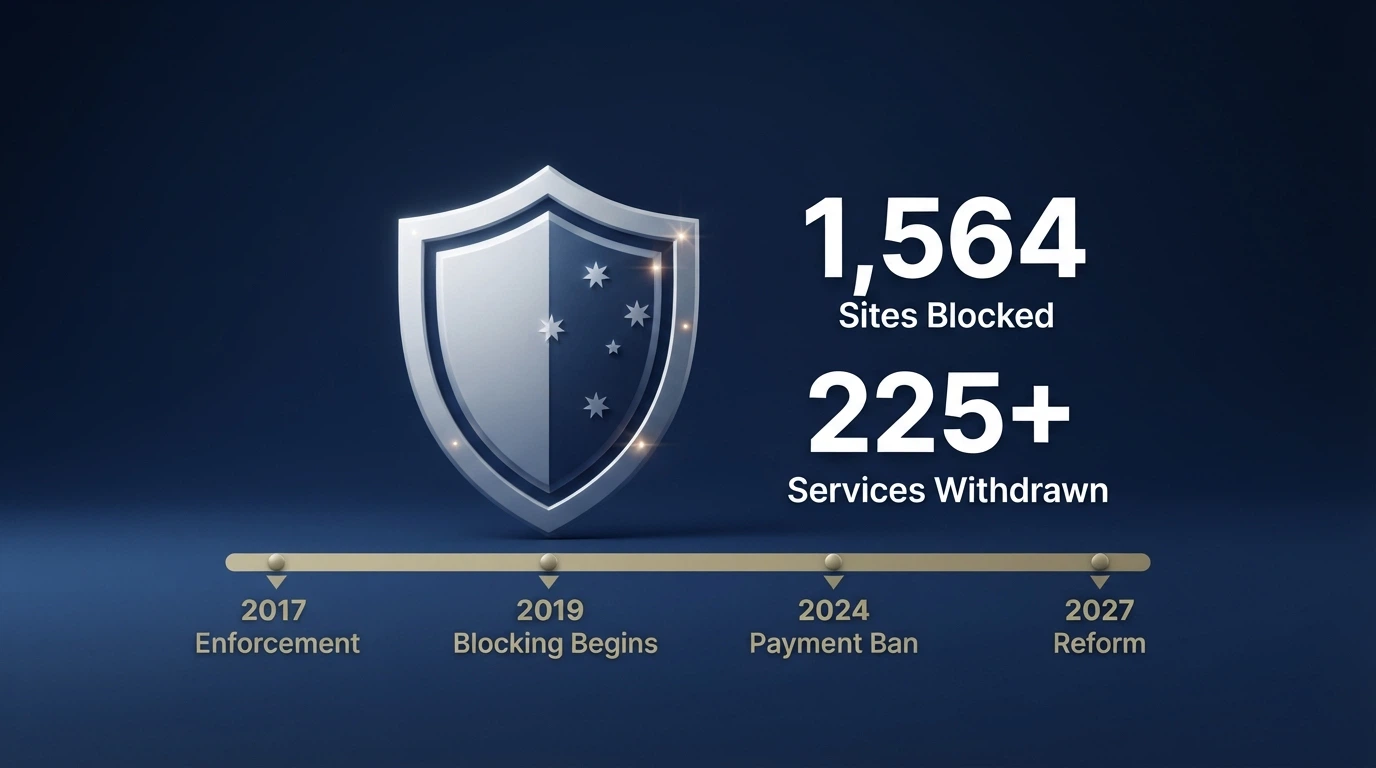
The individual player is not prosecuted under the IGA. The Act targets the provider. A person in Australia who plays at an offshore casino commits no offence under the Act itself. The cost of using an offshore site is not criminal — it is consumer-protection. There is no Australian recourse if the operator refuses a withdrawal, voids a win, or closes an account with a balance still on it.
The Interactive Gambling Act and the ACMA: who regulates what
The IGA is the federal prohibition. The ACMA, the Australian Communications and Media Authority, enforces it. The ACMA investigates complaints, issues formal warnings, refers operators for civil penalty proceedings, and directs Australian ISPs to block illegal sites at the DNS level.
The IGA divides interactive gambling services into two categories. Prohibited: online casino games, online pokies, and in-play betting on a sporting event once it has started. Permitted and licensable: wagering on races and sport placed before the event begins, lotteries, and keno — through operators licensed by a state or territory. The Northern Territory Racing and Wagering Commission, administered through Licensing NT, is the de facto national licensor for online wagering, and the large Australian online bookmakers hold NT licences.
In Q4 2025 alone, the ACMA looked into 483 enquiries and complaints, completed 23 investigations into 45 gambling sites, found 69 breaches of the IGA, issued 10 formal warnings, and blocked 133 websites. The breaches broke down into 38 for providing a prohibited interactive gambling service, 26 for providing an unlicensed regulated interactive gambling service, and 5 for advertising a prohibited or unlicensed service. The ACMA is active, and the pace of enforcement is not slowing.
Licensed vs offshore: how to tell which is which
A three-point test separates licensed Australian wagering from offshore casinos.
The first point is the product. If the operator offers online pokies — slots, video pokies, jackpot games — it is not licensed in Australia for that product, because no Australian online casino licence exists. It is offshore by definition.
The second point is the payment method. Since 11 June 2024, credit cards, credit-related products and cryptocurrency have been banned as payment for online wagering in Australia. An operator that asks for a credit card or crypto deposit is signalling that it sits outside Australian rules. The legal alternatives are debit card, PayID and bank transfer.
The third point is BetStop. BetStop — the National Self-Exclusion Register — binds roughly 150 Australian-licensed wagering services. If the operator is not on BetStop, it is not licensed for Australian wagering, and it is not covered by the register’s protections. An offshore casino is not connected to BetStop, regardless of whether the site claims to support responsible gambling.
NT-licensed bookmakers are the licensed contrast. They hold state/territory licences for racing and sport, they accept PayID and debit card only, they appear on BetStop, and they do not offer online pokies. The licensed market in Australia is wagering on races and sport, not online casino games.
The credit card and crypto payment prohibition — what the ban means in practice
The ban on credit cards, credit-related products and cryptocurrency as payment for online wagering took effect on 11 June 2024. The penalty for an operator that fails to enforce it is up to A$247,500. The ban sits inside the broader prohibition on online casino games — the product itself is illegal, and the payment-method ban closes a common entry path to it.
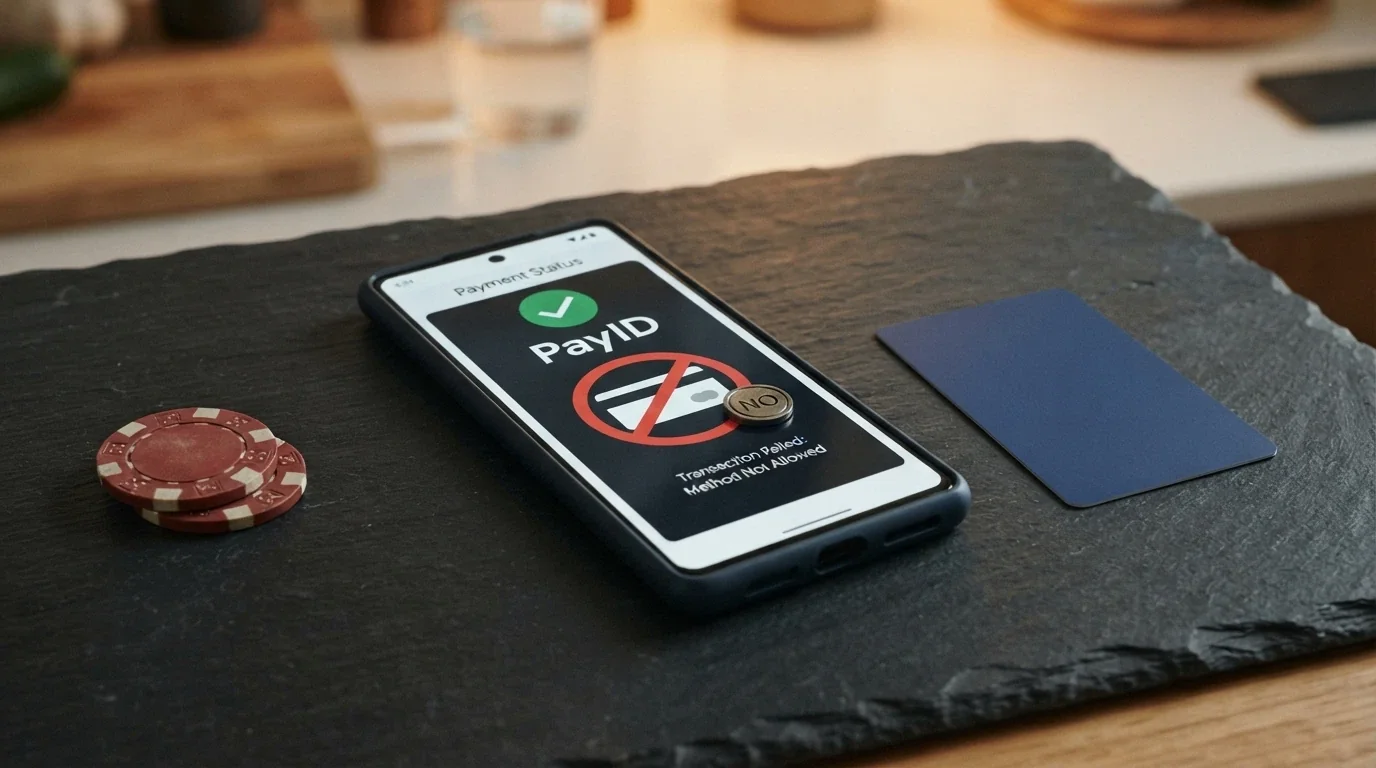
The practical signal is direct. An Australian player asked for a credit card number or a crypto wallet address by a gambling site is being served by an operator outside Australian rules. The legal payment routes — debit card, PayID, bank transfer, BPAY — are the only ones an Australian-licensed operator will accept, and an offshore operator will usually offer at least one illegal method alongside the legal ones.
PayID is the fastest legal alternative for Australian players. Deposits through PayID appear in a casino balance within 30 seconds; the typical minimum is A$10 and the typical maximum is A$5,000 to A$10,000 per transaction. Where the operator accepts PayID, it does so as a licensed wagering service — offshore operators do not connect to PayID.
Crypto’s share of total AU pokies volume sits at about 22% in 2026, but that share reflects offshore operator dominance rather than legality. The payment-method ban applies to crypto on licensed platforms, and crypto’s 22% volume figure is the size of the offshore market the ban is pushing against.
The 2026 gambling reform: what changes on 1 January 2027
The Interactive Gambling Amendment (Gambling Reform) Bill 2026 passed Parliament on 19 August 2026. Its measures commence on 1 January 2027. The reform strengthens the existing prohibition — it does not create a new one, and it does not legalise any form of online casino gambling.
From 1 January 2027, the advertising environment tightens. No more than three wagering ads per hour between 6:00 am and 8:30 pm. No wagering advertising from 15 minutes before a live sporting event until 5 minutes after it ends. Radio ads are barred during school drop-off and pick-up times. Broadcasting sporting odds is banned outright. Online wagering ads are shown only to logged-in, confirmed-over-18 users who have not opted out. No wagering advertising inside sports venues or on player or official uniforms. Athletes, celebrities and influencers are barred from promoting wagering products.
From the same date, direct marketing of inducements is prohibited for 14 days after a customer signs up, for 3 months after a person deregisters from BetStop, and indefinitely for customers identified as at risk of gambling-related harm.
From the same date, banks and payment providers gain express authority to block transactions to illegal gambling operators. The DNS-level blocking the ACMA already directs is augmented by transaction-level blocking at the banking system.
Every provision above is from 1 January 2027, not current law. The reform is real, it passed, but it is not yet in force.
What you risk playing at an offshore casino: no recourse, no protection, no BetStop
The cost of using an offshore pokies site is consumer risk, not criminal risk. The IGA does not prosecute the player. The ACMA does not pursue individuals. The cost is that the protections Australian consumer law offers simply do not reach offshore operators.
No ACMA recovery of disputed funds. If an offshore operator refuses a withdrawal or voids a win, the player has no Australian regulator to complain to. The ACMA can investigate the operator’s breach of the IGA, but it cannot compel a payout from an offshore company.
No BetStop coverage. BetStop blocks access to roughly 150 Australian-licensed wagering providers. An offshore casino is not on the list. Self-excluding from BetStop does not stop an offshore account from accepting deposits.
Account access can be cut off at any time. DNS-level blocking directed by the ACMA can make a site unreachable from an Australian connection overnight. A player with funds sitting in an offshore account at the moment of a blocking event has no Australian avenue to recover the balance.
The operator can refuse withdrawal or void a win with no Australian remedy. The operator’s terms page is the only contract, and the operator is the only interpreter of it.
The legal payment ban signals the operator’s status. The credit card and crypto ban is in part a consumer-protection measure — a tell that an operator asking for either is offshore.
How to Protect Yourself — Limits, Self-Exclusion and Where to Get Help
The player-protection tools in this section are the licensed-Australian response to a market that, for online pokies specifically, has no licensed operators to apply them to. They are the practical levers available to anyone in Australia whose gambling is causing concern — regardless of whether that gambling is happening on a licensed wagering platform or on an offshore casino.
BetStop — the national self-exclusion register and what it actually covers
BetStop is the National Self-Exclusion Register. It went live in August 2023. As at 31 July 2026, it had 67,480 registrations, of which 41,290 exclusions were still active — more than 60% of everyone who has ever registered remains excluded. 78% of registrants are under 40. 38% chose lifetime exclusion.
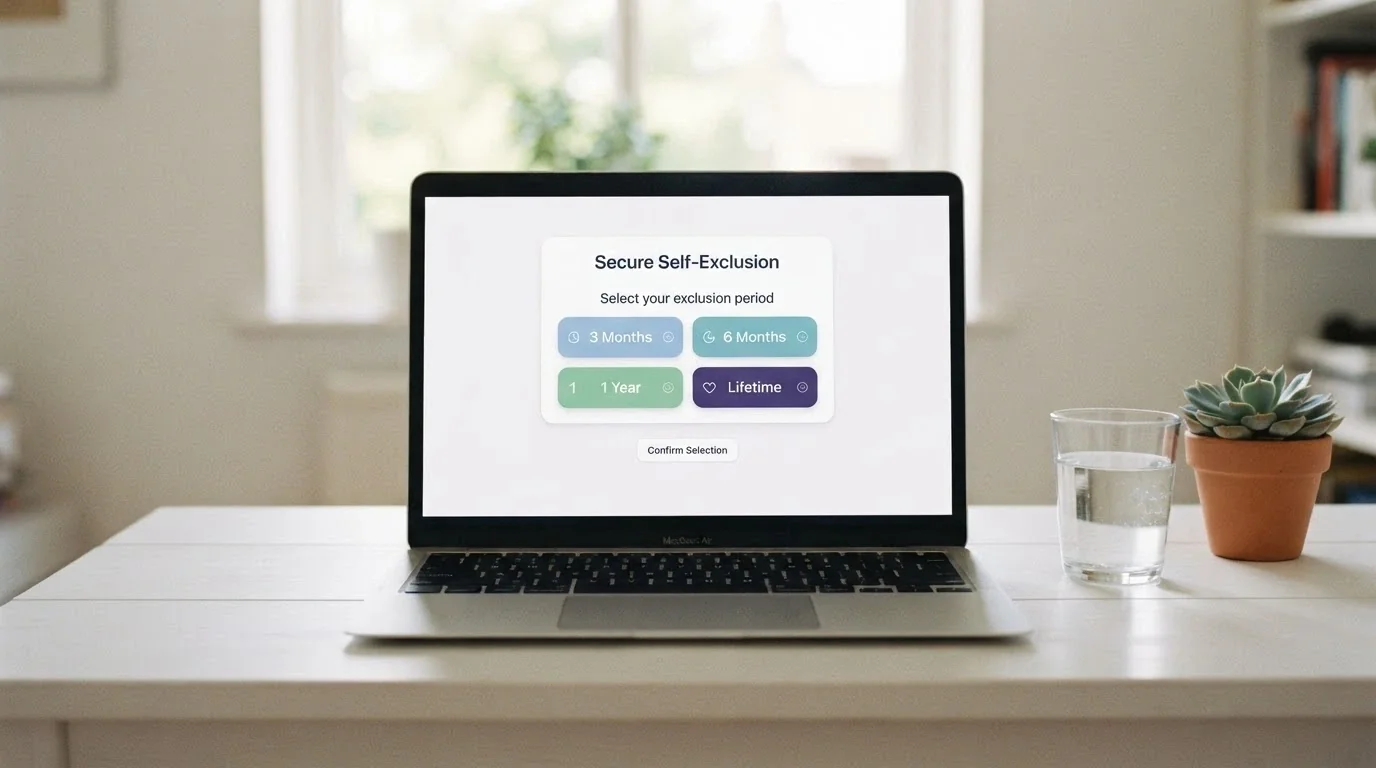
BetStop binds Australian-licensed wagering providers only. According to the ACMA, “if you self-exclude, you will be excluded from all of the approximately 150 licensed wagering providers in Australia.” Offshore casinos are not connected. BetStop will not block a deposit to Skycrown, Uptown Pokies, The Pokies.net or any other operator on this list.
Registration is available for a minimum of 3 months up to a lifetime. The choice is the registrant’s. A 3-month exclusion can be extended; a lifetime exclusion cannot be reversed.
BetStop is the strongest player-protection tool Australia has for wagering, and it is genuinely effective within its scope. The gap is that the offshore casinos that dominate the no-deposit free-spins market sit outside its scope entirely.
Deposit limits, time limits and activity statements — the tools licensed operators must offer
Australian-licensed wagering operators are required to offer customer-set deposit limits, take-a-break and time-out tools, and activity statements under state and territory conditions. A player can set a daily, weekly or monthly deposit cap on a licensed account, take a 24-hour to 30-day time-out, or request an activity statement that itemises deposits, withdrawals and net position over a chosen period.
These tools are not available as legal requirements on offshore casinos. An offshore operator may offer some of them voluntarily, but the player has no Australian recourse if the operator fails to honour a limit. A deposit cap set on an offshore account is a promise the operator can break.
For a player who wants the protections Australian law actually provides, the licensed wagering market is where they sit. For online pokies specifically, that market does not exist.
Spotting the signs: when pokies stop being entertainment
The prevalence data makes the stakes concrete. Approximately 3.29 million Australians aged 5 and over are affected annually by their own or another person’s gambling, including approximately 1.38 million adult affected others. An estimated 1,970,000 Australian adults are classified as having at-risk or problem gambling.
13.0% of the Australian population — an estimated 2,857,000 people — were experiencing some form of gambling harm from their own gambling behaviours as of March 2026, according to Roy Morgan Research. 15.1% of Australians are experiencing some form of gambling harm either from their own or others’ gambling. Risky gambling increased from 13.7% in 2024 to 19.4% in 2025, while overall participation slightly declined. More than half (56.1%) of individuals who gambled mainly participated online in the past 12 months. The annual health loss associated with gambling-related harm in Australian adults is estimated at over 400,000 Years Lived with Disability.
The behavioural signs matter more than the statistics. Chasing losses — depositing again to recover a session that ended badly — is the single most reliable warning sign. Hiding the size of the gambling spend from family or household is a second. Playing longer than planned, returning sooner than planned, or escalating the stake size to chase a bigger outcome are all signals that the activity has stopped being entertainment.
The link to offshore accessibility is direct. The easier it is to deposit, the shorter the gap between impulse and action, the harder it is to interrupt the pattern. Offshore operators that accept crypto and credit card are removing the friction that licensed operators are required to keep.
Where to get help: 1800 858 858 and the full support network
The single most important number on this page is 1800 858 858 — the National Gambling Helpline. It is free, confidential, and staffed 24 hours a day, 7 days a week. Online chat and counselling are available through Gambling Help Online.
The full support network includes:
- National Gambling Helpline: 1800 858 858 — free, confidential, 24/7, Australia-wide
- Gambling Help Online: gamblinghelponline.org.au — online chat and counselling 24/7
- BetStop: betstop.gov.au — National Self-Exclusion Register, from 3 months to lifetime
- National Debt Helpline: 1800 007 007 — help with the financial consequences of gambling
- Healthdirect: healthdirect.gov.au/gambling-addiction — information and support resources
- Gambler’s Help: 1800 858 858 — Victorian service, same national number
- ReachOut — peer workers available online for young people
Every one of these services is free. Every one of them is confidential. Every one of them is staffed by people who have worked with Australians in the situation the reader is in.
How We Selected and Ranked These Operators
The selection draws on two sources: independent traffic data for offshore casinos accessible from Australia, and online search popularity for the brands Australian players are actively looking for.
The ranking is by confirmed AU traffic share where available, then by public search popularity. Market share reflects traffic and revenue, not legality. A high share is evidence of traffic, nothing else. Every operator was checked against the ACMA framework: no Australian online casino licence exists, so every operator is offshore by definition, regardless of the licence jurisdiction they hold elsewhere.
Bonus terms were cross-referenced across multiple sources where possible. Where terms could not be independently confirmed — a wagering multiple, a max cashout figure, an eligible-pokie list — the operator’s own entry above states this. The gaps are deliberate. A bonus term that cannot be confirmed is a bonus term that should not be carried forward into the article as if it were known.
The methods above are qualitative, not quantitative. This article does not apply weighted scoring across bonus terms, payout speeds, or game-library depth, because the underlying data does not support it. Where an operator’s terms are unconfirmed, the comparison leaves the gap visible rather than filling it with a guess.
What This Means for Your Next Pokies Session
Three structural facts sit underneath everything on this page.

Online pokies are illegal in Australia under the Interactive Gambling Act 2001. There is no Australian online casino licence. The 2026 reform strengthens that prohibition from 1 January 2027; it does not create an exemption.
Every operator on the comparison above is offshore. The player is not prosecuted, but neither is the player protected by Australian consumer law, by BetStop, or by ACMA recovery of disputed funds. An operator asking for a credit card or crypto deposit is signalling its offshore status.
No-deposit free spins are mathematically engineered to pay out a fraction of their advertised value. The wagering requirement, the cashout cap and the expiry window together convert the headline number into a real number that is usually between A$10 and A$50 — and the expected house-edge loss over the required turnover can exceed the spin value entirely.
The practical question is not whether the offers work. They do — that is what the wagering and the cashout cap are designed to do. The question is whether the reader wants to play anyway, and on what terms.
If the reader plays, the verification checklist is short. Check the wagering multiple — the 30x–35x band is reasonable, anything above 50x is not. Check the maximum cashout cap — A$100 or below is the usual range, and an offer with no cap is rare and worth noticing. Check the eligible-pokie list and the bonus-fund validity window. Verify the payment methods the operator accepts — credit card or crypto means offshore.
If the reader is concerned about their own play, the helpline is staffed right now. 1800 858 858 is free, confidential, and answered 24 hours a day, seven days a week. Gambling Help Online, BetStop and the National Debt Helpline are all free and all confidential.
The most valuable number on this page is not the spin count and is not the wagering multiple. It is the helpline.
Frequently Asked Questions
What is the maximum I can withdraw from no-deposit free spins in Australia?
Most Australian-facing no-deposit offers cap withdrawals at A$50 to A$200, with most sitting at A$100 or below. Anything above the cap is retained by the casino even if the wagering requirement has been cleared. Operators without a stated cashout cap are rare and worth noting.
Can I use PayID or crypto to deposit at Australian online pokies sites?
PayID deposits land in an account within about 30 seconds at most operators and are the fastest legal deposit method for licensed Australian wagering. Crypto is banned as a payment method for online wagering under Australian law since 11 June 2024, so any operator asking for crypto is offshore and outside Australian rules.
How do I check if an online pokie’s RTP is genuine?
The pokie provider’s official site lists the RTP for each title — Pragmatic Play publishes RTP figures for Big Bass Bonanza, Sweet Bonanza, Gates of Olympus, Wolf Gold and Sugar Rush, all in the 96.5% range at the maximum setting. Operators can run lower RTP variants, so check the in-game help screen rather than relying on the headline figure.
What is the difference between no-deposit free spins and no-deposit bonus cash?
Free spins are credits on a specific pokie at a fixed per-spin stake, expiring within 24 to 72 hours. Bonus cash is a credit to the account balance that can usually be played on multiple games but still carries a wagering requirement. Both convert to withdrawable cash only after the wagering requirement has been cleared.
Are winnings from online pokies taxable in Australia?
No. Betting and gambling winnings are not assessable income under section 6-5 of the ITAA 1997, and gambling losses are not deductible under section 8-1, unless the person is carrying on a business of betting or gambling. No Australian case has held the winnings of an ordinary punter assessable.
Why do some pokies sites advertise credit card deposits when they are banned in Australia?
Because those sites are offshore and outside Australian law. The credit card and crypto ban applies to Australian-licensed wagering operators only. An offshore casino that accepts credit cards is doing so in breach of Australian rules, and the player has no Australian recourse if a dispute arises.