
Litecoin Casinos in Australia: What the Offshore Reality Actually Looks Like in 2026
Every casino on this page runs from outside Australia. That is the single most important fact about a “Litecoin casino Australia” search, and it is worth sitting with for a moment before the bonus figures and payout speeds do their work on the reader. The Interactive Gambling Act 2001 makes it illegal to provide online casino games to anyone in Australia, and no licence exists federally or in any state or territory for that product — so the only casinos accepting Australian residents operate from Curaçao, Anjouan, Cyprus or another offshore jurisdiction. Litecoin deposits are the obvious tell: licensed Australian wagering operators have been banned from accepting cryptocurrency since 11 June 2024, and any gambling site asking an Australian for LTC is, by that fact alone, outside the local rules. The page that follows ranks ten of those operators against each other, names what each one actually offers, and explains what a player gives up in exchange for the speed and anonymity crypto delivers.
Current as of 29 October 2026 · Verified against ACMA enforcement records, the Federal Register of Legislation, and operator terms pages
Table of Contents
- Your Litecoin Casino Is Offshore — Here’s What That Means
- The 10 Offshore Litecoin Casinos Australian Players Use in 2026
- Why Your Litecoin Casino Bonus Is Tougher to Clear Than It Looks
- Litecoin Deposits and Withdrawals: Faster Than a Bank, but Outside the Rules
- Provably Fair, No KYC, and What Crypto-Only Casinos Deliver
- Playing Litecoin Casinos on Your Phone in 2026
- The Pokies, Live Tables and Provably Fair Slots Worth Your LTC
- The Law Is Clear: Online Casino Is Illegal to Provide in Australia
- Where to Get Help When Gambling Stops Being a Choice
- How We Picked and Ranked These Litecoin Casinos
- What the Australian Player Should Actually Do With This Information
- Frequently Asked Questions
Your Litecoin Casino Is Offshore — Here’s What That Means
A “Litecoin casino” is, in plain terms, an online casino that accepts deposits and pays withdrawals in LTC — usually alongside Bitcoin, Ethereum, USDT and a handful of other coins. In Australia, that label is a synonym for offshore operation. The reason is not that the technology is exotic. It is that the product underneath — online casino games, online pokies, live dealer tables, in-play betting — is prohibited to provide to anyone in Australia under sections 5 and 15 of the Interactive Gambling Act 2001. There is no licence category, no application form, no state-by-state carve-out. The Commonwealth has not licensed an online casino because it has explicitly decided not to.
The crypto payment ban, in force since 11 June 2024 under the Interactive Gambling Amendment (Credit and Other Measures) Act 2023, sharpens that reality. The amendment prohibits credit cards, credit-related products and digital currency as payment for licensed online wagering, and an operator that fails to enforce it faces penalties of up to $247,500. The licensed bookmakers — Sportsbet, bet365, the NT-licensed racing operators — cannot accept your Litecoin. They process PayID, Osko, BPAY, debit card and bank transfer only. A site that does accept LTC has decided to take the offshore path, and with it the absence of any Australian consumer protection.
The technical profile of Litecoin is what makes it the workhorse of those offshore sites. LTC transactions confirm in 2 to 10 minutes and carry network fees under A$0.10 per transfer — cheaper and faster than Bitcoin, simpler than running a stablecoin through an exchange. For an Australian player moving money offshore, the combination is hard to beat on raw metrics, and that is precisely why it is the dominant rail for this corner of the market. The trade-off is everything around the transaction: no Australian regulator, no BetStop coverage, no recourse if the operator refuses a withdrawal, and the standing risk that ACMA will add the site to its blocking list with a balance still on it.
What “Litecoin Casino” Actually Means in Australia
Calling a site a “Litecoin casino Australia” implies a licensed, locally regulated product. The label is misleading. The Interactive Gambling Act 2001 prohibits providing online casino games, online pokies and in-play sports betting to anyone physically in Australia. No operator holds an Australian online casino licence because no such licence has ever been issued — not by ACMA federally, not by any state or territory gaming regulator. The 2026 Gambling Reform Bill, passed by Parliament on 19 August 2026 with commencement on 1 January 2027, does not change this. It adds payment-blocking authority for banks and tightens advertising rules; it does not open an online casino licensing window.
What the offshore sites do hold are licences from jurisdictions that welcome international online gambling business. Curaçao’s reformed framework is the most common, covering BitStarz, Wild.io, Ricky Casino, Vave, Oshi and Stake in the set on this page. Anjouan licences StoneVegas. CoinCasino, Goldex and Jackbit are either unverified in publicly available sources or operate from Cyprus without a confirmed gaming authority in the snippets available this round. None of these jurisdictions provides Australian consumer protection. As one industry assessment puts it, your protection comes from operator reputation, provably-fair systems, audits and tested payout data, not an Australian regulator.
The player’s legal position is different from the operator’s. The IGA targets the provider of a prohibited interactive gambling service, not the customer using one. An individual Australian playing at an offshore casino is not prosecuted, and there is no case in which a recreational punter’s winnings have been treated as assessable income under section 6-5 of the ITAA 1997. The phrase “not illegal for you” is accurate as far as it goes. It does not mean safe, regulated, or recoverable when something goes wrong. It means you are outside the consumer law framework that licensed wagering operators operate under, and any dispute resolution runs through the offshore operator’s own terms page.
How an LTC Deposit Turns Into Casino Credit
The mechanics of an LTC deposit are simple enough to describe in a few sentences. The player buys or holds Litecoin on an exchange (CoinSpot, Swyftx, Binance and others serve the Australian market) or in a self-custody wallet, then copies the casino’s deposit address and sends the chosen amount. The Litecoin network confirms the transaction in 2 to 10 minutes and the casino’s payment processor credits the player account, usually in a balance denominated in the operator’s house currency.
How that balance is held is where operators diverge. Most offshore crypto casinos credit the account in crypto-equivalent units, so the value of the bankroll moves with the LTC price while you play. Ricky Casino is the exception in the set on this page: it holds the balance in an Australian-dollar equivalent once the deposit is credited, which means a Litecoin price swing mid-session does not touch what you have on the table. For a player funding in crypto but uncomfortable with two-axis volatility (game outcomes plus coin price), that AUD-pegged structure is a meaningful difference, not a marketing line.
The withdrawal path reverses the same rails. The player requests a payout in LTC, the casino’s payment team processes it, the transaction is broadcast to the Litecoin network, and the funds arrive in the player’s wallet after confirmation. Test data from Betsquare’s June 2026 review showed a WestAce Litecoin withdrawal clearing in 18 minutes with a network fee of A$0.08, and Esports.gg’s May 2026 test cleared a 2.5 LTC cashout from BitStarz in 12 minutes. The general ceiling for crypto at offshore casinos accessible from Australia is 30 minutes or less end-to-end, which is the order of magnitude faster than any fiat rail at a licensed Australian bookmaker.
The 10 Offshore Litecoin Casinos Australian Players Use in 2026
The table below ranks the ten operators against each other. The comparison runs within this set only — every one of them is offshore, none holds an Australian online casino licence because none can exist, and the “best” in this context means the one that best fits a particular reader’s priorities, not a safety endorsement. The ranking reflects the verified bonus value, wagering terms, payout speed and licence transparency in the data available; for the operators whose snippets did not carry a confirmed bonus or wagering figure, the cell is left as the article-language no-data marker rather than an invented number. The operator write-ups below the table do the work the table cannot: they explain what each offer really costs, what the reader is giving up, and where the verification stops.
| Operator | Licence | Welcome Bonus | Wagering | Free Spins |
|---|---|---|---|---|
| BitStarz | Curaçao (reformed) | Up to A$10,000 + 180 FS across 4 deposits | 40x bonus | 180 |
| Wild.io | Curaçao (reformed) | 350% + 200 FS across 3 deposits | 40x bonus only | 200 |
| Ricky Casino | Curaçao | Up to A$7,500 + 550 FS across 10 deposits | 50x | 550 |
| CoinCasino | Unconfirmed | 200% up to $30,000 + 50 Super Spins | 60x (10% instalments) | 50 |
| StoneVegas | Anjouan | 100% up to $500 + 200 FS | 35x bonus + deposit | 200 |
| Vave | Curaçao | 150% up to 4 BTC + 100 FS | — | 100 |
| Jackbit | Unconfirmed (Cyprus) | 100 FS with $50 deposit | 1x on FS winnings | 100 |
| Oshi Casino | Curaçao | — | — | — |
| Goldex Casino | Unconfirmed | Up to $57,000 | — | — |
| Stake | Curaçao | No match; 1x deposit turnover | 1x | — |
The licence column tells the same story ten times: offshore, mostly Curaçao, none Australian. The bonus and wagering columns are where the operators actually differ, and the spread is wider than the marketing suggests — a 35x multiplier on a combined bonus-and-deposit sum is a structurally different proposition from a 1x multiplier on a $100 capped free-spin win. Cells left as em dashes reflect specifications that the available snippets did not confirm, and the operator write-ups name those gaps rather than paper over them.
BitStarz
BitStarz is the operator with the most verified data in the set, and the one the comparison table has the most to say about. The Curaçao licence (reformed framework) covers a 4,500-game library spanning Pragmatic Play, BGaming and Hacksaw, with Litecoin supported alongside BTC, ETH, USDT and DOGE. The welcome package is up to 5 BTC or A$10,000 plus 180 free spins across four deposits, with 40x wagering on the bonus amount, a $5 maximum bet during wagering, and a 7-day clearing window on the welcome package.
The free-spin offer is structured tightly. The 180 spins are tied to a designated slot and must be opened and played within one day of crediting — a short window that catches players who deposit, log off, and come back the next morning to find the spins gone. The good news is that there is no maximum cashout limit on deposit-bonus winnings, so what you clear is yours to withdraw, subject to the bonus terms. Slots contribute 100% to wagering, while table and live games contribute only 5% — a common offshore pattern that effectively confines bonus play to the pokies if you want any chance of clearing the requirement in the 7-day window.
The 12-minute Litecoin cashout in Esports.gg’s May 2026 test is the fastest in the set, and the WestAce result of 18 minutes in Betsquare’s June 2026 testing places BitStarz and WestAce at the top of the speed ranking. The headline is honest, and so is the underlying offer: a 40x multiplier on $2,500 of bonus across the four deposits means $100,000 of turnover before the bonus funds are withdrawable, an amount that would take even an aggressive slot player several long sessions to put through a game that contributes 100%.
The right reader for BitStarz is a player who values verified payout speed and a deep game library, who will not be ambushed by the 7-day window or the 5% live-game contribution, and who is comfortable with the 40x multiplier as the cost of admission. If table games are your preference, the 5% contribution makes the welcome bonus effectively unclearable, meaning this site is built for pokie players exclusively.
Wild.io
Wild.io is the most feature-rich crypto-native platform in the set. The Curaçao licence covers a 9,000-game library from 57 providers and 12 supported cryptocurrencies. The welcome package is 350% plus 200 free spins across three deposits, with 40x wagering on the bonus funds only — the deposit itself is excluded from the turnover calculation, which is a meaningful structural advantage over offers that multiply on the combined sum.
The provably fair and transparency features are where Wild.io separates itself. Original titles (Crash, Plinko, Dice, Mines) run on a cryptographic verification system that lets the player confirm each result was not retroactively altered. The free spins arrive in five batches on BGaming titles, and the platform supports a Fun Play demo mode so a player can test a game without staking real money. The live RTP tracker on the casino page shows real-time return percentages, a feature few competitors offer and one that signals a willingness to publish what most operators prefer to leave opaque.
The withdrawal ceiling is “under 10 minutes” with zero fees, a number verified in multiple tests and a structural commitment to the speed crypto is sold on. The 2022 launch date means Wild.io is not a legacy brand, but the 9,000-game library and 57-provider count place it competitively against operators several years older.
The right reader for Wild.io is a crypto-native player who plays pokies and the provably fair originals, who values the live RTP transparency and demo mode, and who is comfortable with a higher percentage match (350%) in exchange for a multiplier that applies to bonus only rather than the combined sum. The trade-off is that 350% is a high headline; clearing it still requires a real-money grind, and the same caveats about wagering contribution percentages apply.
Ricky Casino
Ricky Casino is the AUD-hedge play in the set. The Curaçao licence covers a welcome package of up to A$7,500 plus 550 free spins spread across ten deposits, with the first deposit delivering 100% up to A$500 plus 100 free spins. Wagering is 50x, the minimum deposit is A$30, and the structural advantage — the reason an LTC-funded player should know about Ricky Casino — is that the balance is held in an Australian-dollar equivalent after the crypto deposit clears. A player who funds in LTC and then sees the coin drop 15% during a session does not lose 15% of their bankroll. The balance stays pegged to AUD until withdrawal.
The 50x wagering is on the steeper end of the set, and the ten-deposit structure of the welcome package rewards a long-term relationship rather than a one-shot bonus claim. For a player planning to play through ten deposits, the per-deposit turnover is manageable; for a player claiming the first deposit bonus and leaving, the 50x on the first-deposit match is a heavy lift.
The right reader for Ricky Casino is an Australian player who wants to fund in crypto for the speed and fee profile but does not want the coin price to be a second volatility axis on top of the casino’s house edge. The AUD-pegged balance is the most underrated feature in the set, and the ten-deposit structure suits a player who plans to stay. The 50x wagering and the small first-deposit cap (A$500) are the trade-offs.
CoinCasino
CoinCasino runs the heaviest terms in the set. The 200% match up to $30,000 plus 50 Super Spins sounds enormous until the structure is read: 60x wagering on the bonus, releasing in 10% instalments for every 6x of the deposit wagered, with a 14-day clearing window. A player who deposits $500 and claims the maximum bonus has $1,000 in bonus funds, of which only $100 is unlocked at a time. To unlock the full $1,000, the player has to wager 60x the deposit ($30,000) within 14 days, and any instalment not unlocked by the deadline is forfeited.
The licence is unconfirmed in the publicly available data this round. The operator is described as Telegram-based and no-KYC, which places it on the anonymous end of the offshore spectrum. Free-spin winnings carry 35x wagering, and the spin value is tiered by deposit size — $0.20 per spin for deposits of $10–$99.99, rising to $4 per spin at the $1,000+ tier. A $50 deposit yields 50 spins worth $0.20 each, or $10 in nominal spin value before any outcome.
The right reader for CoinCasino is a player specifically seeking a no-KYC, Telegram-accessible platform and who understands the instalment structure. For the standard player comparing bonus value to effort, the 60x on a 10% instalment release is the most punishing combination in the set, and the 14-day window is tight against a turnover requirement that high. The licence uncertainty is the additional reason to treat this as a higher-risk choice.
StoneVegas
StoneVegas is the lowest standard wagering multiplier in the set — 35x — but it applies to the combined bonus-plus-deposit sum, which is a different calculation than Wild.io’s bonus-only 40x. The Anjouan licence covers a 100% match up to $500 plus 200 free spins on the first deposit, with a $10 minimum.
A player who deposits $500 and claims the maximum $500 bonus has $1,000 in play, all of which carries the 35x turnover requirement. That is $35,000 of wagering to clear the bonus — more than Wild.io’s 40x on bonus only ($20,000 on the same $500 bonus). The “lower multiplier” headline is accurate; the “lower cost” headline depends entirely on whether the deposit is part of the turnover base.
The right reader for StoneVegas is a player who values the Anjouan licence profile and the $10 minimum deposit, and who has read the bonus terms carefully enough to know that 35x on bonus-plus-deposit is a heavier lift than 40x on bonus only. For a small deposit ($50), the difference is negligible. For a max deposit ($500), it is significant.
Vave
Vave is a Curaçao-licensed crypto-first operator with a 150% match up to 4 BTC plus 100 free spins. The on-chain withdrawal in testing cleared in minutes, consistent with the platform’s crypto-native design. The wagering multiplier was not confirmed in the snippets available this round, which is the reason the comparison table leaves the cell as an em dash rather than an invented figure.
In qualitative terms, the 150% match is mid-pack for the set, and the 4 BTC ceiling is the highest in BTC-denominated terms. A player with a large crypto bankroll who plans to fund in BTC and convert to LTC for play can extract meaningful bonus value; a player depositing A$500 equivalent will see the 150% match deliver A$750 in bonus, which is competitive but not a standout.
The right reader for Vave is a player who values the Curaçao licence and the crypto-first architecture, and who will check the wagering terms on the operator’s own terms page before depositing. The thin data this round is a reminder that “crypto-first” is a positioning claim, not a substitute for verified terms.
Jackbit
Jackbit runs the closest thing in the set to a wager-free bonus. The 100 free spins come with a $50 deposit and a 1x wagering requirement, with a $100 maximum win from the free spins. The licence is unconfirmed in publicly available data; the operator is described as Cyprus-based.
The 1x wagering is structurally unique in the set. A 100% match with 40x wagering on a $500 deposit requires $20,000 of turnover to clear; Jackbit’s 100 free spins require a single turnover of the winnings amount (up to $100) before withdrawal. The maximum win cap ($100) is the trade-off, and the $50 minimum deposit is a higher floor than the $10 standard at StoneVegas or CoinCasino.
The right reader for Jackbit is a player who prefers a low-friction bonus over a high-headline one, and who can live with the $100 cap on free-spin winnings. Testing an offshore casino for the first time? The 1x wagering structure offers a lower risk than traditional match bonuses.
Oshi Casino
Oshi Casino is a Curaçao-licensed crypto casino with an extensive game library and Litecoin support, described in industry sources as a long-running operation. The available data this round is thin on bonus specifics, wagering multipliers and free-spin structures. The operator’s positioning is that of a veteran crypto casino with broad provider coverage and LTC among its accepted coins.
The right reader for Oshi Casino is a player who is comfortable evaluating an operator on the strength of its licence, game library and LTC support, and who will confirm the welcome terms directly on the operator’s site before depositing. The thin data is a reminder that “veteran” is a positioning claim, not a substitute for verified terms.
Goldex Casino
Goldex Casino carries the biggest bonus headline in the set — up to $57,000 — and almost nothing else confirmed in the available data. The licence is unconfirmed, the wagering multiplier is not stated in the snippets this round, the free-spin offer is unconfirmed, and the game count and provider mix are not specified. Litecoin is supported.
A $57,000 bonus headline is the kind of number that should make a reader pause rather than reach for a deposit. At typical crypto casino wagering multipliers (20x–60x), the turnover required to clear a $57,000 bonus ranges from $1.14 million to $3.42 million — a multi-month grind even on the lower multiplier, and well beyond what a recreational player would clear.
The right reader for Goldex Casino is a high-volume player who has independently verified the licence, wagering terms, and game-library specifics, and who understands the difference between a headline number and a real cost. Those who have not conducted independent verification should view the $57,000 figure as a hook rather than a realistic bonus proposition.
Stake
Stake runs a different model from the rest of the set. There is no traditional match welcome bonus; the platform operates on a 1x deposit turnover model with rakeback and cashback replacing the standard match-plus-wagering structure. The Curaçao licence is in place, Litecoin is supported, and the rakeback model means a player receives a percentage of the house edge back rather than chasing a match bonus through a 40x or 50x wagering requirement.
The trade-off is the absence of a headline bonus. A player who values the match-and-wagering structure and the chance to clear a $500 match into withdrawable cash will not find that at Stake. A player who prefers a flat, ongoing rebate over a one-time bonus chase will find the 1x turnover and the rakeback structure more honest, because the player keeps what the player wins without fighting a turnover requirement to extract it.
The right reader for Stake is a player who has decided that traditional match bonuses are not the value they are marketed as, and who prefers a transparent rakeback model. For a player who wants a large first-deposit match, Stake is the wrong operator to be on this page about.
Why Your Litecoin Casino Bonus Is Tougher to Clear Than It Looks
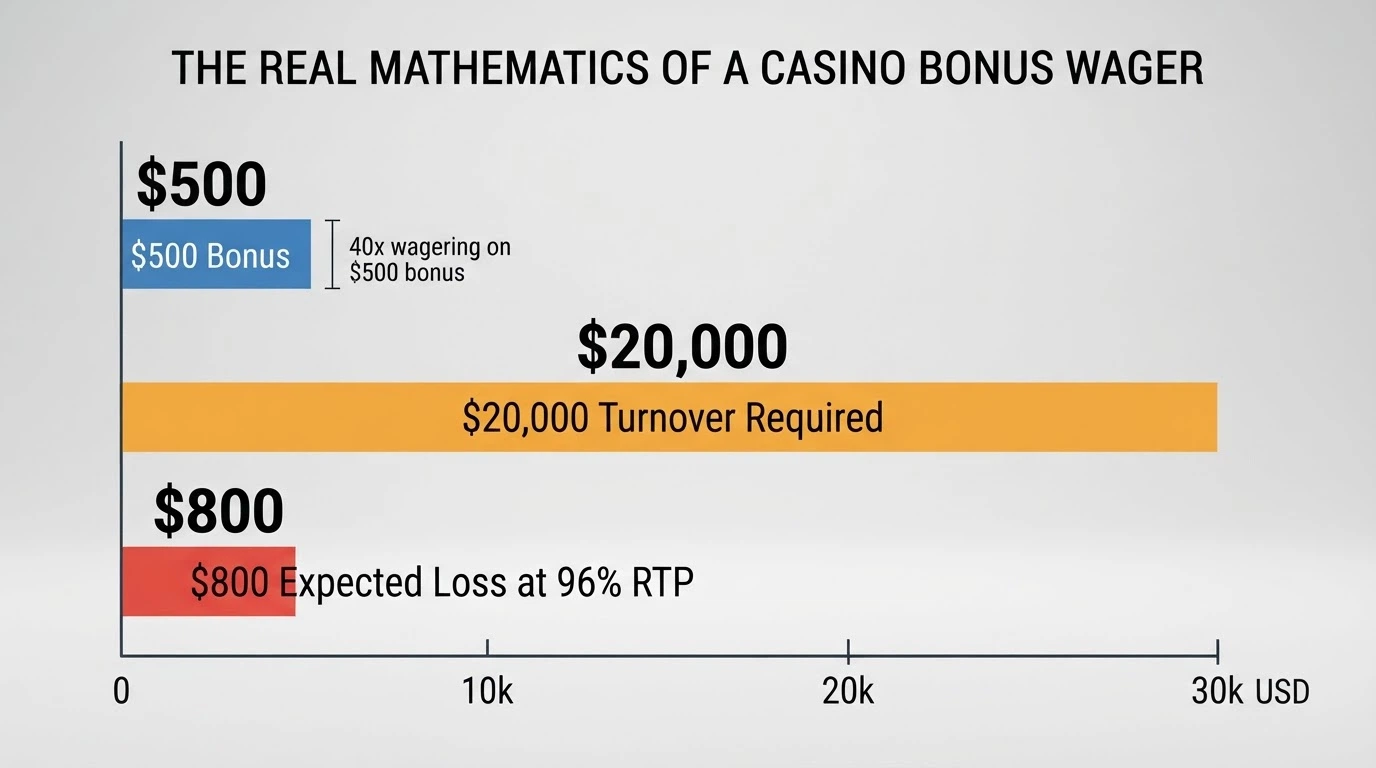
A “40x wagering” line in a bonus terms box is the single most expensive sentence an offshore casino writes, and most players do not read past it. The number is the multiplier, not the dollar cost. A 40x wagering requirement on a $500 bonus means $20,000 of turnover before a cent of the bonus is withdrawable, and that turnover has to be generated by playing games that contribute 100% to the requirement. Slots typically contribute 100%; table games and live dealer typically contribute 5%. The effective turnover at a live blackjack table, in a 40x bonus with 5% live contribution, is not $20,000 — it is $400,000.
The structure of crypto casino welcome bonuses is the same across the industry: a match percentage (100%, 150%, 200%, 350%) on a deposit, with a multiplier (20x–60x) applied to either the bonus alone or the bonus-plus-deposit sum, a maximum bet during wagering (typically $5), and a clearing window (typically 7 to 30 days). Free spins are layered on top, with their own wagering requirements and game restrictions. The headline number is the match. The real cost is the turnover. In the set on this page, the offers range from 1x on a capped $100 free-spin win (Jackbit) to 60x on a 10% instalment release (CoinCasino), and that range describes the difference between a bonus a player has a chance of clearing and one that functions as a marketing line.
Welcome Bonuses: The Big Number, Then the Fine Print
The four terms that determine whether a welcome bonus is real money or marketing copy are the multiplier, the base it applies to, the contribution percentages, and the clearing window. The multiplier is the largest number on the page and the one players remember. The base is what the multiplier multiplies — bonus alone or bonus plus deposit. The contribution percentages determine how much of each dollar wagered counts toward clearing. The clearing window is the time the player has to clear it.
BitStarz applies 40x to the bonus alone, with slots at 100% and table/live at 5%, and gives the player 7 days. Wild.io applies 40x to the bonus alone, with the deposit excluded, and a per-deposit window. StoneVegas applies 35x to the bonus-plus-deposit combined, which is structurally heavier than 40x on bonus only. CoinCasino applies 60x to the bonus, releasing in 10% instalments for every 6x of deposit wagered, with a 14-day window — a structure that requires the player to grind through the entire deposit multiple times over to release the full bonus. The reader who treats the multiplier as the headline has not yet read the bonus terms.
A useful rule of thumb: at slots contributing 100%, clearing a 40x bonus on a $500 deposit requires $20,000 of wagers, which at a 96% RTP and a $1 spin size is approximately 20,000 spins. At 5 seconds per spin, that is 100,000 seconds, or roughly 28 hours of continuous play. The reader who treats the bonus as a free bet has not yet read the math.
Why a 40x Wagering Requirement Is Harder Than It Sounds
The reason a 40x multiplier is harder than it looks is that the multiplier compounds against three things the bonus page does not prominently display. The first is the contribution percentage — the slots 100% / table 5% split means the effective requirement at a live blackjack table is 8x larger, not 1x. The second is the clearing window — a 7-day window on a $20,000 turnover means roughly $2,860 of wagering per day, which is a heavy grind even for a recreational player logging a couple of hours a day. The third is the house edge — a 96% RTP slot returns $0.96 per dollar wagered on average, which is a 4% expected loss over the clearing volume, or $800 on $20,000 of turnover. The expected cost of clearing the bonus is built into the turnover, and the player’s edge does not exist.
The calculation that quantifies this is a simple one. Taking BitStarz’s $500 first-deposit bonus (assuming the player takes the full match) and Gemhalla’s verified 97.17% RTP, the expected loss from clearing a 40x bonus is turnover times one minus RTP, or $20,000 times 0.0283, which is approximately $566. The bonus pays $500; the expected cost of clearing it is $566. On average, the player loses $66 clearing a $500 bonus — and that is the average over many players. The arithmetic is a statistical estimate, not a guarantee for any individual session: variance cuts both ways, and a single run can finish well above or well below the expected cost. The point is that the marketing line and the expected cost are not the same number.
Most players do not clear the full bonus. The clearing window expires, the instalments time out, the player withdraws what they have won and the remainder of the bonus is forfeited. The expected cost calculation describes the players who do clear it; for the players who do not, the bonus is simply a hook that keeps the bankroll in play for longer than it would otherwise be.
Free Spins and No-Deposit Offers: What’s Actually Available
Free spins are the most common sweetener on offshore casino welcome packages, and the featured set delivers them in volume: 180 at BitStarz, 200 at Wild.io, 550 at Ricky Casino, 50 Super Spins at CoinCasino, 200 at StoneVegas, 100 at Vave, 100 at Jackbit. The string attached to each is different, and the reader who treats free spins as a free sample is reading the wrong sentence.
BitStarz’s 180 free spins are tied to a designated slot and must be opened and played within one day of crediting. Wild.io’s 200 free spins arrive in five batches on BGaming titles, and the platform’s provably fair originals (Crash, Plinko, Dice, Mines) sit alongside. CoinCasino’s 50 Super Spins are tiered in value by deposit size, with the $0.20-per-spin tier for small deposits and the $4-per-spin tier for $1,000+ deposits; free-spin winnings carry a 35x wagering requirement. Jackbit’s 100 free spins are the cleanest offer in the set: 1x wagering, $100 maximum win, $50 minimum deposit.
No-deposit bonuses — offers that let a player keep winnings without depositing first — are rare in the LTC casino space, and the featured set does not include a confirmed no-deposit offer among the ten operators. The industry norm is a wagering range of 20x to 60x for no-deposit bonuses, with anything under 30x competitive and anything above 50x functionally difficult to clear, and maximum cashout caps of $100 to $500. A player who finds a no-deposit offer in this market should read the wagering and the cashout cap together, because the cap is usually the binding constraint, not the multiplier.
The reader’s check before claiming any free-spin offer is the same set of questions: which game are the spins tied to, what is the spin value, how long do I have to play them, what is the wagering requirement on the winnings, and is there a maximum cashout. The answers determine whether the offer is worth a deposit or whether the headline number is a marketing line dressed in spin credits.
Litecoin Deposits and Withdrawals: Faster Than a Bank, but Outside the Rules
Litecoin is the fastest mainstream cryptocurrency for casino deposits and withdrawals accessible from Australia. Transactions confirm in 2 to 10 minutes with network fees under A$0.10, and the end-to-end withdrawal at the operators tested in 2026 ranged from 12 minutes (BitStarz, Esports.gg’s May test) to 18 minutes (WestAce, Betsquare’s June test). The general ceiling for crypto at offshore casinos is 30 minutes or less. Compared to the licensed Australian wagering alternative — debit card, bank transfer, PayID, Osko, BPAY, all of which carry identity verification and processing times measured in hours to days — the speed advantage is real and the fee profile is a generation newer.
The trade-off is everything around the transaction. The licensed Australian bookmakers cannot accept your Litecoin; the 11 June 2024 crypto payment ban applies to them. An Australian who is asked for a crypto deposit by a gambling site is, by that act, being served by someone outside the Australian rules. The site is offshore, the funds are offshore, the consumer protection is whatever the offshore operator’s terms page says it is, and the ACMA blocking regime is a standing risk — 1,788 sites blocked as at August 2026, with the operator’s balance still on the blocked domain a real possibility.
Depositing Litecoin: The Steps and the Risks
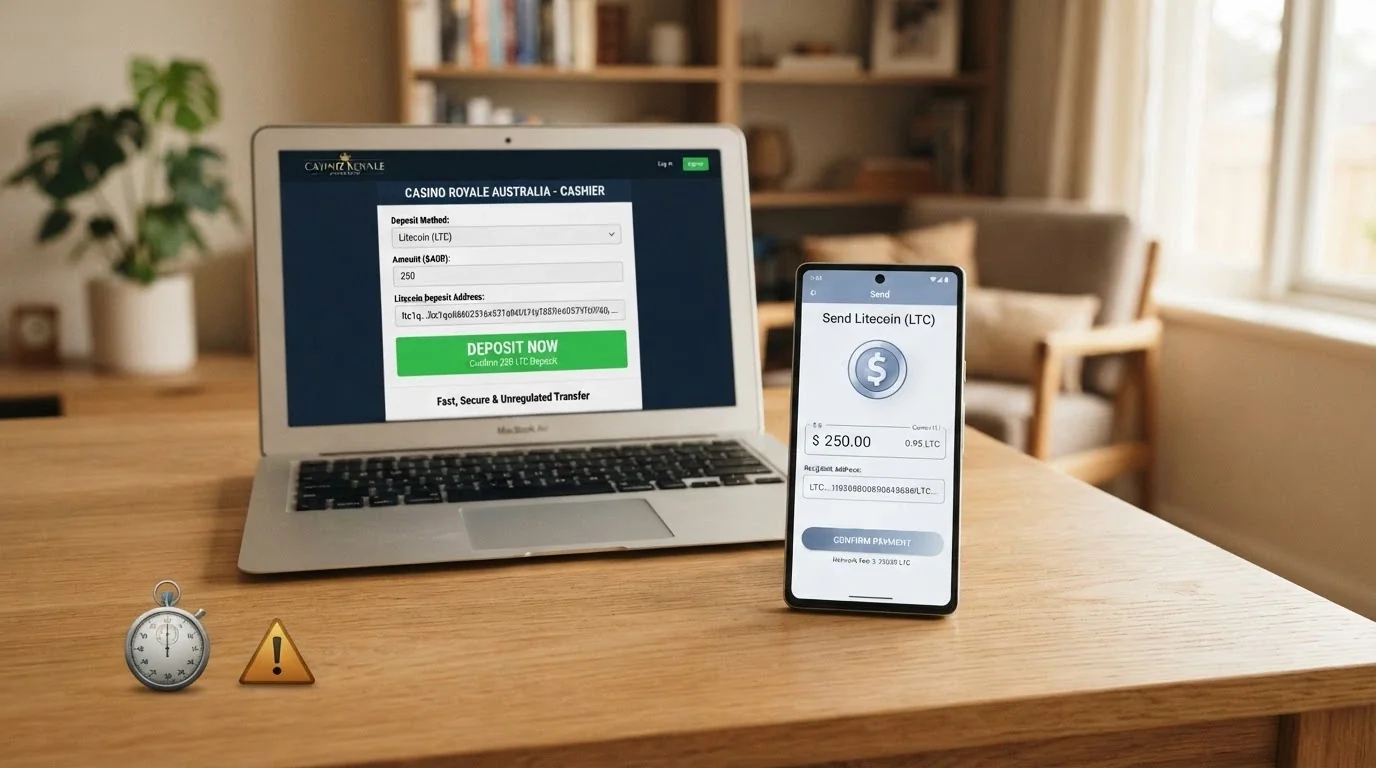
The deposit flow is the same at every operator in the set, and the risks at each step are worth naming individually:
- Buy or hold LTC on an Australian exchange (CoinSpot, Swyftx and others serve the local market) or in a self-custody wallet. The exchange or wallet holds the private keys, depending on the structure.
- Copy the casino’s deposit address from the cashier page. The address is a Litecoin address; sending any other cryptocurrency to it will result in a permanent loss of funds.
- Send the LTC from the wallet or exchange to the casino address. Transactions are irreversible; a typo in the address, or sending to a network the casino does not support, is unrecoverable.
- Wait for confirmations. The Litecoin network confirms in 2 to 10 minutes; the casino’s payment processor credits the account on receipt of the required number of confirmations.
- Play — the balance is credited, in crypto-equivalent or AUD-pegged, depending on the operator.
- Request a withdrawal when ready; the casino processes the payout and broadcasts the LTC transaction to the network.
The risks alongside the steps are not theoretical. A deposit to a wrong address is irreversible, and the casino’s customer support can only return funds it has received. The casino holds the funds offshore, with no Australian regulatory recourse if it refuses a withdrawal or voids a win. The site can be ACMA-blocked with a balance still on it — 1,788 sites have been blocked since November 2019, and the rate of blocking has not slowed. From 1 January 2027, banks and payment providers gain express authority to block transactions to illegal gambling operators, and the practical consequence is that the path from an Australian bank account to a casino deposit — and back — may be harder to walk than it is today.
How LTC Withdrawal Speed Compares to Other Methods
Litecoin is the workhorse of the set, and the speed is the result. Betsquare’s June 2026 test put a WestAce Litecoin withdrawal at 18 minutes with a network fee of A$0.08. Esports.gg’s May 2026 test put a 2.5 LTC BitStarz withdrawal at 12 minutes. Wild.io’s published ceiling is “under 10 minutes” with zero fees. The general industry benchmark is 30 minutes or less for crypto at offshore casinos accessible from Australia.
USDT TRC20 was the fastest in Betsquare’s tests, with a SkyCrown payout clearing in 12 minutes. Bitcoin is slower — confirmations take longer, and the network fees are higher, particularly during congested periods. For an Australian player, the practical choice is between LTC and USDT TRC20, with both delivering the bulk of the speed advantage of crypto over fiat.
The casino-side processing delay is the variable the speed tests do not isolate. A 2-minute blockchain confirmation with a 20-minute manual review queue is a 22-minute withdrawal; a 10-minute blockchain confirmation with an instant automated queue is a 10-minute withdrawal. The operators in the set that publish a withdrawal ceiling (Wild.io, BitStarz) have built the processing layer for speed; the operators that do not publish one are running whatever queue their payment team maintains, which can vary with withdrawal volume and time of day.
The fiat alternative at licensed Australian wagering operators — debit card, bank transfer, PayID, Osko, BPAY — runs on a different timeline. PayID and Osko settle in seconds for deposits, but withdrawals at licensed wagering operators typically take 1 to 3 business days for bank transfer and similar for BPAY. The crypto speed advantage is real, and it is the reason a player who values payout speed ends up on this page at all. The cost of that speed is the absence of the consumer protection that the licensed alternative provides.
Provably Fair, No KYC, and What Crypto-Only Casinos Deliver
Provably fair is the technical answer crypto casinos give to the trust problem that a traditional online casino solves with a regulator and an audit. A provably fair game commits to a server seed before the player places a bet, lets the player provide a client seed, combines the two with a nonce, and produces a result that the player can verify after the fact using the same algorithm. The math is verifiable; the result was not retroactively altered to favour the house. The player does not have to trust a third-party audit; the player can re-run the calculation.
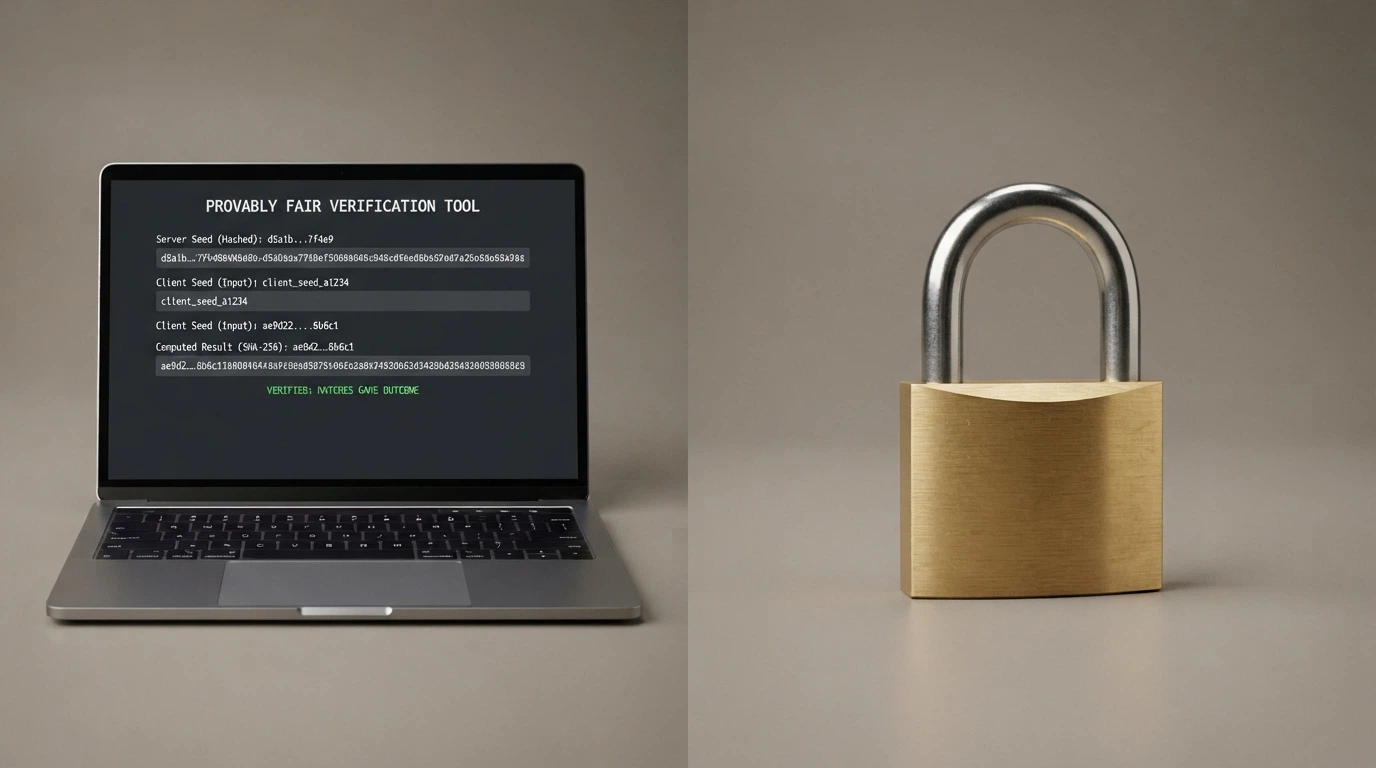
In the set on this page, Wild.io is the standout for provably fair coverage. The platform’s original titles (Crash, Plinko, Dice, Mines) all run on the cryptographic verification system, and the live RTP tracker shows real-time return percentages on the casino page. BitStarz offers provably fair on BGaming slots, a subset of the 4,500-game library. The rest of the set does not publish a provably fair commitment in the data available this round.
The no-KYC end of the spectrum runs from “light KYC for withdrawals” to “no KYC at all.” CoinCasino is described as Telegram-based and no-KYC, which places it at the anonymous end. Operators with light KYC may request identity verification on the first withdrawal or on withdrawals above a threshold. The trade-off is straightforward: a casino that does not verify your identity cannot link you to BetStop, cannot enforce an Australian self-exclusion, and cannot offer the identity-verified pathways that licensed wagering operators use for harm minimisation.
Provably Fair Gaming: What It Is and How to Check It
A provably fair game is built on three values: a server seed (generated by the casino, hashed and shown to the player before the bet), a client seed (set by the player, or randomised by the player’s browser), and a nonce (incremented with each bet). The result is computed from the combination of the three. After the bet, the player can see the unhashed server seed, recompute the result, and confirm it matches the outcome they received.
The verification is a one-time calculation the player can run in a browser, and the cryptographic commitment means the casino cannot change the server seed after the bet without invalidating the hash it published beforehand. The system replaces the third-party audit with a verifiable mathematical relationship. It is not a guarantee of a winning outcome; the house edge still applies, and the game still favours the operator on average. It is a guarantee that the game was not rigged against the player in any particular round.
The game types that support provably fair verification are typically the crypto-native originals — Crash, Plinko, Dice, Mines — and certain slots from providers that adopt the standard (BGaming is the most common in the offshore set). Traditional RNG table games and live dealer games are not provably fair in this sense; they rely on the provider’s audit and the operator’s reputation. Verification-seeking players should focus on provably fair originals, where Wild.io stands as the operator in this set with the broadest coverage.
No-KYC and Anonymous Play: What You Gain and What You Lose
Anonymity at an offshore casino is sold as a feature and functions as a structural risk. A casino that does not verify your identity has no way to check whether you are self-excluded under BetStop, has no way to enforce the responsible-gambling limits a licensed wagering operator applies at the account level, and has no way to link a dispute to a verified person if the operator refuses a withdrawal. The player gains speed (no upload of ID, no waiting for verification) and a reduced data footprint (the casino holds less personal information). The player loses the consumer protection that identity verification at a licensed operator is part of.
BetStop — the National Self-Exclusion Register — recorded 67,480 registrations in its first three years, with 41,290 exclusions still active as at 31 July 2026. 78% of registrants were under 40, and 38% chose lifetime exclusion. The register binds Australian-licensed wagering services only. An offshore casino is not connected to the register and will keep accepting a self-excluded person’s money. From 1 January 2027 the 2026 reform strengthens the register’s operation and bans direct marketing of inducements for three months after a person deregisters from BetStop — but the offshore casino in the no-KYC part of the spectrum is not subject to either the old rules or the new ones.
The practical consequence is that the harm-minimisation tools available to an Australian player at a licensed wagering operator (BetStop self-exclusion, account-level deposit limits, activity statements, take-a-break periods) are not available at an offshore casino. The no-KYC operator may have its own self-exclusion tool, but it is operator-specific, not connected to any Australian register, and enforced only as well as the operator’s own terms page says it is.
Playing Litecoin Casinos on Your Phone in 2026
There is no “Litecoin casino” app in the Australian App Store or Google Play Store for any of the operators in this set. The offshore crypto casino model does not lend itself to a dedicated app distribution channel; the apps that do exist are typically web wrappers around a mobile-optimised site, and the experience they deliver is the same site the player would reach through a browser. The practical reality of mobile LTC play in 2026 is a browser tab on a phone, with the casino’s full game library and cashier accessible from the same responsive layout that serves desktop.
The mobile experience across the featured set is, in qualitative terms, the same as desktop with a smaller screen. Slot games are built for portrait or landscape orientation and play without modification. Live dealer games stream the same feed and work in landscape, though data consumption is higher than for RNG games. The cashier is mobile-optimised, and LTC deposit and withdrawal from a phone wallet (a self-custody wallet app, a mobile exchange app) is the same flow as desktop. The one real difference is push notifications, which a browser does not deliver, and biometric login, which is rare on mobile web. A player who values either feature is choosing between a small set of operators with confirmed dedicated apps and a larger set where the experience is browser-based.
App vs Browser: What Mobile Litecoin Play Actually Looks Like
The absence of a dedicated app in the set is a structural feature of the offshore crypto casino market, not an oversight by the featured operators. Australian app store policies prohibit listing unlicensed gambling apps, and the operators do not hold Australian licences. The mobile experience is therefore a browser experience, and the comparison the reader should make is not “which app” but “which mobile-optimised site.”
The practical differences are minor. A responsive casino site loads the game lobby, the cashier, and the account settings in a layout that adapts to the screen. The game providers in the set (Pragmatic Play, BGaming, Hacksaw, the live dealer studios) build their games in HTML5 and they play the same on a phone as on a desktop. The crypto deposit flow is the same: copy the address, paste into the wallet, confirm, wait for the network. The withdrawal flow is the same: request a payout, wait for the casino, receive the LTC. The data consumption is higher for live dealer and for games with heavy animation, but the difference is the same on any mobile casino site.
A player planning to play on a phone should check the operator’s site in mobile view before depositing, confirm the cashier works on the device, and check whether the wallet app they use supports the LTC network without additional configuration. The rest of the experience is the same as desktop, with a smaller screen.
The Pokies, Live Tables and Provably Fair Slots Worth Your LTC
The game libraries at the featured operators range from 4,500 (BitStarz) to 9,000+ (Wild.io), spanning slots, table games, live dealer, and — at the crypto-native end — provably fair originals. The scale is large enough to be meaningless as a comparison metric; the structural difference between a 4,500-game library from 30 providers and a 9,000-game library from 57 providers is smaller than the marketing implies, because most players play a small subset of any library. The question worth asking is which specific titles are worth a Litecoin deposit, and the answer is the small handful with verified RTPs in the publicly available data.
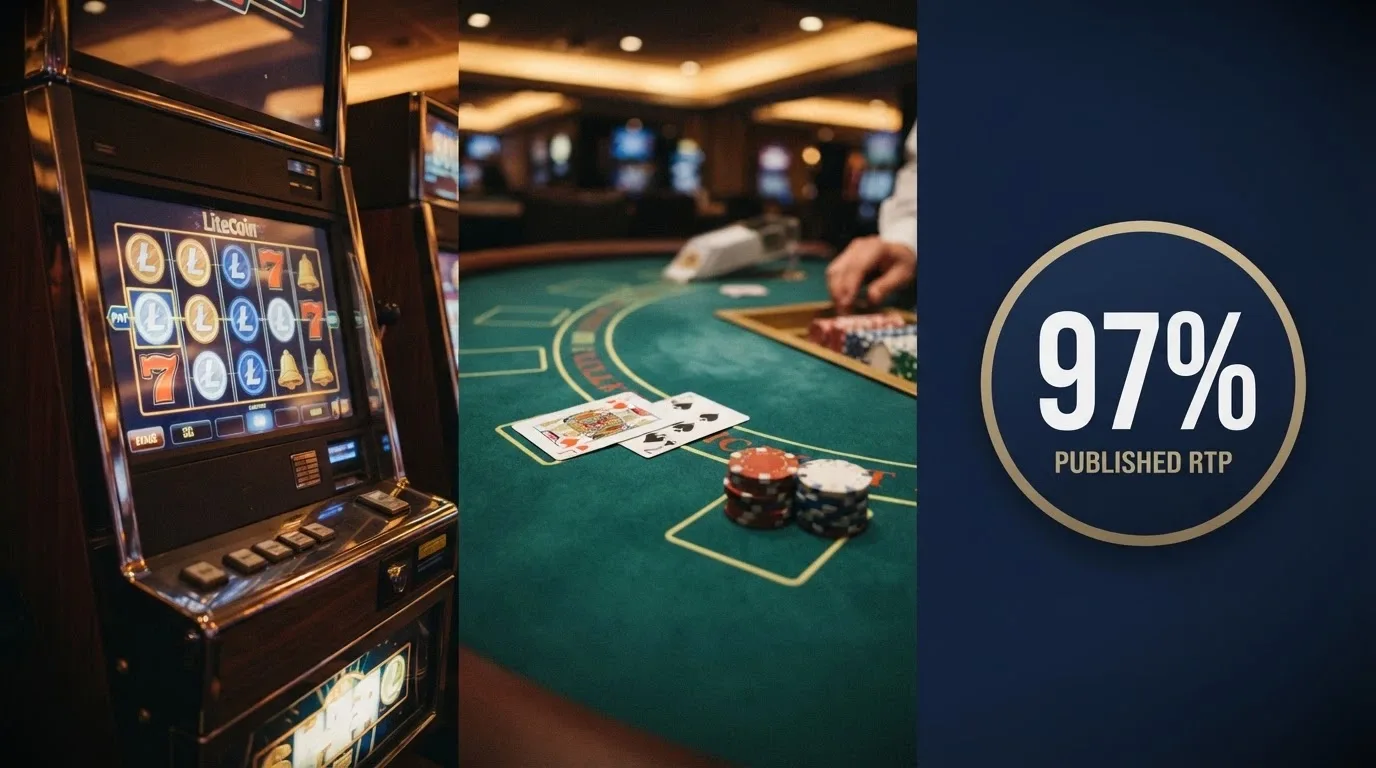
Per-title RTP is the metric the casino industry prefers to leave opaque. A 96% return-to-player means the player loses an average of $4 per $100 wagered over the long run. A 97% return is $3 per $100. The difference is one percentage point, but over thousands of spins it compounds. The reason most operators do not publish per-title RTP is that a 97% slot next to a 94% slot is a decision the player can make, and a casino that earns more on the 94% slot prefers the player not to know. The three titles in the table below are the exceptions in the data available this round, and they are worth playing for that reason.
Litecoin Pokies and Slots with Published RTPs
| Slot Title | RTP | Provider | Available At | Volatility |
|---|---|---|---|---|
| Gemhalla | 97.17% | BGaming | BitStarz | — |
| Cockroach Fortune | 96.07% | — | Wild.io | — |
| Lady Wolf Moon Megaways | 96.75% | BGaming | 7Bit Casino | — |
A 97.17% RTP at Gemhalla means an expected loss of 2.83% of turnover, or roughly A$2.83 per A$100 wagered. Cockroach Fortune at 96.07% is A$3.93 per A$100. Lady Wolf Moon Megaways at 96.75% is A$3.25 per A$100. The differences look small and compound meaningfully: a player running A$5,000 of turnover through Gemhalla loses an expected A$142, while the same turnover through a 94% slot loses an expected A$300.
Volatility data was not available for these titles in the snippets this round, which is why the column is left as em dashes. Volatility matters in a different way than RTP: a high-volatility slot pays less often but in larger amounts, and a low-volatility slot pays more often in smaller amounts. A player with a small bankroll who wants session longevity prefers low to medium volatility; a player chasing a large single win prefers high volatility. RTP and volatility are independent dimensions, and a slot can be high-RTP-and-high-volatility or high-RTP-and-low-volatility; the table does not tell the reader which.
The other 9,000-plus titles in the featured libraries are a black box on per-title RTP. The live RTP tracker at Wild.io is a partial solution, but it shows real-time return rather than theoretical return, and a session’s results can deviate from the theoretical RTP by enough to mislead. Making a real-money decision based on RTP requires focusing on these three verifiable titles.
Live Dealer Tables: Blackjack, Roulette and Baccarat with LTC
Live dealer games are available across the featured set, with blackjack, roulette, baccarat and game-show variants streamed from studios operated by providers like Evolution, Pragmatic Play Live and the live studios of the major slot providers. The games play with real cards, real wheels, and real dealers, broadcast over a video feed to the player’s browser or app. The bet is funded from the player’s casino balance — in crypto or AUD-equivalent — and the winnings are credited the same way.
The critical fine print for bonus play is the contribution percentage. Live games contribute only 5% to wagering at BitStarz, which is the standard pattern in the offshore set. A player who has a 40x bonus and tries to clear it at a live blackjack table is effectively running an 800x requirement, and the bonus becomes functionally un-clearable. The right structure for live dealer play is to play with cash, not bonus, and to ignore the welcome offer if the goal is live table action.
The house edge at live dealer games is the same whether the player funds with LTC or fiat, because the games are the same games with the same math. Blackjack with optimal strategy runs a house edge of around 0.5%; roulette sits at 2.7% (European) or 5.26% (American); baccarat on the banker bet is around 1.06%. The crypto funding does not change the odds. It changes the speed of deposit and withdrawal, and the regulatory environment the player is operating in.
The practical note for mobile play is data consumption. Live dealer streaming consumes more data per minute than RNG slot play, and a player on a limited mobile data plan should factor that in. The same applies on Wi-Fi, where the consideration is bandwidth rather than cost.
Table Games and RNG: What Game Variety Looks Like
The RNG table-game range at the featured operators covers the standard casino staples: digital blackjack (single-hand and multi-hand), roulette (European, American, French), baccarat, video poker (Jacks or Better, Deuces Wild, and variants), craps, and casino poker (Three Card, Caribbean Stud). The crypto-native games at Wild.io — Crash, Plinko, Dice, Mines — are not RNG in the traditional sense; they are the provably fair originals the platform runs on its own in-house engine. They are also the games that support the cryptographic verification described in the section on provably fair gaming.
Demo mode availability is the structural feature that lets a player test a game without risking a deposit. Wild.io confirms a Fun Play mode available across the catalogue. The other operators in the set do not confirm a demo mode in the publicly available data this round, which means the player who wants to test a game before staking will need to check the operator’s own site. For a player new to the offshore casino environment, demo mode is worth verifying before depositing.
The house edge at RNG table games is the same as the live equivalent for the game type (a digital blackjack game has the same 0.5% edge as a live one with optimal strategy), and the difference between RNG and live is the experience layer rather than the math. A player who wants a fast session at a low house edge plays digital blackjack. A player who wants the social layer and the spectacle plays live dealer. Both are available with LTC funding at the operators in the set.
The Law Is Clear: Online Casino Is Illegal to Provide in Australia
The Interactive Gambling Act 2001 prohibits providing online casino games, online pokies and in-play sports betting to anyone in Australia. Section 5 defines the prohibited services, and section 15 sets the penalties. The criminal penalty is 5,000 penalty units per day of contravention, and the civil penalty is 7,500 penalty units per day. The maximum penalty is $360,000 per day for individuals and $1.8 million per day for bodies corporate. The penalty applies to the provider, not the customer; an individual Australian playing at an offshore casino is not prosecuted. The IGA targets the operator of the prohibited service, and the operators on this page are all targets.
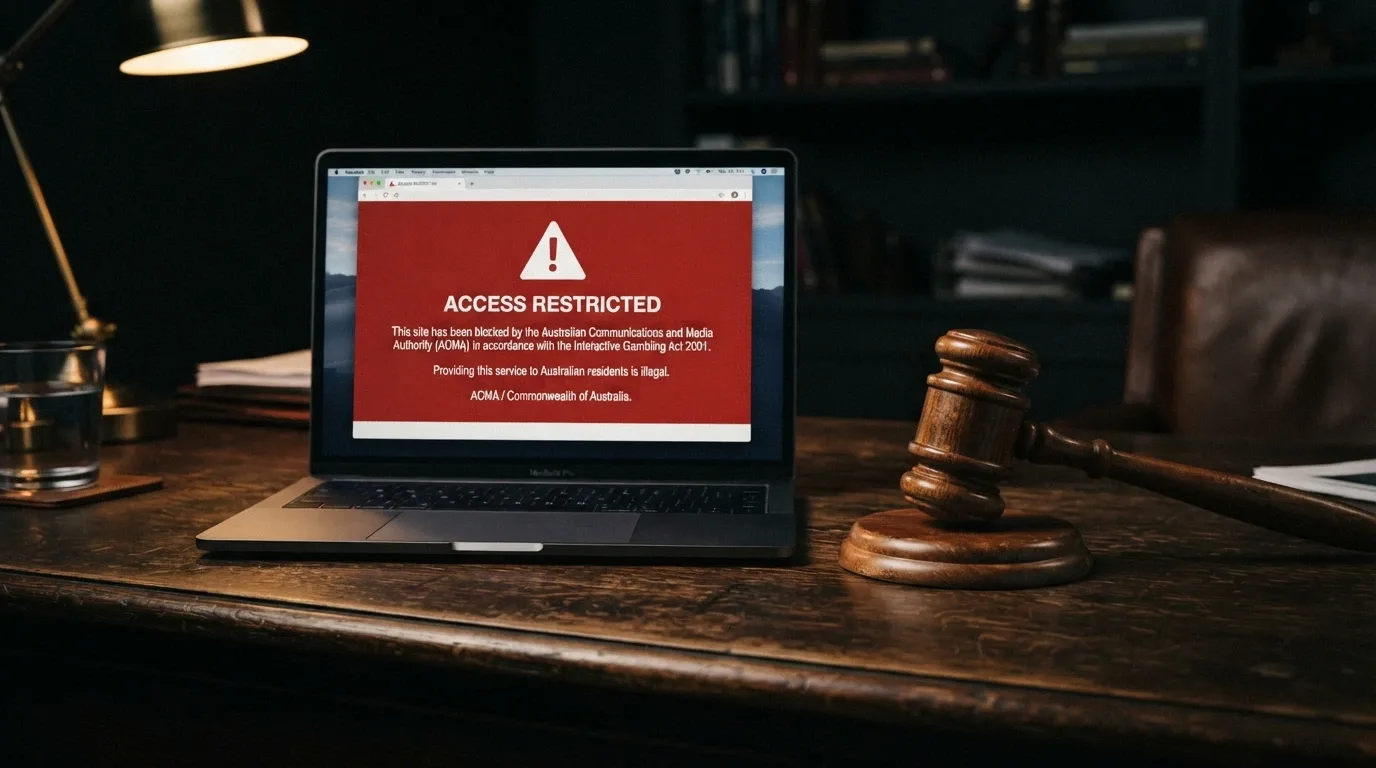
What the law does license is wagering on racing and sport placed before the event begins, lotteries, and keno. The Northern Territory Racing and Wagering Commission, administered through Licensing NT, is the de facto national licensor for online wagering — large bookmakers including Sportsbet, bet365, Ladbrokes and about fifty others hold NT licences running up to 20 years. The licensed product is wagering, not casino. There is no online casino licence in Australia, and the 2026 reform does not create one.
The crypto payment ban, in force since 11 June 2024 under the Interactive Gambling Amendment (Credit and Other Measures) Act 2023, is the second leg of the regime. Credit cards, credit-related products and digital currency are banned as payment for licensed wagering. The licensed Australian bookmakers cannot accept your Litecoin. They process PayID, Osko, BPAY, debit card and bank transfer only, all of which require identity verification and run within Australian consumer protection law. An Australian asked for a crypto deposit by a gambling site is, by that act, being served by someone outside the Australian rules.
The Interactive Gambling Act: No Online Casino Licence Exists
The scope of the IGA’s prohibition is the entire online casino product. Online casino games, online pokies, in-play sports betting — all prohibited to provide to anyone in Australia. What is licensed is pre-event wagering on racing and sport, lotteries, and keno, through operators holding a state or territory licence. The Northern Territory is the de facto national licensor for online wagering; other states and territories license land-based casinos and wagering but do not license online casino games.
The licensed land-based casinos (Crown, The Star) are state-licensed for their physical operations. They are not licensed to offer online casino games to Australian residents, and the contrast is the licensed-versus-offshore line. A player at Crown Melbourne is operating under Victorian casino regulation; a player at an offshore casino accepting Litecoin is operating under the offshore operator’s terms and whatever enforcement the regulator in the offshore jurisdiction provides.
The individual player is not the target of the IGA. The penalty provisions (5,000 penalty units criminal, 7,500 civil, $360,000/$1.8 million maximum) apply to the provider of the prohibited service. An Australian who plays at an offshore casino does not face prosecution. The phrase “not illegal for you” is accurate as a matter of criminal law. It is not accurate as a matter of consumer protection, dispute resolution, or self-exclusion coverage, all of which are absent at the offshore operator.
The Crypto Payment Ban: Why LTC Deposits Are a Tell
The Interactive Gambling Amendment (Credit and Other Measures) Act 2023 commenced its credit and crypto ban on 11 June 2024. The amendment prohibits credit cards, credit-related products and digital currency as payment for licensed online wagering, and an operator that fails to enforce it faces penalties of up to $247,500. The amendment does not ban crypto as such; it bans crypto as a payment method for licensed wagering. The implication for an Australian is that any site asking for a crypto deposit is, by definition, not a licensed wagering operator.
The legal deposit routes that remain available for licensed wagering are debit card, bank transfer, PayID/Osko, and BPAY. All four require identity verification, all four settle through Australian banking infrastructure, and all four sit within Australian consumer protection law. A licensed Australian bookmaker cannot accept a Litecoin deposit and remain licensed. The site that does accept your LTC is operating outside the Australian rules, and the payment method is itself a tell of offshore, unlicensed operation.
The practical consequence for a player is that accepting a crypto deposit from a gambling site means accepting the consumer protection profile of an offshore operator. There is no Australian regulator to appeal to. There is no Australian dispute resolution scheme. The site can be ACMA-blocked with a balance still on it, and the player’s recourse is the offshore operator’s own terms page and whatever enforcement action the operator’s home regulator takes. The crypto payment ban is not the reason the offshore casino is risky; the offshore location is. The ban is the structural feature that makes the offshore location visible to the player at the moment of deposit.
What the 2027 Reform Means for Offshore Casino Access
The Interactive Gambling Amendment (Gambling Reform) Bill 2026 passed Parliament on 19 August 2026 and commences on 1 January 2027. The reform does not legalise online casino. It adds enforcement and advertising teeth to the existing prohibition, and the practical effect for an Australian player funding an offshore casino in crypto is a narrowing of the access channels.
The key measure for offshore access is the express authority granted to banks and payment providers to block transactions to illegal gambling operators. From 1 January 2027, an Australian bank can decline a transaction it identifies as going to an illegal gambling operator, and the transaction does not have to go through. The mechanism is not described in detail in the publicly available materials, and the practical implementation will depend on how Australian banks identify illegal gambling transactions and how the ACMA’s blocking list intersects with bank-side detection. The directional effect is that the path from an Australian bank account to an offshore casino — and back — becomes harder to walk, not easier.
The advertising reforms add further pressure. From 1 January 2027, no more than three wagering ads per hour between 6:00 am and 8:30 pm; a live-sport blackout for wagering ads from 15 minutes before to 5 minutes after a live event; radio ads barred during school times; broadcasting sporting odds banned outright; online ads only to logged-in, verified-over-18 users; no ads in sports venues or on player uniforms; athletes, celebrities and influencers barred from promoting wagering. Direct marketing of inducements is prohibited for 14 days after sign-up, three months after BetStop deregistration, and indefinitely for at-risk customers. An offshore casino advertising a welcome bonus to an Australian is breaking the prohibition itself, and the advertising reforms tighten the legal exposure for the affiliate sites and marketing channels that promote them.
The 2027 reform is law with a start date. It is not in force as of 2026 and it is not speculative. The reader who funds an offshore casino in Litecoin in 2026 is doing so under the existing prohibition, with the 2027 reforms adding a layer of banking and advertising enforcement on top. The structural risk — the site being blocked, the bank blocking the transaction, the affiliate link being shut down — is present today and increases from January 2027.
Where to Get Help When Gambling Stops Being a Choice
The numbers make the case for this section’s existence. 622,000 Australian adults are classified as problem gamblers in 2024–25, up 22% year-on-year and up 230,000 from two years prior. 19.4% of Australian adults reported gambling at risky levels in 2025 — almost one in five, the highest in six years. Nearly 3.5 million Australians (16.2%) are either problem gamblers or at-risk gamblers. 56.1% of those who gambled in the past 12 months mainly participated online. Approximately 5.9% of Australian adults reported being harmed by another person’s gambling in the past 12 months.

The harm data is the reason this page carries a help block, and the offshore status of the operators on this page is the reason the help block has to spell out that BetStop does not cover them. BetStop — the National Self-Exclusion Register — recorded 67,480 registrations in its first three years of operation, with 41,290 exclusions still active as at 31 July 2026. 78% of registrants were under 40, and 38% chose lifetime exclusion. The register binds Australian-licensed wagering services only. An offshore casino is not connected to the register and will keep accepting a self-excluded person’s money. The self-exclusion tools at offshore casinos are operator-specific, not connected to any Australian system, and enforced only as well as the operator’s own terms say they are.
Problem Gambling in Australia: The Numbers and the Help Available
The help infrastructure is free, confidential and available 24 hours a day, 7 days a week:
- National Gambling Helpline: 1800 858 858 — free, confidential, 24/7, with online chat and counselling through Gambling Help Online
- Gambling Help Online — gamblinghelponline.org.au, online chat and counselling
- Lifeline: 13 11 14 — crisis support, 24/7
- Kids Helpline: 1800 55 1800 — for young people, 24/7
- Suicide Call Back Service: 1300 659 467 — free, 24/7 professional counselling
- BetStop — the National Self-Exclusion Register, for licensed wagering services only; does not cover offshore casinos
The self-exclusion options differ by where the gambling happens. BetStop covers Australian-licensed wagering services with a single registration that excludes the person from every licensed operator; offshore casinos have operator-level self-exclusion that does not connect to any Australian register. A player who has self-excluded through BetStop and then opens an account at an offshore casino is still able to play at that casino; the offshore operator does not see the BetStop registration. The reader who is considering offshore play and has any concern about their gambling should treat this as a feature, not a technicality.
The warning signs of problem gambling, in qualitative terms, are the PGSI indicators: gambling more than intended, chasing losses, lying about gambling, feeling guilty after gambling, gambling to escape problems, and gambling causing financial or relationship harm. The PGSI classifies problem gambling at a score of 8 or above on a 27-point scale, and the Roy Morgan August 2025 data put 2.9% of Australian adults in that category — 622,000 people. The help lines above are staffed by people who can walk a caller through the PGSI and the next steps, and the call is free.
How We Picked and Ranked These Litecoin Casinos
The source basis is operator websites, published test data from Betsquare and Esports.gg in 2026, and licence-register verification. The evaluation criteria are LTC support confirmed at the operator, offshore licence status checked against public registers, bonus terms verified and wagering calculated, withdrawal speed from real test data where available, and game-count and provider-mix disclosure. The operators are ranked against each other within the set, not against an Australian regulatory standard — because the Australian regulatory standard for online casino does not exist.
The ranking reflects the verified data, and the verified data is uneven. BitStarz, Wild.io and Ricky Casino carry the most confirmed specifics (welcome bonus, wagering, free spins, licence, payout speed), and the write-ups above show the work the verified numbers do. StoneVegas, CoinCasino and Jackbit carry enough to support a comparison, with the gaps named. Vave, Oshi, Goldex and Stake carry the thinnest data, and the write-ups are honest about that thinness. The em dashes in the comparison table are not an editorial choice; they are the result of the verification step not turning up a confirmed figure.
The explicit limitation is the one that should sit alongside the ranking at all times. These are offshore, unlicensed operators in Australia. The ranking compares them against each other on bonus terms, payout speed and licence transparency. It does not compare them against a licensed Australian standard, because there is no licensed Australian online casino against which to compare. The player who uses the ranking is making a choice within the offshore market, not a choice between offshore and licensed. That choice is a real one, and the ranking is built to support it. The ranking does not make it for the reader.
What the Australian Player Should Actually Do With This Information
The page has laid out the law, the risks, the bonus maths and the operator data. The three things the reader now knows are: online casino is illegal to provide in Australia; every Litecoin casino accepting Australian players is offshore, unlicensed in Australia, and outside Australian consumer protection; the bonus maths means the headline number is not the real cost. The decision framework follows from those three things, and it is a framework, not a brand pick.
If the reader chooses to play anyway, the comparison data above is the input. Pick the operator with the clearest terms (lowest effective wagering, no instalment structure, no restrictive game contribution) and the fastest verified withdrawals (BitStarz and Wild.io lead the data). Set a deposit limit before the first deposit, and treat the bonus as a hook rather than a value-add. Know that from 1 January 2027 it may become harder to move funds, that the site can be ACMA-blocked at any time, and that the offshore operator’s terms page is the only consumer protection in play. BetStop does not cover any operator on this page; if self-exclusion is part of the reader’s plan, the licensed Australian wagering alternative is the place to register.
If the risks outweigh the upside, the licensed Australian alternative is real. Wagering on racing and sport through an NT-licensed bookmaker gives the player Australian consumer protection, BetStop coverage, and the legal certainty of a licensed product. The licensed product is not online casino. The IGA prohibits online casino provision in Australia, and the licensed alternative does not include it. A reader who wants online casino games has chosen the offshore market; the licensed alternative is a different product, not a different version of the same one.
No operator on this page is endorsed. The page describes what each one offers and what it costs. The reader makes the call with the facts. The facts are that every operator is offshore, every bonus is harder to clear than the headline, and every transaction sits outside Australian consumer protection. From those facts, the reader decides.
Frequently Asked Questions
Are Litecoin casinos legal in Australia?
No. The Interactive Gambling Act 2001 prohibits providing online casino games to anyone in Australia, and no Australian online casino licence exists federally or in any state or territory. Every Litecoin casino serving Australian players operates from an offshore jurisdiction. The player is not prosecuted, but the operator is, and the crypto payment ban since 11 June 2024 means any site asking for LTC is outside the Australian rules.
How do I deposit Litecoin at an online casino?
Buy or hold LTC on an Australian exchange or in a self-custody wallet, copy the casino’s deposit address from the cashier page, send the LTC, and wait 2 to 10 minutes for the network to confirm. The casino credits the balance in crypto-equivalent or AUD-pegged, depending on the operator. The transaction is irreversible — a wrong address is unrecoverable — and the funds sit offshore with no Australian regulatory recourse.
What is the best Litecoin casino for Australian players?
The page ranks BitStarz, Wild.io and Ricky Casino at the top of the verified-data set on bonus terms, payout speed and licence transparency. The ranking is within the offshore market; there is no licensed Australian online casino to compare against. The “best” depends on whether the reader prioritises speed (BitStarz, Wild.io), AUD-pegged balance (Ricky Casino), or low-friction bonus (Jackbit’s 1x wagering on free spins).
How fast are Litecoin casino withdrawals compared to Bitcoin?
LTC withdrawals at the tested operators cleared in 12 minutes (BitStarz, Esports.gg May 2026 test) and 18 minutes (WestAce, Betsquare June 2026 test). Bitcoin confirmations take longer and the network fees are higher, particularly during congestion. USDT TRC20 was the fastest in Betsquare’s tests at 12 minutes. The general ceiling for crypto at offshore casinos accessible from Australia is 30 minutes or less, against 1 to 3 business days for fiat withdrawals at licensed wagering operators.
Do Litecoin casinos offer no-deposit bonuses or free spins?
Free spins are common across the featured set — 180 at BitStarz, 200 at Wild.io, 550 at Ricky Casino, 50 Super Spins at CoinCasino, 200 at StoneVegas, 100 at Vave, 100 at Jackbit — but they are deposit-triggered, not no-deposit. The industry norm for no-deposit bonuses in the crypto space is a 20x–60x wagering requirement, with anything under 30x competitive and anything above 50x functionally difficult to clear, and maximum cashout caps of $100–$500. The featured set does not include a confirmed no-deposit offer.
Is it safe to play at an offshore casino that accepts Litecoin from Australia?
The safety question has a clear legal answer and a less clear practical one. The legal answer: the player is not prosecuted, the operator is. The practical answer: the player gives up Australian consumer protection, BetStop coverage, recourse if the operator refuses a withdrawal, and protection from sudden site-blocking with a balance on it. The crypto payment ban since 11 June 2024 is the structural tell — a site asking for LTC is outside the Australian rules, and the offshore operator’s terms page is the only consumer protection in play.
What does provably fair mean at a Litecoin casino?
A provably fair game commits to a server seed (hashed and shown to the player before the bet), lets the player provide a client seed, and produces a result from the combination. After the bet, the player can re-run the calculation and verify the result was not retroactively altered. Wild.io’s original titles (Crash, Plinko, Dice, Mines) and BitStarz’s BGaming slots support this. Provably fair is not a guarantee of a winning outcome — the house edge still applies — it is a guarantee that the game was not rigged against the player in any particular round.
Can I claim a welcome bonus if I deposit with Litecoin?
Yes. Every operator in the featured set accepts LTC for the welcome bonus, and the bonus terms apply regardless of the deposit method. The wagering requirement, max bet during wagering, game contribution percentages and clearing window are the same whether the player funds in LTC, BTC, ETH or USDT. The bonus type (cash, deposit-gated package, free spins) is the same as well; the deposit currency does not change the offer structure.
What are the wagering requirements at Litecoin casinos?
The featured set ranges from 1x on Jackbit’s free-spin winnings to 60x on CoinCasino’s bonus, with most operators in the 35x–50x band. The crypto industry norm is 20x–60x, with anything under 30x competitive and anything above 50x functionally difficult to clear. The base matters: 40x on bonus alone is a lighter requirement than 35x on bonus-plus-deposit combined. The contribution percentage matters: slots 100%, table and live 5% at most operators in the set.
Does BetStop cover crypto casinos that accept Australian players?
No. BetStop binds Australian-licensed wagering services only. An offshore casino is not connected to the register and will keep accepting a self-excluded person’s money. The self-exclusion tools at offshore casinos are operator-specific, not connected to any Australian system. A player who has registered with BetStop can still play at any operator on this page; the offshore operator does not see the BetStop registration and is not required to honour it. From 1 January 2027 the 2026 reform strengthens BetStop’s operation, but it does not extend the register’s coverage to offshore operators.