
Best 3-Reel Pokies Australia: Classic Slots That Still Outpay the Rest
 Available in US
The classic 3-reel format has been on the wrong end of marketing for two decades, written off as a museum piece by the same industry that keeps churning out feature-heavy 5-reel video slots. The data tells a different story. A meaningful slice of the 3-reel titles available to Australian players return 97–98% RTP, against the roughly 96% average for video slots. Two percentage points does not sound like much, but it compounds across a session of two or three hundred spins, and at higher volatility the difference between an average pokie and a tight one is the difference between a playable bankroll and a dead one.
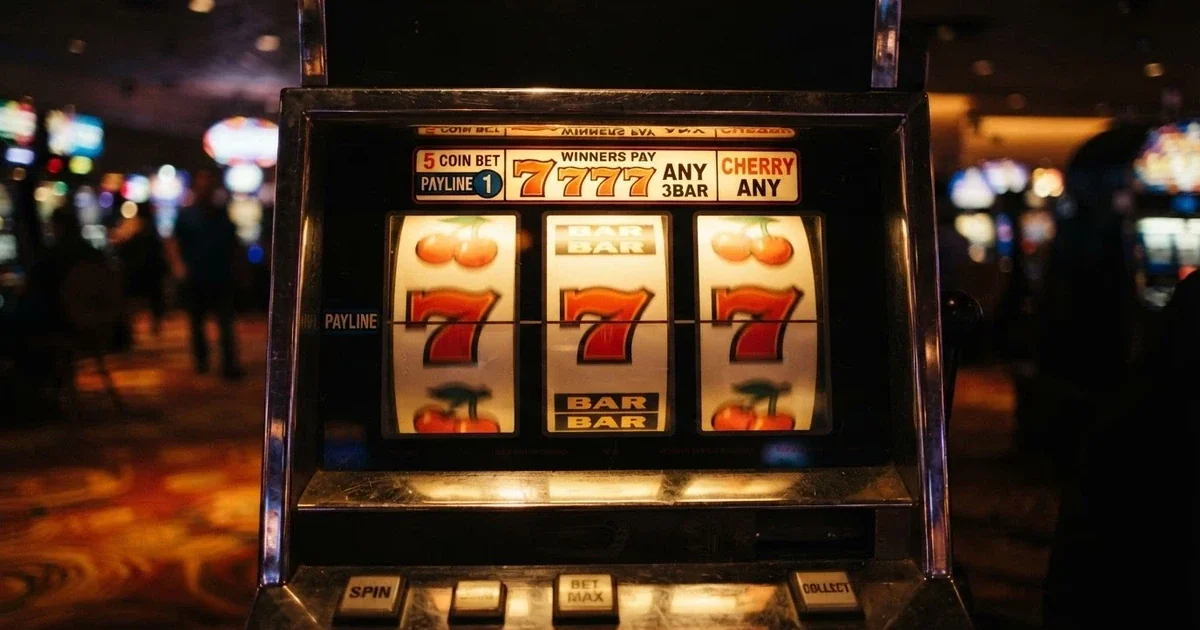
There is a second, less comfortable fact that the rest of the market would rather skip: every online pokie site an Australian can actually reach is offshore. Australia does not licence online casinos. Not federally, not in any state or territory. The Interactive Gambling Act 2001 makes it an offence to provide one, the ACMA has been blocking sites since November 2019, and a 2026 reform package adds bank-level transaction blocking from 1 January 2027. So the rest of this page sits inside a particular kind of decision: which of these offshore operators is worth the risk, and for which player.
Current as of 3 September 2026 and verified against the Australian Communications and Media Authority register and the Interactive Gambling Act 2001 framework.
Table of Contents
- Top 3-reel pokie titles: RTP, volatility and max win compared
- Classic fruit machines and modern 3-reel pokies — same reel count, different decades
- 3-reel vs 5-reel — why fewer reels can mean more value
- Free 3-Reel Pokies — Try Every Title Without Risking a Cent
- Real-Money 3-Reel Pokies — What Changes When You Deposit
- Bonuses and Free Spins on 3-Reel Pokies — What the Offer Actually Costs You
- The AU Legal Reality — Every Online Pokie You Can Reach Is Offshore
- Offshore Casinos for 3-Reel Pokies — What Australians Are Actually Using
- How We Evaluated These Offshore Casinos — Scope, Sources and Limits
- Should You Play 3-Reel Pokies in 2026? What the Data Actually Says
- Frequently asked questions
Top 3-reel pokie titles: RTP, volatility and max win compared
A short ranking follows of every 3-reel pokie this page could source a confirmed RTP for. Titles without a sourced RTP have been left out rather than padded in with guesswork, because a guessed RTP is worse than no RTP at all. Where volatility and max win were not specified by the source, the cell carries a dash.
| Title | Provider | RTP | Volatility | Max win | Paylines |
|---|---|---|---|---|---|
| 888 Gold | Pragmatic Play | 97.52% | — | — | — |
| Hold the Gold | 1spin4win | 97.2% | High | 2,000x | — |
| Piggy Bank | — | 96.98% | Low–medium | 2,500x | — |
| Ultra Hot and Spin | Pragmatic Play | 96.7% | Medium | 500x | 5 |
| Grand Spinn Superpot | NetEnt | 96.21% | — | — | 1 |
| Burning Wins | Playson | 96.21% | Medium | 60x | 5 |
| Coins of Ra — Hold & Win | Betsoft | 96.18% | High | 3,600x | — |
| Fruit Duel | Hacksaw | 96.12% | — | — | 5 |
| Yummy Dumplings: Hold the Spin | — | 96.02% | High | 10,000x | 125 payways |
| Super Burning Wins: Classic 5 Lines | Playson | 96.3% | — | — | 5 |
| Power Sun | 3 Oaks | 96% | High | 1,000x | 5 |
| Coin Volcano | 3 Oaks | 95.66% | Medium | 2,551x | 40 |
| Coin Strike: Hold and Win | Playson | 95.66% | Medium–high | 5,150x | 5 |
| Lost Mystery Chests | Betsoft | 95.37% | — | — | 10 |
| Fire Joker Freeze | Play’n GO | 94.2% | Medium | 1,000x | 5 |
| Betty Bonkers | Quickspin | 94.19% | — | — | 5 |
| Reels of Fortune Hot Drop Jackpots | Woohoo Games | 93.63% | High | 250,000 (payout) | 1 |
| Red, White and Blue | IGT | 93.98% | Medium–high | 2,500 credits | 1 |
| Triple Money Jackpot | Playtech | 93.44% | High | 1,334x | 5 |
The top of the table is the case the rest of this article keeps coming back to. Hold the Gold at 97.2% sits in the high-volatility bracket — the same shape of payout curve as a 5-reel Megaways title, but with a slightly higher mean return. Coins of Ra at 96.18% is the standout among the modern Hold & Win titles because it carries four in-game jackpots (Mini, Minor, Major, Grand) with the Grand at A$50,000 on a max bet of A$50. Coin Strike offers 5,150x max win on a 5-payline setup, which is a rare combination of a stripped-back reel count and a top end that competes with the best video slots.
The bottom of the table is the warning. Triple Money Jackpot’s 93.44% includes a 1% progressive contribution, which is not money you are likely to see; the effective non-jackpot return is worse. Red, White and Blue at 93.98% is a heritage title with no Wilds, no Scatters, no Free Spins and no bonus rounds — a pure 3-reel single-payline game in the original IGT mould, and the kind of game that pays a lot of small wins and almost nothing memorable. The point of putting it in the same table as Hold the Gold is precisely so the spread is visible at a glance.
A scatter note on volatility. Where the source gave no volatility, the cell is a dash. That is not because volatility does not matter — it matters enormously, because high-volatility titles can hold your bankroll hostage for hundreds of spins before a feature lands — but because guessing it is the same error as guessing an RTP. The empty cells are honest cells.
Classic fruit machines and modern 3-reel pokies — same reel count, different decades
The phrase “3-reel pokie” used to mean one thing: a one-payline mechanical fruit machine, three reels, a single bet line, symbols you could name from memory — cherries, bars, sevens. The heritage IGT title Red, White and Blue is exactly that. Five reels were not added, no fourth reel snuck in. It is a one-payline game, max win 2,500 credits, and it has no Wilds, no Scatters, no Free Spins and no bonus round to interrupt the spin. That is the format at its purest, and players who like it like it for a reason that does not need a marketing department to explain.
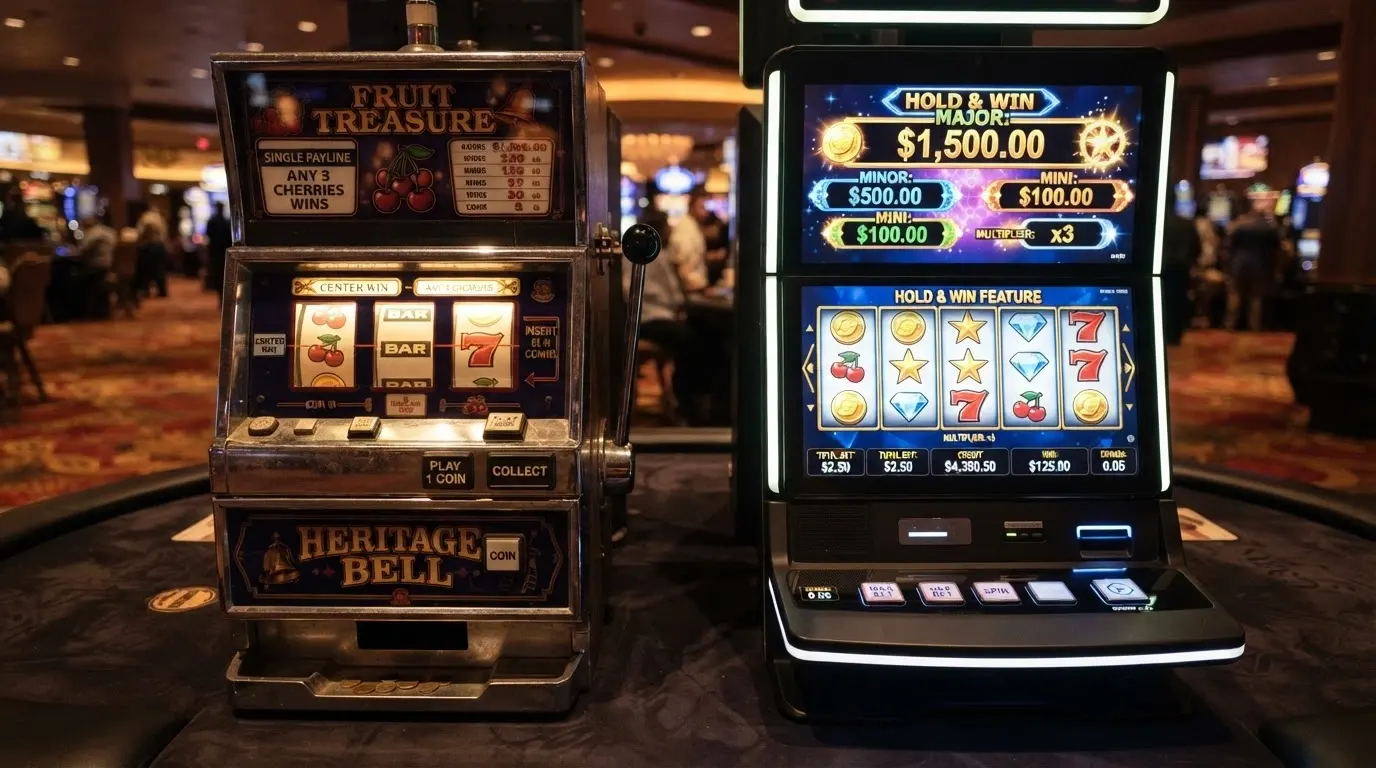
What changed in the last few years is that the 3-reel frame stayed the same and the feature layer underneath it went from nothing to a lot. Hold the Gold, released on 10 August 2023, is a 3-reel pokie with a Hold & Win mechanic — landing the right combination of bonus symbols locks them in place and triggers a respin sequence that can run for several rounds. The base game looks like a classic fruit machine; the bonus round behaves like a modern jackpot slot. Coin Strike, also a 3×3 fruit-themed pokie with five paylines, ships with a 5,150x max win and a medium–high volatility curve. Coins of Ra, from Betsoft, packs four fixed jackpots into a 3×3 layout — Mini, Minor, Major and Grand, with the Grand at A$50,000 if you happen to be playing at max bet. Yummy Dumplings: Hold the Spin runs to 10,000x max win on 125 payways, which is technically still a 3-reel game because the developers did not add a fourth reel, even though everything else about it has been pushed to a modern ceiling.
What the stripped-back format still does better than any feature-heavy video slot is the same thing it always did. The hit rate on a classic 3-reel title tends to be higher than a 5-reel Megaways game, which means a smaller bankroll stays alive longer. The math is more transparent because there are fewer moving parts: three reels, a small number of paylines, a paytable you can read in five seconds. For a player who wants to know what the house edge actually looks like over a session, that transparency is worth more than another bonus feature. A modern 3-reel Hold & Win title is a different proposition — you are playing for the feature, the base game is the price of admission — and a player who treats one like the other will misread the volatility.
3-reel vs 5-reel — why fewer reels can mean more value
The cleanest version of the comparison is the RTP gap. The classic 3-reel format runs higher on average — closer to 97% or 98% on the better titles, with 888 Gold at 97.52% and Hold the Gold at 97.2% setting the upper end of what a sourced number looks like. The video-slot average sits around 96%, sometimes a touch above, often a touch below. Across a few hundred spins at the same stake, two percentage points is the difference between a player who gets a session’s worth of play and a player who runs out halfway through. The 3-reel format does not win every head-to-head — there are 5-reel video slots above 97% — but on average, the 3-reel set is the more generous one.
The volatility split is the second-order question. A heritage 3-reel pokie tends to be low-to-medium volatility with a high hit rate and a low max win, which is the format that suits a longer bankroll session. A modern Hold & Win 3-reel title can be high volatility with a low hit rate in the base game and a max win above 5,000x, which is the format that suits a player who wants a shot at a big payout and is prepared to wait. The 5-reel video slot, particularly the Megaways format, lives in the same high-volatility territory, but the 3-reel Hold & Win game usually gets there on a tighter reel set with fewer paylines — which is part of why the RTP has to run higher to compensate.
The trade-off that does not get talked about is hit frequency. A 5-reel slot with 243 ways and a feature buy is selling a sparse event, often a base-game stretch where nothing meaningful happens, followed by a feature round that decides the session. A 3-reel pokie, especially a 5-payline classic, hits more often, pays less per hit, and rarely has a feature round at all. For a player who values the experience of the spin over the experience of the bonus, that is a real advantage. For a player who wants the chance at a 10,000x payout, the 3-reel format has answers now — Coin Strike at 5,150x, Yummy Dumplings at 10,000x — but the shape of the session is still different from a 5-reel feature buy.
The format choice is a real money decision because the math is different, not because one is “better”. A player with a small bankroll who wants a long session will find more value in a heritage 3-reel title at 96% RTP than in a 5-reel video slot at the same RTP, because the hit frequency keeps the bankroll alive. A player chasing a specific feature payout will find the same 3-reel title boring inside fifty spins. The format fits the goal, not the other way around.
Free 3-Reel Pokies — Try Every Title Without Risking a Cent
Every 3-reel pokie on this page runs in a browser in demo mode. No download, no sign-up, no deposit. The offshore casino operators have an interest in letting you play for free because a player who has spent twenty minutes with a title in demo mode is more likely to deposit later, and the demo build is also a quick way for the operator to demonstrate the catalogue. That is not a complaint; it is a description of the incentive. What matters for the player is what demo play does and does not reveal.

Demo mode and free-play practice — what you actually learn before depositing
Demo play reliably teaches three things: how the paylines behave across a hundred or so spins, how often the feature round triggers in normal play, and how the title feels at the stake you intend to play for real. Volatility is the most important of the three, and demo play is the only honest way to feel it before you commit a deposit, because no review will tell you that a title has long quiet stretches in the base game between feature triggers. You have to sit through them yourself.
What demo play cannot teach is anything about the operator. The demo build does not simulate the KYC process you will face at withdrawal, the bonus-term surprises that may not surface until you try to cash out free-spin winnings, or the payout speed. A pokie can feel generous in demo mode and still be hosted by an operator that takes three business days to approve a withdrawal, voids wins on a bonus-rule technicality, or simply closes the account. The game and the operator are two different risks, and demo play covers only the first.
A useful demo session is at least a few hundred spins at the stake you would actually play, because a fifty-spin session is too short to feel a high-volatility title. The session should also include a feature trigger or two if the title has a bonus round, which usually means running for longer than feels productive. The right time to judge a title is when the screen has stopped surprising you, not when the first feature has fired.
No-download instant play — how free 3-reel pokies actually load
Most modern pokies are built in HTML5 and run in a standard browser tab. There is nothing to install, no .exe file, no plugin. The same browser tab on a phone and on a laptop loads the same game, with the layout adjusting to the screen. For a player on a metered connection or a shared computer — both common in Australia — the no-download model matters because there is no local install carrying an unknown payload, and no software left behind when the tab is closed.
The difference between a phone demo session and a desktop one is mostly ergonomic. The reel set is the same; the touch targets for spin, bet size and autoplay are smaller. A player who plans to play for real on a phone should run the demo on a phone first, because the bet-size adjustment controls are where most mobile play goes wrong, and adjusting them in a quiet demo session is faster than finding them mid-spin in a real-money round.
Real-Money 3-Reel Pokies — What Changes When You Deposit
Free play teaches the game. Real money adds the operator, the payment system, the bonus terms, the KYC process and the offshore-casino legal reality. None of those is part of the pokie itself, and all of them are where most of the friction lives.
How real-money 3-reel play works from Australia
The sequence at most offshore operators is roughly the same. Sign up, verify an email address, fund the account, choose a pokie, place a bet, request a withdrawal when there is something to withdraw. Each step has its own friction.
The deposit step is the cleanest part. PayID and Osko credit the account in seconds via the New Payments Platform, with minimums typically in the A$15 to A$30 range. Debit cards and bank transfers work; BPAY is accepted by some operators but tends to be slower. Credit cards and crypto are banned for online wagering in Australia since 11 June 2024, with penalties of up to A$247,500 for operators that accept them — so an operator asking for either is a compliance tell you cannot ignore.
The withdrawal step is the slowest. A request goes into a queue, gets reviewed, often sits in pending for anywhere between a few hours and 24 hours, and then either releases the funds or, more often than the marketing pages admit, comes back with a KYC request — a photo of a driver’s licence, a recent utility bill, sometimes a selfie holding the document. The minimum withdrawal at most operators sits in the A$25 to A$50 range, and PayID/Osko is the fastest route back to an Australian bank account.
The pokie step is the only one that behaves the same in real-money play as it did in demo. The math is the math. The bet is real, the hit frequency is the same, the feature triggers the same way. What changes is the emotional cost of the same losing streak that felt unremarkable in demo.
Deposit methods that reach an offshore casino — and the ones that signal trouble
PayID and Osko are the fastest AU-native deposit routes, with funds credited in seconds via the New Payments Platform. Debit cards work at most operators. Bank transfer is the slowest of the standard options but the most reliable for larger amounts. BPAY is accepted by some operators and processes more slowly.
The two methods that should make an Australian player close the tab are credit cards and cryptocurrency. Both have been banned as payment for online wagering since 11 June 2024, under the Interactive Gambling Amendment (Credit and Other Measures) Act 2023, with penalties of up to A$247,500 for operators that accept them. An operator asking for a credit card or a crypto deposit is, by definition, not running under Australian rules — because the Australian rules do not allow it to. From 1 January 2027, banks and payment providers gain express authority to block transactions to illegal operators, which means a credit-card or crypto request is also a sign that the operator is exposed to having its payment rails cut.
Bonuses and Free Spins on 3-Reel Pokies — What the Offer Actually Costs You
A welcome bonus is not free money. The wagering multiple, the validity window and the max-cashout cap together set the real price of an offer, and most players who claim one do not see the price until they try to withdraw. Two examples from the featured set make the point.
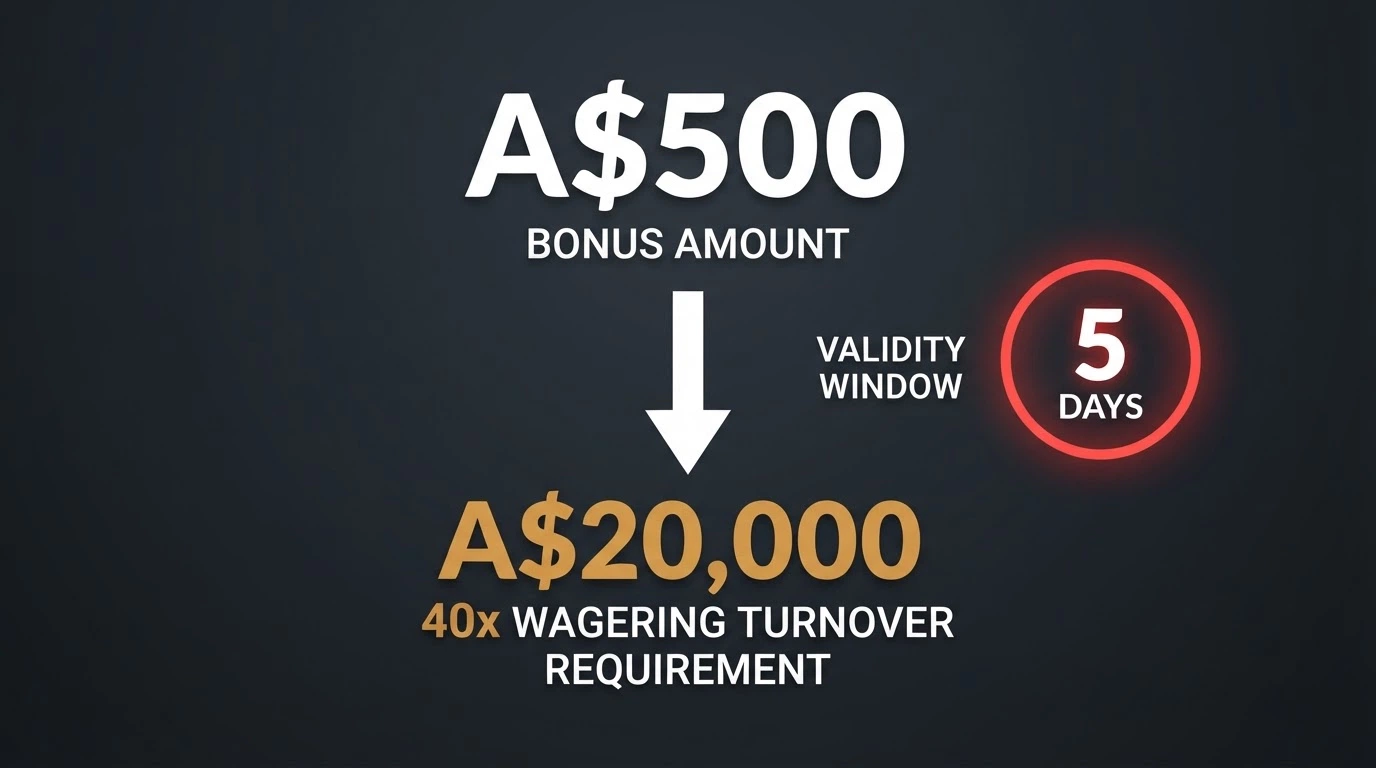
RocketPlay’s welcome package is a 100% match up to A$500 on the first deposit, plus 100 free spins delivered at 20 per day for five days, with 40x wagering on the bonus amount, a five-day validity window and a max cashout of A$300 from the free spins. The bonus cost, run against a representative classic 3-reel RTP of about 97% and a minimum stake per spin of A$0.10, looks like this. The full A$500 bonus carries a turnover requirement of A$500 multiplied by 40, which is A$20,000 of in-game wagering to clear the bonus alone. At A$0.10 a spin, that is 200,000 spins. At a five-second interval per spin, the math runs out to roughly 278 hours of continuous play — about thirty-five eight-hour sessions, all inside a five-day window. Even on a higher stake of A$1 a spin, you are still looking at around 28 hours of play in five days, and the house edge of about 3% against the A$20,000 turnover gives an expected loss in the order of A$600 — meaning the bonus, on its own terms, is worth less than the turnover it demands. The headline number is “up to A$500”. The arithmetic behind it is the opposite of a gift.
The RocketPlay offer is at the harder end of the market. The other end has an alternative. Rainbet, Curaçao-licensed, runs a no-wager 100% match up to $700 as one of its welcome options — meaning whatever you win from the bonus is yours, with no playthrough requirement. The standard Rainbet welcome is heavier, with 40x playthrough across a $2,100 package over three deposits, but the no-wager option is the kind of structure that does not need a calculator to read. It is the only no-wager welcome on this list.
No-deposit bonuses on 3-reel titles — free spins with strings attached
A genuinely deposit-free offer exists, and the most-cited one is at Fair Go Casino — 15 free spins on Bubble Bubble (an RTG title), 60x wagering on the winnings, and a max cashout in the A$100 to A$200 range. The arithmetic against a representative RTG RTP and a low spin value tells the same story the RocketPlay math tells, only smaller. The free-spin winnings are usually in the low tens of dollars; the 60x wagering on those winnings is a turnover that the no-deposit bonus is rarely large enough to clear, and the A$100 to A$200 cap is the ceiling on what can ever come out of the offer. It is a trial, not a payout. The point of the offer is to put a player on the site, and it does that reliably.
Rainbet runs a different shape of no-deposit offer — a A$10 bonus for completing identity verification, deposit-free. It is smaller than the free-spin package and serves the same purpose. A player who values the right to test a site without committing a deposit will treat both as trials, not income.
Free-spin welcome packages — the wagering catch inside the headline number
The free-spin welcome package is the most common form of bonus on offshore casinos serving Australia, and the structure is consistent. A number of free spins (50, 75, 100, sometimes more), delivered across several days, attached to a specific title, with a wagering multiple and a max-cashout cap. The headline reads as a gift. The terms read as a price.
The RocketPlay package — 100 spins at 20 per day for five days, 40x wagering on bonus, max A$300 cashout — is the largest spin count among the verified offers on this page. The cost of the package, in turnover, is what the calculation above runs out. The honest reading of the offer is that the headline is the marketing and the terms are the contract, and a player who treats the terms as the real product will skip the offer when the terms are wrong. A bonus with a five-day validity window on a 40x requirement is asking for a session of more than a full-time job’s hours of play inside a work week. Most players who attempt it will run out of bankroll or time, and the bonus expires unconverted.
The alternative, where it exists, is worth taking. Rainbet’s no-wager welcome is the cleanest version of this on the list. A bonus with no playthrough requirement and a 100% match is not a marketing trick. It is a different kind of product.
In-game bonus features in classic 3-reel pokies
The 3-reel pokie of 2026 is not the 3-reel pokie of 2006. The format stayed at three reels, and the feature layer underneath expanded to the point where some modern 3-reel titles compete with 5-reel video slots on the same ground.
The Hold & Win mechanic is the most visible change. Hold the Gold (released 10 August 2023) uses it: a set of bonus symbols lands on the reels, locks in place, and a respin sequence begins with the locked symbols held. Coin Strike uses the same mechanic on a 3×3 fruit-themed layout with five paylines and a 5,150x max win. Yummy Dumplings runs Hold the Spin on 125 payways and a 10,000x max win. The mechanic is a way to bolt a jackpot feature onto a 3-reel frame without violating the format, and it has been the single biggest reason the 3-reel category has stayed commercially viable.
Coins of Ra from Betsoft is the cleanest example of fixed jackpots in a 3-reel frame. Four jackpots — Mini, Minor, Major and Grand — sit on top of a 96.18% RTP base game, with the Grand at A$50,000 if played at the A$50 max bet. Triple Money Jackpot from Playtech runs a progressive, with 1% of each wager feeding the jackpot pool; the headline RTP of 93.44% includes that contribution, so the effective return without the progressive is lower.
The other feature that has migrated into the 3-reel format is the multiplier wild. Fire Joker Freeze (Play’n GO) ships a bonus wheel, a multiplier, respins, stacked symbols and wilds, all on a 3×3 grid with five paylines. Reels of Fortune (Woohoo Games) uses multiplier wilds and a bonus game with prizes up to 500x the bet. These are not the heritage fruit-machine features — there is no “gamble” button, no nudge, no hold — and a player who buys a 3-reel title expecting the simplicity of Red, White and Blue is in for a different kind of session.
Bonus-buy is rare on 3-reel titles. The format is built around organic triggers, partly because the reel count and payline count are too small to make a feature-buy price feel reasonable, and partly because the Hold & Win mechanic that has defined the modern 3-reel category works better as an organic feature.
The AU Legal Reality — Every Online Pokie You Can Reach Is Offshore
This is the part of the page that most reviews of 3-reel pokies for Australian players do not write. The legal status of the product is not a footnote; it is the frame. Every operator named later in this article is offshore, because there is no licensed online casino in Australia to name.
The IGA prohibition — what the law actually bans and who it targets
The Interactive Gambling Act 2001 makes it an offence to provide online casino games, online pokies or in-play sports betting to a person in Australia. The Act targets the provider, not the player. The distinction matters: an individual Australian placing a bet at an offshore casino is not prosecuted under the IGA. The operator, by contrast, is committing an offence by offering the product to anyone in Australia.
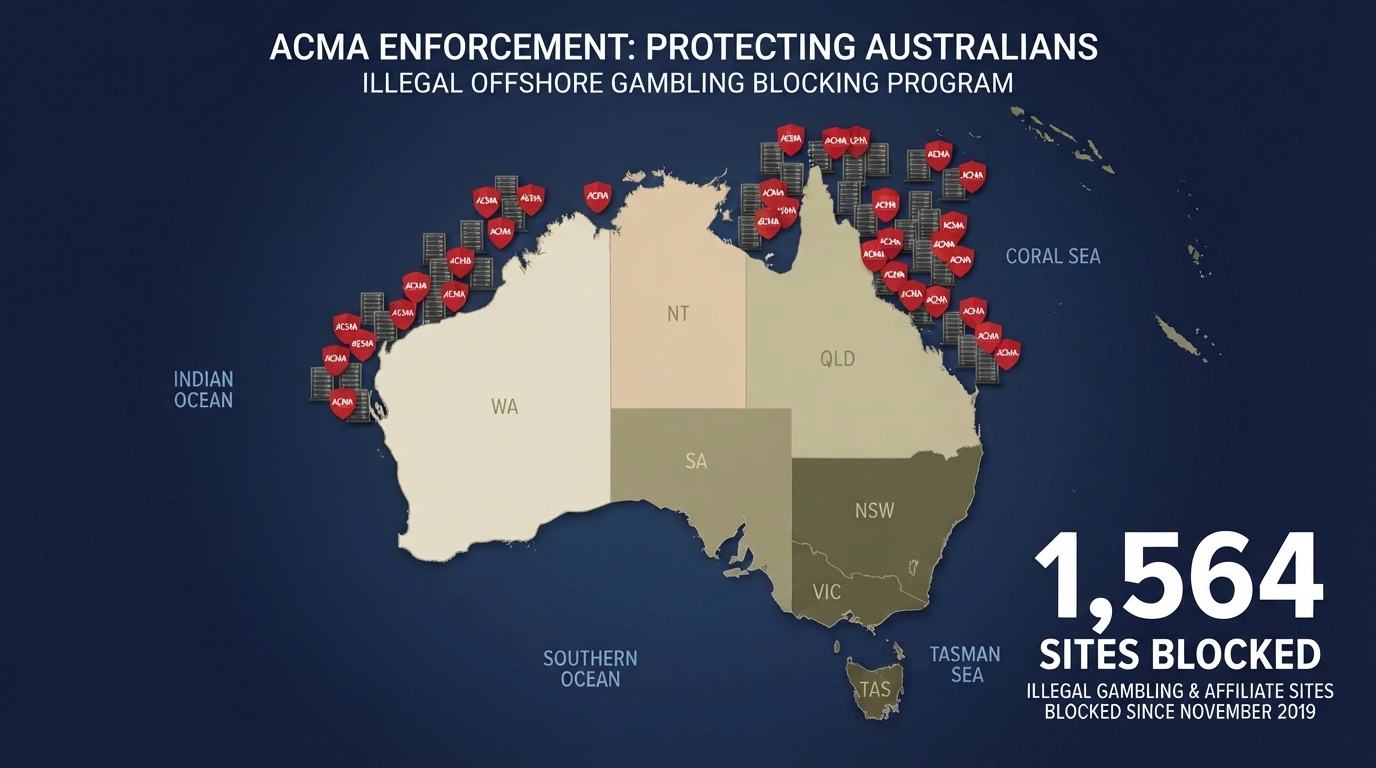
The Interactive Gambling Amendment Act 2017 strengthened the original law, closing loopholes that offshore operators had been using to argue they were not technically providing to Australian customers, and giving the Australian Communications and Media Authority its enforcement and blocking powers. The ACMA has had 1,564 illegal gambling and affiliate websites blocked by Australian ISPs since its first blocking request in November 2019, and more than 225 illegal services have withdrawn from the Australian market since 2017. The withdrawals are not the ACMA being unreasonable; they are the ACMA’s blocking notices making it commercially unviable to keep serving Australian customers.
There is no licence for online casino anywhere in Australia. Not federally, not in any state or territory. The closest equivalent is a wagering licence issued by a state or territory regulator — Sportsbet, bet365 and Ladbrokes are Northern Territory licensees through Licensing NT — but those licences cover pre-event sports and racing betting, not online casino games. A land-based casino licence (Crown, The Star) covers a physical premises, not an offshore online operation. There is no path to a licensed Australian online casino under the current framework.
Offshore means no Australian safety net — what you lose the moment you deposit
The moment a deposit lands at an offshore casino, every Australian consumer protection stops applying. There is no Australian Financial Complaints Authority jurisdiction. There is no state or territory ombudsman to escalate a dispute. The ACMA cannot recover a player’s money, because the ACMA’s job is to enforce the prohibition on the operator, not to mediate individual disputes. An offshore operator that refuses a withdrawal, voids a win on a bonus-rule technicality, or simply closes an account has broken no Australian consumer law — because no Australian consumer law covers the transaction in the first place.
The site itself can be blocked at any time. The ACMA’s blocking list has grown to 1,564 entries. A block does not refund balances; a player whose account was open and whose withdrawal was pending is left with a casino that no longer resolves the request. The blocking is not a risk in the abstract — it has happened to specific sites, with specific balances on them.
There is also no Australian Consumer Law protection, no local KYC framework an Australian regulator can enforce, and no way to compel a Curaçao- or MGA-licensed operator to act on an Australian complaint. The offshore licences are real licences in their issuing jurisdiction. They confer zero Australian protection.
BetStop cannot save you from an offshore casino
BetStop — the National Self-Exclusion Register — has been live since August 2023. As at 31 July 2026 it had 67,480 registrations, of which 41,290 exclusions were still active. Seventy-eight per cent of registrants were under 40, and 38% chose a lifetime exclusion. The register excludes a person from every Australian-licensed online and phone wagering service in a single step. It is the most concrete player-protection tool Australia has built.
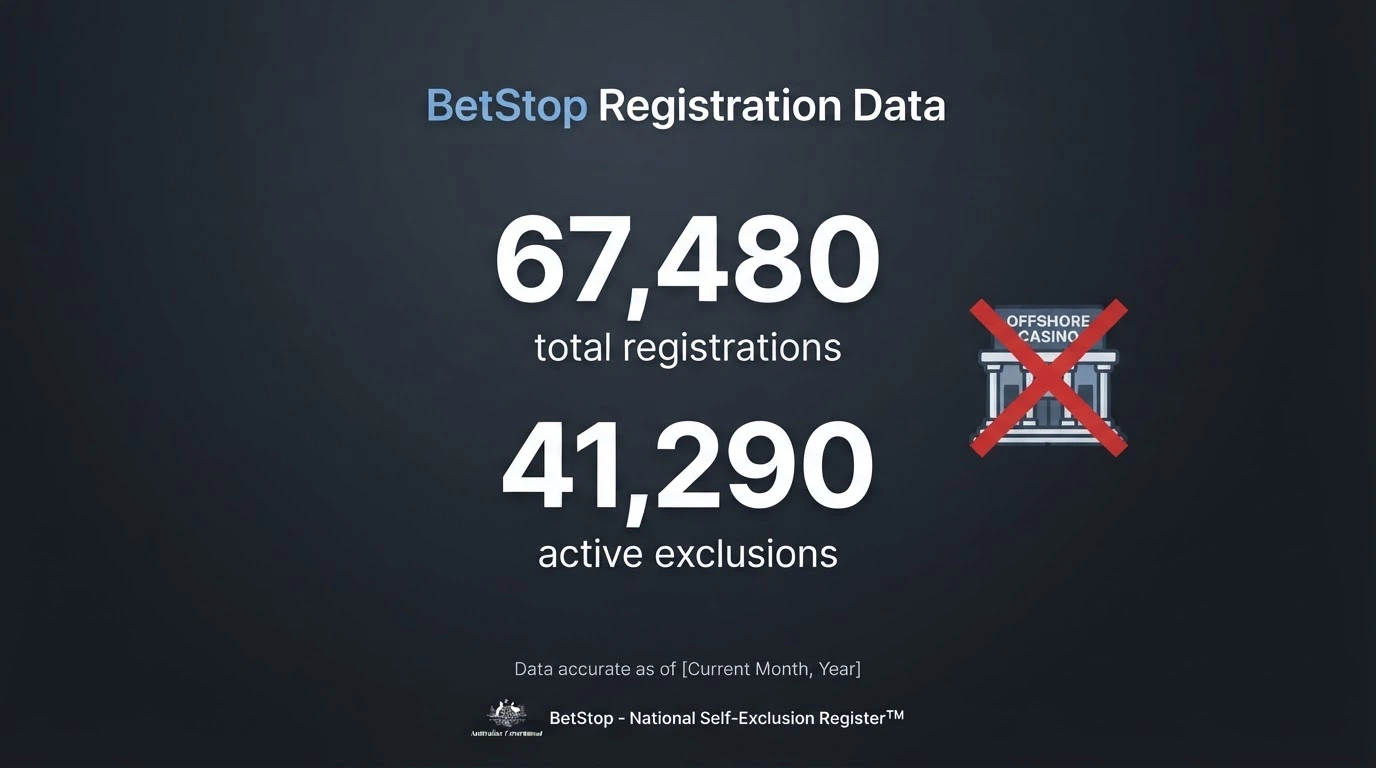
It does not cover offshore casinos. An offshore operator is not connected to BetStop, will not honour a BetStop registration, and will continue to take deposits from a self-excluded person who reaches the site. A player who has registered with BetStop and then logs into an offshore casino has not self-excluded from that casino — they have self-excluded from the licensed market and stayed exposed to the unlicensed one. The 2026 reform adds a three-month marketing ban after BetStop deregistration from 1 January 2027, but the gap remains: BetStop binds Australian-licensed wagering services only.
The honest reading of BetStop is that it is an excellent tool for the market it covers, and an irrelevant one for the market that actually offers online pokies to Australians. The two are not the same market.
Payment rules — why credit cards and crypto are a red flag
Since 11 June 2024, credit cards, credit-related products and digital currency (cryptocurrency) have been banned as payment for online wagering in Australia, under the Interactive Gambling Amendment (Credit and Other Measures) Act 2023. Penalties for operators that fail to enforce the ban reach A$247,500. The legal deposit routes for licensed wagering are debit card, bank transfer, PayID/Osko and BPAY — all of which require a real bank account in a real name and which can be traced back to a verified identity.
An offshore operator that asks for a credit card or a crypto deposit is, by definition, not running under the Australian rules, because the Australian rules do not permit that payment method for this product. The payment method is a compliance tell, and the absence of the ban is a sign the operator has no interest in the Australian framework at all. From 1 January 2027, banks and payment providers gain express authority to block transactions to illegal operators, which means a credit-card or crypto request is also a sign the operator is exposed to having its payment rails cut off. PayID/Osko remains the fastest AU-native option, with funds credited in seconds via the New Payments Platform.
The 2026 reform — what changes on 1 January 2027
The Interactive Gambling Amendment (Gambling Reform) Bill 2026 passed Parliament on 19 August 2026, and its measures commence on 1 January 2027. Three changes matter for an Australian player at an offshore casino.
The first is advertising. From 1 January 2027, no more than three wagering ads per hour between 6:00 am and 8:30 pm on television and radio, a live-sport blackout from fifteen minutes before to five minutes after an event, and a bar on athletes, celebrities and influencers promoting wagering. Online wagering ads can only target logged-in users who have been verified as over 18 and who have not opted out. The rules are aimed at licensed operators, not at offshore casinos, and an offshore casino is already in breach of the underlying IGA by offering the product — so the advertising rules tighten a prohibition that already exists in spirit.
The second is inducements. Direct marketing of bonuses and other inducements is prohibited for fourteen days after a customer signs up with a licensed operator, for three months after a person deregisters from BetStop, and indefinitely for customers identified as at risk of gambling-related harm. The same point applies: the rules are aimed at licensed operators, and the offshore casino is already outside the framework.
The third is bank payment-blocking authority. From 1 January 2027, banks and payment providers in Australia gain express authority to block transactions to illegal gambling operators. The mechanism is not a ban on all gambling transactions — PayID/Osko deposits to offshore casinos have been legal for the receiving bank to refuse, and the reform makes that explicit. The practical effect is that a deposit that reaches an offshore operator today may be blocked by an Australian bank tomorrow. A player who treats that as a risk to plan around, rather than a technicality to ignore, will pick their payment method more carefully.
What the reform does not change is the core fact. Online casino remains prohibited. Offshore casinos remain outside the Australian framework. No reform in the 2026 package legalises, licences or regulates the product this page is about. The reform tightens the licensed side. The unlicensed side stays where it was.
Offshore Casinos for 3-Reel Pokies — What Australians Are Actually Using
The table below compares the ten operators that appear most prominently in AU-facing search for 3-reel pokies. Every one of them is offshore, because no licensed Australian online casino exists. Cells where research did not confirm a specific value are marked with a dash rather than estimated.
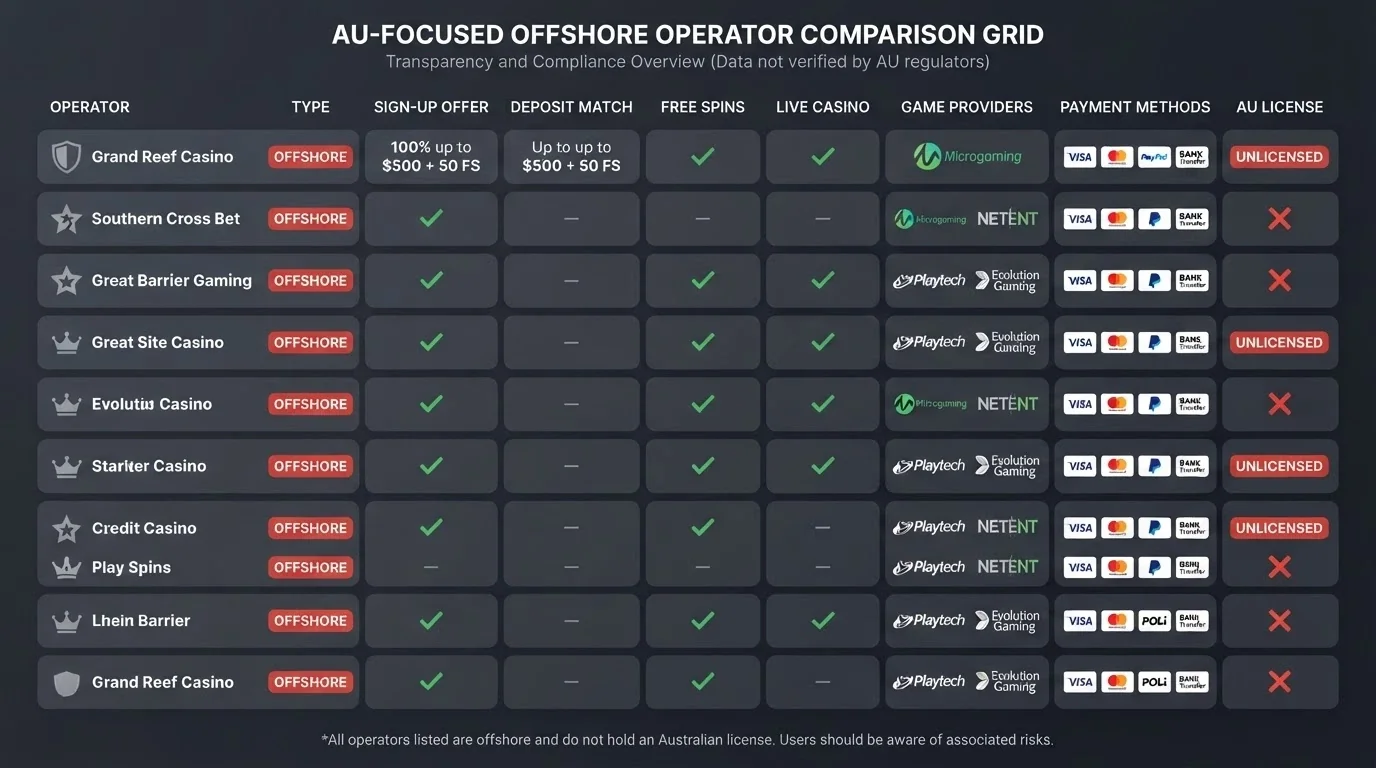
| Operator | Legal status in Australia | Bonus offering | Game providers |
|---|---|---|---|
| RocketPlay | Offshore — no AU licence (IGA prohibition) | 100% up to A$500 + 100 FS, 40x wagering, 5-day validity, max A$300 from FS | Pragmatic Play, BGaming (600+ slots) |
| SkyCrown | Offshore — no AU licence (IGA prohibition) | A$1,750 + 75 FS welcome; 75% up to A$300 Friday reload at 30x | Pragmatic Play, NetEnt, Play’n GO (350+ slots) |
| Royal Reels | Offshore — no AU licence (IGA prohibition) | — | — |
| WinSpirit | Offshore — no AU licence (IGA prohibition) | — | Yggdrasil, Pragmatic Play, Push Gaming |
| Stake | Offshore — no AU licence (IGA prohibition, Curaçao suspected) | — | — |
| Rainbet | Offshore — Curaçao-licensed (GCB), no AU licence | Up to $2,100 across three deposits; no-wager 100% up to $700 alternative; A$10 KYC bonus | 3,000+ games including provably fair originals |
| Fair Go | Offshore — no AU licence (IGA prohibition) | 100% up to A$200 on each of 5 deposits (A$1,000 total), 30x deposit+bonus; 15 FS no-deposit on Bubble Bubble at 60x, max A$100–A$200 | RTG only |
| Scream Casino | Offshore — no AU licence (IGA prohibition) | — | — |
| Bizzo Casino | Offshore — no AU licence (IGA prohibition) | Free Spin Mondays; daily slot races; table-game tournaments with prize pools in the tens of thousands | — |
| Rocket Casino | Offshore — no AU licence (IGA prohibition) | — | — |
The table is the honest version of the operator landscape. The four columns that research could populate are populated; the cells that research could not confirm are left blank. A reader looking for a licensed alternative will not find one in this table, because there is no licensed Australian online casino to add.
RocketPlay
RocketPlay runs 600+ slot titles from Pragmatic Play, BGaming and others, with an average RTP of about 96%. The welcome package is the headline number: 100% up to A$500 on the first deposit, plus 100 free spins delivered at 20 per day for five days. The headline is generous. The terms are not. Wagering is 40x on the bonus amount, validity is five days, and the max cashout from the free spins is capped at A$300. The second-deposit offer is a 200% match up to A$500, with a A$50 minimum.
The offer is the kind that converts well to a marketing screenshot and badly to a player’s bankroll. The 40x bonus wagering on a A$500 match is A$20,000 of turnover, and the five-day window is the bottleneck. A player who can clear that in five days of concentrated play will see the bonus; a player who has a job, a life and a sleep cycle will not. RocketPlay is a reasonable choice for a high-volume player who specifically wants the spin volume the bonus funds and who has read the terms. It is a poor choice for a casual player who interprets “A$500 bonus” as “A$500 to play with”.
SkyCrown
SkyCrown has the largest headline welcome package on this list at A$1,750 plus 75 free spins, backed by Pragmatic Play, NetEnt and Play’n GO across 350+ slots with an average RTP of about 95.7%. The Friday reload is a 75% match up to A$300 at 30x wagering, which is a more player-friendly structure than the welcome package.
The catch is the absence of confirmed bonus terms beyond the headline numbers. The welcome package validity, the free-spin wagering, the max-cashout cap and the exact wagering multiple on the welcome bonus were not confirmed at review time. A player who values those terms in writing will find SkyCrown harder to evaluate than RocketPlay or Fair Go, where the verified terms are public. The catalogue is a real differentiator, though — NetEnt and Play’n GO together cover a meaningful slice of the heritage 3-reel space, and a player who cares about the specific titles those studios ship will find reasons to look at SkyCrown.
Royal Reels
Royal Reels surfaces in AU-facing search for 3-reel pokies, which is why it is on this list. The licence jurisdiction, the provider list, the welcome offer, the wagering terms and the withdrawal mechanics were not confirmed at review time. That is not a verdict on the brand — it is a description of what the page was able to verify. A player considering Royal Reels should treat the absence of verifiable terms as the actual data point. The brand may be legitimate, the offer may be competitive, the providers may be familiar. The page does not have the data to say, and the operator has not published the data the page was looking for. The risk of depositing at an operator whose terms are not visible is a different risk from the risk of depositing at an operator whose terms have been read and judged.
WinSpirit
WinSpit has a credible provider mix — Yggdrasil, Pragmatic Play and Push Gaming are the three names research could confirm, and each of them ships the kind of catalogue an Australian 3-reel player would recognise. The rest of the operator profile was not confirmed. The welcome bonus, the wagering terms, the licence jurisdiction, the withdrawal speed and the customer-support structure are all blanks on this page. Evaluating WinSpirit on providers alone is one thing; evaluating it on bonus transparency is another, and that transparency is currently missing.
Stake
Stake is a major global brand, which is a fact in itself. The brand’s prominence in crypto-gaming circles is well established, and a Curaçao licence is suspected but not confirmed at the licence-register level for this page. The AU-specific welcome bonus, the slot count for the AU-facing product, the provider list and the wagering terms on any AU-relevant offer were not confirmed at review time. The page treats Stake as a brand worth knowing about and an operator that has not, on this evidence, prioritised the AU-facing verified-data set. Those who already have a Stake account and are considering it for 3-reel play should look to their own dashboard, as this page cannot verify the site’s AU-specific terms.
Rainbet
Rainbet is the operator on this list with the most complete verified profile. Curaçao-licensed through the GCB, 3,000+ games including a provably fair originals catalogue, Trustpilot 3.5/5, and a welcome structure that does not need a calculator to read. The standard welcome is up to $2,100 across three deposits: 100% up to $700 plus 20 free spins on the first and third deposits, 50% up to $700 plus 20 free spins on the second, with 40x wagering on the standard offer. The alternative is a no-wager 100% match up to $700, with a A$30 minimum deposit, and what the bonus wins are is what the player keeps. The no-deposit offer is a A$10 bonus for completing identity verification — deposit-free, wagering terms on the bonus apply — and the ongoing 10% weekly rakeback is a real retention mechanic for a player who plans to come back.
The honest reading of Rainbet is that it is the only operator on this list where the welcome bonus can be evaluated without a calculator on the no-wager side, and where the catalogue size makes the 3-reel format one of many rather than the headline. The crypto focus is part of the brand, and an Australian player should read that against the credit-and-crypto payment ban: a deposit made in crypto from Australia is in tension with the Interactive Gambling Amendment (Credit and Other Measures) Act 2023, and the legal deposit routes for wagering are debit card, bank transfer, PayID/Osko and BPAY. Rainbet is the operator on this list where the math is cleanest and the legal status is the most explicit, which is not the same as saying it is safe — none of them is safe under the Australian framework — but it is the operator where the page can say the most.
Fair Go
Fair Go is the only operator on this list with a genuinely deposit-free no-deposit offer: 15 free spins on Bubble Bubble, 60x wagering, and a max cashout in the A$100 to A$200 range. The deposit welcome is 100% up to A$200 on each of the first five deposits — a A$1,000 total — with 30x wagering on deposit plus bonus, a A$20 minimum deposit, and a A$2,500 weekly withdrawal limit. The provider list is RTG (RealTime Gaming) only, the payment methods are Bitcoin, eWallets, Visa, Paysafecard, Skrill, Neteller and Amex, and there are no live dealer games. The whole product is aimed at the Australian market in a way the other operators on this list are not, which is part of why the bonus terms are spelled out clearly and the A$2,500 weekly withdrawal limit is published as a feature rather than a restriction.
The A$2,500 weekly cap is the part of the offer most players will under-read. A player who hits a 3,000x win on a 5-payline 3-reel game at a A$5 stake is looking at A$15,000 in winnings, which the weekly limit will stretch across six weeks of withdrawals. The bonus terms are fair for the kind of player the offer is built for — a small-stakes, RTG-loyal Australian who values a familiar product over a large one — and a poor fit for a player who wants a fast payout on a large win. The Bitcoin acceptance is in tension with the AU credit-and-crypto ban, and the same legal caveat that applies to Rainbet’s crypto focus applies here.
Scream Casino
Scream Casino surfaces in AU-facing search for 3-reel pokies, which is why it is on this list, and the same data gap that defines Royal Reels defines it. The licence jurisdiction, the provider list, the welcome offer, the wagering terms and the withdrawal structure were not confirmed at review time. A player who considers depositing at an unverified operator is making a decision the verified operators on this list do not require, and the absence of verifiable terms is the data point the page has.
Bizzo Casino
Bizzo is the operator on this list where the catalogue is the offer. Daily slot races, table-game tournaments with prize pools in the tens of thousands, a Hall of Fame leaderboard that tracks biggest winners in real time, and Free Spin Mondays as a recurring promotion. The tournament layer is a real differentiator — most operators on this list are selling a welcome bonus, and Bizzo is selling a competitive structure inside the games themselves. The welcome bonus and the wagering terms on that bonus were not confirmed at review time, which means a player evaluating the bonus value of Bizzo is doing so on less data than the RocketPlay or Fair Go player has. A player evaluating the tournament value of Bizzo has the data they need, because the race structure and the prize pools are the published product.
Rocket Casino
Rocket Casino is the operator on this list that is most likely to be confused with another. The brand surfaces in AU-facing search alongside RocketPlay, and the similar name is the only relationship between them that research could confirm. Rocket Casino’s licence jurisdiction, provider list, welcome offer and wagering terms were not confirmed at review time. A player who intends to deposit at “Rocket” and lands on the wrong site is making a different deposit than the one they planned, and the page’s data on Rocket Casino is the data the brand has not published.
How We Evaluated These Offshore Casinos — Scope, Sources and Limits
This page is built from four source families. The first is operator bonus-terms pages — the actual text of the welcome offer, the wagering multiple, the validity window, the max-cashout cap, read against the offer headline. The second is AU-focused affiliate review sites (Bonzerpokies.com, Topaussiepokies.org, aussiepokies.com, Bestaustralianonlinepokies.com, Betopokie.com, Vegaspokie.com and others), used for per-title slot specifications, RTPs and provider attributions. The third is the ACMA public register and the Interactive Gambling Act framework, used for the legal-status facts that recur through the page. The fourth is the Australian regulation skill dataset that aggregates federal statute, ACMA enforcement data and the 2026 reform package.
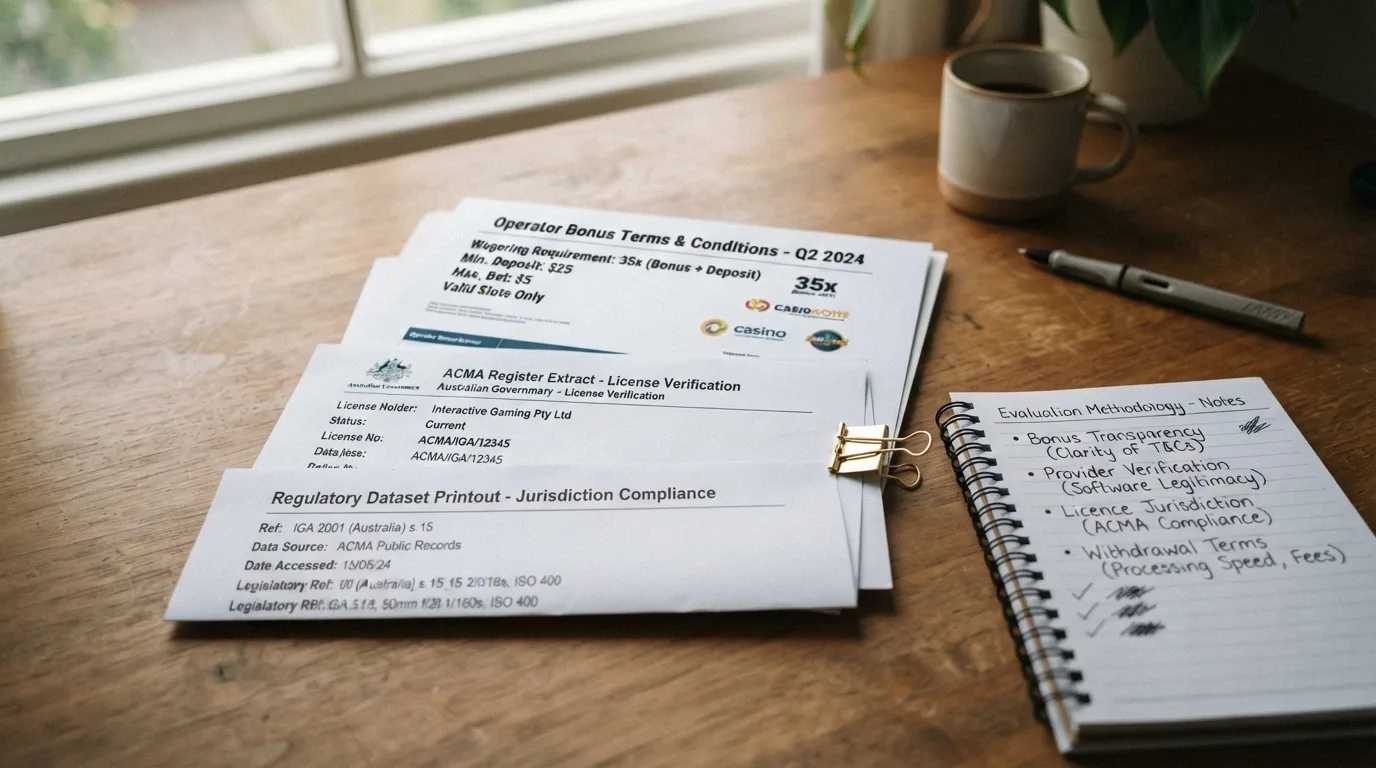
The ten operators featured are the brands that appear most prominently in AU-facing search for 3-reel pokies. They are not a complete market census — there are more offshore operators than this, and the ones not on the list may carry terms this page would have ranked higher. The list reflects what an Australian player would actually see when they searched, not a curated “best of” the global offshore market.
The ranking inside the list is by data transparency, not by endorsement. Operators with verified bonus terms, confirmed provider lists and a traceable licence jurisdiction rank ahead of those with unconfirmed data. The honest reason is that a player can only act on what is verifiable, and a brand that does not publish its terms is a brand that cannot be compared on value. The four operators with confirmed welcome-bonus specifics (RocketPlay, SkyCrown, Rainbet and Fair Go) carry the most readable offers on the list, and the six with unconfirmed specifics are presented as such.
The page does not verify the current licence status or the financial solvency of any offshore operator. The Curaçao GCB and the MGA are real regulators in their issuing jurisdictions, and a licence check on either register is a step this page did not take. The 2026 reform’s bank payment-blocking authority is also a moving target — from 1 January 2027, the practical accessibility of these operators from an Australian bank account will change, and the deposit methods that work today may not work in six months. Data is point-in-time, drawn from research conducted in 2026.
Should You Play 3-Reel Pokies in 2026? What the Data Actually Says
The RTP argument for the 3-reel format is real. The titles at the top of the comparison table return 97–98% against an industry average closer to 96% for video slots, and across a session of a few hundred spins, two percentage points is a meaningful gap. The 3-reel format suits a player with a small bankroll and a long session in mind, and the modern Hold & Win variants of the format now offer 5,000x to 10,000x max wins for the player who wants a feature payout. The format has a real claim on the player’s attention, and the data backs it.
The legal argument against the offshore route is also real. Every online pokie site an Australian can reach is offshore, and the moment a deposit lands, the Australian consumer protection framework stops applying. There is no Australian complaints body that can recover a withdrawal. There is no BetStop coverage. There is no Australian Consumer Law that covers the transaction. The site can be blocked at any time, and from 1 January 2027 banks will have express authority to block transactions to illegal operators. The player is not breaking the law — the IGA targets the provider — but the player is also not protected by the law. Those are two different facts, and both are true.
The bonus argument cuts in the same direction. The RocketPlay 100-spin welcome package is the cleanest example: a headline of 100 free spins, a 40x wagering multiple on the bonus, a five-day validity window, and a A$300 max cashout on the free spins. The arithmetic on that package, run against a representative 3-reel RTP of 97% and a minimum stake of A$0.10 per spin, gives turnover of A$20,000 to clear a A$500 bonus, around 200,000 spins, and roughly 278 hours of continuous play to clear in five days. The expected loss against a 97% RTP is around A$600 — meaning the bonus, on its own terms, costs more than it pays out. Most welcome packages in this market work the same way, and the no-wager alternative at Rainbet is the exception that proves the rule.
The practical verdict, given all three, is narrow. Demo-play every title before depositing, because the game math is the only part of the experience demo play can reveal. Cap the deposit at an amount the player is genuinely willing to lose, because the offshore route carries risks no Australian consumer law reaches. Use PayID rather than credit or crypto, because the payment method is itself a compliance tell and from 1 January 2027 the bank may make the decision for the player. Set a session limit before opening the site, because the 3-reel format rewards longer sessions and the bankroll will not last forever. Know the National Gambling Helpline number — 1800 858 858 — and keep Gambling Help Online in mind, because the 2.1% of Australian adults who experience problem gambling include the readers of this page as much as any other audience.
What the page does not say matters as much as what it does. It does not endorse any operator as a place to play. It does not claim offshore casino play is safe. It does not suggest that the absence of an Australian licence is a marketing point rather than a legal one. It states what the data shows and what the law says, and it leaves the choice where the choice belongs.
Frequently asked questions
Can Australian players be prosecuted for playing online pokies?
No. The Interactive Gambling Act 2001 targets the provider, not the player. An individual Australian placing a bet at an offshore casino has not committed an offence under the IGA. The operator has. That distinction is the only legal protection an Australian player has, and it is not the same as consumer protection.
Can you use PayID to deposit at an online casino from Australia?
PayID and Osko are accepted by most offshore casinos serving Australian players, and deposits credit the account in seconds via the New Payments Platform. The minimum deposit is typically in the A$15 to A$30 range. PayID is also a legal payment route for licensed wagering under the AU framework, which is one reason it has become the standard option for offshore operators that want a frictionless deposit.
Which game providers make the best classic 3-reel pokies?
The providers most associated with strong 3-reel titles on the verified list are Pragmatic Play (888 Gold, Ultra Hot and Spin), Playson (Burning Wins, Coin Strike), Betsoft (Coins of Ra, Lost Mystery Chests), 3 Oaks (Coin Volcano, Power Sun), NetEnt (Grand Spinn Superpot) and Hacksaw (Fruit Duel). Pragmatic Play is the most consistent across both the heritage 3-reel format and the modern Hold & Win variant.
What should I do if I think I have a gambling problem in Australia?
The National Gambling Helpline is 1800 858 858 — free, confidential and staffed 24/7. Online chat and counselling are available through Gambling Help Online at gamblinghelponline.org.au. BetStop, the National Self-Exclusion Register, covers every Australian-licensed wagering service in a single registration, though it does not reach offshore casinos. About 2.1% of Australian adults — roughly 430,000 people — experience problem gambling, and the AIHW put high-risk gambling at 1.8% in 2022. Asking for help is a normal thing to do, and the services listed above are set up to receive the call.
Why are pokies legal in Australian pubs and clubs but banned online?
Land-based pokies are state and territory licensed, with each state setting its own regulations on the number of machines, the location restrictions and the harm-minimisation requirements. Online casino games are prohibited under the Interactive Gambling Act 2001 because the federal framework treats the online product as a different category with a different risk profile. The 2001 Act was drafted before online casino was a meaningful market; the 2017 amendments strengthened the prohibition; and the 2026 reform package tightens the licensed side without legalising the online product.
What happens if an offshore casino refuses to pay out your winnings?
There is no Australian complaints body that can compel a payout. The ACMA’s role is to enforce the prohibition on the provider, not to mediate individual disputes. The Australian Financial Complaints Authority does not have jurisdiction over offshore gambling transactions. The only practical recourse is the licence-issuing regulator in the operator’s jurisdiction — Curaçao, MGA, Gibraltar — which is a slow and uncertain process for an Australian player. The honest answer is that the offshore route does not have a backstop, and that is one of the costs of using it.
Prepared by the Bitcoin Casinos Australia editorial staff.