
Australia’s Fastest-Paying Online Casinos Ranked for 2026
Every “fast payout” casino an Australian can sign up to today sits offshore. None holds a licence from an Australian regulator, because no such licence exists — online casino games are prohibited under the Interactive Gambling Act 2001, and the ACMA has had 1,564 illegal gambling and affiliate websites blocked by Australian ISPs as of March 2026. The speed these casinos advertise is real, but it is the speed of operators running outside the rules that would otherwise force them to verify, queue and delay.

This page ranks ten offshore casinos accessible to Australian players by tested withdrawal speed across crypto, PayID, e-wallets and bank transfer. Each operator is described on its merits, and the legal context is stated openly, because choosing one of these sites is a choice a reader makes with eyes open rather than with marketing doing the looking for them.
Data current as of 3 November 2026 and checked against the ACMA register, operator licence pages and the Curaçao Gaming Control Board public register.
Table of Contents
- What “Fast Payout” Actually Means at an Australian Online Casino
- Why Every Fast-Payout Casino Serving Australia Sits Offshore
- The Fastest-Paying Casino Sites for Australian Players in 2026
- How Fast Your Withdrawal Actually Arrives — by Method
- Fast-Payout Bonuses: The Catch Behind the Offer
- Pokies That Pay: RTP and Payout Speed by Game Type
- Crypto Casinos and the Promise of Near-Instant Cashouts
- How to Pick a Fast-Payout Casino You Can Actually Trust
- Responsible Gambling When Speed Is the Selling Point
- How We Selected and Ranked These Fast-Payout Casinos
- What the Fast-Payout Market Means for Australian Players in 2026
- Frequently Asked Questions
What “Fast Payout” Actually Means at an Australian Online Casino
The phrase promises a certainty the math never delivers. No casino site is truly instant — every legitimate operator runs account verification before a first withdrawal, and a first-payout KYC review routinely takes longer than the transfer itself. “Fast payout” at an Australian-facing offshore casino really means a tested median window of minutes for crypto, under an hour for PayID, a few hours for an e-wallet, and a couple of working days for cards. The bank-transfer end of the range runs out to seven working days.
The distinction that matters, and that marketing routinely blurs, is between pending time (the period between requesting a withdrawal and the operator approving it) and transfer time (the period between approval and money landing in the player’s account). A casino can advertise “instant payout” while sitting on a 24-hour pending window and then releasing through a method that itself takes two working days. Tested median payout windows collapse both phases into one figure — a 42-minute crypto result means approval plus blockchain settlement — and that figure is the one a reader should trust over any banner.
Crypto is the fastest method tested across the Australian-facing set, with most transactions settling within 30 minutes. PayID is the fastest fiat option, usually clearing in under an hour. Every other method sits behind those two on tested medians. The spread is wide enough that “fast payout” without naming the method is, in practice, a marketing word doing the work of a specification that does not exist.
Typical Payout Windows vs the Industry Norm
The numbers a player actually experiences sit well behind the headline claims. In Betsquare testing across the Australian-facing market, crypto (Bitcoin, Litecoin, USDT) posted a median payout of 42 minutes with a worst case of 4 hours. PayID came in at a 2-hour median and an 8-hour worst case. E-wallets — Skrill, Neteller, eZeeWallet — sat at 6 hours median, 18 hours worst. Visa and Mastercard ran a median of 2 working days, worst case 5. Bank transfers held the bottom of the table at a 3-working-day median and 7-day worst case. Incomplete KYC is the number one cause of withdrawal delays — verify your account to avoid issues.
The first withdrawal is always the slowest. The operator has to confirm identity, sometimes confirm the source of funds, and route the payout through whatever compliance queue the licence jurisdiction requires. Repeat withdrawals, once the file is in place, run closer to the rail’s true speed than the operator’s. A reader who plans ahead — uploading documents before the first cashout — shaves hours off the median and removes the worst-case scenarios entirely. A reader who treats verification as an afterthought hits both the worst case and the queue, and that combination is what generates the player-forum complaint threads.
The spread within a single method is striking. PayID’s fastest Q2 2026 test cleared in under 10 minutes; the slowest operator took just over 11 hours. Crypto showed the same shape — a 42-minute median alongside a 4-hour worst case. Operator variance, it turns out, dwarfs method variance. The reason is processing posture: an operator with a one-hour approval queue sets the floor for every payout regardless of whether PayID settles in ten seconds or not.
How Fast-Payout Casinos Differ from Standard Withdrawal Sites
A casino branding itself “fast payout” is signalling something specific, and a reader who knows what to look for can read it. The signals cluster into three groups: internal processing time (how long the operator sits on the withdrawal before releasing it), method availability (whether the casino supports the rail that actually delivers fast), and KYC posture (whether verification is done up-front or only when the player asks to cash out).
PayID runs on Australia’s New Payments Platform, which settles between Australian banks in real time, 24/7 — so the rail itself is not the bottleneck. A casino without PayID support cannot be fast for Australian players using bank accounts, regardless of how aggressive its marketing is on the homepage. Crypto support narrows the gap further: a casino without crypto support caps an Australian player’s speed at PayID and below, even if its internal processing is genuinely fast. The label “fast payout” on a site that does not support PayID or crypto is, in effect, a label that has nothing to back it up.
Why Every Fast-Payout Casino Serving Australia Sits Offshore
The Interactive Gambling Act 2001 makes it an offence to provide online casino games, online pokies or in-play sports betting to a person in Australia. There is no licence for the product anywhere in the country — not federally, not in any state or territory. The Australian Communications and Media Authority enforces the prohibition: it investigates complaints, issues formal warnings and civil penalty proceedings, and directs ISPs to block illegal sites.

The ACMA’s enforcement record is the clearest sign that the prohibition is not theoretical. Since its first blocking request in November 2019, 1,564 illegal gambling and affiliate websites have been blocked by Australian ISPs as of March 2026, and more than 225 illegal services have withdrawn from the Australian market since enforcement was strengthened in 2017. The IGA targets the provider, not the player — the individual Australian who signs up at an offshore casino is not prosecuted. But the operator behind that casino is, by definition, committing the offence the Act names.
What IS licensed under Australian law is narrower than the marketing around offshore sites suggests. Wagering on races and sport placed before the event begins, lotteries and keno — these products are licensed, through state and territory regulators, with the Northern Territory Racing and Wagering Commission acting as the de facto national licensor for online wagering (Sportsbet, bet365, Ladbrokes and around fifty others hold NT licences). Online casino is not on that list. A site that calls itself “Australian” while offering pokies is calling itself something the law does not recognise.
The IGA and Why Australia Licences No Online Casino
The Interactive Gambling Act 2001 bans a defined set of services, and the list is specific. Banned services include online casinos, in-play sports betting, lottery betting, and unlicensed sports betting. The Act does not ban wagering altogether — it bans the product class that an offshore casino offers. A licensed Australian bookmaker can offer pre-event fixed-odds betting; it cannot offer a slot machine, a blackjack table or a roulette wheel online. The asymmetry is deliberate, and it is what makes every operator on this page legally offshore, regardless of how local the branding looks.
State and territory licensing fills the licensed side of the line. The Northern Territory Racing and Wagering Commission, through Licensing NT, issues the licences that allow Sportsbet, bet365, Ladbrokes and the rest of the licensed wagering market to take bets from Australian customers online. That same body does not issue, and cannot issue, an online casino licence — the product is outside its authority because the IGA prohibits it. A reader looking for a licensed alternative to the offshore casinos on this page will not find one for online casino games, because the licensed alternative does not exist.
BetStop Won’t Protect You at an Offshore Casino
BetStop — the National Self-Exclusion Register — has been live since August 2023. One registration excludes a person from every Australian-licensed online and phone wagering service in a single step, with a minimum exclusion period of three months and a maximum of lifetime. As at 31 July 2026, 67,480 people had registered, 41,290 exclusions were still active, 78% of registrants were under 40, and 38% had chosen a lifetime exclusion. Removal requires a statutory declaration confirming counselling from a qualified counsellor, psychologist or doctor. The register is built to make self-exclusion hard to undo, and on the licensed side it works.
The gap is the offshore side. BetStop binds Australian-licensed wagering services only — an offshore casino is not licensed here, is not connected to the register, and will keep taking a self-excluded person’s money. A player who has registered with BetStop, sat through the counselling process and excluded themselves for the longest available period can still open an account at any operator on this page, deposit, lose and cash out. Self-exclusion through BetStop is one of the most consequential consumer protections available to Australian gamblers, and it does not reach the sites where the speed claims live.
What the 2026 Gambling Reform Changes for Players
The Interactive Gambling Amendment (Gambling Reform) Bill 2026 passed Parliament on 19 August 2026, and its measures commence on 1 January 2027. The reform tightens the landscape around licensed wagering — and, by extension, around the offshore operators the licensed market competes with. Key provisions include a wagering advertising cap of three ads per hour between 6am and 8:30pm, a live-sport blackout running from 15 minutes before to 5 minutes after a live event, a bar on athletes, celebrities and influencers promoting wagering products, and a prohibition on inducement marketing for 14 days after sign-up and three months after a BetStop deregistration.
The most consequential change for someone playing at an offshore casino is the payment-blocking power. From 1 January 2027, banks and payment providers gain express authority to block transactions to illegal gambling operators. The reform does not legalise online casino — the product prohibition under the IGA stands — but it gives Australian banks a clear mandate to refuse payments to operators the ACMA has flagged. A casino accessible to an Australian player today may, from the start of 2026’s second month, become inaccessible through the banking system. Any balance left with that operator at that point becomes harder to retrieve, not easier.
Online keno branded as “pocket pokies” and foreign-matched lotteries are also banned under the reform. Radio wagering ads are barred during school drop-off and pick-up times, broadcasting of sporting odds is banned outright, and no wagering advertising is permitted inside sports venues or on player and official uniforms. The reform is broader than payment blocking; the payment provision is simply the one that reaches the offshore casino market directly.
The Fastest-Paying Casino Sites for Australian Players in 2026
Ten offshore casinos accessible to Australian players, ranked by tested withdrawal speed and AU-market presence. None holds an Australian licence. The table below is the comparison; the entries that follow it describe each operator on its own terms. Where research did not carry a specific figure this run, the column shows an em dash rather than a guess.

| Operator | Licence | Welcome Bonus | Free Spins | Payout Speed (crypto) | Min Withdrawal |
|---|---|---|---|---|---|
| Rocket Play | Curacao (OGL/2024/1307/0748) | 100% up to AU$200 | 50 | 5–10 min | — |
| SkyCrown | Curacao | Up to AU$8,000 | 400 | 1h 44m tested | ~AU$20 |
| PlayAmo | Curacao | 100% up to AU$500 | 100 | 1–2 hours | AU$50 |
| Hell Spin | Curacao | Up to A$5,200 (4 deposits) | 150 | Within hours | A$100 |
| Fair Go | Curacao | 100% up to A$200 × 5 | — | 15–60 min | A$100 |
| Ozwin Casino | Curacao | 400% up to A$4,000 | 100 | 15–30 min | A$100 |
| King Billy | MGA + Curacao | Up to A$3,000 | 300 | ~2 hours | — |
| Bizzo Casino | Curacao | Up to AU$7,250 | 175 | Instant–2 days | ~AU$10 |
| National Casino | Curacao | Two-stage welcome | — | Within hours | — |
| Stake | Curacao | — | — | — | — |
Rocket Play
Rocket Play sets the upper boundary on tested speed at this end of the ranking. Crypto withdrawals clear in 5–10 minutes, and PayID withdrawals process in under an hour for most Australian banks. Card transactions complete within 24 hours. The casino is operated by Scores55 Tech B.V. and licensed by the Curaçao Gaming Control Board under number OGL/2024/1307/0748 — a verifiable licence number a reader can look up rather than a footer logo to take on trust. The daily withdrawal limit typically sits around AU$5,000, which is high enough for most player budgets without exposing the operator to a single-transaction risk it cannot absorb.
The bonus structure is a 100% match up to AU$200 plus 50 free spins on the welcome offer — modest by the standards of this list. Modest is not a flaw. A smaller headline bonus typically carries less aggressive bonus terms, and a reader who wants to preserve the option of withdrawing quickly is better served by a smaller matched amount with lighter wagering than by a headline figure that costs thirty hours of play to clear.
Rocket Play suits an Australian player who wants the fastest tested rail — crypto or PayID — without taking on the highest possible bonus exposure. The licence is verifiable, the daily limit is generous enough for ordinary play and the crypto speed is the best the featured set posts.
SkyCrown
SkyCrown sits in second place on tested speed: a Betsquare test deposit of A$100 on Gates of Olympus cashed out in 1 hour 44 minutes via crypto with first-payout KYC included. That figure includes the verification step the rest of the crypto numbers skip, which makes it the more honest comparison for a first-time withdrawal. The welcome offer runs up to AU$8,000 plus 400 free spins, with typical payout speed of 24–48 hours for e-wallets and crypto. The minimum withdrawal is around AU$20.
The 400 free spins and the headline AU$8,000 sit on the high end of the welcome-offer spectrum on this list. Readers who take the full bonus should expect the wagering requirements that come with it — a bonus at this scale rarely arrives without conditions that bind the withdrawal timeline to bonus clearance. The crypto rail itself is fast; the bonus-driven delay between deposit and withdrawal-ready is not.
SkyCrown suits a player who plans to use a meaningful portion of the welcome bonus and wants a verifiable first-withdrawal benchmark. The 1h 44m test with first-payout KYC is the number a reader should compare against, not the 24–48-hour typical figure that assumes verification is already complete.
PlayAmo
PlayAmo has been operating since 2016 and runs 3,000+ pokies under a Curaçao licence. AUD, Bitcoin, Ethereum, Litecoin, Mastercard, Neosurf and Visa are all supported. The welcome bonus is 100% up to AU$500 (or 1 BTC) plus 100 free spins on the first deposit, with a minimum deposit of AU$10. E-wallet withdrawals (Skrill, Neteller) typically arrive within 30 minutes to 1 hour; crypto withdrawals take 1–2 hours. The minimum withdrawal is AU$50, and the maximum per transaction runs AU$5,000 for e-wallets and AU$10,000 for cards.
The minimum deposit of AU$10 and the e-wallet withdrawal floor of AU$50 set a low entry cost without capping the upside. A reader who wants to test the rail with a small deposit, play through a portion of the welcome bonus and cash out via Skrill is in PlayAmo’s sweet spot. The crypto window of 1–2 hours is slower than Rocket Play’s 5–10 minutes but faster than the median for the broader market.
PlayAmo suits an Australian player who values a long-running operator with broad method support and a low deposit floor, and who is happy to trade some speed for a longer track record.
Hell Spin
Hell Spin’s welcome package totals up to A$5,200 plus 150 free spins across four deposits, with 40x wagering on each deposit and a maximum bonus winnings payout of A$15,000. Crypto withdrawals process within hours of approval. The minimum withdrawal is A$100. The bonus is the headline feature; the speed is a secondary characteristic.
The 40x wagering and the A$15,000 maximum winnings cap on the bonus are the two terms a reader should weigh before claiming. At the AU$5 bet cap that typically applies during wagering, clearing 40x on the full A$5,200 across all four deposits is a substantial play requirement — measured in tens of hours of slot time. The bonus payout ceiling is large in absolute terms but it caps the upside of the bonus specifically, not the upside of subsequent deposits or non-bonus play.
Hell Spin suits a player who will use the bonus across all four deposits, plays at AU$5–AU$10 per spin, and reads the bonus terms before claiming. The wagering is on the heavy side of this list, and the cap deserves a second look.
Fair Go
Fair Go is an RTG-powered casino aimed squarely at Australian pokies players. The welcome bonus is a 100% match up to A$200 on each of the first five deposits, totalling A$1,000 — five modest deposits rather than one large headline figure. Crypto withdrawals process within 15–60 minutes after approval. The minimum withdrawal is A$100.
The five-deposit structure spreads the bonus over time and keeps the per-deposit wagering lower than a single large match. For a player who plays small and steady rather than large and concentrated, this structure is friendlier than a headline package that demands a single large qualifying deposit. The minimum withdrawal of A$100 is on the higher side of the list — a small-balance player will need to build a bankroll before cashing out.
Fair Go suits a player who prefers RTG pokies, plays across multiple sessions, and wants a welcome bonus split into manageable per-deposit chunks.
Ozwin Casino
Ozwin offers a 400% welcome boost up to A$4,000 plus 100 free spins across two deposits — 200% up to A$2,000 plus 50 free spins on Bubble Bubble 2, then 200% up to A$2,000 plus 50 free spins on Cash Bandits 2. Wagering is 30x on the bonus and deposit combined, and 20x on free spin winnings. Crypto clears in 15–30 minutes after approval, and the weekly withdrawal limit is A$7,500. Bank transfers carry a A$50 fee and a A$100 minimum.
The 30x wagering on bonus-plus-deposit is the heaviest combination on this list — a reader multiplying it out should remember that “30x bonus and deposit” is roughly double the play requirement of “30x bonus” alone. The bank transfer fee and minimum are a clear steer: a player at Ozwin who is not using crypto is paying for the privilege. Crypto is the intended rail here.
Ozwin suits a player who plans to use crypto, reads the bonus terms carefully and is comfortable with a weekly ceiling on withdrawals.
King Billy
King Billy is the only operator on this list with a European regulator behind it — a dual MGA + Curaçao (GCA) licence. The welcome bonus runs up to A$3,000 plus 300 free spins with 30x wagering. Withdrawal limits are A$4,000 per day, A$15,000 per week and A$30,000 per month — the highest published limits on the list. Crypto processes in roughly 2 hours, e-wallets within 24 hours, cards within 3–5 business days.
The dual licence is the trust signal that separates King Billy from the rest of the set. The MGA is a more demanding regulator than Curaçao, and an operator that holds both is operating under more scrutiny than a single-jurisdiction brand. The withdrawal limits, on the other hand, are the kind of figure a high-volume player needs but an ordinary player will never approach.
King Billy suits a higher-volume player who values regulatory depth and is willing to accept a slightly slower crypto window in exchange for the dual-licence signal.
Bizzo Casino
Bizzo runs up to AU$7,250 plus 175 free spins as a welcome bonus. Typical payout speed runs 1–2 days, with a crypto range from instant to 2 days. The minimum withdrawal is around AU$10 — the lowest on the list.
The crypto range of “instant to 2 days” is the figure a reader should look at twice. The wide spread covers both ends of what crypto is actually capable of at this operator: under perfect conditions, instant; under load, two full days. The minimum withdrawal of AU$10 is genuinely low and a useful feature for small-balance play.
Bizzo’s low entry barrier makes it a strong contender for small-stakes players prioritising accessible minimums over payout consistency.
National Casino
National Casino payouts are often processed within hours once account verification is complete. The welcome bonus runs as a two-stage structure with transparent wagering conditions. Specific payout speeds by method were not available at review time for this entry, so the figures carried here come from the operator’s general reputation rather than from a tested benchmark.
The transparent wagering framing is the differentiator. Where other entries lean on a headline bonus figure, National Casino’s positioning is on the bonus terms being legible. That is a real signal for a reader who has been frustrated by bonus terms that read one way at sign-up and another at withdrawal.
National Casino suits a reader who values bonus transparency over headline size and is willing to verify the current terms page before claiming.
Stake
Stake is the crypto-native outlier on the list. The operator runs a provably fair game model — outcomes verifiable through cryptographic proof rather than trust in a regulator — and settles crypto payouts near-instantly. There is no traditional welcome bonus structure; the product is built around crypto deposits, crypto play and crypto withdrawals, with no wagering requirements and no bonus terms binding the withdrawal timeline. Research did not carry a welcome bonus, wagering multiple, free spin allocation or specific payout-speed figure for Stake this run, so the description sits on the operator’s positioning rather than on tested numbers.
The absence of a welcome bonus is the point, not a gap. A reader who wants a traditional deposit-match-and-wager structure is on the wrong product. A reader who wants to deposit crypto, play and withdraw without bonus terms governing the cashout is on the right one.
Stake suits a crypto-fluent player who treats the welcome bonus as a tax rather than as a feature and wants speed built into the product design rather than added on top of it.
How Fast Your Withdrawal Actually Arrives — by Method
The payment rail matters more than the casino’s marketing. A bank transfer from the fastest operator is slower than crypto from the slowest. The table below carries the tested figures side by side, with the AU-availability note that decides which rail an Australian player can actually use.
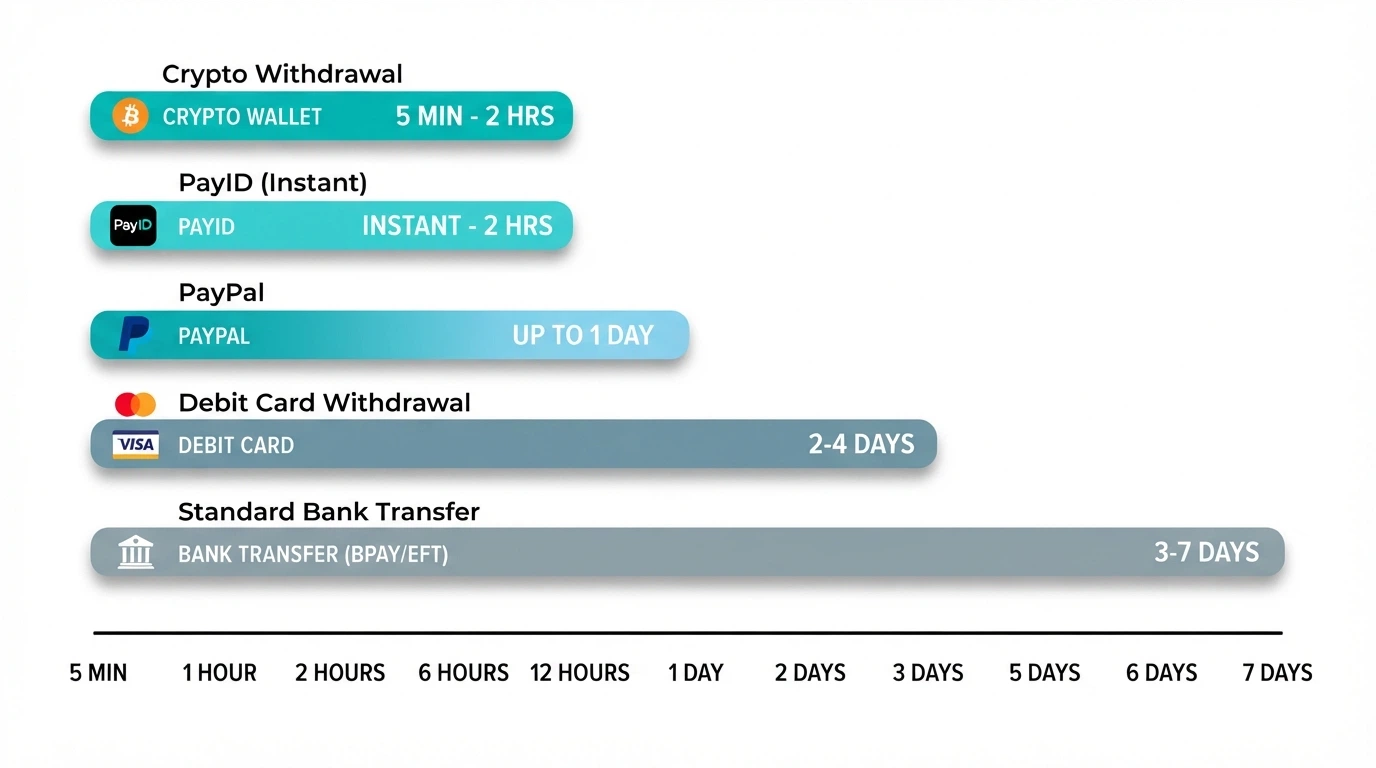
| Method | Typical Speed | Median (Betsquare tested) | Worst Case (Betsquare tested) | AU Availability Note |
|---|---|---|---|---|
| Crypto (BTC, ETH, LTC, USDT) | 5–30 min | 42 min | 4 h | Widely supported at offshore casinos; banned for AU-licensed wagering since 11 June 2024 |
| PayID (NPP) | 15–60 min | 2 h | 8 h | Requires an Australian bank account on NPP; not offered at AU-licensed operators |
| E-wallets (Skrill, Neteller, eZeeWallet) | 1–6 h | 6 h | 18 h | Supported by most offshore casinos; AUD funding is straightforward |
| Visa / Mastercard | 1–3 working days | 2 working days | 5 working days | Banned for AU-licensed wagering since 11 June 2024; common at offshore casinos |
| Bank Transfer | 3–7 working days | 3 working days | 7 working days | The slow rail; AU-licensed operators generally use this exclusively |
PayID: Australia’s Fastest Fiat Payout Rail
PayID runs on Australia’s New Payments Platform, which settles transfers between Australian banks in real time, 24/7. The rail itself is not the bottleneck — a PayID transfer completes between participating banks in seconds, which is why PayID is the fastest fiat option at any casino that supports it. The 2-hour median and 8-hour worst case in Betsquare testing are operator-side delays, not rail-side ones. In Q2 2026 testing, the fastest PayID casino payout processed in under 10 minutes; the slowest operator took just over 11 hours. The same rail, the same method, ten minutes at one casino, eleven hours at another. The operator’s approval queue is doing the work.
The fastest tested pokie withdrawal in Betsquare’s record cleared in 58 minutes via PayID/instant banking on a A$50 deposit at Sweet Bonanza. That figure includes the verification step. PayID is the right rail for an Australian player who wants fiat speed without crypto — and the requirement is straightforward: an account at an Australian bank on the NPP. Every major Australian bank is on the platform.
Crypto Withdrawals: Minutes, Not Days
Crypto payouts settle in 5–30 minutes across the tested set, with the 42-minute median hiding the per-coin variation underneath. USDT on TRC20 and Solana settle in under 5 minutes. Ethereum and Litecoin land within 5 to 30 minutes. Bitcoin is the slowest major coin at 30 to 60+ minutes. The reason is the blockchain, not the casino — block confirmation times and network congestion set the floor, and the casino’s processing time adds minutes on top.
Crypto bypasses the banking system entirely, which is both the source of the speed and the source of the regulatory problem. From 11 June 2024, credit cards, credit-related products and digital currency are banned as payment for licensed online wagering in Australia. An Australian player who is asked for a crypto deposit by a gambling site is being served by someone outside the Australian rules — the payment method is itself a tell. The penalty for an Australian operator that ignores the ban runs up to A$247,500, which is the regulator’s clearest signal of how seriously the prohibition is treated.
E-Wallets: The Reliable Middle Ground
Skrill, Neteller and eZeeWallet settle in 1–6 hours, with a 6-hour median and an 18-hour worst case in Betsquare testing. E-wallets are not as fast as crypto or PayID, but they are predictable and they are widely supported across the featured set. PlayAmo’s e-wallet cashouts land within 30 minutes to 1 hour, faster than the broader tested median. The middle-ground position is the value proposition: a reader who wants fast but is not set up for crypto, or whose bank does not support NPP for the casino’s PayID implementation, gets a reliable rail without the long wait of a card or bank transfer.
E-wallets also decouple the casino payout from the player’s bank account. A reader who does not want gambling transactions appearing on a personal bank statement — a real concern for players whose banks have begun declining gambling-related transactions — uses an e-wallet as a buffer. The trade-off is the verification step on the e-wallet itself, which adds a one-time hurdle that PayID and crypto do not impose.
Bank Transfers and Cards: Why They Still Take Days
Visa and Mastercard withdrawals take 2 to 5 working days in tested data; bank transfers take 3 to 7. The slow rail is a feature of the underlying payment system, not a flaw at the operator — Australian bank transfers do not settle in real time, and card schemes are built around multi-day clearing. A reader who chooses this rail is choosing it knowing it is the slowest option on the page. Ozwin’s bank transfer carries an additional A$50 fee on top of the time cost, with a A$100 minimum.
The regulatory dimension is sharper here than elsewhere. Credit cards and crypto have been banned as payment methods for licensed Australian wagering since 11 June 2024. A casino that accepts either method from an Australian customer is, by definition, operating outside the licensed regime — the IGA prohibits the product and the payment ban prohibits the rail. A bank transfer to a licensed Australian operator is permitted under the rules; a bank transfer to an offshore casino is the one rail the IGA does not technically prohibit, which is why it is the default for many offshore operators.
Fast-Payout Bonuses: The Catch Behind the Offer
A bonus marketed beside “fast payout” creates a tension. The fast payout is a withdrawal speed; the bonus is a binding on that withdrawal. Wagering requirements delay access to the funds, and the wagering takes hours or days of play that the bonus itself has not priced in. The marketing word “fast” does not apply to a balance the player cannot yet withdraw.

No-deposit bonuses sharpen the tension. The wagering on a no-deposit bonus typically runs 30x to 60x — meaning a player must wager the bonus amount 30 to 60 times before any withdrawal is permitted. The typical maximum cashout from a no-deposit bonus in Australia ranges from AU$50 to AU$150 for cash chips and AU$20 to AU$100 for bonus spins. The typical expiry window is 7–14 days for cash chips and 3–7 days for bonus spins. During active wagering, most Australian-facing casinos cap bets at AU$5 to AU$10 per spin, and exceeding the cap can void winnings.
The arithmetic on a no-deposit bonus is unforgiving. At AU$5 per spin, 5-second spin interval and 96.71% RTP (Big Bass Bonanza as a representative slot), clearing 40x wagering on a AU$50 cash chip is 40 × 50 = AU$2,000 in required turnover. At AU$5 per spin, that is 400 spins. At 5 seconds per spin, that is 2,000 seconds, or roughly 33 minutes of continuous play — assuming only the bonus amount is wagered, which the bonus terms rarely permit in practice. The cashout cap of AU$50 to AU$150 caps the upside regardless of how well the session runs. Most players never reach the withdrawal stage at all, not because the math is impossible but because the cap and the expiry close the window before it opens.
Why a No-Deposit Bonus Rarely Pays Out Fast
A no-deposit bonus promises free money, and the terms convert that promise into a multi-stage condition. Claim the bonus, wager it 30 to 60 times, do not exceed the per-spin bet cap, finish within the expiry window, and then withdraw up to the cap. Each stage narrows the path. The wagering requirement multiplies the play volume needed; the bet cap limits how fast the volume can be generated; the expiry window caps the time available; the cashout cap limits the return if all the conditions are met. None of these terms is hidden, but their combined effect is to make the bonus a structured exercise rather than a free lunch.
The expiry is the variable most players underestimate. A 7-day expiry on a cash chip with 40x wagering at AU$5 per spin requires roughly 285 minutes of play in a week — about 40 minutes a day. That is a real commitment, and it is one the marketing does not surface. A player who reads the bonus terms before claiming sees the timer; a player who claims and learns later sees the deadline pass.
Wagering, Caps and Expiry — the Fine Print That Delays Your Cash
Three terms control when, and whether, a payout from a bonus arrives. They differ sharply across the featured set.
- Hell Spin — 40x wagering on each of four deposits; maximum bonus winnings payout A$15,000. The wagering is on the heavier side of the list; the cap is high in absolute terms.
- Ozwin Casino — 30x wagering on bonus and deposit combined; 20x on free spin winnings. The bonus-plus-deposit weighting makes the effective play requirement close to 60x on the bonus alone.
- King Billy — 30x wagering on the welcome bonus. The cleanest of the three — no compounding weighting, no deposit included in the multiplier.
- Rocket Play, SkyCrown, PlayAmo, Fair Go, Bizzo, National Casino, Stake — wagering multiples were not available at review time. Check the operator’s current terms page before claiming any welcome offer on these brands.
Beyond the wagering, the typical maximum cashout from a no-deposit bonus sits between AU$50 and AU$150. The typical expiry window is 7 to 14 days for cash chips and 3 to 7 days for bonus spins. The typical bet cap during active wagering is AU$5 to AU$10 per spin, and exceeding it can void winnings. These are the standard terms across the Australian-facing market, and they are the terms that turn “fast payout” into a longer wait than the rail itself would suggest.
Pokies That Pay: RTP and Payout Speed by Game Type
The pokie a player chooses affects both the return and how quickly wagering can be cleared. Return-to-player (RTP) is the long-run percentage of stakes a pokie returns to players; volatility is the size and frequency of payouts. A high-RTP, high-volatility pokie returns most of every dollar in the long run but concentrates the returns into fewer, larger hits — a session can run cold for a long stretch before a payout arrives. A high-RTP, low-volatility pokie returns most of every dollar in smaller, more frequent payouts. The math is the same over millions of spins; the experience is different over the few hundred spins a single session covers.

The RTP range of popular pokies at fast-payout casinos sits in a narrower band than most players assume. Eight of the most-played titles at the featured operators all clear 96% RTP. Big Bass Bonanza runs 96.71%, Gates of Olympus 96.50%, Razor Returns 96.55% at its higher setting, Sugar Rush 1000 96.53%, Buffalo King Megaways 96.52% at its certified default, Temple Tumble 96.25%, Trigger Happy 96.58% and Big Bass Splash 96.71%. The spread from 96.25% to 96.71% is narrower than the marketing around “high-RTP” pokies implies.
The Pokies with the Highest RTP at Fast-Payout Casinos
| Pokie Title | Provider | RTP | Volatility | Max Win |
|---|---|---|---|---|
| Big Bass Bonanza | Pragmatic Play | 96.71% | High | 2,100x |
| Big Bass Splash | Pragmatic Play | 96.71% | High | 5,000x |
| Trigger Happy | Big Time Gaming | 96.58% | Very High | 50,000x |
| Razor Returns | Push Gaming | 96.55% | High | 100,000x |
| Sugar Rush 1000 | Pragmatic Play | 96.53% | High | 25,000x |
| Buffalo King Megaways | Pragmatic Play | 96.52% | High | — |
| Gates of Olympus | Pragmatic Play | 96.50% | High | 5,000x |
| Temple Tumble | Relax Gaming | 96.25% | Very High | 9,600x |
Pragmatic Play dominates this list — six of the eight titles. The provider mix is not random: Pragmatic Play has built a distribution relationship with most of the offshore casinos accessible to Australian players, and the Big Bass and Gates of Olympus franchises have become the default titles for bonus play. Razor Returns’ two-RTP configuration (96.55% at the higher setting, 94.49% at the lower) is a reminder that an RTP figure published by the provider is sometimes the better of two settings the operator can configure. Buffalo King Megaways carries the same dual-setting structure. A reader who cares about RTP should check which setting the specific casino runs.
How Game Choice Affects Your Withdrawal Timeline
Slots clear wagering faster than table games because of how operators weight game contributions. Slots typically contribute 100% of each spin to the wagering requirement; table games contribute less, sometimes nothing; live-dealer titles frequently contribute nothing at all. A player clearing a bonus on roulette, for example, may find that 10% of each bet counts toward wagering, which extends the time to clear by a factor of ten against a slot. The bonus terms page at any operator spells out the contribution table — it is the document a reader who plans to clear a bonus should read first.
The game outcome itself is independent of the withdrawal pipeline. A spin result on Gates of Olympus is determined the moment the player presses the button, regardless of whether the withdrawal is going to take 10 minutes or 7 days. The game does not pay out faster because the casino pays out faster; the casino pays out faster because of the rail it uses and the queue it runs. A player choosing a pokie for “payout speed” is really choosing a pokie for RTP, volatility and contribution weighting — not for the speed at which the operator will release funds.
Crypto Casinos and the Promise of Near-Instant Cashouts
Crypto delivers the fastest payouts on the page — and using it at an offshore casino means the payment method itself signals the operator is outside Australian regulation. The speed is real. The regulatory tell is real too, and the two facts together describe the trade-off the player is making.
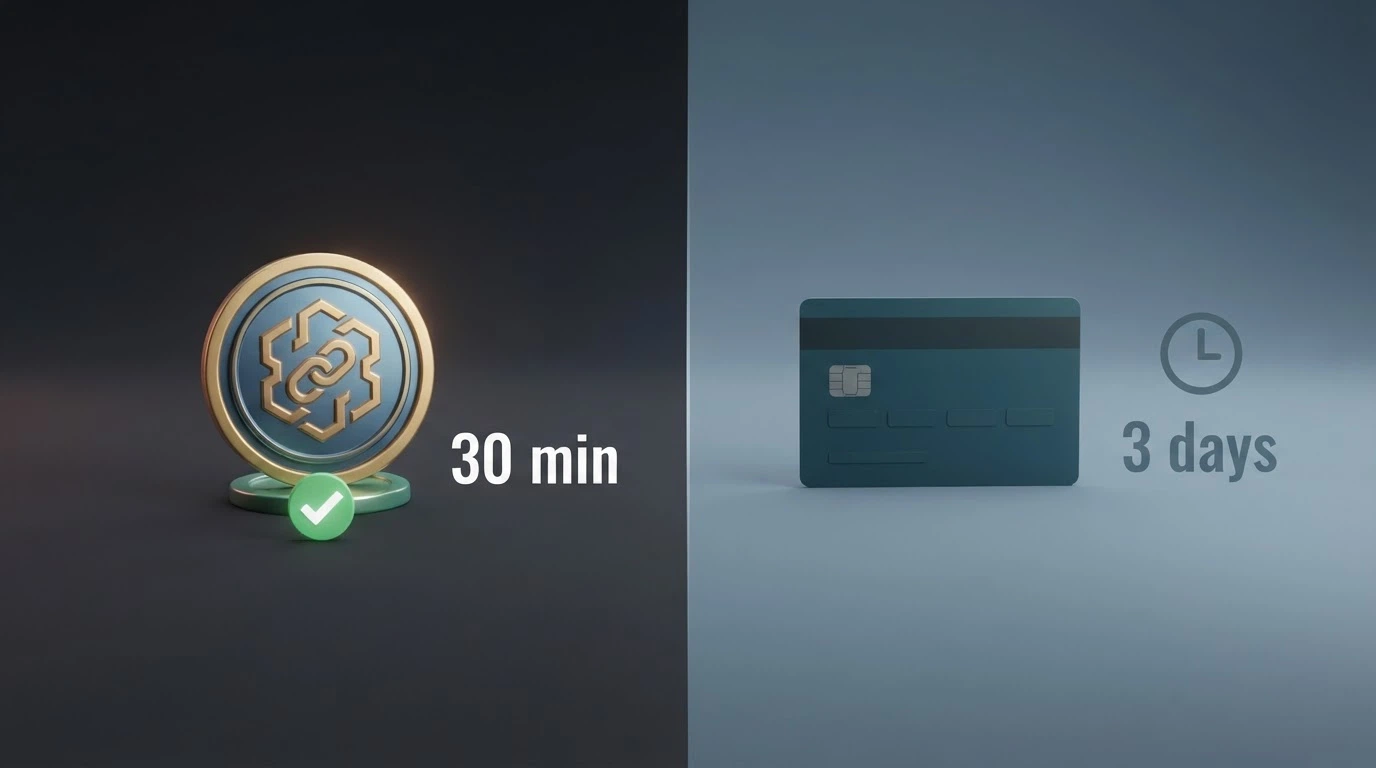
Crypto bypasses the banking intermediary entirely. There is no Australian bank in the transaction, no NPP, no card scheme, no waiting for a working day. The casino releases the funds and the blockchain settles them — and the settlement time is governed by the coin’s block time and network load, not by the operator. USDT on TRC20 settles in under 5 minutes because Tron produces blocks every three seconds and the network is uncongested. Bitcoin settles in 30 to 60+ minutes because Bitcoin produces blocks every 10 minutes and the network often is congested. The casino does not control this. The blockchain does.
The per-coin hierarchy puts USDT on TRC20 and Solana at the top (under 5 minutes), Ethereum and Litecoin in the middle (5–30 minutes), and Bitcoin at the bottom (30–60+ minutes). For a player who wants the fastest possible crypto rail, USDT on TRC20 is the choice. For a player who already holds Bitcoin, the speed is what it is.
Bitcoin vs Altcoins: Which Crypto Pays Out Fastest
The spread across coins is wide enough to matter. USDT on TRC20 and Solana both clear in under 5 minutes at tested operators. Ethereum and Litecoin land within 5 to 30 minutes. Bitcoin is the slowest major coin at 30 to 60+ minutes. Across the featured set, the coins actually supported vary — most operators run BTC, ETH, LTC and USDT; fewer run SOL. A player who wants Solana-level speed at an operator that does not support Solana gets the next tier down, which is still fast.
The reason is the blockchain, and it is worth stating plainly. A Bitcoin block is produced every 10 minutes on average. An Ethereum block is produced every 12 seconds. A Tron block is produced every 3 seconds. The casino’s processing time adds minutes on top of that, but the floor is set by the coin. A reader who treats crypto as a single speed category is missing the spread inside it.
The Trade-Off: Speed vs Consumer Protection
A crypto payout clears in minutes. The operator offering it is unlicensed in Australia, not connected to BetStop, and can be blocked by the ACMA at any time with a balance still on it. From 1 January 2027, banks gain express authority to block transactions to illegal gambling operators, and the regulatory pressure on the offshore market is going to tighten, not loosen.
What the player forfeits by using an offshore crypto casino is the full set of Australian consumer protections. There is no ACMA complaints recourse — the regulator does not hear disputes with unlicensed operators. There is no BetStop coverage — the self-exclusion register does not reach offshore sites. There is no Australian consumer law backstop — no ACL guarantee, no state-based dispute resolution. There is no recourse if the operator refuses a withdrawal or voids a win. The site can be blocked at any time under ACMA direction, and an ACMA block catches every Australian player at once, including those with balances mid-withdrawal.
The concrete cost behind the speed is the absence of every protection that an Australian consumer otherwise takes for granted. The casino offers minutes because the casino is operating outside the regime that would force it to wait. A player who values speed above other considerations gets exactly what is on offer; a player who values protection has to decide how to weight the trade-off.
How to Pick a Fast-Payout Casino You Can Actually Trust
Speed claims are marketing. The operator’s licence, tested payout record, KYC posture and player-feedback history are what predict whether a withdrawal actually arrives.

The trust signals cluster into four groups. Licence verifiability is the first — a licence number that resolves against a regulator’s public register is a stronger signal than a footer logo. Rocket Play’s Curacao licence OGL/2024/1307/0748 and King Billy’s dual MGA + GCA licence are both verifiable against the regulator’s own database. A licence number that does not resolve, or a regulator that does not publish a public register, is a weaker signal. Tested payout data is the second — a deposit-and-withdraw test with timestamps and method details beats any banner. SkyCrown’s 1h 44m test result at Betsquare is a stronger speed signal than “instant payout” on a homepage. KYC posture is the third — operators that run verification at sign-up rather than at first withdrawal deliver faster first payouts. Player-forum signal is the fourth — long-standing player reports with dates and amounts are useful, though they need to be read for signal rather than noise.
Reputation Signals That Matter More Than a “Fast Payout” Badge
A site calling itself “fast payout” costs nothing. The label is a marketing word, and the cost of putting it on a homepage is zero. Look past the badge and look for independently tested withdrawal times, named licence numbers and player forums with dated payout reports.
A licence lookup takes a minute. The Curaçao Gaming Control Board publishes a public register, and the MGA publishes a licensee search. A licence number on the operator’s footer that resolves against the register is a verifiable fact. A licence number that does not resolve is a marketing claim without a foundation. The time cost of checking is small; the signal it produces is large.
The same logic applies to independent test results. Betsquare and similar affiliate testers run real-money deposit-and-withdraw tests with timestamps. The data is dated, the methods are named, the amounts are specified. That kind of record is closer to evidence than to marketing. A reader who can find a tested withdrawal time for the specific operator and method they intend to use has more information than a reader who reads the homepage banner.
Verifying an Operator Before You Deposit
A five-minute licence lookup and a scan of the withdrawal terms page tell you more about payout speed than any homepage banner ever will.
- Licence lookup. Take the licence number from the operator’s footer and check it against the regulator’s public register. The Curaçao Gaming Control Board, the MGA and other serious regulators maintain searchable databases. A number that does not resolve is a red flag.
- Withdrawal-terms review. Read the terms page before depositing. Look for the minimum withdrawal (PlayAmo: AU$50; Ozwin: A$100; Fair Go: A$100), the maximum per transaction (PlayAmo runs AU$5,000 for e-wallets and AU$10,000 for cards), the weekly or monthly limit (Ozwin: A$7,500 weekly; King Billy: A$4,000/day, A$15,000/week, A$30,000/month) and any fees on the rail you intend to use (Ozwin charges A$50 on bank transfers).
- KYC document readiness. Have the operator’s required documents ready before depositing. Incomplete KYC is the number one cause of withdrawal delays — verify your account to avoid issues. A driver licence, a proof of address and a payment-method verification are typically the floor.
- Method availability. Check that the operator supports the rail you intend to use. A casino without PayID cannot deliver PayID speed to an Australian player, regardless of what its homepage says.
- Independent test search. Look for a tested payout record for the specific operator and method. A Betsquare-style deposit-and-withdraw test is the kind of evidence a homepage banner is not.
Responsible Gambling When Speed Is the Selling Point
Fast payouts do not fix a gambling problem. An offshore casino offers none of the deposit limits, activity statements or BetStop coverage that Australian-licensed services must provide, and the marketing around speed can actively obscure the risk for someone whose gambling is moving faster than their judgement.
About 2.1% of Australian adults — roughly 430,000 people — experience problem gambling; the Australian Institute of Health and Welfare put high-risk gambling at 1.8% in 2022. The numbers are large enough that any guide to gambling services has to address them, and the offshore nature of the operators on this page makes the addressing more important rather than less.
The infrastructure for help exists. The National Gambling Helpline is 1800 858 858 — free, confidential, staffed 24 hours a day, 7 days a week. Online chat and email counselling is available through Gambling Help Online at gamblinghelponline.org.au. BetStop — the National Self-Exclusion Register — has been live since August 2023, with 67,480 registrations as at 31 July 2026 and 41,290 active exclusions. Self-exclusion runs from a minimum of three months up to lifetime, and removal requires a statutory declaration confirming counselling from a qualified counsellor, psychologist or doctor.
Where to Get Help — and Why Fast Payouts Don’t Fix a Gambling Problem
The infrastructure is real, but it does not reach the offshore operators on this page. BetStop binds Australian-licensed wagering services only — an offshore casino is not connected to the register, and will keep taking a self-excluded person’s money. A player who has registered with BetStop, gone through the counselling process and excluded themselves for the longest available period can still open an account at any operator on this page, deposit and lose. The deposit limits that Australian-licensed operators must offer do not apply offshore. The activity statements that let a player see their own gambling history do not apply offshore. The speed at which an offshore casino pays out does not change any of this — it just makes the cycle faster.
The help lines are there for a reason. Gambler’s Help (1800 858 858) offers face-to-face, online and telephone counselling, financial counselling and peer support. The National Gambling Helpline and Gambling Help Online run 24/7. None of this is unique to problem gambling — it is available to anyone whose gambling has moved from entertainment into something they want to think about with someone else.
A fast payout is a marketing feature, not a safety feature. The speed at which an operator releases funds says nothing about the operator’s willingness to support a player who has decided to stop. The decision to use the help infrastructure is the same decision a player would make at an Australian-licensed operator, with the same routes available, and the offshore status of the casino does not change which number to call.
How We Selected and Ranked These Fast-Payout Casinos
Every operator on this page was evaluated against tested withdrawal-speed data, licence verifiability, bonus-term transparency and Australian-market relevance. No ranking was bought and no operator holds an Australian licence — none exists.
The criteria, in order of weight, were tested withdrawal speed (Betsquare-style deposit-and-withdraw tests where available), licence status (verifiable numbers at the regulator’s register preferred over footer logos), bonus-term transparency (the terms legible at sign-up rather than at withdrawal), AU-market accessibility (does the operator accept Australian players, support AUD or PayID, and have a track record of serving the market) and independent test data (Betsquare, GamblingInsider, CardPlayer and other Australian affiliate testers). The criteria were not given numeric weightings; the ranking reflects the editorial read of the available data.
The sources consulted included the ACMA register (for the IGA framework and the BetStop coverage gap), the Curaçao Gaming Control Board public register (for licence number verification), the MGA licensee search (for King Billy’s MGA licence) and third-party deposit-and-withdraw tests from Betsquare and similar affiliate testers. No figure on this page was drawn from a memory that could not be tied back to a named source.
The operator set is ten offshore casinos accessible to Australian players, ordered by tested payout speed and AU-market presence rather than by advertising spend or market share. The set is not exhaustive — there are more than ten offshore casinos accessible to Australian players, and a longer list would not change the underlying point. Every operator on this page is offshore, every one is outside Australian consumer protection, and every one is subject to the ACMA’s blocking power.
What the Fast-Payout Market Means for Australian Players in 2026
The operator that pays out fastest is still an offshore entity outside every Australian consumer protection. The speed is real, but it comes from operating beyond the IGA, not from a superior product.
The central tension of this market is that the speed a reader wants and the protection a reader might want are, in this product class, mutually exclusive. The licensed Australian market does not offer online casino at all — there is no licensed alternative to compare against. The offshore market offers speed, but the speed is possible only because the operators are outside the regime that would slow them down. Every fast payout on this page is paid by an operator that the ACMA can direct ISPs to block, that BetStop cannot reach, and that an Australian bank will gain the express authority to refuse from 1 January 2027.
The concrete takeaway is straightforward. If a reader chooses to play, verify the licence at the regulator’s register before depositing, complete KYC before the first withdrawal, and never deposit more than the reader can afford to lose to an ACMA block that catches every Australian player at once. The decision belongs to the reader. This page describes the market; it does not argue for or against any operator on it, and it does not recommend one as a place to play.
The 2026 reform tightens the landscape further. The payment-blocking power from 1 January 2027 will reduce the number of Australian banks willing to process transactions to offshore gambling operators, and the practical reach of the offshore market is going to narrow rather than widen over the next twelve months. A reader who treats this page as a snapshot of the current market is treating it correctly; a reader who treats it as a forecast for 2026’s second half is reading past the data.
Frequently Asked Questions
What causes casino withdrawal delays and how can I avoid them?
Incomplete KYC is the number one cause — verify the account with the operator’s required documents before requesting the first withdrawal. The second cause is method mismatch: requesting a bank transfer when PayID or crypto is available adds days. The third is bonus wagering still being active; a bonus-locked balance cannot be withdrawn regardless of the rail. Pre-uploading ID, choosing the fastest supported method, and clearing any active bonus before requesting the cashout are the three steps that prevent the bulk of delays.
What is the minimum withdrawal amount at fast payout casinos?
It varies by operator and method. PlayAmo sets AU$50 as the floor; Ozwin and Fair Go set A$100; Bizzo runs around AU$10, the lowest on this list. Crypto minimums are often lower than fiat minimums because the rail costs less to settle. The maximum per transaction ranges from AU$5,000 (e-wallets at PlayAmo) to AU$10,000 (cards at PlayAmo), with weekly and monthly caps layered on top at most operators — King Billy runs A$4,000/day, A$15,000/week, A$30,000/month, and Ozwin caps at A$7,500 per week.
Can I get instant payouts with a no-deposit bonus in Australia?
Not in any practical sense. The wagering requirement (typically 30x to 60x) must be cleared first, and the maximum cashout is capped (AU$50 to AU$150 for cash chips, AU$20 to AU$100 for bonus spins). The expiry window runs 7–14 days for cash chips and 3–7 days for bonus spins. By the time the bonus clears, the payout arrives through the same rail as any other withdrawal — fast on crypto or PayID, slow on cards or bank transfer. The “instant” in the offer refers to the claim, not the cashout.
What wagering requirements apply to fast payout casino bonuses?
The featured operators differ sharply. Hell Spin applies 40x wagering on each of four deposits. Ozwin applies 30x on bonus and deposit combined — roughly double a 30x bonus-only requirement. King Billy runs a clean 30x on the welcome bonus. For operators without confirmed wagering multiples this run — Rocket Play, SkyCrown, PlayAmo, Fair Go, Bizzo, National Casino and Stake — check the current terms page before claiming any welcome offer, because the wagering multiple is the single most consequential term in the bonus package.
Are there any fees for withdrawing from an Australian fast payout casino?
Most operators do not charge a fee on crypto or e-wallet withdrawals. The exception worth flagging is Ozwin’s bank transfer, which carries a A$50 fee and a A$100 minimum. Card withdrawals are typically fee-free at the operator end but can carry a cash-advance fee from the card issuer, which is worth checking before requesting. Crypto network fees are paid by the player on the blockchain, not by the casino, and are usually under AU$5 on Ethereum or Tron.
Does BetStop cover fast payout casino sites in Australia?
No. BetStop — the National Self-Exclusion Register — binds Australian-licensed wagering services only. An offshore casino is not licensed in Australia, is not connected to the register, and will keep taking a self-excluded person’s money. As at 31 July 2026, 67,480 people had registered with BetStop and 41,290 exclusions were still active. None of that protection reaches any operator on this page. Self-exclusion through BetStop is meaningful for the licensed market; it has no effect on the offshore market.
Do crypto casinos offer faster payouts than PayID casinos?
In tested medians, yes — though not by as much as the marketing suggests. Crypto posts a 42-minute median with a 4-hour worst case; PayID posts a 2-hour median with an 8-hour worst case. The fastest PayID test cleared in under 10 minutes, faster than the crypto median. The choice between them is not really about speed — both are well inside an hour at most operators — but about access and regulation. Crypto is banned for Australian-licensed wagering since 11 June 2024, so a casino accepting crypto is, by definition, outside the licensed regime. PayID is not banned, but no licensed Australian casino offers online pokies for the PayID rail to carry.