
Best Instant Payout Online Casinos Australia: What Tested Speed Actually Looks Like in 2026
“Instant payout” is a promise most casinos break, and the gap between the marketing claim and the bank-account reality is where most Australian players lose time they didn’t know they were spending. The promise is everywhere: top of the homepage, in the bonus email, in the live-chat sales pitch. What arrives is often a pending period, a manual approval, a payment-rail window, and then the funds. Fewer than 30% of platforms claiming “instant payouts” actually delivered on that claim in the tested AU-facing online-casino sample. As one industry source put it plainly, “Many casinos advertise ‘instant withdrawals’, but what they actually offer is fast approvals, not instant receipt of your funds.” This page is about the gap, and which operators actually close it.

Current as of 24 November 2026 against the ACMA register and published operator terms.
Table of Contents
- What “instant” really means at an online casino
- The fastest-paying casinos Australian players can actually join in 2026
- Sportsbet
- bet365
- Ladbrokes
- Picklebet
- Betr
- SkyCrown
- RocketPlay
- Royal Reels
- Stake
- BitStarz
- Playing from Australia: why every instant-payout casino sits offshore
- The pokies that pay: which games deliver when the cashout is instant
- Crypto withdrawals land in minutes: the rail AU banks can’t match
- No-deposit bonuses at fast-payout casinos: the fine print that kills the offer
- Real money means real verification: why KYC is the gatekeeper
- How we chose and ranked the casinos on this page
- Your instant-payout casino checklist: what to do before you sign up
- Frequently asked questions
What “instant” really means at an online casino
The word does one job in marketing and a different one in a cashier system. In the cashier, a withdrawal moves through two distinct stages that get blurred into the single word “instant”. The first stage is operator-side: the casino receives the request, runs compliance checks, checks KYC, checks bonus status, and approves the payment. The second stage is rail-side: the payment method carries the funds from the operator to the player’s account. Each stage has its own clock, and “instant” usually describes the second one while hiding the first.
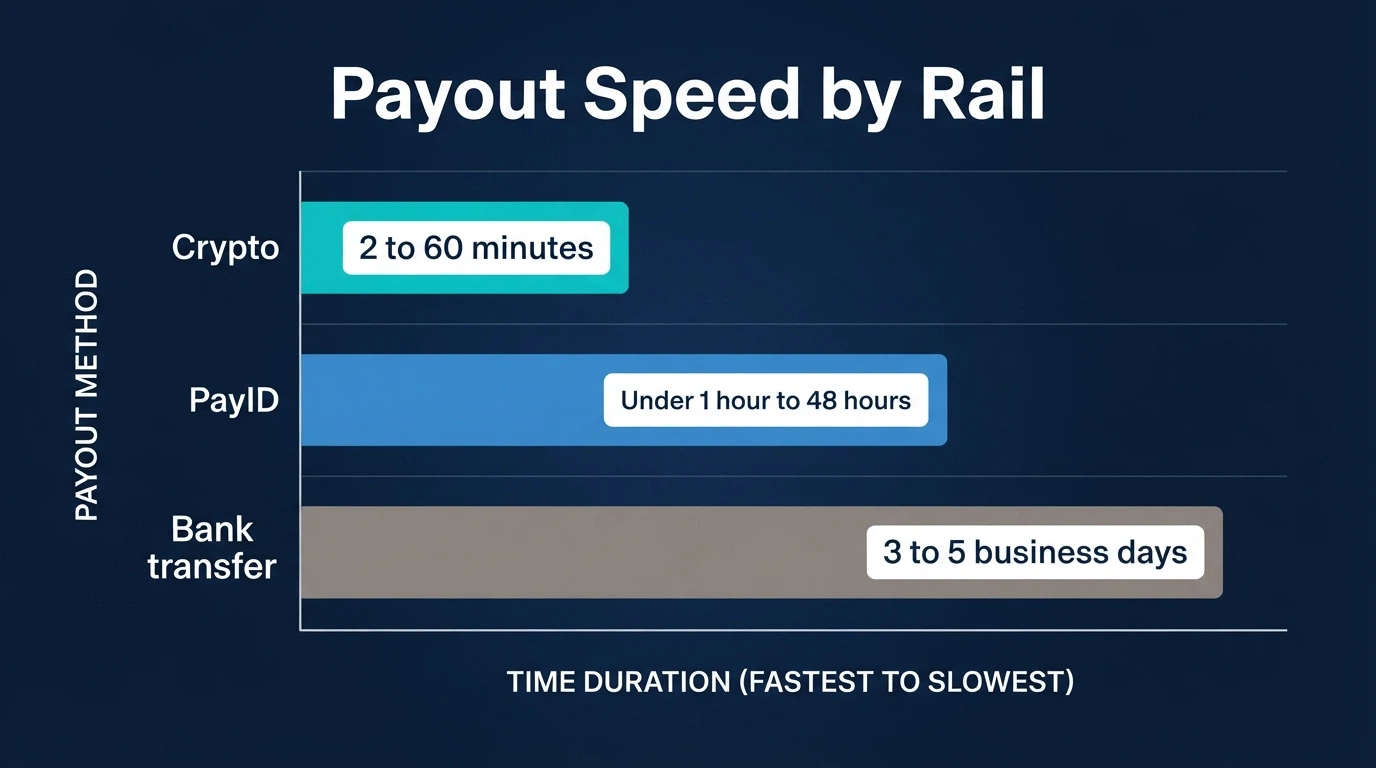
In 2026 testing, crypto payouts were the fastest AU-facing online-casino withdrawal route, often landing in 2–60 minutes once approved. PayID, the real-time bank-transfer rail built on the New Payments Platform (NPP), was identified as the fastest fiat option, usually clearing in under one hour once approved. The reason it feels instant is that the NPP settles between Australian bank accounts in near-real time, with Osko delivering the funds on the receiving end in seconds for most retail banks. Bank wires through the international SWIFT network lag at 3–5 business days, and the gap is structural rather than operational: a SWIFT message hops through correspondent banks, each with its own cut-off, before the funds land.
So when an operator advertises instant withdrawals, the meaningful question is: instant from which point? Instant from approval, where the operator has clicked the funds out, can still mean a 3–5 business-day wait if the rail is a bank wire. Instant from request, where the operator auto-approves the moment the button is pressed, can still be throttled by a pending KYC review. The next sections break these tiers down.
Approval time versus money in your account
The approval window is the first clock. A pending period runs from the moment the withdrawal request is submitted to the moment the operator marks it approved. During this window the casino is running the checks it is legally required to run: confirming the account holder matches the payment destination, checking the bonus is cleared, and reviewing for AML flags. KYC verification failures often cause significant payout delays at these operators. A player who deposited in a hurry and uploaded a partial document set is the player whose first withdrawal sits longest in the queue.
Once the operator has approved, the payment rail takes over. NPP with PayID and Osko is the fastest fiat rail: transfers between participating Australian banks settle in seconds, with no retail end-user fee. International cards and bank wires sit at the other end of the ladder. The same PayID withdrawal averaged 24–48 hours across operators in the broader tested comparison, which means the test set included a number of operators that were not running true Osko settlement in real time. The fastest PayID operators, by contrast, were processing in under 10 minutes, and the slowest in the test set took just over 11 hours. The rail is the same; the operator’s integration determines how fast the rail’s potential is actually used.
This is the practical reason the term “instant” needs to be unpacked. A player comparing casinos is not comparing a single number, they are comparing a pending window plus a rail window. The pending window depends on the operator’s KYC discipline and bonus system. The rail window depends on which payment method the player picks.
The payout-speed ladder
Four tiers describe what an Australian player will actually encounter, drawn from the tested comparison rather than from the marketing copy:
- Instant (under one hour): crypto rails on offshore casinos (USDT on Tron is the workhorse, confirmations running 1–3 minutes and network fees under A$2) and the fastest PayID/Osko integrations on licensed bookmakers. GoBet’s AU bookmaker testing had Dabble at the fastest average withdrawal speed of 8.74 seconds, with various other licensed operators also offering near-instant withdrawals via Osko.
- Same-day (under 24 hours): most crypto payouts at offshore casinos once approved, with BitStarz crypto withdrawals averaging 0.2–2 hours, Stake 1–4 hours, and Wild Fortune 5 hours 24 minutes on USDT TRC20. Royal Reels declared payout speed under 24 hours.
- Fast (24–48 hours): the bulk of the tested PayID field, where personal testing had Hell Spin clearing in 25 minutes, Goldenbet in 28 minutes, Lucky7 in 35 minutes, and LuckyVibe within 1 hour, but the broader cross-operator PayID average sat at 24–48 hours. Picklebet’s published payout processing is 24–48 hours, with withdrawal handling seven days a week between 11am and 7pm.
- Standard (3–5 business days): international bank wires and most card withdrawals, where the rail rather than the operator is the bottleneck.
The four tiers are not equally populated. The instant tier is dominated by crypto on offshore casinos and by the NPP/Osko fast lane on licensed bookmakers. The standard tier is mostly bank wire. The same-day and fast tiers absorb everything in between, and the spread within them is wide enough that two operators running the same rail can deliver wildly different times.
Who delivers and who just advertises
The 14 AU-facing casinos tested between January and July 2026 by MerchantCircle AU gave a clear answer: the marketing term is far more generous than the operational reality. Among offshore casinos with tested fast rails, the leaders were BitStarz (0.2–2 hours on crypto), Stake (1–4 hours on USDT TRC20) and Wild Fortune (5 hours 24 minutes on USDT TRC20). Among licensed AU wagering operators running Osko, Dabble led at 8.74 seconds average, with several other licensed operators also near-instant.
The pattern is sharper than the averages suggest. Operators running Osko and routing through NPP can clear payouts in seconds because the rail does the work. Operators running crypto can clear in minutes because the blockchain settles without a banking intermediary. Operators running traditional bank wires cannot shorten the rail itself, and the marketing claim runs aground on correspondent banking cut-offs. The reliable shortcut is choosing operators that have integrated the fast rail, not operators that promise a fast time on a slow rail.
Why demo play and free-play mode miss the point
Demo play, free-play mode, “fun mode” — these are different names for the same thing: a casino account that uses play-money credits rather than deposited funds. The relevant fact for a withdrawal guide is that demo play has no cashout. A demo account cannot request a withdrawal because there is no balance to withdraw. Real-money play, meaning a deposited account with real funds at risk, is the only mode where the payout-speed question even applies. A player testing a casino in demo mode will never see the cashier’s actual behaviour.
The other reason the distinction matters: the bonus system is usually gated behind a real-money account. Royal Reels’ A$10 no-deposit offer is delivered after phone verification, and the 30x wagering requirement applies once the bonus is credited to a real-money account. A player who has only opened a demo account has not seen the offer at all.
The fastest-paying casinos Australian players can actually join in 2026
Online gambling products, including casino games, pokies, and in-play sports betting, are prohibited for Australian residents under the Interactive Gambling Act 2001. No Australian licences exist for these categories. The Interactive Gambling Amendment Act 2017 further strengthened this framework. The federal regulator that enforces it is the Australian Communications and Media Authority (ACMA). What is permitted is wagering on races and sport placed before the event begins, plus lotteries and keno, through operators licensed by a state or territory — the de facto national online wagering licensing concentrates in the Northern Territory through Licensing NT and the Northern Territory Racing and Wagering Commission (NTRWC). The individual player is not prosecuted under the IGA — the Act targets the provider, not the punter. That is the legal ground every AU-facing “instant payout casino” sits on, and the rest of the page works through it.
The set below is the realistic shortlist of operators an Australian player comparing fast payouts would actually consider. It is split by legal product, not by the marketing language that operators use. The licensed wagering operators (Sportsbet, bet365, Ladbrokes, Picklebet, Betr) offer sports and racing products under AU law; they are not online casinos. The offshore operators (SkyCrown, RocketPlay, Royal Reels, Stake, BitStarz) run online casinos, but are not licensed in Australia. Both categories process fast payouts; only one is a legal product in this country.
| Operator | AU legal status | Fastest tested payout speed | Key withdrawal rail |
|---|---|---|---|
| Sportsbet | Licensed AU wagering (no online casino product) | Bank transfer (specific time not tested this run) | APRA-regulated ADI bank account, member’s own name only |
| bet365 | Licensed AU wagering (no online casino product) | 1–24 hours; same-day the norm; most within 2 hours | Bank transfer via Osko, near-instant |
| Ladbrokes | Licensed AU wagering (no online casino product) | 1–24 hours | Bank transfer |
| Picklebet | NTRWC-licensed wagering (no online casino product) | 24–48 hours | Bank transfer (handled 11am–7pm, 7 days) |
| Betr | NTRWC-licensed wagering (no online casino product) | Instant to 72 hours | Bank transfer via Osko, near-instant |
| SkyCrown | Offshore; Curacao 8048/JAZ2019-015; not licensed in AU | Crypto instant; e-wallets 0–1 hour; bank 3 days | Crypto and e-wallet |
| RocketPlay | Offshore; Curacao 8048/JAZ2020-013 (Antillephone N.V.); not licensed in AU | Under 1 hour on PayID for most AU banks | PayID |
| Royal Reels | Offshore; Curacao; ACMA-blocked in AU | Under 24 hours | Crypto, e-wallet, bank |
| Stake | Offshore; not licensed in AU | 1–4 hours tested on USDT TRC20 | Crypto (USDT TRC20) |
| BitStarz | Offshore; not licensed in AU | 0.2–2 hours tested on crypto | Crypto |
A reader scanning that table will see that the licensed wagering operators and the offshore casinos are not directly comparable. A licensed bookmaker is constrained to sports and racing; an offshore casino offers slots and live dealer. The payout speeds are tested under the same methodology, and the split is roughly as fast on the offshore side via crypto as on the licensed side via Osko. The legal product split is the page’s other ranking axis and the one a reader cannot resolve by looking at payout speed alone.
How payout speeds compare across operators and rails
The numbers in the table come from a small set of published tests, not from a single uniform benchmark. PayoutVerdict’s tested comparison showed crypto leaders like BitStarz and Stake processing payouts in 0.2–4 hours, while PayID averaged 24–48 hours across operators and bank wires lagged at 3–5 business days. Personal PayID testing by PokiesAustralia had Hell Spin clearing in 25 minutes, Goldenbet in 28 minutes, Lucky7 in 35 minutes, and LuckyVibe within 1 hour. Q2 2026 testing by AussiePokies96 found the fastest PayID payout processed in under 10 minutes and the slowest tested operator at just over 11 hours.
The same rail behaves differently at different casinos. The PayID rail is the same PayID rail at Royal Reels and at Betr; what differs is the operator’s integration. An operator running Osko settlement, the real-time layer that NPP enables, can land the funds in seconds. An operator running standard NPP clearing on a queue can take hours. The 11-hour tail in the PayID test is not a PayID problem; it is an operator problem, and the only way to know is to test or to read a test.
This is why the “fastest” tier on a list is not a single number. The instant rail is crypto on the offshore side, Osko on the licensed side, and each side has its leader. Dabble’s 8.74-second average on the Osko bookmaker side and BitStarz’s 0.2–2 hours on the crypto side are not directly comparable, because the first is in fiat to an Australian bank account and the second is in crypto to a private wallet. A player choosing between them is choosing between rails and currencies, not between two close numbers on the same scale.
Trust filters: licence, regulation and what keeps your money safe
The payout-speed table sorts by speed. The legal-product table sorts by what is actually legal. The two rankings are not the same, and a player looking only at the first risks ending up at an operator that ACMA has blocked from Australian ISPs. The ACMA has had 1,564 illegal gambling and affiliate websites blocked by Australian ISPs since its first blocking request in November 2019, and more than 225 illegal services have withdrawn from the Australian market since enforcement was strengthened in 2017.
- Licensed AU wagering (Sportsbet, bet365, Ladbrokes, Picklebet, Betr): regulated by state and territory bodies, principally the Northern Territory Racing and Wagering Commission. Withdrawals go to APRA-regulated Authorised Deposit-taking Institution bank accounts in the member’s own name. BetStop, the National Self-Exclusion Register, binds these operators. The product is sport and racing wagering, not online casino.
- Offshore online casinos (SkyCrown, RocketPlay, Royal Reels, Stake, BitStarz): licensed in Curacao (and similar offshore jurisdictions), not licensed in Australia. The product is online casino, including pokies and live dealer. BetStop does not bind these operators. ACMA blocking can interrupt access, and balances stranded on a blocked domain are not protected by an Australian regulator.
- The 2024 payment ban: from 11 June 2024, credit cards, credit-related products and digital currency are banned as payment for online wagering with licensed AU operators. An operator that fails to enforce the ban faces penalties of up to A$247,500; the government’s own media release stated fines of up to A$234,750.
- The 2027 change: from 1 January 2027, banks and payment providers gain express authority to block transactions to illegal gambling operators. This does not affect licensed wagering today, but it changes the practical risk for offshore casino play from 2027.
The pragmatic filter is: licensed wagering for sport and racing, with the protections that come with it; offshore casino for pokies and tables, with the corresponding absence of those protections. A player who values BetStop coverage and ADI-bank-account protection will land on the licensed side and accept that there is no online casino product there. A player who values the casino product will end up offshore and accept the unprotected status.
Sportsbet
Sportsbet is Australia’s largest licensed wagering operator, and the operator with the most restrictive withdrawal policy in the licensed set: withdrawals must go to a bank account held with an APRA-regulated Authorised Deposit-taking Institution, in the member’s own name, and withdrawals to foreign bank accounts are not available. That rule is the price of being a fully licensed AU wagering service, and it is the structural reason Sportsbet cannot offer the crypto or e-wallet rails that the offshore casinos do. Deposits can be made by debit card, BPAY, cheque, money order, Moneybookers, PayPal for Australian residents only, direct deposit or telegraphic transfer. The product is wagering on races and sport, not online casino. For a player whose primary need is sport and racing with a guaranteed ADI-bank-account payout, Sportsbet is the most banked path in the licensed set. For a player who wants online pokies or a faster rail than BPAY-and-wait, Sportsbet does not have the product.
bet365
bet365 is the closest the licensed AU wagering market comes to an instant-payout bookmaker, and the closest it comes to matching the offshore casino rail on speed without the offshore status. A bet365 AU audit recorded deposits from A$5 and withdrawal turnaround of 1–24 hours, with same-day payouts described as the norm and most requests processed within two hours. GoBet’s AU bookmaker testing also found bet365 among the operators offering near-instant withdrawals via Osko. The combination — AU licence, Osko rail, A$5 minimum deposit — covers the speed question for a player who only needs sport and racing and who is happy with a bank-account destination. The product is wagering, not online casino, and the same legal split applies as it does to Sportsbet and Ladbrokes. A reader who arrived here for “instant payout online casino” will not find the casino product at bet365 AU; they will find the fastest licensed bank-account payout in the country.
Ladbrokes
Ladbrokes is the third of the three big licensed AU bookmakers and the one most often listed alongside Sportsbet and bet365 in head-to-head speed tests. A Ladbrokes AU audit recorded deposits from A$5 and withdrawal turnaround of 1–24 hours, the same 1–24 hour window bet365 showed in the same audit family. The product is wagering on races and sport. The structural advantages and limits of the licensed wagering set apply: ADI bank account withdrawals, BetStop coverage, no online casino product. For a player comparing the three big Australian bookmakers, the speed ranking within the licensed set is bet365 (most requests within 2 hours) and Ladbrokes (1–24 hours), with Sportsbet as the slower, more banked path.
Picklebet
Picklebet is the operator that gives the clearest picture of a Northern Territory Racing and Wagering Commission licence at work, including its operational hours. Picklebet is regulated by the NTRWC, payouts are processed in 24–48 hours, and withdrawal handling runs seven days a week between 11am and 7pm. The published 24–48 hour window is slower than bet365 and Ladbrokes, and the 11am–7pm handling window is the kind of detail that matters for a player timing a withdrawal around a weekend evening or a public holiday. The product is wagering, not online casino. A player who values a clearly stated NTRWC licence and is happy with a 24–48 hour payout window has a fit here; a player who needs instant will want to look at bet365 or the offshore crypto set.
Betr
Betr sits between Picklebet and the instant tier in the licensed set, and is the other NTRWC-licensed operator in the comparison. Betr is licensed by the Northern Territory Racing and Wagering Commission and lists withdrawal times as instant to 72 hours, with customer support available 24/7. GoBet’s AU bookmaker testing also found Betr among the operators offering near-instant withdrawals via Osko. The “instant to 72 hours” wording covers the full range from the best-case Osko run to the worst-case manual review, and the 24/7 support is a small but real differentiator for a player who needs help at midnight on a Saturday. The product is wagering, not online casino. For a player who wants the speed range of a crypto operator but with an NTRWC licence, Betr is the licensed-side answer, with the understanding that “instant” here means Osko-fast, not crypto-fast.
SkyCrown
SkyCrown is the Curacao-licensed casino with the broadest speed ladder in the offshore set. SkyCrown’s published terms list minimum withdrawal €20 or equivalent, maximum withdrawal A$7,500, licence Curacao 8048/JAZ2019-015, and crypto cashout “instant” with e-wallets at 0–1 hour and bank transfers at 3 days. The welcome package is listed as up to A$4,000 plus 400 free spins. The A$7,500 per-transaction cap is a constraint worth noting for a player expecting a large cashout, and the 3-day bank rail is a reminder that the rail itself, not the operator, is the bottleneck. A player who picks crypto avoids the cap by working at the per-transaction level; a player who picks bank wire inherits the rail. The Curacao licence is the standard offshore credential, and ACMA blocking of Curacao-licensed services has been a feature of the AU enforcement record since 2019. For a player who wants a large welcome package and is comfortable with crypto, SkyCrown is the most balanced of the deposit-gated offshore packages.
RocketPlay
RocketPlay is the Curacao casino with the cleanest PayID integration among the offshore set, and the one most often cited for Australian players who want a fiat rail without going to a licensed bookmaker. RocketPlay is licensed by Antillephone N.V. under Curacao licence number 8048/JAZ2020-013. RocketPlay’s PayID withdrawals are processed in under an hour for most Australian banks, with a daily limit usually A$5,000 unless higher-tier verification is completed. The higher-tier verification lift is the mechanism that breaks the daily ceiling — a player moving a large balance will go through the additional checks, which is where the typical KYC delay sits, and which is why completing KYC at signup rather than at first cashout is the single best speed move. The PayID rail puts RocketPlay close to the licensed bookmakers’ Osko times without the licensed bookmaker’s product limits. For a player who wants fast fiat and is comfortable with Curacao licensing, RocketPlay is the most direct answer.
Royal Reels
Royal Reels is the Curacao-licensed casino with the only confirmed no-deposit offer in the featured set, and the one most clearly on ACMA’s radar. Royal Reels is listed as operating under a Curacao licence, offering a A$10 no-deposit bonus after phone verification, 5,400+ pokies from 40+ providers, and payout speed under 24 hours. The published standard weekly withdrawal cap is A$10,000, with higher VIP tiers up to A$25,000 and A$50,000 and top-tier bespoke arrangements. The 30x wagering requirement on the welcome bonus is the lever that turns A$10 into A$300 of required turnover, and the cap and the bonus lock are the levers that turn any winnings from the bonus into something harder to extract. ACMA has had 1,564 illegal gambling and affiliate websites blocked from Australian ISPs since November 2019, and Royal Reels is among the services that have been blocked. The product is online casino; the offer is the only confirmed no-deposit in the set; the legal status is offshore and blocked. For a player specifically looking for a no-deposit test, Royal Reels is the option; for a player looking for an unblocked AU-friendly casino, Royal Reels is not.
Stake
Stake is the offshore crypto casino with the most widely tested payout time, and the one most often recommended for players who already hold USDT. Stake is not licensed in Australia. A tested AU-facing casino payout comparison found Stake’s USDT TRC20 withdrawals at 1–4 hours, which is not the fastest crypto rail in the test (BitStarz is faster) but is consistently within the same-day tier and well ahead of the PayID average. The casino is crypto-only, with no fiat rail and no AU bank account integration, and the choice is between speed and fiat compatibility. The credit-card and crypto wagering payment ban from 11 June 2024 applies to licensed AU wagering and not to offshore casinos, so the use of USDT here is a separate path from the licensed market. For a player who already uses USDT and wants a tested fast crypto rail, Stake is the cleanest fit.
BitStarz
BitStarz is the fastest raw crypto rail in the tested comparison, and the operator most often cited when the question is “what is the fastest withdrawal available to an Australian player today”. A tested AU-facing casino payout comparison found BitStarz crypto withdrawals averaging 0.2–2 hours, faster than Stake’s 1–4 hours and Wild Fortune’s 5 hours 24 minutes. The casino is offshore, not licensed in Australia, and the same offshore-status caveats apply. The 0.2–2 hour range is the headline number, and the practical question is whether the player is set up to receive crypto at that speed — the wallet, the network fee awareness, the understanding that USDT on Tron settles in 1–3 minutes with fees under A$2. For a player who wants the fastest rail available and is comfortable with the offshore status, BitStarz is the fastest answer on this page.
Playing from Australia: why every instant-payout casino sits offshore
The legal ground every AU-facing “instant payout casino” sits on is the Interactive Gambling Act 2001, strengthened by the Interactive Gambling Amendment Act 2017. Online casino games, online pokies and in-play sports betting are prohibited to persons in Australia. There is no Australian licence for that product, anywhere. The ACMA is the federal regulator that enforces the prohibition. The product that is permitted, wagering on races and sport placed before the event begins, plus lotteries and keno, goes through state and territory-licensed operators — and what is permitted is not what an “instant payout casino” reader is usually looking for.

The split has practical consequences for everything on this page. The licensed wagering operators (Sportsbet, bet365, Ladbrokes, Picklebet, Betr) sit inside Australian consumer-protection law, hold ADI bank-account withdrawal rules, and bind to BetStop. The offshore online casinos (SkyCrown, RocketPlay, Royal Reels, Stake, BitStarz) sit outside that framework, offer casino products that no AU operator can offer, and do not bind to BetStop. For those prioritizing BetStop and banking safety, the licensed path is the only consistent choice.
The Interactive Gambling Act in practice
The IGA 2001 prohibits the provision of online casino games, online pokies and in-play sports betting to a person in Australia. The Interactive Gambling Amendment Act 2017 strengthened that framework. The ACMA enforces it, and since its first blocking request in November 2019, has had 1,564 illegal gambling and affiliate websites blocked by Australian ISPs. More than 225 illegal services have withdrawn from the Australian market since enforcement was strengthened in 2017. The individual player is not prosecuted under the IGA; the Act targets the provider.
The credit-card and crypto wagering payment ban from 11 June 2024 was the second structural change: credit cards, credit-related products and digital currency are now banned as payment for online wagering with licensed AU operators. An operator that fails to enforce the ban faces penalties of up to A$247,500, with the government media release stating fines of up to A$234,750. The 2027 legislative reforms extend banking and payment block authorities to illegal operators, closing the practical rail that offshore casinos currently rely on.
A consequence of the prohibition is that there is no federal deposit, loss or stake ceiling for online gambling. Australia does not cap what a player can deposit, because the product itself is banned. The cap the country does apply is on the payment method. The licensed wagering market’s protection framework runs through customer-set deposit limits and activity statements under state and territory conditions, not through a federally mandated cap.
Offshore casinos versus licensed wagering
The product, the protections and the payout rails are different between the two categories, and a reader choosing between them is choosing between two sets of trade-offs rather than between two operators on the same set.
Licensed AU wagering gives Osko and NPP settlement for fast bank-account payouts, BetStop coverage, ADI bank-account verification, state and territory consumer protection, and a product limited to sport and racing. Offshore online casinos give crypto and PayID rails for fast payouts, no BetStop coverage, no AU bank-account protection, no AU regulator on the other end, and a product that includes online pokies and live dealer. The licensed operators cannot offer the casino product; the offshore operators cannot offer the Australian framework.
The difference is the structural reason this page’s tables are split the way they are. Speed alone does not decide the choice. A player who values BetStop and the ADI bank-account protection lands in the licensed set and accepts the wagering-only product. A player who values the casino product lands offshore and accepts the unprotected status. The page does not try to flatten the choice; it lays out the trade-off.
PayID and Osko: the fastest fiat rail for Australian players
PayID is the addressing layer on top of the New Payments Platform, the real-time settlement system operated by NPP Australia. Osko is the specific payment type within NPP that uses PayID to deliver near-instant transfers between participating Australian banks. A PayID withdrawal at a casino is a request to a participating bank to send funds from the operator’s account to the player’s account, identified by something simpler than a BSB and account number — typically a phone number or an email address.
The rail’s strength is the settlement speed: transfers between participating banks clear in near-real time, with no retail end-user fee. Most AU-facing fast payout casinos charge zero fees on PayID withdrawals, and NPP Australia does not impose end-user fees on PayID transfers. The minimum withdrawal limits at major AU-facing sites ranged from A$10 to A$30, and maximum daily limits ranged from A$2,000 to A$10,000. The cap is the operator’s cap, not the rail’s cap, and the operator sets it.
The performance data tells the same story. GoBet’s AU bookmaker testing found Dabble at the fastest average withdrawal speed of 8.74 seconds, with Neds, Betr, Palmerbet, Bet365, NextBet, Unibet and PuntX also offering near-instant withdrawals via Osko. Personal PayID testing by PokiesAustralia had Hell Spin clearing in 25 minutes, Goldenbet in 28 minutes, Lucky7 in 35 minutes, and LuckyVibe within 1 hour. Q2 2026 testing by AussiePokies96 found the fastest PayID casino payout processed in under 10 minutes and the slowest tested operator at just over 11 hours. The spread within PayID is wide, and the spread is the operator’s integration, not the rail’s capability.
The pokies that pay: which games deliver when the cashout is instant
The payout-speed question is a cashier question, not a game question. A pokie does not pay out a player; the casino pays out a player. The pokie determines the RTP, the volatility, and the size of any single win — the casino’s cashier determines whether that win reaches the player’s account in two minutes or two days. A high-RTP pokie at a slow-paying casino is still a slow payout; a low-RTP pokie at a fast-paying casino is still a fast payout. The two decisions are independent.

That said, the game a player chooses does affect the value side of the equation. A 96.5% pokie returns A$96.50 of every A$100 wagered across enough spins; a 94% pokie returns A$94. Across a long session, that 2.5 percentage points is the difference between a session that costs A$5 per A$100 wagered and one that costs A$6.50. For a player who has chosen a fast-paying casino and is comparing games to play at it, the high-RTP end of the market is where the value sits.
The AU-facing high-RTP pokies with published RTPs in the research set run from Pragmatic Play titles in the mid-96% band to Big Time Gaming’s Bonanza Megaways at 96.0% to Nolimit City’s high-volatility titles at the top of the volatility scale. The names that recur across the comparison are Gates of Olympus (Pragmatic Play, 96.5%), Big Bass Splash 1000 (Pragmatic Play, 96.51%), Sweet Bonanza 1000 (Pragmatic Play, 96.48%), Sugar Rush 1000 (Pragmatic Play, 96.53%), Gates of Olympus 1000 (Pragmatic Play, 96.50%), Sleeping Dragon Ultra Dark (Pragmatic Play, 96.50%, launched 23 July 2026), Bonanza Megaways (Big Time Gaming, 96.0%), Tombstone R.I.P. (96.08%, max win 300,000x) and San Quentin xWays (96.03%, max win 150,000x).
Which pokies pay out when the casino processes instantly
The game’s effect on payout speed is indirect. An RNG-based pokie processes the spin in the time the server takes to run the random number generator, which is effectively instant. A live-dealer game pays out winnings through the casino’s cashier, the same way a pokie does, and the rail that carries the funds is the same rail. The provider, the game type, and the volatility do not change the cashier’s behaviour. A high-volatility pokie that pays a large win once every few hundred spins will produce a single large withdrawal request, which then faces the same rail and the same cap as any other withdrawal request. The slow payout is the rail; the slow game is the math.
The relevant provider-level information is the RTP band the provider publishes, because a player comparing games is comparing expected returns. Pragmatic Play’s published RTP range is 94.0–97.5%, with most titles in the 96.0–96.7% band. Nolimit City’s default RTP sits in a narrow 96.0–96.2% band, while operators can deploy reduced builds closer to 94%. Big Time Gaming, BGaming, and Hacksaw Gaming sit in a similar mid-96% band on their published titles. The narrowness of the bands is itself the answer: across the high-RTP providers, the spread is small enough that the difference between a 96.0% and a 96.5% pokie is a few percent of expected return, not a step change.
High-RTP pokies worth playing at fast-payout casinos
| Pokie title | Provider | RTP | Volatility | Max win |
|---|---|---|---|---|
| Bonanza Megaways | Big Time Gaming | 96.0% | — | — |
| Gates of Olympus | Pragmatic Play | 96.5% | — | — |
| Big Bass Splash 1000 | Pragmatic Play | 96.51% | — | — |
| Sweet Bonanza 1000 | Pragmatic Play | 96.48% | — | — |
| Sugar Rush 1000 | Pragmatic Play | 96.53% | High (5/5) | 25,000x |
| Gates of Olympus 1000 | Pragmatic Play | 96.50% | High | 15,000x |
| Sleeping Dragon Ultra Dark | Pragmatic Play | 96.50% | High | 20,000x |
| Tombstone R.I.P. | — | 96.08% | — | 300,000x |
| San Quentin xWays | — | 96.03% | — | 150,000x |
A reader scanning the table will see Pragmatic Play dominate the published-RTP set, and the band’s narrow spread confirms that the high-RTP end of the AU-facing pokie market is mostly Pragmatic Play titles in the 96.0–96.7% range. The volatility column is populated for the Pragmatic Play titles where research carries it, and left as the no-data marker for the rest. Max win is the headline number on a Nolimit City title like Tombstone R.I.P. (300,000x) and San Quentin xWays (150,000x), but the volatility data for those titles was not carried in this research set. A player using the table as a starting point is picking within the high-RTP band; a player who also wants the volatility data will have to read the provider’s information page for each title.
The providers behind the top instant-payout pokie titles
Pragmatic Play is the most-published provider in the research set, and the one that recurs across the comparison. The published RTP range is 94.0–97.5%, with most titles in the 96.0–96.7% band. Gates of Olympus, Big Bass Splash 1000, Sweet Bonanza 1000, Sugar Rush 1000, and Gates of Olympus 1000 all sit inside that band, and a player at an AU-facing casino comparing Pragmatic Play titles to other providers’ titles will generally find Pragmatic Play at the higher end of the RTP comparison.
Nolimit City sits in a narrower 96.0–96.2% default band, with reduced builds closer to 94% available to operators. The default-versus-reduced distinction matters because the operator chooses which build to deploy. A player who checks the in-game information page on a Nolimit City title can confirm whether the operator is running the default or the reduced build. The published RTPs for Tombstone R.I.P. (96.08%) and San Quentin xWays (96.03%) sit at the lower end of Nolimit City’s default band, with much higher max wins than the typical Pragmatic Play title.
Big Time Gaming is the provider behind Bonanza Megaways, the Megaways mechanic itself, and the 96.0% RTP on Bonanza Megaways sits at the entry of the high-RTP band. BGaming and Hacksaw Gaming appear in the broader provider landscape but did not surface with published RTPs in the research set for this comparison. Royal Reels lists 40+ premium providers, which is the breadth-of-lobby indicator that the high-RTP titles are not the only titles; the lobby is the operator’s choice and the page-level data here covers only the titles research carried.
Crypto withdrawals land in minutes: the rail AU banks can’t match
Crypto is the fastest withdrawal rail available to an Australian player today, and the gap is structural rather than operational. The licensed AU wagering market banned credit cards and digital currency as payment for online wagering from 11 June 2024, with penalties of up to A$247,500 for operators that fail to enforce the ban. The ban applies to licensed operators, not to offshore casinos, which is the practical reason crypto is the rail the offshore set runs on. The licensed set pays out to ADI bank accounts; the offshore set pays out to crypto wallets.

In 2026 testing, crypto payouts were the fastest AU-facing online-casino withdrawal route, often landing in 2–60 minutes once approved. The tested comparison found BitStarz crypto withdrawals averaging 0.2–2 hours, Stake 1–4 hours, and Wild Fortune 5 hours 24 minutes on USDT TRC20. The fastest end of the range is faster than the fastest PayID run, and the gap is the absence of a banking intermediary in the payout chain.
Bitcoin, USDT and the crypto rails AU players actually use
The research set carried USDT on Tron (TRC20) as the workhorse rail, with confirmations running 1–3 minutes and network fees under A$2. Bitcoin and Ethereum are the other two major rails a player might encounter, though the research did not carry specific tested times for BTC or ETH at the featured operators. USDT on Tron is the rail that is most often optimised for casino payouts because the network fees are low and the confirmation time is short. A player picking crypto for the first time will find USDT TRC20 the easiest on-ramp for the casino-side speed.
The fee structure is part of the value. A$2 on a A$1,000 withdrawal is a fee-to-amount ratio of 0.2%, lower than most fiat rails and lower than most card rails. The trade-off is the volatility of the asset itself: a player withdrawing A$1,000 in USDT has A$1,000 in USDT, which is a dollar-denominated claim that does not move with the Australian dollar but does not move with any other asset either. A player withdrawing in BTC is exposed to BTC’s price movement between withdrawal and conversion.
Crypto versus fiat: anonymity, speed and the trade-offs
Crypto’s speed comes from the absence of a banking intermediary. A bank transfer carries the funds through a correspondent banking chain; a crypto transfer carries them through a blockchain. The bank chain has cut-offs, holidays, and compliance steps; the blockchain has confirmations and network fees. The crypto payout is faster because the rail is simpler.
The crypto payout also sits outside the BetStop framework. BetStop binds Australian-licensed online and phone wagering services, and an offshore casino that is not licensed here is not connected to the register. A player who has self-excluded through BetStop will find that the exclusion does not cover offshore casino play. The upcoming 2027 banking blockades will further restrict the fiat pathways currently available for offshore casino transactions. The crypto route, run through a private wallet rather than a bank, sits outside that change.
The trade-off is consumer protection. A bank transfer carries chargeback rights and a regulator on the other end. A crypto transfer carries neither. A player who has a dispute with an offshore casino over a delayed crypto withdrawal has no Australian regulator to escalate to, and the dispute resolution runs through the operator’s licensing jurisdiction — in the case of Curacao, through the Curacao Gaming Control Board rather than through an Australian body. The protection is what is given up for the speed.
No-deposit bonuses at fast-payout casinos: the fine print that kills the offer
The no-deposit offer is the most aggressively marketed bonus in the offshore casino set, and the one with the most aggressive fine print. The promise is “free cash, no deposit needed”. The mechanism is a small bonus credited after a verification step, with a wagering requirement that turns the small bonus into a much larger turnover requirement, and a max-cashout cap that limits how much of the resulting winnings can actually be withdrawn. The offer is real, the cashout is constrained, and the headline number is rarely the number a player ends up with.

Across the featured operator set, Royal Reels is the only confirmed no-deposit offer this run. Royal Reels is listed as operating under a Curacao licence and offers a A$10 no-deposit bonus after phone verification, with 5,400+ pokies from 40+ providers and payout speed under 24 hours. The 30x wagering requirement on the welcome bonus is the lever that turns A$10 into A$300 of required turnover. The standard weekly withdrawal cap is A$10,000, with VIP tiers lifting the cap to A$25,000 and A$50,000.
No-deposit bonus claims: which operators actually offer them
Across the featured set, only Royal Reels carries a confirmed no-deposit bonus this run. The other offshore operators in the set (SkyCrown, RocketPlay, Stake, BitStarz) carry deposit-gated welcome packages, free-spin bundles, or no welcome offer at all in the data carried. The licensed AU wagering operators (Sportsbet, bet365, Ladbrokes, Picklebet, Betr) carry no no-deposit offer, because the product is wagering and the bonus structures are different.
A player looking specifically for a no-deposit test of an offshore casino is looking at one offer in this set, and that offer is at an ACMA-blocked Curacao casino. The expected return on A$10 at 30x wagering through a 96.5% pokie is calculated in the next section. A player who wants the casino product at a faster rail than Royal Reels’ sub-24-hour will not find a no-deposit offer there. A player who wants a no-deposit offer with a longer track record will not find it in this set.
Wagering requirements and cashout caps decoded
The A$10 no-deposit bonus at Royal Reels, with a 30x wagering requirement, requires A$300 of turnover before the bonus winnings are withdrawable. The required turnover is the bonus amount multiplied by the wagering factor: A$10 × 30 = A$300. That A$300 is the volume the player must wager through eligible games before any bonus winnings become withdrawable.
The expected loss on that turnover depends on the game played. Gates of Olympus has a published RTP of 96.5%, which means a A$300 turnover returns an expected A$289.50 in payouts. The expected loss is the turnover minus the expected return: A$300 − A$289.50 = A$10.50. That is the statistical cost of clearing the wagering requirement at Gates of Olympus, presented as an estimate over many spins rather than a guaranteed outcome for any single player. The expected loss scales linearly with the turnover: a player playing a 96.0% pokie (Bonanza Megaways) would expect to lose A$12 on the same A$300 turnover; a player playing a 96.51% pokie (Big Bass Splash 1000) would expect to lose A$10.47. The difference is small in absolute terms but visible across a long session.
The cap is the harder constraint. Royal Reels’ standard weekly withdrawal cap is A$10,000, and the bonus winnings are subject to that cap along with regular winnings. A player who clears the A$300 wagering and is left with a bonus win above the cap waits for the weekly cycle; a player who clears the wagering and is left with a win below the cap can withdraw immediately, modulo the rail. The bonus lock is the mechanism that ties the wagering requirement to the withdrawal: a player who requests a withdrawal with an uncleared bonus loses the bonus balance and any winnings derived from it. The 30x requirement and the cap together are why a “free A$10” reads very differently on a fine-print page than it does in a banner ad.
Real money means real verification: why KYC is the gatekeeper
KYC verification failures often cause significant payout delays at these operators. The finding is not surprising. A casino running under any reputable jurisdiction — Australian or offshore — has anti-money-laundering obligations, and those obligations require the operator to verify the identity of the account holder before processing a withdrawal. The verification is the gate, and the gate is what every fast-payout claim sits behind.

KYC is also the difference between the first withdrawal and every subsequent one. A first withdrawal is the moment the casino asks for the documents it did not ask for at deposit: proof of identity (driver licence, passport), proof of address (utility bill, bank statement), and proof of payment method (card scan, e-wallet account confirmation). A player who has uploaded everything at signup, in good light, with all four corners visible, will pass first withdrawal on the operator’s first pass. A player who uploaded a partial document set will be asked to resubmit, and the resubmission is the delay.
KYC verification: the step that delays every first withdrawal
The KYC step is not optional. It is the operator’s legal compliance step under anti-money-laundering and counter-terrorism-financing laws, and the operator cannot bypass it without taking on the regulatory risk. The licensed AU wagering operators run KYC under Australian AML/CTF obligations; the offshore casinos run KYC under the AML obligations of their licensing jurisdiction. The framework differs by jurisdiction; the gate is the same.
The documents required are broadly consistent across the market: a government-issued photo ID, a recent proof of address, and a confirmation that the payment method belongs to the account holder. The licensed wagering operators also require the withdrawal destination to be an APRA-regulated ADI bank account in the member’s own name, which adds a same-name verification step. The same-name rule is the reason a player cannot withdraw to a partner’s account or a family member’s account, and it is the structural reason Sportsbet’s rules specify a member’s-own-name ADI bank account only.
The way to speed up the first withdrawal is to complete KYC at signup rather than at first cashout. Upload the documents when the account is opened, before any deposit, and the first withdrawal request is not blocked on a KYC review. The casinos that process fast payouts are not the casinos that skip KYC; they are the casinos that let players complete KYC before they need it.
Withdrawal limits, VIP tiers and what they mean for your cashout
Withdrawal limits are the second gate, and the one that bites players who clear the first one cleanly. Royal Reels’ standard weekly cap is A$10,000, with VIP tiers lifting the cap to A$25,000 and A$50,000 and top-tier bespoke arrangements. RocketPlay’s daily limit is usually A$5,000, with higher-tier verification lifting the cap. SkyCrown’s per-transaction maximum is A$7,500. Betr’s range from “instant to 72 hours” is a speed range, not a cap. Picklebet’s 24–48 hour processing and 11am–7pm handling window is a clock constraint rather than a cap. The PayID daily limits at major AU-facing sites ranged from A$2,000 to A$10,000.
The cap structure shapes what “instant” actually delivers. A player withdrawing A$2,000 from Royal Reels at standard tier will clear in a single weekly cycle; a player withdrawing A$15,000 will split across two cycles or seek a VIP tier lift. A player withdrawing A$5,000 from RocketPlay will clear in a single day at standard tier; a player withdrawing A$20,000 will run into the cap and need higher-tier verification. A player withdrawing A$10,000 from SkyCrown will split across two transactions against the A$7,500 per-transaction maximum.
The VIP-tier lift is a real mechanism, and it is the operator’s answer to the high-roller segment. The lift is also a re-verification event, which is the part of the tier-lift that the marketing language tends to leave out. A player who expects the VIP cap to apply immediately will find that the additional verification is the time-cost of the lift, and that the cap is only available once the re-verification has cleared.
How we chose and ranked the casinos on this page
The ranking on this page is built from a small set of published tests and operator-published terms, not from a single uniform benchmark. MerchantCircle AU tested 14 AU-facing online casinos between January and July 2026, tracking actual withdrawal times, payment-rail behaviour, and KYC friction across multiple transaction sizes. PayoutVerdict contributed the crypto comparison that put BitStarz at 0.2–2 hours, Stake at 1–4 hours, and Wild Fortune at 5 hours 24 minutes on USDT TRC20, and the broader PayID and bank-wire averages. CasinoAudit’s Royal Reels review provided the A$10 no-deposit and 30x wagering specifics. PokiesAustralia’s personal PayID testing put Hell Spin at 25 minutes, Goldenbet at 28 minutes, Lucky7 at 35 minutes, and LuckyVibe within 1 hour. AussiePokies96’s Q2 2026 testing found the fastest PayID payout at under 10 minutes and the slowest at just over 11 hours, and reported the PayID fee and limit structure. GoBet’s AU bookmaker testing ranked Dabble at 8.74 seconds average and named Neds, Betr, Palmerbet, Bet365, NextBet, Unibet and PuntX as also offering near-instant withdrawals via Osko.
The ranking criteria are: tested payout speed, payment-rail availability, licence transparency, and clarity of AU legal status. The legal-status split is the page’s structural decision: licensed AU wagering operators sit on one side of the ranking, offshore online casinos on the other, and the two are not directly compared on speed alone. Every operator on the list was checked against the ACMA blocking record and against the Interactive Gambling Act framework, and the offshore operators are flagged as not licensed in Australia.
The page does not invent weightings. The order in which operators appear within each half of the ranking is the order the published tests and the operator-published terms support, with the legal-status split as the first ordering principle. Where a metric was not carried in the research set — a specific KYC document requirement, a specific bonus term — the column is left as the no-data marker rather than fabricated.
Your instant-payout casino checklist: what to do before you sign up
The fastest payout is the one that doesn’t hit a delay. The delays that actually happen — incomplete KYC, an uncleared bonus, a withdrawal request over the cap, a payment to a non-matching account name — are all avoidable if the player does the prep work at signup rather than at first cashout. The checklist below is built from the figures on this page and from the consumer-protection framework the page has already described, and it is the practical synthesis of everything above.
Verify the licence. A licensed AU wagering operator (NTRWC, state or territory) gives the consumer-protection framework, including BetStop, ADI bank-account withdrawals, and state/territory complaint mechanisms. An offshore casino gives the product that the AU framework does not allow, with the protections that the framework would have provided. The decision between the two is the first decision and the one the rest of the checklist does not unwind.
Check the payout rail that matches your bank. PayID and Osko are the fastest fiat rails and are most cleanly delivered by the licensed bookmakers (Dabble, Neds, Betr, Palmerbet, bet365, NextBet, Unibet, PuntX). Crypto is the fastest rail overall and runs through the offshore casinos (BitStarz, Stake). The rail that matches the player’s existing setup is the rail that will actually work, because the operator cannot speed up a rail the player cannot use.
Complete KYC at signup. The single biggest cause of withdrawal delay is incomplete KYC, and the single best move is to upload the documents (photo ID, proof of address, payment-method confirmation) when the account is opened rather than at first cashout. The cost is ten minutes at signup; the benefit is the first withdrawal going through on the operator’s first pass.
Read the withdrawal caps before claiming a bonus. Royal Reels’ A$10,000 standard weekly cap, RocketPlay’s A$5,000 daily cap, and SkyCrown’s A$7,500 per-transaction maximum are all numbers a player should know before requesting a large cashout. The bonus wagering requirement (Royal Reels’ 30x) is a separate number that converts a small bonus into a much larger turnover, and the cap on bonus winnings is the number that limits what the cleared bonus actually pays.
Know that BetStop covers licensed wagering only. BetStop is Australia’s National Self-Exclusion Register, live since August 2023, and one registration excludes a person from every Australian-licensed online and phone wagering service. An offshore casino that is not licensed here is not connected to the register. A player who has self-excluded through BetStop has not self-excluded from offshore play, and the offshore casino will accept the deposit.
Set a deposit limit. Licensed wagering operators offer customer-set deposit limits and activity statements under state and territory conditions. Offshore casinos vary; some offer limit-setting tools, some do not. The player-side move is to set the limit at signup regardless of what the operator offers, and to treat it as a hard rule.
Save the helpline. About 2.1% of Australian adults — roughly 430,000 people — experience problem gambling, and the Australian Institute of Health and Welfare put high-risk gambling at 1.8% in 2022. The National Gambling Helpline is 1800 858 858, free, confidential and staffed 24 hours a day, 7 days a week, with online chat and counselling through Gambling Help Online. From 1 January 2027, the reformed framework will ban direct marketing of inducements for three months after a person deregisters from BetStop. The helpline is for any player, at any stage, and the number is the one piece of information on this page a reader should write down before they sign up to anything.
Frequently asked questions
Is it legal for Australians to play at instant payout online casinos?
Prohibitions under the Interactive Gambling Act 2001 ensure that no online casino or pokies product is licensed for Australian residents. Since November 2019, the ACMA has aggressively blocked 1,564 illegal gambling and affiliate websites to maintain market integrity. The individual player is not prosecuted under the IGA; the Act targets the provider. From 1 January 2027, banks and payment providers gain express authority to block transactions to illegal gambling operators. The legal product in Australia is wagering on races and sport placed before the event begins, plus lotteries and keno, through state and territory-licensed operators.
Why does KYC verification delay a withdrawal even at a fast payout casino?
KYC verification failures often cause significant payout delays at these operators. KYC is the operator’s anti-money-laundering compliance step, and the operator cannot bypass it without taking on the regulatory risk. The first withdrawal is the moment the operator asks for the documents it did not ask for at deposit: photo ID, proof of address, and payment-method confirmation. A player who has uploaded everything at signup, in good light, with all four corners visible, will pass first withdrawal on the operator’s first pass. A player who uploaded a partial document set will be asked to resubmit, and the resubmission is the delay.
Are licensed Australian bookmakers faster or slower than offshore casinos at paying out?
It depends on the rail. GoBet’s AU bookmaker testing found Dabble at the fastest average withdrawal speed of 8.74 seconds via Osko, with several other licensed operators also offering near-instant withdrawals. BitStarz’s tested crypto withdrawals averaged 0.2–2 hours, and Stake 1–4 hours on USDT TRC20. The licensed bookmakers are faster on the fastest fiat rail (Osko) and slower on the wider range of payment options. The offshore casinos are faster on crypto and the licensed bookmakers are not in the crypto game at all, because the credit-card and crypto wagering payment ban from 11 June 2024 applies to licensed operators.
Does BetStop self-exclusion apply to offshore instant payout casinos?
No. BetStop is Australia’s National Self-Exclusion Register, live since August 2023, and one registration excludes a person from every Australian-licensed online and phone wagering service. An offshore casino that is not licensed here is not connected to the register. A player who has self-excluded through BetStop has not self-excluded from offshore play, and the offshore casino will accept the deposit. As at 31 July 2026, BetStop had 67,480 registrations, of which 41,290 exclusions were still active. 78% of registrants were under 40 and 38% chose lifetime exclusion. From 1 January 2027, the reformed framework will ban direct marketing of inducements for three months after a person deregisters from BetStop.
What payout limits should Australian players check before joining a casino?
The caps differ by operator and by rail. Royal Reels’ standard weekly cap is A$10,000, with VIP tiers up to A$25,000 and A$50,000. RocketPlay’s daily limit is usually A$5,000 unless higher-tier verification lifts it. SkyCrown’s per-transaction maximum is A$7,500. PayID daily limits at major AU-facing sites ranged from A$2,000 to A$10,000. A player expecting a large cashout should match the cap to the withdrawal amount before requesting: a A$15,000 withdrawal against a A$10,000 weekly cap will not clear in one cycle. The VIP-tier lift is a re-verification event, and the marketing language around it tends to leave the time-cost out.
Which payout method is fastest for Australian players: PayID or cryptocurrency?
Both are fast, and both can land in under an hour; the practical difference is the rail. In 2026 testing, crypto payouts were the fastest AU-facing online-casino withdrawal route, often landing in 2–60 minutes once approved. PayID was the fastest fiat option, usually clearing in under one hour once approved, and the fastest PayID run in the test set was under 10 minutes, with the slowest at just over 11 hours. Crypto runs on a blockchain with no banking intermediary; PayID runs on NPP with Osko settlement between Australian banks. The licensed AU wagering operators cannot offer crypto for deposits or withdrawals because of the 11 June 2024 ban, so the choice of rail is also a choice of operator set.