
Highest-RTP Online Pokies for Australian Players in 2026
A pokie’s return-to-player percentage is the only number on a slot machine that the operator cannot advertise around. Spin speed, jackpot size, theme, even the bonus round — these all sit in the marketing. The RTP sits in the maths, and the maths is what eats a bankroll over time. So the question “which are the best paying online pokies in Australia?” sounds like a request for a ranked list. It is. But the list only means anything once you understand that no casino offering these games holds an Australian licence, that the same title can ship in four different RTP versions depending on which offshore operator is hosting it, and that the highest figure on the table is still a long-run average over millions of spins, not a promise for your next session.

This page covers what Australian players searching for the best paying online pokies actually need to know in 2026: which games sit at the top of the RTP rankings, which offshore casinos carry them, how the welcome packages at those casinos actually convert into withdrawable cash, and where the law sits around the whole market. The numbers on the page come from a research sweep of the highest-ranked affiliate sites, casino review aggregators and the Australian Communications and Media Authority (ACMA), cross-checked against the operators’ own terms pages where those are accessible. Verification as of 24 November 2026 against the ACMA’s interactive gambling register.
Table of Contents
- Where Australia’s Best-Paying Pokies Actually Live
- The Pokies That Give You the Most Money Back — Ranked by RTP
- Top 10 Online Casinos for Australian Pokies Players
- How Fast Your Winnings Actually Land — Payout Methods Compared
- Playing High-RTP Pokies on Your Phone — What Changes
- Is It Legal to Play Online Pokies in Australia? The Honest Answer
- Responsible Gambling Tools and Support
- How We Picked and Ranked These Casinos
- Your Move — What a High-RTP Pokie Strategy Actually Looks Like
- Frequently Asked Questions
Where Australia’s Best-Paying Pokies Actually Live
The Online Pokies Landscape for Australian Players
There is no Australian-licensed online casino. The Interactive Gambling Act 2001 makes it an offence for a provider to offer online pokies, online casino games or in-play sports betting to a person physically in Australia, and no licence exists for these products at a federal or state level. Every casino on this page is an offshore operator, holding a Curacao or Anjouan licence, and every one of them is technically offering Australians a product that the ACMA has spent seven years trying to take off the internet.
That has not stopped Australians from playing. Research from the Office of Impact Analysis puts the share of Australian adults who gambled online in the past 12 months at 33% — roughly 7 million people. The Australia online gambling market was valued at USD 5.5 billion in 2025, with forecasts pointing to USD 9.0 billion by 2034. The market exists because demand exists, and the demand is met by operators who have set up shop in jurisdictions with light-touch regulation, taken deposits through PayID or cryptocurrency, and run a sportsbook or casino product that Australian law says cannot be offered here.
The typical casino a punter lands on looks like a stock offshore template: a few thousand pokies from Pragmatic Play, NetEnt, Hacksaw and Nolimit City, a live casino tab with Evolution Gaming, a four-deposit welcome package worth several thousand dollars and a Curacao licence number in the footer. None of the ten operators covered later in this guide is Australian-licensed, and none of them can be. The framing for the rest of this page is therefore: given that the Australian market is offshore by construction, which operators treat players the best and which games give the most back per dollar wagered?
Payout Rate vs Game RTP — Why the Distinction Matters
A casino’s overall payout rate and a single pokie’s RTP are two different numbers, and the second is the one that matters for picking a game. The first is a casino-wide average: all slots, all table games, all live dealer products, weighted by how much each is played. The second is the return built into one specific game — a property of the mathematics the developer wrote, not a property of the casino.
Affiliate sites sometimes publish “payout percentages” of 96% or 97% for a given casino. That figure is an average over the casino’s whole library, often pulled from a third-party audit, and it tells you almost nothing about the specific pokie you are about to play. If Royal Reels runs an average RTP of 96.4% across its top 50 most-played pokies, a 99% Mega Joker sitting alongside an 88% variant of some branded slot still brings the average down to that number. The average is the casino’s report card, not yours.
What the rest of this page works from is the per-title RTP — the figure a game ships with, on its highest setting, played under the conditions the developer designed. That number is the closest thing to a fair comparison between two pokies, and it is the column that matters in the rankings below. Where a title ships in multiple RTP versions, the highest version is listed with a note. Where the highest version requires unusual play — a Supermeter mode, a maximum bet, a specific feature trigger — that is noted too. A 99% RTP that only delivers 76.9% in base play is not a 99% game for anyone not playing that mode.
What “Best Paying” Means for Real-Money Pokies Players
“Bests paying” is shorthand for the pokie that returns the most per dollar over a long run. The long run is the part most players skip past, so it is worth setting out plainly: a pokie with a 99% RTP returns 99 cents of every dollar wagered, averaged over millions of spins. The house keeps the other cent. That is the edge. Over 10 spins, the edge is invisible. Over 1,000 spins, the edge starts showing up. Over 1,000,000 spins, the edge is the only number that matters.
Volatility is the other side of the same coin. A low-volatility pokie pays out often, in small amounts, and your bankroll moves in a slow sawtooth. A high-volatility pokie pays out rarely, in large amounts, and your bankroll looks like a flat line with occasional spikes. Both can carry a 96% RTP, but they feel like different games — the high-volatility version will burn through a small bankroll in long losing streaks, while the low-volatility version will let a small bankroll grind for a long time without much movement either way.
The two pokies at the 99% ceiling — Mega Joker from NetEnt and Book of 99 from Relax Gaming — both reach that figure under specific conditions. Mega Joker’s 99% requires the Supermeter mode at maximum bet, with base play returning somewhere between 76.9% and 85.1%. Book of 99’s 99% is unconditional but paired with a max win of 12,075x. The ceiling is real. The conditions on reaching it are the part marketing copy tends to leave out.
The Pokies That Give You the Most Money Back — Ranked by RTP
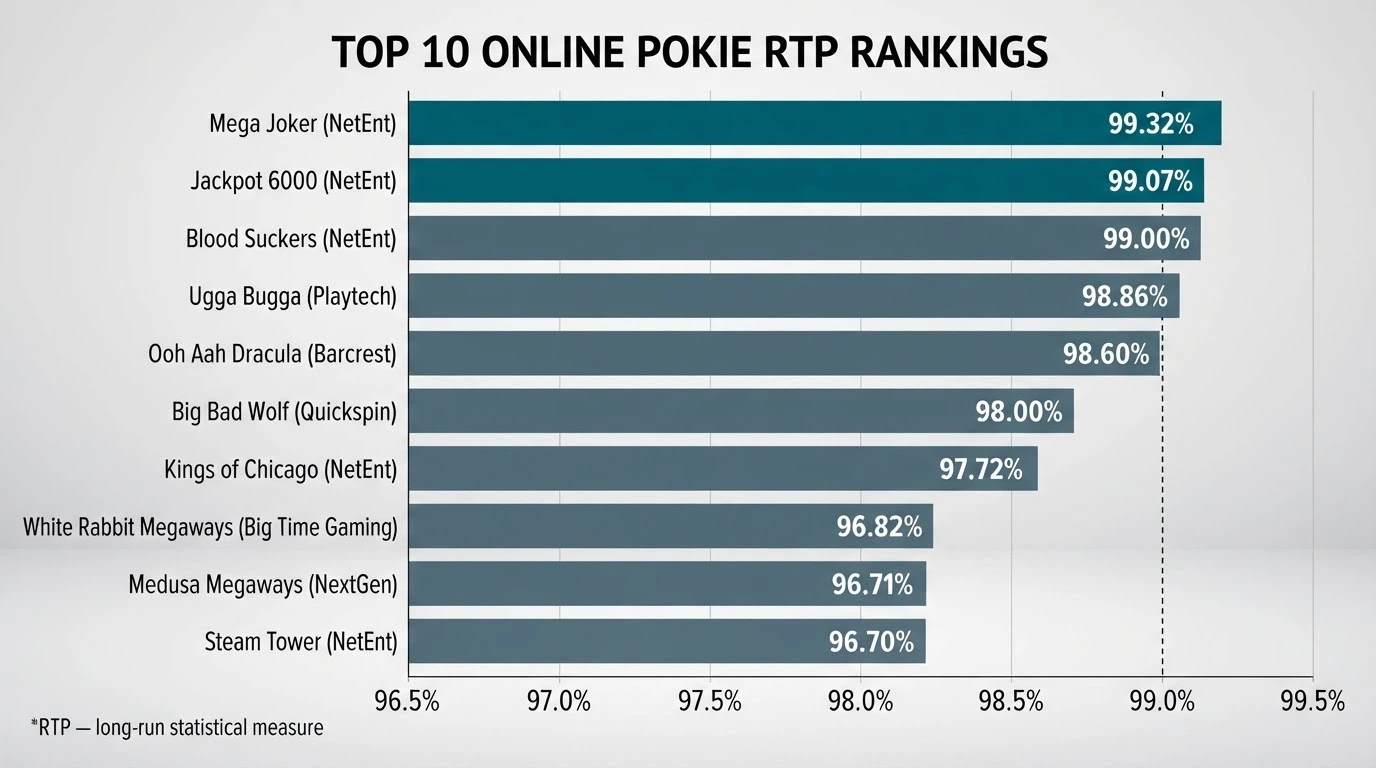
The table below ranks the highest-RTP pokies available to Australian players through the featured operators, with volatility class and maximum win where research carries those figures. Titles are listed in descending order of RTP. Where a game ships in multiple RTP versions, the highest is shown with a note on the spread.
| Pokie | Provider | RTP | Volatility | Max Win |
|---|---|---|---|---|
| Goblin’s Cave | Playtech | 99.32% | — | — |
| Ugga Bugga | Playtech | 99.07% | — | — |
| Mega Joker | NetEnt | 99.00% | — | Supermeter only |
| Book of 99 | Relax Gaming | 99.00% | — | 12,075x |
| Ooh Aah Dracula | Playtech | 99.00% | — | — |
| Jackpot 6000 | NetEnt | 98.86% | — | Supermeter mode |
| 1429 Uncharted Seas | Thunderkick | 98.60% | — | — |
| Blood Suckers | NetEnt | 98.00% | Low | 900x |
| White Rabbit Megaways | Big Time Gaming | 97.72% | High | 13,029x |
| Big Bass Bonanza | Pragmatic Play | 96.71% | High | 2,100x |
| Razor Shark | Push Gaming | 96.70% | Extremely High | 50,000x |
| Dead or Alive 2 | NetEnt | 96.82% | Very High | 111,111x |
| Gates of Olympus 1000 | Pragmatic Play | 96.50% | High | 15,000x |
The ceiling sits at 99.32% — Goblin’s Cave, a Playtech three-reel pokie with a hold feature. The next four titles cluster between 99.0% and 99.07%, with Book of 99 and Mega Joker tying at the round figure. The list is dominated by NetEnt, Playtech and Relax Gaming, with Push Gaming, Pragmatic Play, Big Time Gaming and Thunderkick filling out the high-RTP range. The bulk of the games an Australian punter will actually see at a featured casino — Sweet Bonanza, Gates of Olympus, Big Bass Bonanza — sit in the 96.5% to 96.8% band, not at the ceiling. The ceiling is for players who specifically seek it out.
Three caveats are worth flagging before the table becomes a shopping list. First, volatility matters as much as the RTP figure, and the table is honest about that. Blood Suckers at 98% with low volatility plays completely differently from Dead or Alive 2 at 96.82% with very high volatility, and a player picking on RTP alone without reading the volatility column is making half a decision. Second, the maximum win figures are theoretical ceilings on a single spin, not averages — a 111,111x max win on Dead or Alive 2 is what the game is capable of paying, not what it typically pays. Third, and most importantly, the figure in the RTP column is the highest version the developer publishes. Sweet Bonanza, which is the pokie that probably comes up first in any offshore casino’s lobby, ships in at least four RTP versions: 96.51%, 95.45%, 94.51% and 91.51%. The operator picks which one to load. A 96.51% version and a 91.51% version of the same game pay out at completely different rates, and the player cannot tell from the lobby which one they are playing.
How RTP Actually Works — And Why the Number on the Label Isn’t the Whole Story
RTP is a statistical long-run measure. A pokie with 96% RTP has been mathematically designed, over millions of simulated spins, to return $96 for every $100 wagered. That figure is baked into the game’s random number generator. It is the same at every casino, in every currency, on every device — if the casino is running the same version of the game. And that is the part that breaks.
Game developers often release multiple RTP versions of a single title. Pragmatic Play’s Sweet Bonanza, for example, ships in at least four: 96.51%, 95.45%, 94.51% and 91.51%. The mathematics are adjusted — different symbol weights, different feature triggers — so the long-run return comes out at the chosen figure. The operator chooses which version to deploy on their platform. The player has no way to check from the lobby which version is loaded, and a five-percentage-point spread between versions is the difference between a game that loses you $3.50 per $100 and one that loses you $8.50 per $100.
The reason operators run lower-RTP versions is straightforward: the house edge is higher, and the margin flows to the operator. A casino running the 91.51% version of Sweet Bonanza keeps 8.49 cents of every dollar wagered, against 3.49 cents on the 96.51% version. Multiply that across a few thousand active players and the cumulative gain is significant. The player sees a “96%” tag on the game card on some sites — because the developer publishes that figure somewhere in the documentation — and assumes that is what they are getting. They may not be.
The practical implication is that RTP is a starting point, not a guarantee. Picking a pokie with a high published RTP is necessary but not sufficient. The casino’s actual deployment, the version of the game being run, the conditions under which the headline RTP applies — all of these are the next layer of detail a sharp player reads. For the casual punter, the simpler rule is to play at casinos that publish their own game-by-game RTP in the help or fairness section, and to avoid operators that bury the version in the fine print.
High Volatility vs Low Volatility — What It Means for Your Balance
Two pokies at the same RTP can drain a bankroll at radically different speeds. Volatility is the variable that determines the shape of the experience: how often the game pays, how much it pays when it does, and how long the dry spells run between meaningful wins.
Blood Suckers, at 98% RTP and low volatility, is the kind of pokie that keeps a small bankroll ticking. Wins come frequently and the average size is small relative to the stake. The bonus round pays out often, and the vampire theme does not dress up a punishing math model. For a player with A$50 in their account who wants to play for an hour, this is the right shape. The session will likely end with most of the bankroll intact and a long, slow bleed toward zero.
Dead or Alive 2, at 96.82% RTP and very high volatility, is the opposite shape. Wins are rare. When they come, they can be enormous — the 111,111x ceiling on a max bet is a life-changing figure on paper. But the dry spells between bonus rounds are long, and a session that runs into a cold stretch will burn through a bankroll before the math catches up. Razor Shark at 96.70% and extremely high volatility is similar. White Rabbit Megaways at 97.72% sits in the same camp. Big Bass Bonanza at 96.71% is high volatility but a touch friendlier to a small balance, because the bonus round triggers more often.
The rule of thumb is straightforward. Small bankroll, low volatility, long session. Large bankroll, high volatility, shorter session. The 99% RTP pokies at the top of the table — Goblin’s Cave, Mega Joker, Book of 99, Jackpot 6000 — rely on maths that typically delivers consistent, smaller returns, distinct from the high-volatility, massive-win models. The high-volatility monsters with the 50,000x and 111,111x ceilings sit lower down the table, trading raw RTP for the chance of a payout that reshapes a session.
The Six Pokies That Break the 98% RTP Barrier
Six titles available to Australian players in 2026 officially publish an RTP of 98% or higher. They are: Goblin’s Cave (99.32%), Ugga Bugga (99.07%), Mega Joker (99.0%), Ooh Aah Dracula (99.0%), Jackpot 6000 (98.86%) and 1429 Uncharted Seas (98.6%). Four of them — Goblin’s Cave, Ugga Bugga, Ooh Aah Dracula and 1429 Uncharted Seas — are under-the-radar titles that a casual player will rarely encounter, but a regular at the featured offshore casinos will see them in the lobby if they look for them. The other two, Mega Joker and Jackpot 6000, are NetEnt classics with a specific catch.
Both Mega Joker and Jackpot 6000 reach their headline RTP only in Supermeter mode. Supermeter is a secondary game that activates after a win on the base reels, where the player can choose to wager the winnings on a higher-stakes set of reels with better symbol weights. The mode is the entire point of the games. In base play, Mega Joker returns somewhere between 76.9% and 85.1% — a much harsher game. At maximum bet with the Supermeter strategy fully engaged, the long-run return climbs to 99%. The same pattern applies to Jackpot 6000, where the 98.86% figure is the Supermeter-mode RTP and the base-game figure is lower.
The implication for an Australian player considering these titles is that the 99% figure is not a passive property. It requires the player to engage the Supermeter mode at every available opportunity, including wagering winnings from the base game, and to bet at the maximum level to access the highest-paying reel combinations. A player who treats the game as a standard pokie — spin, win, collect — is playing the lower-RTP base game. The title is honest about this. The marketing around it is less so.
Top 10 Online Casinos for Australian Pokies Players
This section is not a ranking of who is licensed, because none of them are. No online casino holds an Australian licence, because no such licence exists. What follows is a comparison of the offshore operators that carry the high-RTP pokies listed above, ranked by the overall package they offer: the size of the welcome bonus relative to the wagering multiple, the breadth of the game library, the speed and availability of the withdrawal rails, and the transparency of the licence they do hold. The table is the quick comparison. The deep-dives after it are the detail.

The Comparison at a Glance — How the Top 10 Stack Up
Every operator below is offshore, and the table does not list an “AU licence” column because no such column would have content. The Curacao and Anjouan entries are the licences these operators actually hold, and neither provides Australian consumer protection.
| Casino | Licence | Welcome Bonus (A$) | Free Spins | Wagering |
|---|---|---|---|---|
| Skycrown | Curacao | A$8,000 | 400 | 40x bonus / 30x FS |
| Royal Reels | Curacao (Digibrite S.R.L.) | A$2,500 | 50 | 35x bonus |
| RocketPlay | Curacao | A$200 | 50 | 30x bonus |
| Fair Go | Curacao | A$1,000 | — | — |
| Rainbet | Anjouan | A$2,100 | 60 | 40x |
| WinSpirit | Curacao (Antillephone) | €400 | 100 | 40x bonus |
| Stake | Curacao | — | — | — |
| Bizzo | Curacao | A$450 | 150 | — |
| Neospin | Curacao | A$11,000 | 100 | — |
| GoldenBet | Curacao (Anjouan transition) | A$1,000 | 200 | — |
The spread is wide, and the headline numbers do not line up. A casino advertising A$11,000 across four deposits is not ten times better than a casino advertising A$200 on a single deposit; it is a different offer with a different wagering cost. A player reading the bonus column alone will land at Neospin; a player reading the wagering column will land at RocketPlay. The full table — bonus size, free spin count, wagering multiple and the licence on the wall — is what the deep-dives unpack. Where a cell shows an em dash, the corresponding figure was not confirmed in the source sweep, and the operator’s own terms page should be checked directly before committing funds.
Skycrown
Skycrown is the headline figure in the set: A$8,000 across four deposits plus 400 free spins. The package is among the largest welcome offers in the offshore market serving Australians, and the wagering is on the higher end of the comparison — 40x on bonus funds, 30x on free-spin winnings. A$20 minimum deposit to trigger, A$5 maximum bet during bonus play.
On the withdrawal side, Skycrown processes crypto and e-wallet cash-outs in an average of 10 minutes, with a A$30 minimum and a A$6,000 ceiling per transaction. That ceiling matters for high-volume players: a A$6,000 cap means a large win gets paid in tranches, not in one hit. The 10-minute average applies after KYC verification is complete — first-time withdrawals require ID, and that step is where the timeline blows out for new players.
The game library runs to 8,000+ titles across 107 providers, including Pragmatic Play, NetEnt and Evolution Gaming. The breadth is the right shape for a player who wants the high-RTP pokies in the table above: Mega Joker, Blood Suckers, Book of 99 and the Gates of Olympus series are all present, and the search function surfaces them without delay. Curacao licence — offshore, not AU-licensed. The headline number is the lure, the wagering is the cost, and 10-minute crypto payouts are the lever that makes it competitive on the other side.
Royal Reels
Royal Reels leans pokies-heavy: approximately 1,400 of its 1,800 titles are pokies-format games, and the average RTP across the top 50 most-played pokies is 96.4%. The library is narrower than Skycrown’s but deeper on the pokie side, which is the right shape for a player whose interest is slots specifically rather than the full casino vertical.
The welcome package is A$2,500 across three deposits (100% up to A$500, 75% up to A$750, 100% up to A$1,250) plus 50 free spins at A$0.20 per spin, with 35x wagering on the bonus amount only and a A$5 per-spin cap during clear-down. The wagering multiple is below Skycrown’s 40x, and “bonus only” means deposit funds are not tied to the requirement — a meaningful distinction, because a player who deposits and plays with deposit cash while the bonus is pending does not have those winnings eaten by the wagering. The licence is Curacao, held by Digibrite S.R.L. — the corporate entity named on the operator’s own page, which is a small point in favour of transparency relative to operators that do not name the licence holder.
For a pokies-first player with a moderate bankroll, Royal Reels sits in the middle of the comparison: smaller bonus than Skycrown or Neospin, but lower wagering, a pokies-dense library and a published top-50 RTP that gives the player a benchmark to play against. The 96.4% average is a useful number to keep in mind, because it tells the player the operator is not loading 91.51% versions of every title.
RocketPlay
RocketPlay is the most modest welcome bonus in the set, and the wagering is the most generous: 100% up to A$200 plus 50 free spins, with 30x wagering on the bonus amount, a A$500 maximum cashout from the bonus and a 30-day validity window. The 30-day window is the detail that matters — most welcome packages in the offshore market run 7 to 14 days, and a player with a small bankroll playing 50-cent spins needs the time. RocketPlay gives it.
The A$500 maximum cashout is the other side. A player who hits a 1,000x bonus win on a featured slot is not seeing that full payout — anything above A$500 from bonus-derived winnings is forfeit. The cap is standard for low-deposit welcome offers, and it is the price of the lower wagering.
RocketPlay fits a specific player: someone making a small first deposit, wanting to test the platform with a low-stakes bonus, and planning to cash out winnings under A$500. For that player, 30x wagering over 30 days is a more realistic target than 40x over 14 days at a higher-headline competitor. The Curacao licence is offshore, as is every other entry in this comparison. This represents a tight offer for a specific kind of punter — the player who values time-to-clear and a small cap over the A$8,000 and A$11,000 headlines elsewhere.
Fair Go Casino
Fair Go is the only RTG-exclusive casino in the set. Real Time Gaming is the only provider on the platform, which is a smaller library than the other operators but a deliberately Australian-focused one — RTG’s game catalogue was developed with the Australian and US markets in mind, and the themes and volatility profiles skew toward what a regular Australian pokie player already knows.
The welcome package is 100% up to A$200 on each of the first five deposits, totalling A$1,000 in bonus funds. There is a separate weekly promotion — 25 free spins on Fun Monday — that runs independent of the welcome. Wagering terms on the welcome were not specified in the source sweep, and that is the gap to be aware of: the headline is clean, but the multiplier behind it requires a direct check on the operator’s terms page.
The trade-off is straightforward. A player who wants RTG’s specific catalogue — Achilles, Cash Bandits, the bubble-pop style bonus rounds that RTG built its reputation on — will find no broader RTG-only selection at an Australian-facing operator. A player who wants NetEnt’s 99% Mega Joker or Pragmatic Play’s Sweet Bonanza will not find them at all, because those studios are not on the platform. The Curacao licence is offshore. The verdict is the right fit for an RTG-loyal player and a poor fit for anyone chasing the high-RTP NetEnt and Pragmatic titles from the ranking above.
Rainbet
Rainbet runs the highest game count in the comparison: 7,000+ titles plus 14 provably fair Originals with a demo mode. The 14 Originals are Rainbet’s own games, built in-house with cryptographic verification of each round’s outcome — a feature no other operator in this set offers. The demo mode means a player can test any Original without committing funds, which is the right way to evaluate a game you have not seen before.
The welcome is 250% up to A$2,100 plus 60 free spins across three deposits (100% up to A$700, 50% up to A$700, 100% up to A$700), with 40x wagering on a wager-locked option or a no-wager gradual release. The dual structure is the distinguishing feature: a player who wants to grind through the requirement can take the 40x version, and a player who would rather take smaller winnings without a wagering lock can take the gradual release. A$30 minimum deposit, 7-day expiry from activation. Withdrawals carry no maximum limit at Level 1 KYC, with no ID documents required at that level — a significant feature for players who prefer to keep their gambling activity off their verified identity.
The Anjouan licence is the second offshore jurisdiction in the set. Anjouan (Comoros) issues gaming licences at a lower cost and with fewer compliance requirements than Curacao, and the trade-off is less regulatory scrutiny. Rainbet’s level-1 no-KYC withdrawal path is a genuine convenience for players who value it and a real concern for anyone who treats KYC as a consumer-protection mechanism — because if the operator does not know who you are, the complaints process when something goes wrong is even thinner than at a Curacao-licensed venue. It offers the broadest game library in the set, with the most flexible bonus structure, and a licence that is lighter than the Curacao alternatives.
WinSpirit
WinSpirit’s welcome offer is denominated in euros — 300% up to €400 plus 100 free spins — which is the only operator in the comparison that does not quote in Australian dollars. For an Australian player, the euro denomination introduces a foreign-exchange variable: a euro worth 1.6 Australian dollars today is not what it was worth last month, and the bonus value in A$ terms shifts with the rate. The 300% match is generous on paper, and 40x wagering on the bonus only is in line with the rest of the offshore market.
The 60+ providers include a reasonable spread of the studios that matter — Pragmatic Play, Hacksaw, Nolimit City and others — though the library is narrower than Skycrown’s 107 or Rainbet’s 40+ curated at 7,000 titles. The Curacao licence is held by Antillephone N.V., one of the four master licence holders in Curacao, and the operating entity is Complete Technologies N.V. Both names are visible on the operator’s own page, which is the small transparency point again.
The verdict is a clean, mid-sized offer for a player who is comfortable with a euro denomination and does not need the broadest library. The 300% match is the headline, the 40x wagering is the cost, and the FX risk is the variable that does not appear in the bonus column.
Stake
Stake sits in this comparison on its profile rather than its bonus, because the welcome offer was not confirmed in the source sweep. The Curacao licence, the crypto-native platform structure and the brand recognition are what land it in the ranking. For a player who already knows the Stake name from sports betting, the casino product is a familiar environment with the same crypto rails.
The absence of a confirmed welcome bonus is itself the data point. A welcome offer is the operator’s main acquisition tool, and an operator that does not run a traditional welcome is making a different bet: that the brand, the game library and the platform quality are enough to attract players without a deposit match. For some players that is a positive — no wagering requirement is better than a low wagering requirement. For others, it means the first-deposit value is whatever the casino’s reload or rakeback structure provides, which is harder to evaluate upfront.
The verdict is that Stake is in the comparison because Australian crypto players already use it, and the platform quality and game availability carry the case the welcome bonus would otherwise make. Check the operator’s own terms page for the current welcome structure before depositing, because the absence of a traditional welcome in this snapshot may be a snapshot issue.
Bizzo Casino
Bizzo runs a compact A$450 plus 150 free spins welcome package. The bonus figure is small relative to the A$8,000 and A$11,000 headlines elsewhere, but the free spin count is high — 150 spins is in the top half of the comparison, and for a player whose main interest is spinning rather than depositing, that ratio matters.
The wagering multiplier on the welcome was not confirmed in the source sweep, and the operator’s own terms page is where that gap has to be closed before committing funds. The Curacao licence is offshore. The game library, payment methods and other operator specifics are not confirmed in detail from the source sweep and need a direct check.
The verdict is a small-bonus, high-free-spin offer for a player who is comfortable doing the term-checking work themselves. The A$450 ceiling is honest about what the operator is willing to put up; the 150 free spins are the part that does the heavy lifting for a slot-focused player. Read the wagering before depositing.
Neospin
Neospin runs the largest raw bonus figure in the comparison: AU$11,000 across four deposits, plus 100 free spins and a 20% daily cashback on top. The cashback is the differentiating feature — most operators in this set run weekly or monthly cashback if they run it at all, and a daily 20% return on net losses is the most aggressive structure in the group.
The wagering multiplier on the welcome was not confirmed in the source sweep, and the A$30 minimum deposit is the entry point. The 5,000+ game library is broad, the Curacao licence is offshore, and the headline A$11,000 number sits alongside the A$6,000 max withdrawal per transaction at Skycrown as a reminder that large bonus figures often come with limits on what can actually be taken out at once.
The verdict is the right fit for a high-volume player who values the daily cashback and is comfortable with a four-deposit commitment. A player making a single A$30 deposit to test the platform gets 25% of the first-deposit match, not the headline figure, and the rest of the A$11,000 unlocks only across three further deposits. Treat the A$11,000 as a four-step journey, not a one-shot bonus.
GoldenBet
GoldenBet pairs the highest free spin count in the comparison — 200 free spins — with a A$1,000 bonus ceiling and PayID as a deposit method. PayID is the most-used Australian deposit rail at offshore casinos, and GoldenBet’s acceptance of it is a relevant feature for a player who would rather not transact in crypto for the deposit step.
The bonus structure is up to A$1,000 plus 200 free spins, with Visa, Mastercard, PayID and crypto all accepted. The licence is in transition from Curacao to Anjouan, which is a regulatory detail that may matter to a player who treats licence stability as a consumer-protection signal. Wagering on the welcome was not confirmed in the source sweep and requires a direct check.
The verdict is a high-free-spin, PayID-friendly offer for a player who prefers the familiar Australian deposit rail. The 200 free spins are the headline, the A$1,000 is the smaller commitment, and the licence transition is the open question for a player who plans to be at the operator for the long term.
How Fast Your Winnings Actually Land — Payout Methods Compared
The pokie with the highest RTP means nothing if the winnings cannot be withdrawn. Payout speed, method availability and the KYC gate that sits in front of the first cash-out are the filter that turns a casino’s welcome offer into actual money. The offshore operators serving Australians broadly support three withdrawal rails: crypto, e-wallets and bank transfer. PayID, the deposit method most players reach for first, is almost never available for cash-outs.
PayID Deposits — Fast, Free, and Almost Universal
PayID is the deposit method that Australian players gravitate toward because it is instant, fee-free and tied to a bank account they already have. The minimum deposit at most operators sits between A$10 and A$30, and the funds clear in seconds. The user experience is what a player expects from a domestic transaction: enter a PayID identifier, confirm the amount, money arrives.
The catch is that PayID is a one-way rail at offshore casinos. Deposits land instantly, but withdrawals through PayID are rare — the operators in this comparison that accept PayID for deposits do not pay out through the same channel. The flow is deposit-instant, withdrawal-to-something-else, and the gap between the two is where the payout time question actually lives. The deposit is the easy half.
For a player making their first deposit at an offshore casino, PayID is the right starting rail because the funds are available to play immediately, the bank statement reads as a standard transfer, and the minimum is low enough to test the platform without a large commitment. The question of how the winnings come back is a different rail, and the section below covers it.
Crypto, E-Wallets and Bank Transfers — Which Gets Your Money Fastest
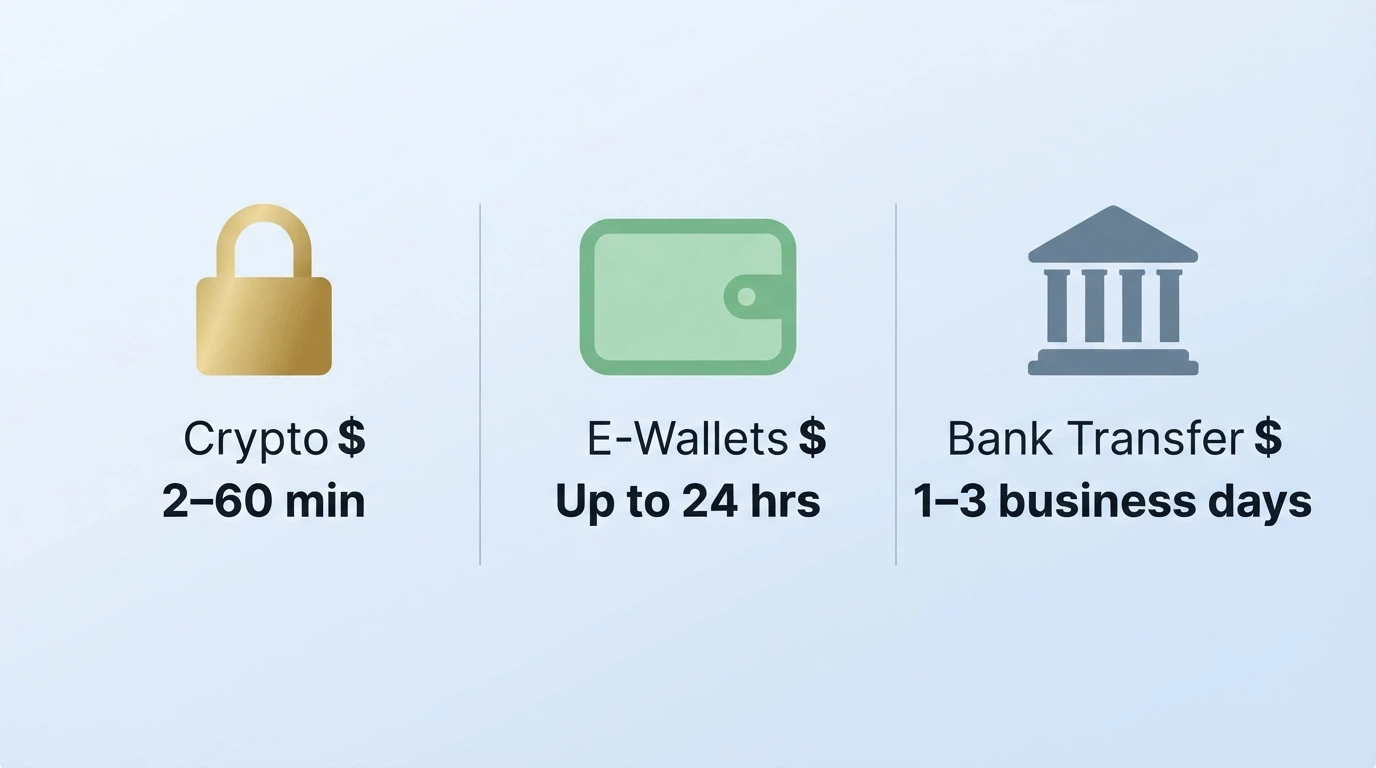
The withdrawal ladder for offshore casinos serving Australian players runs from fastest to slowest as: crypto, e-wallet, bank transfer. The first clears in minutes, the second in hours, the third in days. Crypto payouts at operators like Skycrown average 10 minutes after KYC verification, with a A$30 minimum and a A$6,000 ceiling per transaction. E-wallets (Neteller, Skrill, MiFinity) clear within 24 hours and carry similar minimums. Bank transfers take 1 to 3 business days and tend to be the route for larger withdrawals where the operator’s per-transaction ceiling on other methods would require multiple payouts.
The practical implication is that a player who wants their winnings fast should hold crypto in a wallet they control, complete the KYC verification before requesting a withdrawal, and stay under the per-transaction ceiling. The KYC gate is where most “the casino held my money” complaints originate: a first-time withdrawal requires ID verification, the verification takes 24 to 72 hours depending on the operator, and the player experiences the wait as a delay. It is not a delay. It is the standard process, and it is faster the second time.
For larger balances, the per-transaction ceiling matters. A player withdrawing A$20,000 from Skycrown on a A$6,000 per-transaction cap needs four withdrawals, which means four KYC checks on the first round, then streamlined after that. The math is straightforward; the player experience of a multi-day withdrawal on a large win is not.
What Happens When a Cash-Out Goes Wrong
Offshore casinos sit outside Australian consumer law. The Australian Financial Complaints Authority does not cover disputes with a Curacao-licensed operator. The ACMA enforces the prohibition on the provider, not on the player’s relationship with the provider. If a withdrawal is refused, the bonus terms were retroactively applied, or the account is closed with a balance on it, the player has no Australian ombudsman to call and no local court that has clear jurisdiction over a Curacao-registered entity.
The practical recourse is the licence holder’s own complaint process. Curacao-licensed operators are regulated by the Gaming Control Board of Curacao, and the process is a written complaint, a response from the operator and, if unresolved, an escalation to the regulator. Anjouan has a similar structure. Neither is fast, and neither has the same enforcement teeth as an Australian-licensed operator would face from ACMA. The player is, in effect, relying on the operator’s reputation and the commercial pressure of review sites to resolve a dispute.
The second risk is site blocking. The ACMA has directed Australian ISPs to block 1,564 illegal gambling and affiliate websites since November 2019, and more than 225 illegal services have withdrawn from the Australian market in that period. A player with a balance at a blocked site has no Australian channel to recover the funds; the operator’s terms of service are the only contract in play. This is the structural risk of the offshore market: the regulator can make the site unreachable from Australia at any time, and the player has no advance notice and no compensation mechanism.
The honest framing is that the offshore operators in this comparison are not fraudulent — most of them process withdrawals reliably and have been doing so for years. The risk is structural, not behavioural: there is no Australian backstop when something goes wrong, and a player choosing to play at an offshore casino is accepting that the protection is thinner than at a locally licensed venue. The bonus headline is the upside of that trade. The missing ombudsman is the cost.
Playing High-RTP Pokies on Your Phone — What Changes
RTP is server-side. The game runs on the operator’s platform, the random number generator is the same regardless of the device accessing it, and the return-to-player percentage does not change between a desktop browser, a mobile browser and a dedicated app. The number on the label is the number on the spin. That is the good news.

The experience is different. A pokie designed for a 1920×1080 desktop screen is not a pokie designed for a 6.7-inch phone held in one hand. The button sizes shrink, the paytable takes more taps to reach, the spin speed feels faster because the screen is closer to the eye, and bonus features that depend on visual spectacle (cascading reels, expanding wilds, the various animation styles in modern Megaways titles) lose some of their impact at smaller resolutions. The maths is the same. The feel is not.
Mobile Browser vs Casino App — What Australian Players Actually Use
Most offshore casinos serving Australia run through the mobile browser, not an app store download. iOS does not host real-money casino apps from offshore operators in its Australian App Store, and the Android equivalent requires sideloading an APK from the operator’s site, which carries its own friction. The path of least resistance is a browser bookmark, and that is the path most Australian players take.
The browser experience is functional but not native. Pages load in a few seconds, the games run in HTML5 with touch controls, and the cashier works the same way it does on desktop. Push notifications are absent — the browser does not give the operator the same hooks an app would — which is a feature for a player who does not want a gambling platform interrupting their day, and a limitation for a player who wants session reminders or deposit-limit alerts pushed to them. Among the operators in this comparison, dedicated apps are sparse, and the browser is the default. The browser experience is the experience most players have, and the RTP is the same as on desktop.
Is It Legal to Play Online Pokies in Australia? The Honest Answer
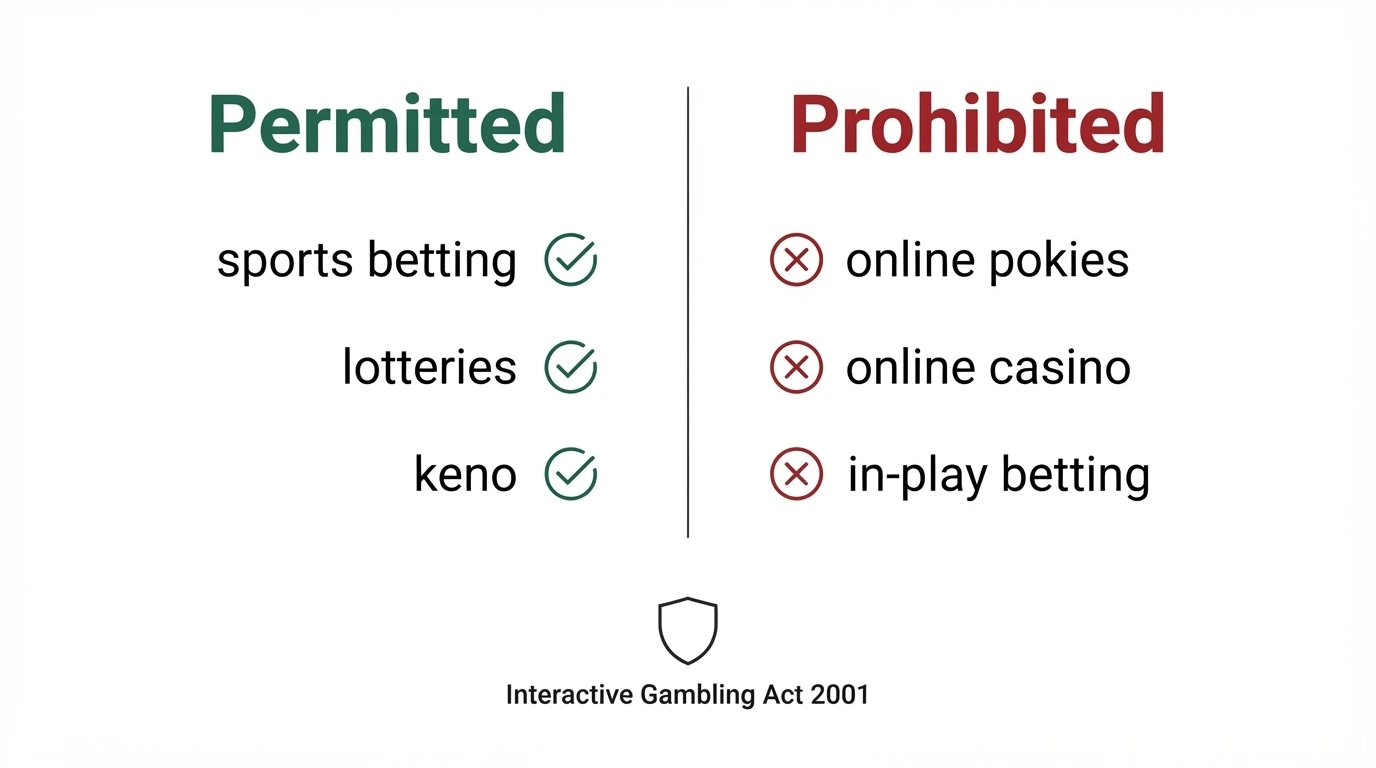
No Australian licence exists for online pokies. The Interactive Gambling Act 2001 makes it an offence for a provider to offer online casino games, online pokies or in-play sports betting to a person in Australia, and no state or territory issues licences for these products. The ACMA enforces the prohibition against the provider, not against the player — the individual who places a bet at an offshore casino is not prosecuted under the IGA. The Act targets the operator, and the penalty regime is structured accordingly.
The Interactive Gambling Act — What It Bans and What It Doesn’t
The IGA draws a clear line. Prohibited services are online casinos, online pokies, in-play sports betting and betting on the outcome of a lottery. Permitted services are wagering on races and sporting events placed before the event begins, lotteries and keno through licensed operators. The Northern Territory Racing and Wagering Commission is the de facto national wagering licensor for the permitted products, and licensed Australian bookmakers operate legally within those bounds.
The ACMA’s enforcement role covers the prohibited side. It investigates complaints, issues formal warnings, brings civil penalty proceedings and directs Australian ISPs to block illegal services. As of March 2026, the ACMA has had 1,564 illegal gambling and affiliate websites blocked and more than 225 illegal services withdrawn from the Australian market since enforcement was strengthened in 2017. The blocking is DNS-level and ongoing — the ACMA does not announce new blocks in advance, and a player with a balance at a newly blocked site has no Australian channel to recover funds.
The ACMA’s own statement on the IGA is blunt: “The Interactive Gambling Act 2001 makes it illegal for gambling providers to offer some online services to people in Australia. Banned services include: … online casinos.” The language targets the provider, and the enforcement follows. The individual player is not the regulatory target, but the player is also not the regulatory beneficiary of any protection.
Offshore Casinos and Their Licences — What Curacao and Anjouan Actually Mean
A Curacao or Anjouan licence is a jurisdictional authorisation for the operator to run a gambling business, not a consumer-protection badge for the player. Curacao’s licence is issued through one of four master licence holders (Antillephone, Curaçao eGaming, Gaming Services Provider and Gaming Curacao), and the cost and compliance burden are a fraction of an Australian or Maltese licence. Anjouan (officially the Union of the Comoros) issues licences at a lower cost still, with fewer compliance requirements and less regulatory scrutiny.
What the licences do not provide is the consumer-protection infrastructure an Australian player would have at a locally licensed operator. There is no BetStop coverage at an offshore casino, because BetStop binds Australian-licensed services only. There is no Australian Financial Complaints Authority pathway. There is no ombudsman. There is no requirement that the operator segregate player funds from operating funds in a way that protects balances in the event of operator insolvency. There is no Australian court with clear jurisdiction over a dispute. The licence means the operator is registered somewhere, pays a fee to that jurisdiction, and submits to that jurisdiction’s complaint process — which is structurally thinner than what an Australian licence would require.
Every operator in this comparison holds an offshore licence. That is the only kind of licence available for the product they are offering. The licence is not a sign that the operator is untrustworthy, but it is a sign that the player has fewer backstops than they would at a locally licensed venue.
The 2026 Gambling Reform — What Changes on 1 January 2027
The Interactive Gambling Amendment (Gambling Reform) Bill 2026 passed both Houses of Parliament on 19 August 2026. Its measures commence on 1 January 2027. The reform is the largest overhaul of Australian gambling regulation in a generation, and three of its provisions matter directly to the player using an offshore casino.
First, AdStop. A national wagering advertising opt-out register, administered by the ACMA, established under new Part 7E of the IGA. Australians who register for AdStop will not receive wagering advertising across the channels covered by the regime, and the registered list constrains what licensed operators can do. AdStop applies to Australian-licensed wagering services — the same offshore-blind-spot as BetStop — but it changes the volume of wagering advertising a player is exposed to at the licensed end of the market.
Second, inducement prohibitions. From 1 January 2027, direct marketing of inducements is prohibited for 14 days after a customer signs up with an Australian-licensed operator, and for 90 days after a person deregisters from BetStop. The 14-day cooling-off period is aimed at curbing the immediate post-signup bonus blitz that has been a feature of the licensed wagering market. It does not bind offshore operators, but it reshapes what the licensed end of the market is allowed to do.
Third, bank payment blocking. From 1 January 2027, banks and payment providers gain express authority to block transactions to illegal gambling operators. The mechanism is targeted at the same offshore casinos that the IGA already prohibits, and it gives the financial system a tool to refuse payments that the ISP-level blocking cannot reach. The practical effect is that a player using a domestic bank account to deposit at an offshore casino may find the transaction declined, and the decline is the bank acting under the new authority rather than the card network’s own rules.
The reform does not legalise online pokies. The IGA prohibition is unchanged. The reform adds enforcement tools, advertising constraints and inducement limits on top of the existing prohibition. A player who plays at offshore casinos in 2027 will face a more constrained environment — bank blocking on deposits, fewer inducement offers at the licensed end of the market, and the ongoing site-blocking regime. None of this changes the player’s legal exposure (still none) or the offshore operator’s licence status (still offshore). It changes the friction of playing.
Player Money, Taxes and the ATO — What Australian Pokies Players Need to Know
Pokies winnings are not assessable income for the casual Australian player. Section 6-5 of the Income Tax Assessment Act 1997 treats gambling winnings as not assessable unless the person is carrying on a business of gambling, and the ATO’s guidance is consistent — a punter hitting a feature on Big Bass Bonanza does not report it as income, does not pay tax on it, and does not declare it on their return. The tax treatment applies equally to winnings at an Australian-licensed venue and an offshore casino; the distinction the IGA draws is on the provider, not the player.
The operator’s tax position is different. Licensed Australian wagering operators pay a 5% wagering tax in the Northern Territory plus a 0.05% racing levy, and state point-of-consumption taxes add another 10 to 15% of net wagering revenue on top. Offshore operators do not pay Australian tax, which is part of why their welcome offers are larger — they are not funding the same compliance and tax structure. The tax gap shows up in the bonus headline; it also shows up in the absence of the consumer-protection infrastructure the tax funds.
The credit-card and crypto payment ban that commenced on 11 June 2024 is the other piece of the picture. Credit cards, credit-related products and digital currency (crypto) are banned as payment for online wagering in Australia. An operator that accepts credit-card deposits from an Australian player is in breach of the IGA, and the operator faces penalties of up to A$247,500 for non-compliance. An Australian player using a credit card to fund a deposit at an offshore casino is transacting with an operator that is, by that transaction alone, outside Australian rules. The ban is a signal: the licensed Australian market does not allow the payment method, and an operator that does is not part of the licensed Australian market.
Responsible Gambling Tools and Support
High-RTP pokies are still gambling products. The maths of a 99% return is the maths of a 1% house edge over millions of spins, and the 1% is the part the player pays. The data on Australian gambling harm is severe: A$36.0 billion lost in the 12 months to March 2026, an increase of close to A$1.3 billion on the prior year and 75% above the pre-COVID baseline. Approximately 2.1% of Australian adults — roughly 430,000 people — experience problem gambling, and the broader “at risk” rate climbed to 19.4% in 2025, nearly double the 2024 figure. More than 70% of Australian adults who regularly bet online on sports or races are experiencing or at risk of experiencing gambling harm. The high-RTP framing of this page is a tool for players who have already decided to play; it is not a reason to start.

BetStop — Australia’s Self-Exclusion Register and Its Limits
BetStop, the National Self-Exclusion Register, has been live since August 2023. As of 31 July 2026, the register has recorded 67,480 registrations, of which 41,290 exclusions are still active — more than 60% of everyone who ever signed up. 78% of registrants are under 40, and 38% have chosen lifetime exclusion. The numbers describe a population that knows the harm and has chosen the formal step to address it.
The critical limit is the one that matters for this page. BetStop binds Australian-licensed wagering services only. An offshore casino is not connected to the register, and a self-excluded person who opens an account at an offshore casino will not be flagged, blocked or contacted by BetStop. The offshore operator has no obligation to check, and the player who has registered for self-exclusion is, in the offshore market, on their own. The responsible-gambling architecture Australia has built does not reach the operators in this comparison, and the gap is structural, not an oversight.
A player who has registered for BetStop and is considering an offshore casino should know that the self-exclusion they have set up does not apply there, and that the protection is only as wide as the licensed market. The National Gambling Helpline (1800 858 858) and Gambling Help Online (gamblinghelponline.org.au) are the support channels that work regardless of where the gambling takes place, and the section below covers them in detail.
The Harm Numbers — What Australia’s Gambling Data Actually Shows
The headline is A$36.0 billion in gambling losses over 12 months to March 2026. That figure includes all forms of gambling — lotteries, pokies, sports betting, racing, casino — and represents a 75% increase on the COVID-19 baseline. Australians are gambling more, and the dollars lost have grown faster than inflation or wage growth. The Australia Institute’s P2037 report is the source, and the number is a national-scale figure, not a player-level one.
The player-level data is where the structural concentration of harm shows. Roy Morgan’s March 2026 research puts 15.1% of the Australian adult population — an estimated 3.32 million people — as experiencing some level of gambling harm from their own gambling or someone else’s. Of that total, 13.0% (around 2.857 million people) are experiencing harm from their own gambling behaviours. The annual health loss is over 400,000 Years Lived with Disability, a measure of the years of healthy life lost to gambling-related conditions.
The concentration is stark. 34% of total dollars spent on sports betting in Australia comes from people experiencing gambling harm, who represent only 10% of the player base. The “harmful gambler” is not a marginal customer — they are the source of more than a third of industry revenue, and the figure is a structural feature of how the products are designed. The 2.1% of adults who meet the clinical threshold for problem gambling are not the only group at risk: the broader “risky gambling” category (PGSI 1+) climbed to 19.4% in 2025, and the research shows almost half of all Australians who gamble are at some level of risk. The numbers are not a warning from a moralising outside; they are the data the regulator and the research community have published, and they describe the market the offshore operators are part of.
Where to Get Help — Numbers, Sites and Services That Work
If pokies stop being fun, the help is free, confidential and available around the clock. The National Gambling Helpline is 1800 858 858, staffed 24 hours a day, 7 days a week. The call is free from any Australian phone, the conversation is confidential, and the line is staffed by counsellors who can talk through what is happening and what the next step is. Online chat and counselling are available through Gambling Help Online at gamblinghelponline.org.au, with the same 24/7 coverage and the same confidentiality.
BetStop is the formal self-exclusion channel for Australian-licensed wagering services. Registration is at betstop.gov.au, and a registered person is excluded from all Australian-licensed wagering operators for the period they select. As covered above, BetStop does not reach offshore casinos, and a player who has self-excluded at BetStop and is still playing offshore is not protected by the register.
Deposit limits and session controls are available at the featured casinos in this comparison, and a player who sets a hard limit before the first spin and stops at it is taking the single most effective step a player can take. The National Gambling Helpline is the channel for anyone who finds they cannot keep the limit.
How We Picked and Ranked These Casinos
The ranking is a qualitative weighting of five criteria: the RTP of the pokies available at the operator, the real cost of the welcome bonus after the wagering requirement is applied, the speed and method availability of the withdrawal rails, the breadth and depth of the game library, and the transparency of the licence the operator holds. No criterion is weighted by a published percentage; the ranking is editorial, and the rationale for each placement is in the operator deep-dives above.
The data sources are the public-facing reviews and aggregators that publish operator and pokie information, cross-referenced where possible against the operator’s own terms pages. The RTP figures for individual pokies come from developer-published specifications and third-party listings; the volatility classifications and max-win figures are from the same source set. The bonus terms — wagering multiples, validity windows, max-cashout caps — are from the operator’s own promotions pages and the review sites that aggregate them. Where a figure could not be confirmed in the source sweep, the operator’s own terms page is the place to verify before depositing.
The official check is the ACMA’s interactive gambling register. No online casino is licensed in Australia, and the register confirms that fact. Every operator in this comparison holds an offshore licence (Curacao or Anjouan) and is not, and cannot be, Australian-licensed. The ranking is therefore not a “best to worst licensed operators” list — it is a “best to worst among the offshore operators that carry the high-RTP pokies Australian players are looking for.” A reader who is not comfortable with the offshore framework should not be at any of these operators, and that is the structural point that the rest of the page tries to be honest about.
The limits of the comparison are worth naming. Operator data is self-reported; bonus terms change; RTP settings are operator-configurable and may differ from the developer-published figure. A ranking is a snapshot, and the next quarter may move an operator up or down. What does not change is the structural reality that no online casino is Australian-licensed, that the offshore operators in this comparison are the market Australian players actually use, and that the responsible-gambling architecture does not reach them.
Your Move — What a High-RTP Pokie Strategy Actually Looks Like
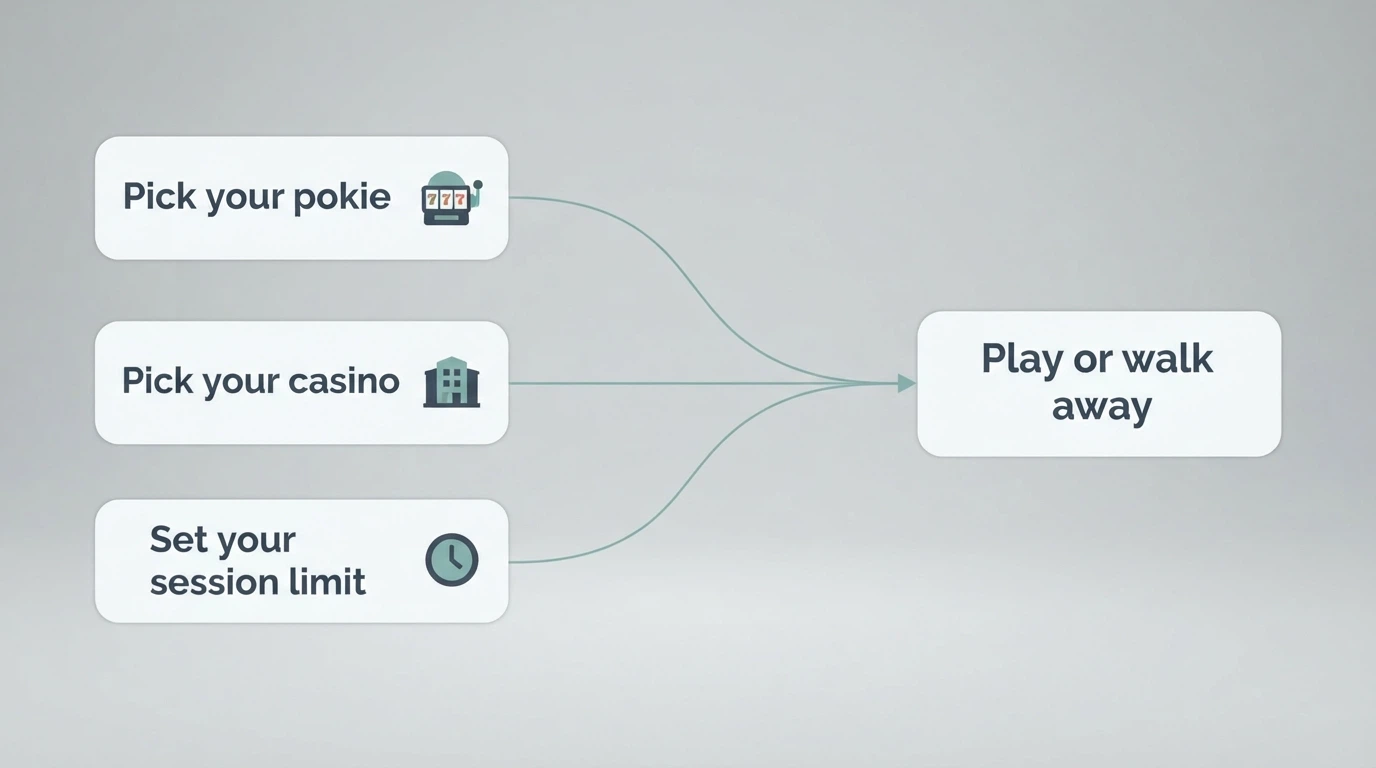
A high-RTP pokie is the starting point, not the strategy. The strategy is the three-way decision between which pokie to play, which casino to play it at, and which payment method to use — and the order those three are decided in matters more than the specific numbers that go into each.
Pokie first. The expected loss per spin is the figure that decides whether a session is worth playing. A 99% pokie at A$1 per spin over 200 spins has an expected loss of A$2 (200 × A$1 × 0.01), while a 96.5% version of the same game at the same stake results in A$7. The 2.5 percentage points of RTP translate to a 3.5x difference in expected loss over the same session, and that is the kind of number a player can act on. Picking on RTP alone, however, ignores volatility. A 99% low-volatility game played for 200 spins at A$1 is a different experience from a 99% high-volatility game played for 200 spins at A$1 — and the 99% high-volatility game, if it exists, will look like a long losing streak followed by a single huge payout, with a 90% chance the session ends before the payout arrives. For most bankrolls, the low-volatility 98% game is the right call, not the 99% headline.
Casino second. The welcome bonus is the operator’s first impression, and the real cost is the wagering multiple applied to it. A A$200 bonus at 30x wagering (RocketPlay) requires A$6,000 of qualifying play to clear, against a A$200 bonus at 40x (Skycrown, Rainbet) requiring A$8,000. The A$8,000 welcome at Skycrown looks bigger, but spread across four deposits and discounted by the 40x wagering, it does not pay ten times the A$200 welcome at RocketPlay — it pays a different amount, on a different timeline, with a different game library. The bonus is the lure. The wagering is the cost. The library is the product.
Payment method third. PayID for deposits is fast and fee-free. Crypto for withdrawals is fast, fee-free at most operators, and avoids the A$6,000 per-transaction ceiling that bank transfers and e-wallets sometimes carry. A player who plans to cash out a significant balance should test the withdrawal at a small amount first, complete the KYC verification before a big win arrives, and know which rail the operator pays out on before the balance gets large.
The offshore risk factor sits alongside the three-way decision, not outside it. BetStop does not bind offshore casinos, the ACMA can block an operator’s site at any time, and there is no Australian ombudsman if a withdrawal is refused. A player who accepts that the trade-off is bonus size and game variety in exchange for the absence of local consumer protection has made the call that the offshore market is worth the structural risk. A player who is not comfortable with that trade-off has answered the question about whether to play at any of these operators, and the answer is no.
The one number that matters most is the expected loss per session, and the one rule that no strategy overturns is that the house edge always wins over the long run. A 99% pokie still keeps 1% of every dollar wagered, averaged over millions of spins. A perfect casino selection and a disciplined payment setup reduce friction, but the math is the math. Set a session limit before the first spin, stop at it, and treat any pokie session as the cost of entertainment rather than an investment with a return.
Frequently Asked Questions
Which online pokies have the highest RTP for Australian players in 2026?
Mega Joker (NetEnt) and Book of 99 (Relax Gaming) both publish a 99.00% RTP, with six titles overall at 98% or higher including Goblin’s Cave at 99.32% and Ugga Bugga at 99.07%. The catch on Mega Joker is that the 99% figure requires Supermeter mode at maximum bet — base play returns 76.9% to 85.1%. Book of 99’s 99% is unconditional, with a max win of 12,075x. Both are available at the offshore operators covered in this comparison.
Is it legal to play online pokies for real money in Australia?
No Australian licence exists for online pokies, and the Interactive Gambling Act 2001 makes it an offence for a provider to offer them to Australians. The Act targets the provider, not the player — an individual placing a bet at an offshore casino is not prosecuted. All the operators in this comparison are offshore and hold Curacao or Anjouan licences, which provide no Australian consumer protection. Playing is not prosecuted; the offshore operator is the regulatory target.
What is the difference between RTP and payout percentage in pokies?
A pokie’s RTP (return to player) is the long-run statistical return built into one specific game’s mathematics — 96% means 96 cents of every dollar wagered is returned over millions of spins. A casino’s payout percentage is an average across the entire library, weighted by how much each game is played, and tells you little about any individual title. For picking a pokie, the per-title RTP is the figure that matters; the casino-wide payout percentage is a report card for the operator, not a guide for the player.
Do online casinos in Australia offer the same RTP settings as international sites?
Not necessarily. The same pokie can ship in multiple RTP versions, and the operator picks which version to deploy. Sweet Bonanza, for example, ships in at least four versions — 96.51%, 95.45%, 94.51% and 91.51% — and a five-percentage-point spread between the highest and lowest version is the difference between a game that loses you $3.50 per $100 and one that loses you $8.50 per $100. Players cannot see which version is loaded from the lobby, and operators that publish their game-by-game RTP in a help section are more transparent than those that do not.
What happens if an offshore casino refuses to pay out my winnings?
There is no Australian ombudsman, no Australian Financial Complaints Authority pathway, and no Australian court with clear jurisdiction over a Curacao-registered entity. The recourse is the licence holder’s own complaint process: a written complaint, a response from the operator, and an escalation to the Curacao or Anjouan regulator if unresolved. Neither process is fast, and neither has the same enforcement teeth as an Australian-licensed operator would face. Players also face the risk of ACMA site blocking, which can make a balance unreachable with no compensation mechanism.
What is the 2026 gambling reform bill and how does it affect pokies players?
The Interactive Gambling Amendment (Gambling Reform) Bill 2026 passed Parliament on 19 August 2026, with measures commencing 1 January 2027. Key provisions are the AdStop wagering advertising opt-out register, advertising caps (3 ads per hour between 6:00 am and 8:30 pm, a live-sport blackout, no athlete or influencer ads), a 14-day inducement ban after sign-up, a 90-day ban after BetStop deregistration, and bank payment-blocking powers. The reform does not legalise online pokies; it adds enforcement tools on top of the existing prohibition. Offshore operators remain offshore, and bank blocking will add friction to deposits from Australian accounts.
Can Australian banks block transactions to online casino sites?
From 1 January 2027, banks and payment providers gain express authority to block transactions to illegal gambling operators. Credit cards and crypto have been banned as payment methods for online wagering since 11 June 2024, with penalties of up to A$247,500 for operators that do not enforce the ban. The bank-blocking power extends the existing prohibition into the financial system, and an Australian player using a domestic bank account to deposit at an offshore casino may find the transaction declined. The mechanism is the regulator acting through the banks, not the card networks.
What payment methods can I use to deposit and withdraw at online pokies sites in Australia?
PayID is the most common Australian deposit rail — instant, fee-free, with a A$10 to A$30 minimum at most operators. PayID is rarely available for withdrawals, and the standard cash-out routes are crypto (2 to 60 minutes), e-wallets (up to 24 hours) and bank transfer (1 to 3 business days). Credit cards and crypto are banned as payment for online wagering under Australian law, and an operator accepting either from an Australian player is, by that transaction, outside Australian rules. E-wallets and bank transfer remain the most widely available withdrawal options at the offshore operators in this comparison.