
Casino Dice Games and the Australian Player: A 2026 Guide to What You Can and Cannot Reach
24 November 2026 · Verified against the Australian Communications and Media Authority (ACMA) register and current federal statutes.

Casino dice games sit among the simplest propositions on a gaming floor. Two cubes, a handful of bets, a result in seconds. The complication arrives when an Australian player tries to find one online. The Interactive Gambling Act makes it an offence to provide an online casino to a person physically in Australia, so what shows up in a search results page is a different category from a licensed wagering service. That gap is the subject of this page. The mechanics of craps and sic bo come first, then the legal framework that decides which of those mechanics a player in Australia can actually access.
Table of Contents
- Why Casino Dice Games Are Simpler Than They Look
- Why Craps Is Not as Intimidating as It Looks
- Playing Dice Online in Australia: What the Law Actually Permits
- Australia’s Gambling Laws and Your Dice Game: The Real Risks
- Staying in Control: What Australian Players Can Actually Do
- Offshore Casinos Accepting Australian Dice Players: What We Found
- How We Evaluated These Offshore Casinos
- What Australian Dice Players Should Actually Do Next
- Frequently Asked Questions
Why Casino Dice Games Are Simpler Than They Look
Dice games carry a reputation for noise and complexity that the rules do not earn. A craps table looks like an airfield marked-up with thirty betting zones. A sic bo layout holds fifty small numbered squares. Neither game requires thirty or fifty decisions per round. The table is wide because it covers every combination the dice can produce, not because a player is supposed to bet on all of them.
What Actually Counts as a Casino Dice Game
Three families cover what a casino calls a dice game. Craps uses two six-sided dice and a two-phase round built around a come-out roll and an optional point. Sic bo uses three dice and a one-shot bet on a layout that resembles a roulette board. Lightning Dice and its successors use three dice inside a live-streamed game show format, with random multipliers applied to selected totals before each roll. What unites them is the role of the dice: the cubes are the sole randomiser, the result is read off their faces, and every payout is calculated from the odds of that result.
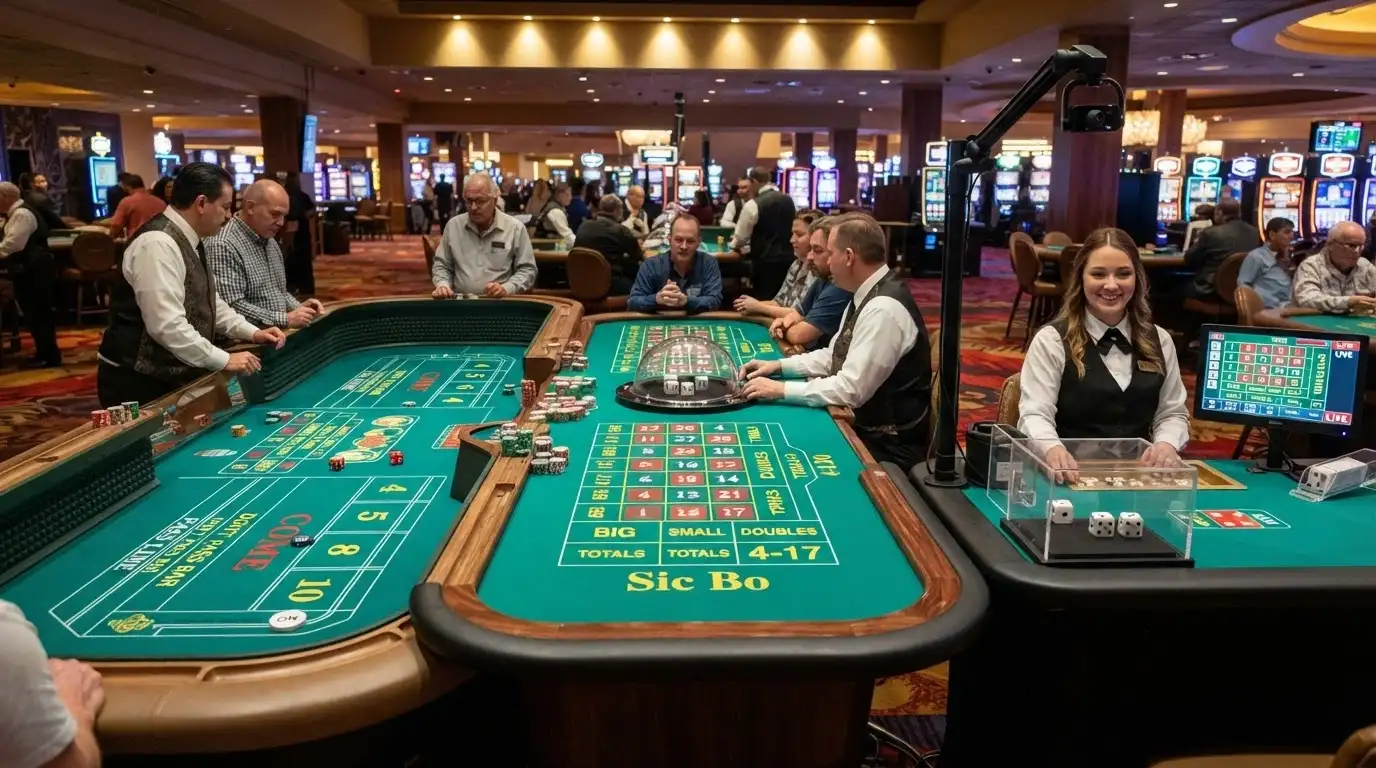
What separates a dice game from other table games is this compression. A hand of blackjack involves twenty or more decision points. A spin of roulette involves one decision and a fixed house edge across the board. A dice game sits in between: one roll settles the round, but the player chooses how much of the layout to cover before the roll.
How a Round of Casino Dice Works
Every variant follows the same three-step shape. A bet goes down on the felt before the roll. The dice are thrown, and the outcome is read off the faces. A payout is calculated from the odds of the specific result. In craps, the round can extend past one roll if a point is established. In sic bo and Lightning Dice, the roll ends the round and pays every winning bet on the layout simultaneously. The pacing differs but the mechanics are identical: predict, roll, settle.
The payouts vary because the probability of each result varies. A bet on a single number in sic bo pays more than a bet on high or low because a single triple is rarer than an aggregate. A pass line bet in craps pays even money because the probability of winning is close to fifty per cent. The house edge sits in the gap between true odds and what the table pays, and it changes from bet to bet within the same game.
Two-Dice Games and Three-Dice Games
Craps uses two dice. The outcome space is thirty-six equally likely combinations, though only twenty-one distinct totals appear because doubles share their total with mixed pairs. Sic bo and Lightning Dice use three dice. The outcome space is two hundred and sixteen combinations, and the totals range from three to eighteen with a bell-curve distribution that favours the middle.
The number of dice changes what the table feels. A two-dice game rewards bets on specific totals because the distribution is flat enough that a single number carries a significant chance of hitting. A three-dice game rewards bets on aggregates because the distribution clusters around ten and eleven, which together cover a substantial portion of all rolls. The layouts reflect this: craps is dominated by proposition bets on specific numbers, sic bo by aggregate bets like big, small, odd and even.
The Strategy Principle That Actually Moves the Odds
One rule cuts the house edge more than any betting system, and it works across every dice game. Choose the bets with the lowest house edge. Stick to them. In craps, the pass line and the odds bet behind it carry the lowest combined edge on the table. The proposition bets in the centre of the layout carry significantly higher edges. In sic bo, big and small carry a lower edge than single-number bets.
Bankroll pacing is the second lever. Dice games resolve quickly, which makes them harder on a finite budget than slower table games. The arithmetic of house edge compounds with the speed of play: a 1.4 per cent edge across two hundred rolls is a different cost from the same edge across fifty. Choosing the best bets and setting a stop-loss before sitting down are the two moves that hold the cost where the player can see it.
Why Craps Is Not as Intimidating as It Looks
Craps carries the reputation of the loudest game on the floor. Players cluster around the stick, bets go down in chorus, the dice arc back and forth across the layout. The noise is misleading. Craps runs on a two-phase structure that anyone can follow in five minutes.

The Come-Out Roll and the Point
The first roll of a new round is the come-out. If it lands seven or eleven, pass line bets win immediately. If it lands two, three or twelve, pass line bets lose. Any other number — four, five, six, eight, nine or ten — becomes the point. A white puck flips to “on” and sits on the point number. The shooter keeps rolling until either the point repeats (pass line wins) or a seven appears (pass line loses). That is the entire structure of the round.
A handful of bets does most of the work. Pass line and don’t pass cover the round’s two outcomes. Come and don’t come let a player join the round after the point is established, on identical terms. The odds bet sits behind any of those four and pays true odds, which is why it carries no house edge at all. Everything else on the layout — the field, the hardways, the hops, the any-seven — is decoration for the few players who want it.
Reading the Craps Table Without Freezing
The felt is divided into sections, each with a clear purpose. The pass line and don’t pass bar run along the perimeter. The come and don’t come areas sit in the corners. The centre of the table holds the proposition bets: single-roll wagers on specific numbers like two, twelve, or any seven. The proposition section is where the layout looks most chaotic, and it is also where the house edge is highest. A sensible craps strategy treats that section as furniture, not as a betting menu.
The pass line and the odds behind it are the core of any low-edge approach. A don’t pass plus don’t come plus odds is the mirror-image alternative, and carries the same combined edge. The difference between the two is psychological: pass line wins with the table, don’t pass wins against it. Either choice is fine. What matters is staying on those bets and ignoring the centre of the felt.
Playing Dice Online in Australia: What the Law Actually Permits
An Australian player searching for online dice games sees offshore casino platforms that accept Australian registrations. None of those platforms holds an Australian licence. The Interactive Gambling Act 2001 makes it an offence to provide an online casino to a person physically in Australia, and no Australian jurisdiction issues a licence for the activity. The platforms that appear in search results operate from Curaçao, Malta, or other offshore hubs under their own house rules.
Online Dice Games: What Is Actually Available
The catalogues an Australian player sees fall into two formats. RNG dice games run software that simulates the roll, with outcomes determined by a random number generator and a published return-to-player percentage. Live-dealer dice games stream a real table and a human dealer from a studio floor, with the player betting through an interface overlaid on the video feed. Both formats are offered by the same offshore platforms that offer online pokies, blackjack and roulette. The legal status of both is identical: they are not licensed in Australia.
What this means in practice is that the consumer protections an Australian might expect do not apply. There is no Australian complaints body, no requirement for an Australian-based dispute resolution service, no obligation on the operator to honour any specific payout timeline. A withdrawal dispute at an offshore casino has no domestic recourse. That gap is the central reason this page lays out the legal framework before discussing any operator.
Live Dealer Dice: Evolution and Beyond
Live-dealer dice games stream a studio table in real time. Evolution’s Lightning Dice built the category: three dice are rolled inside a clear container, random multipliers are applied to selected totals before each round, and the player bets on which totals will hit. Live craps has followed, with a small number of providers streaming a full craps table with a stickman and a dealer. The visual experience approximates a real casino floor. The legal status remains unchanged: the studio is offshore, the licence is offshore, and an Australian player is betting through an offshore account.

The gap between a live-dealer stream and a land-based casino is worth naming. A live stream cannot reproduce the social dynamics of a craps table — the collective betting, the cheering, the noise that defines the game on a physical floor. It can reproduce the rules, the payouts, and the pacing. Players who value craps for its energy will find a live stream thinner than the real thing. Players who value craps for its low-edge bets will find a live stream acceptable.
Free-Play and Demo Mode: What You Can Try Without Spending
Demo-mode dice games let a player run through the rules without risking money. RNG dice games commonly carry a demo mode that opens directly in a browser without registration. Live-dealer dice games do not, because the studio costs money to run. Demo availability varies by operator, by game provider, and by jurisdiction. A player who wants to learn the rules before depositing should look for an operator whose RNG catalogue opens in demo mode by default.

What demo mode simulates and what it does not is worth noting. The mechanics — the rolls, the payouts, the betting flow — run identically to real-money play. The financial pressure does not. A demo session teaches the rules without teaching bankroll discipline, which is the harder skill. Players who move from demo to real money should set a stop-loss before the first real bet, not after the first losing streak.
Australia’s Gambling Laws and Your Dice Game: The Real Risks
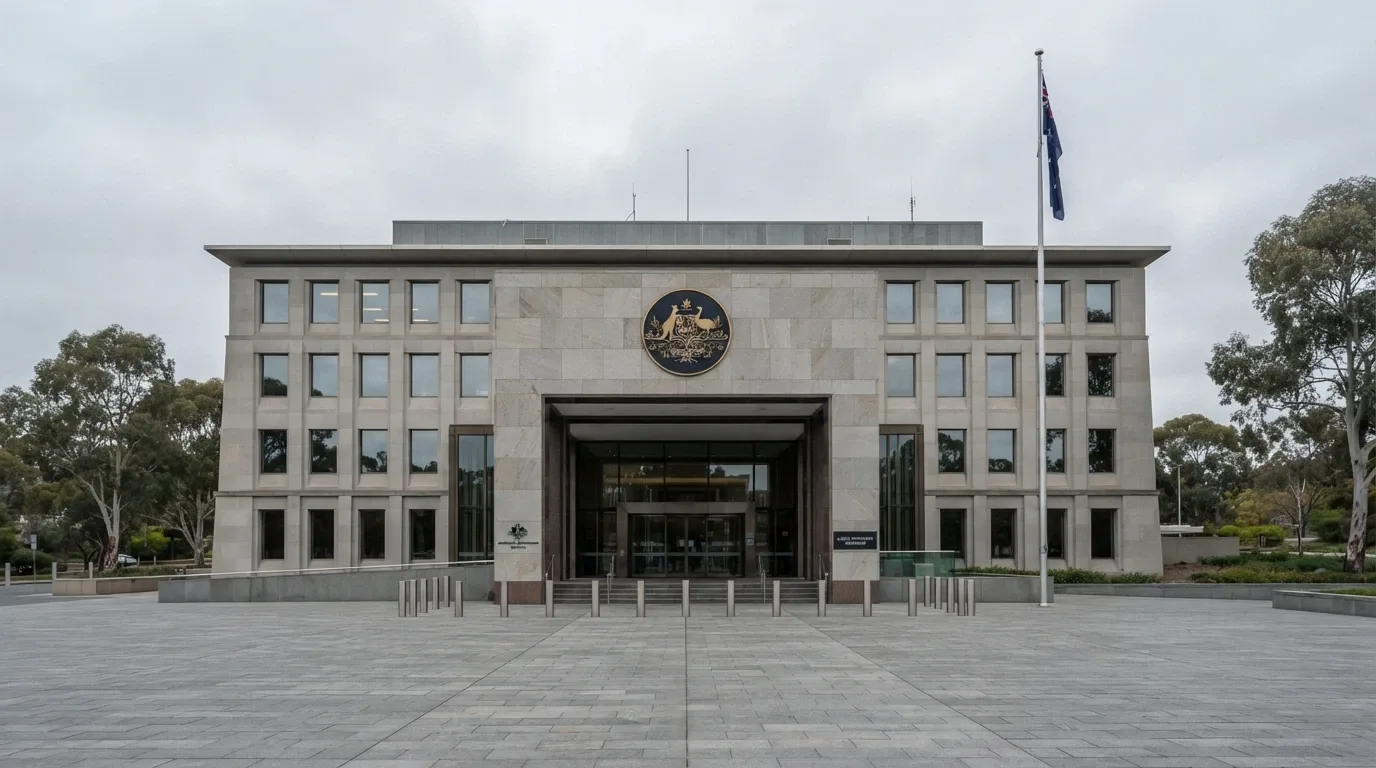
The legal framework that governs an Australian dice player operates on three layers: the Interactive Gambling Act and its amendments, the ACMA’s enforcement powers, and the safeguards designed for licensed wagering that do not reach offshore casinos.
What the Interactive Gambling Act Actually Says
The Interactive Gambling Act 2001 prohibits the provision of online casino games, online pokies and in-play sports betting to a person physically in Australia. The statute targets the provider, not the individual player. The 2017 amendments strengthened the ACMA’s enforcement and blocking powers, giving the regulator the ability to direct Australian internet service providers to block offshore sites and to refer operators to international partners. The Interactive Gambling Amendment (Gambling Reform) Bill 2026 passed Parliament on 19 August 2026 and its measures commence on 1 January 2027, including advertising caps and inducement restrictions.
Two practical bans sit alongside the core prohibition. Credit cards, credit-related products, and digital currency have been banned as payment for online wagering since 11 June 2024, with penalties of up to $247,500 for operators who fail to enforce the ban. The minimum age for any commercial gambling activity in Australia is eighteen. There is no federal deposit, loss or stake ceiling for online gambling; state-level point-of-consumption taxes apply to licensed wagering, typically at rates between 10 and 15 per cent of net wagering revenue, but no equivalent framework exists for casino play.
The gap between the licensed market and the offshore market is the relevant fact for this page. Licensed wagering is concentrated with the Northern Territory Racing and Wagering Commission, which acts as the de facto national licensor for online wagering on racing and sport. Casino games — dice, cards, pokies, roulette — are not licensed at all. An Australian player who wants to bet on a horse race before the event can do so through a licensed platform. The same player who wants to bet on a dice roll online cannot, through any platform that holds an Australian licence.
Offshore Operators and the ACMA Crackdown
The ACMA enforces the IGA prohibition by directing Australian internet service providers to block illegal gambling and affiliate websites. Since November 2019, 1,564 such sites have been blocked. More than 225 illegal services have withdrawn from the Australian market entirely since enforcement was strengthened in 2017. The block rate is accelerating, and new sites continue to appear as quickly as old ones are taken down.
From 1 January 2027, banks and payment providers gain express authority to block transactions to illegal gambling operators. The reform adds a second enforcement lever alongside ISP blocking: even if a player can reach an offshore site through a workaround, the payment to fund the account can be stopped at the banking layer. The reform also caps wagering advertising — no more than three wagering ads per hour between 6:00 am and 8:30 pm, no wagering advertising in the fifteen minutes before and five minutes after a live sporting event, and a prohibition on athletes, celebrities and influencers promoting wagering products.
The broader reform package includes inducement restrictions aimed at licensed operators: from 1 January 2027, direct marketing of inducements is prohibited for fourteen days after a customer signs up, and for three months after a person deregisters from BetStop. The intent is to dampen the acquisition and re-engagement tactics that licensed wagering services have used to chase former self-excluders back into the market. None of these measures extend to offshore casinos, because offshore casinos are not subject to Australian regulation at all.
| Product type | Legal under the IGA | Regulator or notes |
|---|---|---|
| Online casino (dice, cards, pokies, roulette) | No | Prohibited; no Australian licence available |
| Online wagering on racing (pre-event) | Yes | Licensed, primarily through the Northern Territory Racing and Wagering Commission |
| Online wagering on sport (pre-event) | Yes | Licensed, primarily through the Northern Territory Racing and Wagering Commission |
| In-play sports betting | No | Prohibited under the IGA |
| Lotteries | Yes | State and territory lotteries operate under separate frameworks |
| Keno | Yes | Licensed at state and territory level |
Staying in Control: What Australian Players Can Actually Do
The safeguards designed for licensed Australian wagering services do not reach offshore casinos. A player who understands what is and is not covered makes better decisions about where to play, and what limits to set on themselves.
BetStop: The National Self-Exclusion Register
BetStop is Australia’s National Self-Exclusion Register, live since August 2023. One registration excludes a person from every Australian-licensed wagering service. As of 31 July 2026, BetStop had 67,480 registrations, with 41,290 active exclusions. Seventy-eight per cent of registrants were under forty. Thirty-eight per cent chose lifetime exclusion, with the remainder choosing minimum exclusion periods of three months or longer.
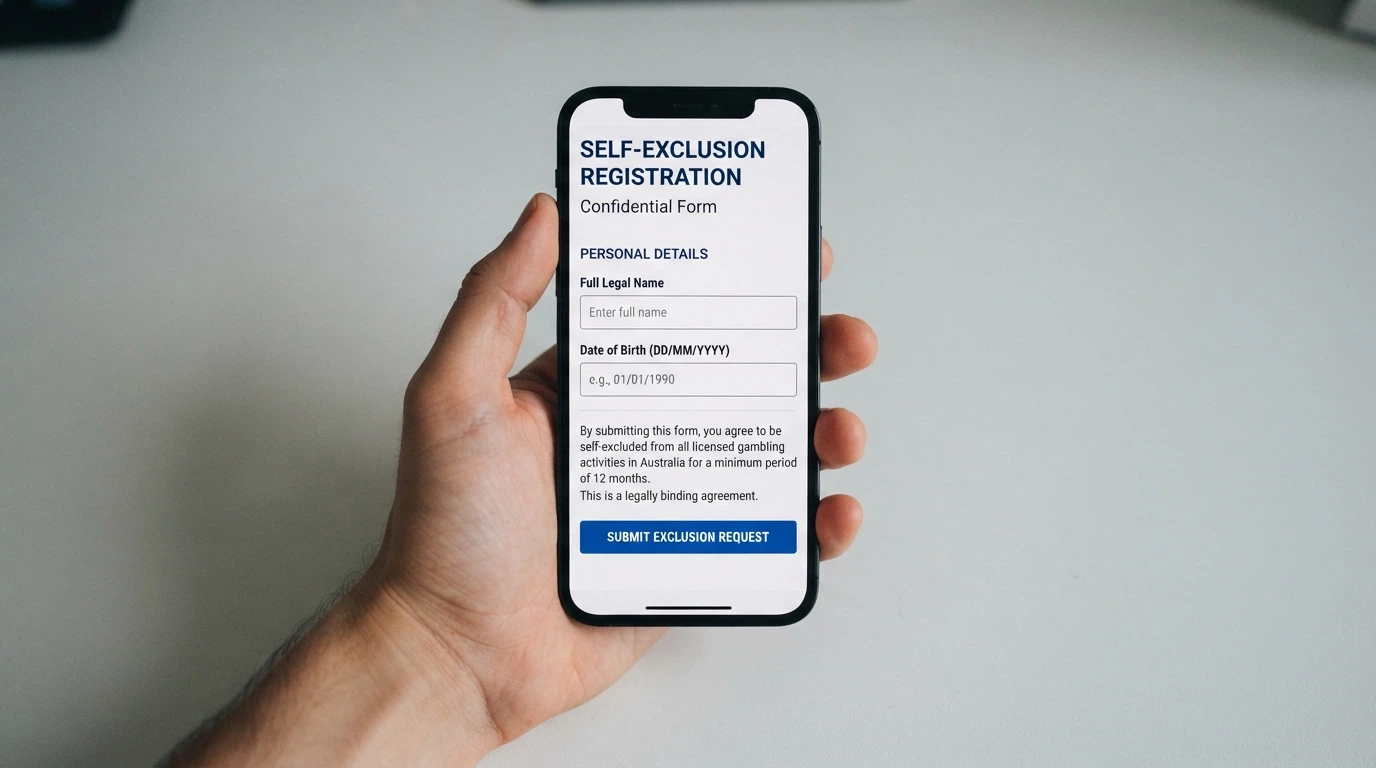
The demographic profile is informative. BetStop is used disproportionately by younger adults, and a substantial share of registrants decide to exclude themselves permanently. The register exists because self-exclusion from a single operator does not address the underlying pattern: a person who self-excludes from one licensed bookmaker can still open an account at another. BetStop closes that gap across the licensed market. It does not close it across the offshore market. An offshore casino is not connected to the register, which means a BetStop registration has no effect on a player’s ability to deposit, play, and lose at an offshore platform.
From 1 January 2027, a complementary protection takes effect: direct marketing of inducements is prohibited for three months after a person deregisters from BetStop. The intent is to prevent the churn pattern where a former self-excluder deregisters, receives a flood of bonus offers, and re-engages before any behaviour change has taken hold. The protection is real for licensed services. It does not apply to offshore casinos, which are not subject to Australian marketing restrictions in the first place.
Deposit Limits, Payment Bans and the Tools You Actually Have
The credit card and cryptocurrency ban took effect on 11 June 2024. The Interactive Gambling Amendment (Credit and Other Measures) Act 2023 was the legislative vehicle; the commencement date was 11 June 2024, with a six-month transition window for operators. After the transition, an operator accepting a credit card or cryptocurrency payment for online wagering faces a penalty of up to $247,500. The ban applies to licensed wagering services. It does not apply to offshore casinos in any practical sense, because the offshore casino is not licensed in Australia and not subject to ACMA enforcement.
There is no federal deposit, loss or stake ceiling for online gambling in Australia. State-level point-of-consumption taxes apply to licensed wagering operators, typically at rates between 10 and 15 per cent of net wagering revenue. These taxes are paid by the operator and do not directly cap a player’s deposit or stake. The closest equivalent for casino play would be a deposit limit set by the operator itself — a feature offered by some licensed wagering services and by some offshore casinos, but not a statutory requirement.
The prevalence data is worth knowing. About 2.1 per cent of Australian adults, roughly 430,000 people, experience problem gambling according to the Australian Institute of Health and Welfare. High-risk gambling prevalence is 1.8 per cent. These figures cover all forms of gambling combined and predate the offshore boom in online casino access. They are a reminder that the safeguards described in this section exist because a measurable share of the population reaches a point where they need them.
The National Gambling Helpline is 1800 858 858, free, confidential, and staffed twenty-four hours a day, seven days a week. Gambling Help Online offers counselling and support services online. Both services are available regardless of where a player has been gambling. A player who has reached a point where self-exclusion is the right move can start with a single call.
Offshore Casinos Accepting Australian Dice Players: What We Found
The operators below appear in Australian-facing search results for online dice games. Every one of them operates from outside Australia and holds no Australian online casino licence. The table records what each operator publicly represents about itself; the assessments that follow discuss each operator in turn.

| Operator | Status in Australia | AU player protections |
|---|---|---|
| Rocket Play | Offshore, unlicensed in AU | None |
| Skycrown | Offshore, unlicensed in AU | None |
| Royal Reels | Offshore, unlicensed in AU | None |
| WinSpirit | Offshore, unlicensed in AU | None |
| Stake | Offshore, unlicensed in AU | None |
| Rainbet | Offshore, unlicensed in AU | None |
| Scream Casino | Offshore, unlicensed in AU | None |
| FairGO | Offshore, unlicensed in AU | None |
| Bizzo Casino | Offshore, unlicensed in AU | None |
| Rocket Casino | Offshore, unlicensed in AU | None |
Rocket Play
Rocket Play operates from outside Australia and accepts Australian registrations through its offshore platform. The operator publicly represents a casino catalogue that includes RNG dice games alongside pokies, table games and live-dealer content. The specific number of dice titles, the game providers behind them, and the terms of the welcome offer were not verified for this review. Rocket Play holds no Australian licence, and an Australian player opening an account there has no recourse to any Australian consumer-protection framework. The platform is accessible from Australia through the same channels that the ACMA’s ISP-blocking program targets.
The practical question for an Australian player considering Rocket Play is not whether the catalogue looks attractive — most offshore platforms do — but whether the lack of Australian consumer protection changes the risk calculus. A player who deposits and wins faces the same withdrawal process as any offshore customer: a request, a verification check, and a payment method that may or may not complete. A player who deposits and loses has the same protections as any offshore customer: the platform’s own terms and the platform’s own dispute process. Neither outcome has an Australian backstop.
Skycrown
Skycrown is another offshore platform that appears in Australian-facing search results. Its publicly represented catalogue includes dice games, and its bonus structure follows the standard offshore pattern of a deposit match plus free spins on selected pokies. Specific bonus terms — the wagering multiple, the maximum cashout cap, the eligible games — were not verified for this review. Skycrown holds no Australian licence.
A player who chooses Skycrown over a competitor is choosing on the basis of publicly represented claims, not verified terms. The platform’s own terms page carries whatever conditions apply, and those conditions are not enforceable under Australian law. The same caveat applies to every operator on this list.
Royal Reels
Royal Reels positions itself in the Australian-facing market with a casino catalogue that includes dice titles. The operator’s regulatory standing is offshore and unlicensed in Australia. Welcome bonus terms, game providers, and the precise dice-game count were not verified for this review.
The name suggests an Australian focus, and the branding does not contradict that impression — but the legal status does. An offshore platform with Australian-themed branding is still an offshore platform. The branding is marketing; the regulatory standing is the same as any other operator on this list.
WinSpirit
WinSpirit operates as an offshore casino accepting Australian players. The publicly represented catalogue includes dice games in its table-games section. Welcome bonus terms and the specific composition of the dice-game library were not verified for this review. WinSpirit holds no Australian licence.
The points made for Rocket Play apply here in full: an Australian player at WinSpirit is betting through an offshore account with no Australian consumer-protection framework behind it. The operator’s own terms govern every interaction.
Stake
Stake is one of the more established offshore platforms accepting Australian players. Its publicly represented catalogue includes a wide range of casino content, and the operator has built a brand around cryptocurrency-friendly banking. Specific bonus terms, the exact composition of the dice-game library, and the regulatory standing outside Australia were not verified for this review.
Stake’s cryptocurrency orientation is worth noting in the context of the Australian payment ban. The ban on credit cards and crypto for online wagering applies to licensed Australian wagering services. An Australian player using cryptocurrency to fund an offshore casino account is not, in the ACMA’s framework, using cryptocurrency for online wagering as defined under the IGA — they are using cryptocurrency to fund an account at a platform that the IGA does not reach. The payment ban was designed to close one funding route for licensed wagering. It does not, in practice, close the funding route for offshore casinos.
Rainbet
Rainbet operates as an offshore platform with a casino catalogue that includes dice games. Welcome bonus terms, game providers, and the precise number of dice titles were not verified for this review. Rainbet holds no Australian licence.
The same structural points apply. An Australian player at Rainbet is operating outside the Australian regulatory framework, with no domestic complaints body and no statutory deposit or loss ceiling. The platform’s own terms govern every interaction.
Scream Casino
Scream Casino appears in Australian-facing search results with a casino catalogue that includes dice titles. The operator’s regulatory standing is offshore and unlicensed in Australia. Welcome bonus terms, game providers, and the specific composition of the dice-game library were not verified for this review.
The branding is distinctive; the regulatory position is not. Scream Casino sits in the same category as every other operator on this list: offshore, unlicensed in Australia, and offering no Australian consumer protection.
FairGO
FairGO carries Australian-themed branding and positions itself as an Australia-facing offshore platform. The operator publicly represents a casino catalogue that includes dice games alongside pokies and other table games. Specific bonus terms, game providers, and the precise dice-game count were not verified for this review. FairGO holds no Australian licence.
The Australian branding does not change the legal status. A platform with a koala in its logo and “FairGO” in its name is still operating outside Australia if it holds no Australian licence. The branding is a marketing choice; the legal standing is a regulatory fact.
Bizzo Casino
Bizzo Casino operates as an offshore platform accepting Australian players. The publicly represented catalogue includes dice games in its broader casino offering. Welcome bonus terms, game providers, and the exact composition of the dice-game library were not verified for this review. Bizzo Casino holds no Australian licence.
The same caveats apply. An Australian player at Bizzo Casino has no Australian consumer-protection framework behind them, and any dispute about withdrawals, bonus terms, or account closure is governed by the operator’s own terms and the operator’s own dispute process.
Rocket Casino
Rocket Casino operates as an offshore platform with a casino catalogue that includes dice titles. The operator’s regulatory standing is offshore and unlicensed in Australia. Welcome bonus terms, game providers, and the specific dice-game count were not verified for this review.
Rocket Casino shares its name’s first word with Rocket Play, but the two are separate platforms. Both sit in the same regulatory category: offshore, unlicensed in Australia, and offering no Australian consumer protection to the players they accept.
How We Evaluated These Offshore Casinos
This review assessed each operator against the Australian regulatory framework as the baseline. The Interactive Gambling Act 2001 prohibits the provision of online casino games to a person in Australia, and no Australian jurisdiction issues a licence for that activity. Every operator on the list was checked against the ACMA regulatory framework and found to hold no Australian online casino licence. The review then recorded what each operator publicly represents about its dice-game catalogue, its bonus terms, and its regulatory standing. No deposits were made and no accounts were opened for this review.
The Limits of This Review
A comparative ranking of these operators would require verified data: actual sign-ups, actual deposits, actual withdrawals, actual gameplay, actual customer-service interactions. That data was not produced for this review. Without it, a quality-based ranking would rest on publicly represented claims — the operator’s own marketing — and would therefore be unreliable. The review’s choice is to report what each operator publicly represents and to flag, uniformly, that the regulatory standing is identical across the list.
This is the most useful thing an honest review can do under the circumstances. An Australian player searching for online dice games will find these operators in their results. The first question is not which is best — it is whether any of them is appropriate, given that none holds an Australian licence and none offers Australian consumer protection. The pages that follow are an attempt to answer that question with the facts available.
What Australian Dice Players Should Actually Do Next
The legal reality is the starting point. No licensed online dice option exists in Australia. The prohibition set out above is the reason, and no Australian jurisdiction issues a licence for the activity. The offshore casinos that appear in search results are not licensed in Australia, do not connect to BetStop, and offer no Australian consumer protection. The credit card and cryptocurrency ban applies to licensed wagering services; it does not, in practice, block the funding routes to offshore casinos.
A player who wants to play dice games within the Australian consumer-protection framework has one option that the law supports: a land-based casino. Every Australian state and territory has one or more licensed casino venues, and the dice games on those floors — craps, sic bo variants, electronic dice — operate under Australian gambling regulation. The player protections that apply to a land-based venue — responsible gambling officers, self-exclusion at the venue level, complaints bodies — do not extend to any offshore platform.
A player who chooses to play at an offshore casino is choosing to step outside that framework. The choice is the player’s. The information on this page is meant to make that choice informed: the offshore platform offers no Australian licence, no Australian consumer protection, no connection to BetStop, and no recourse to an Australian complaints body if a withdrawal is delayed or a bonus term is enforced in a way the player did not expect. The odds at the dice table are the same as they would be at any licensed venue — the house always has an edge — but the protections that surround the play are thinner.
Frequently Asked Questions
Is it legal to play online casino dice games in Australia?
The Interactive Gambling Act 2001 makes it an offence to provide an online casino to a person in Australia, and no Australian licence exists for the activity. The prohibition targets the provider, not the individual player, so an Australian player is not personally prosecuted for playing. The offshore casinos accepting Australian players operate outside Australian law, and an Australian player at one of them has no Australian consumer protection. The only fully licensed route to dice games in Australia is a land-based casino venue.
What is the difference between Craps and Sic Bo?
Craps uses two dice and a two-phase round: a come-out roll establishes or resolves the round, and if a point is set the round continues until the point repeats or a seven appears. Sic bo uses three dice and a one-shot bet: every wager on the layout is settled by a single roll. Craps rewards sticking to the pass line and the odds behind it, which carry the lowest house edge on the table. Sic bo rewards sticking to the big and small aggregate bets, which carry a lower edge than single-number bets. Both are dice games, but the betting structure and the round pacing are quite different.
What are the best offshore casinos for Australian players to play dice games?
Every offshore casino accepting Australian players operates outside Australian law. None holds an Australian licence, none connects to BetStop, and none offers Australian consumer protection. A comparative ranking would require verified data that this review did not produce. The honest answer is that the question of which offshore casino is “best” is the wrong question for an Australian player — the relevant question is whether to play at an offshore platform at all, given the absence of any Australian regulatory backstop.
How does BetStop self-exclusion work for online gambling?
BetStop is Australia’s National Self-Exclusion Register, live since August 2023. One registration excludes a person from every Australian-licensed wagering service. As of 31 July 2026, BetStop had 67,480 registrations with 41,290 active exclusions. Exclusion periods range from a minimum of three months to lifetime. The register binds licensed services only; an offshore casino is not connected to BetStop, so a BetStop registration does not block an offshore account. From 1 January 2027, direct marketing of inducements is prohibited for three months after a person deregisters from BetStop.
What is the house edge in Craps?
The house edge in craps varies by bet. The pass line carries a lower edge than many other bets. Adding the odds bet behind the pass line reduces the combined edge, because the odds bet pays true odds and carries no house edge at all — taking odds at full multiple brings the combined edge down. The don’t pass carries a comparable edge, marginally better than pass. The proposition bets in the centre of the layout carry higher edges. Sticking to the pass line and the odds is the lowest-edge approach on the table.