
Finding Live Roulette with English-Speaking Dealers — and the Offshore Reality Behind It
Data current as of 24 November 2026; licence and regulatory claims checked against the Australian Communications and Media Authority register.

The live dealer roulette wheel an Australian player sees on screen is, almost without exception, illegal to offer from inside Australia. The Interactive Gambling Act 2001 prohibits online casino games outright, and the Australian Communications and Media Authority has been directing internet providers to block offshore sites since November 2019, with 1,296 illegal services and affiliates taken out of reach as of August 2025. Two hundred and twenty more walked away voluntarily. Yet English-speaking croupiers, Evolution-powered lobbies, and HD streams from studios in Europe and North America are exactly what Australian players search for — and roughly what the offshore market delivers. This guide is for the punter who wants to understand what sits behind those streams: the studios, the laws, the bonus maths, the payment routes Australia has banned for licensed wagering, and the cost of playing a game the country will not licence.
Table of Contents
- How Live Roulette Reaches Your Screen: Studios, Streams and Croupiers
- The 10 Live Roulette Casinos Australian Players Actually Use in 2026
- Is Online Live Roulette Legal in Australia? The Short Answer Is No
- Why Most Live Roulette Bonuses Are Not Built for the Roulette Table
- How to Pay at Offshore Live Roulette Sites — and What Australia Bans
- How to Play Live Roulette: Rules, Odds and the Strategy That Actually Matters
- Live Roulette on Mobile: The Same Tables, a Smaller Screen
- How We Picked and Ranked These Live Roulette Casinos
- Is It Worth Playing Live Roulette at an Offshore Casino?
- Frequently Asked Questions
How Live Roulette Reaches Your Screen: Studios, Streams and Croupiers
A live dealer roulette table is not software. It is a physical studio, a real wheel, a steel ball, and a human croupier running the round in front of multiple camera angles. The studio films the action in high definition and pushes it to the player’s browser or app; the player places chips on a digital betting grid that overlays the video; an optical sensor reads the winning number the moment the ball settles, and the system credits wins and losses to player balances before the next betting window opens. There is no random number generator in the loop. The outcome is whatever the wheel produces, in full view of cameras and players alike.
That is the selling point, and it explains why live roulette sits in a different category from the slot-style RNG games that share the same casino lobby. Players who do not trust a computer to be fair — or who simply miss the rhythm of a real table — vote with their deposits. The international studios that built the category have spent the last decade turning that vote into a global, around-the-clock product.
What “Live Roulette” Means at an Online Casino
Top-tier live roulette sites maintain 1080p streams with under half a second of latency, and most major studios run multiple camera positions around the wheel: a wide shot, a close-up of the rotor, and an overhead that catches the ball’s final pocket. Budget operations drop to 480p during busy periods, and the difference is visible. A high-resolution stream means the player can follow the ball’s path without strain; a degraded stream turns a live game into a pixelated blur and undermines the reason a player chose live over RNG in the first place.
The dealer runs the round. Bets are placed through a digital interface. Payouts are calculated by software. The spin itself — the croupier’s arm, the wheel’s deceleration, the ball’s rattle as it settles — is physical. The interface does the arithmetic; the wheel produces the answer. That division of labour is what the category sells, and what the regulator in Australia cannot license.
English-Speaking Dealers: What to Expect at Australian-Friendly Tables
English is the default working language at the major international studios — Evolution, Pragmatic Play Live, Ezugi, Vivo Gaming, and the smaller operators that white-label their tables. A player who logs in from Sydney or Melbourne during Australian prime time will almost always find English-speaking croupiers on duty. Rocket Play is one of the brands where English-speaking dealers are commonly confirmed during the Australian peak window of 7pm to midnight AEST. For the rest of the operators in this guide, English-language coverage during those hours is the typical experience across the international networks — but verify on the specific table before sitting down, because non-English tables do exist, particularly on the European networks outside the busy window.

The interaction gap matters more than the marketing suggests. A live roulette table is a social product; the dealer greets players, calls the end of betting, congratulates winners, and chats at the pace of the spin. When the croupier does not share the player’s language, the table still works, but it flattens. The punter who places a neighbour bet and gets a confused nod in return has lost the small human transaction that justified leaving the RNG lobby in the first place.
Live Dealer vs RNG Roulette: The Difference That Matters
RNG roulette is a computer algorithm. The result of every spin is generated by a pseudorandom number generator that has been tested and certified by an independent laboratory, and the player sees the outcome as a graphic representation of a wheel. There is no stream, no dealer, no camera, and no physical ball. The pace is whatever the player wants — a spin every two seconds if they like — because the round is not waiting on a human.
Live roulette is the opposite: a real wheel, a real ball, a real person, and a pace set by the dealer and the betting window. Trust is built differently. A player who does not believe a certified RNG is fair will not be persuaded by a certificate; a player who wants to see the ball drop into the pocket will not be persuaded by a graphic. The two products answer different suspicions, which is why they coexist in the same casino lobby rather than one replacing the other.
The social dimension is what the live format adds and the RNG cannot replicate. Live dealers talk. They react to chat. They run side bets with banter. An RNG table is silent. That is a feature for some players — no small talk, no waiting, no one’s mood leaking into the spin — and a loss for others.
How a Live Roulette Game Runs, Spin by Spin
A standard live roulette round follows a tight rhythm. The betting window opens for roughly twenty to thirty seconds, during which chips can be placed, moved, and removed. The dealer calls “no more bets,” spins the wheel in one direction, and tosses the ball in the other. The wheel slows, the ball drops into a pocket, and an optical sensor captures the winning number. Software overlays the result on the betting grid, calculates payouts, and credits winning accounts within seconds.
A standard dealer-hosted table runs 25 to 35 rounds per hour, paced by the betting window and the time it takes the wheel to settle. Speed Roulette tightens the same format to 50+ spins per hour by shortening the betting window and compressing the spin-and-result sequence. Auto Roulette goes further: no dealer, mechanical wheel, software-driven ball launch, up to 120 spins per hour. The faster variants change the feel of the game more than the house edge, but they also change how a bankroll breathes. A 120-spin hour is four times as many bets as a 30-spin hour, and the house edge compounds across all of them.
Australian Availability: Where the Tables Actually Sit
No live roulette studio operates on Australian soil. Every live dealer table an Australian player sees on screen is streamed from a studio in Europe, North America, or, increasingly, eastern Europe and Latin America. Evolution Gaming runs the largest network — studios in Latvia, Malta, Georgia, Romania, Canada, and the United States — and powers a significant share of the live roulette tables across the offshore market. Pragmatic Play Live, Ezugi, and Vivo Gaming run smaller but still substantial networks.
There is no Australian licence for online casino. The Interactive Gambling Act 2001 makes it illegal to offer online casino games — including live dealer roulette — to people in Australia, and no state or territory issues a licence for the activity. The ACMA enforces the prohibition by directing Australian internet service providers to block offending sites; As of August 2025, 1,296 illegal sites and affiliates have been blocked since 2019, and 220 illegal services have voluntarily exited the Australian market following action by the ACMA. The tables exist; the law says they should not be reachable from here. The offshore operators route around the blocks as fast as the regulator lays them down, and the player sits in the middle.
The 10 Live Roulette Casinos Australian Players Actually Use in 2026
The brands below are the offshore casinos Australian players are searching for in 2026 — operators the search data shows holding significant Australian traffic, and the ones a punter comparing options will meet first. Every one of them operates outside Australia. None holds an Australian licence, and the product they sell — online casino games, including live dealer roulette — is prohibited to be offered to Australians under the Interactive Gambling Act 2001. They cannot be licensed here. Listing them is not a recommendation; it is a map of what the offshore market looks like in practice.

How the Comparison Works
The honest summary up front: every operator below is an offshore casino. None holds an Australian licence, because none can. Beyond that single fact, the picture this round produced is unusually thin — bonus terms, wagering requirements, game counts, licence jurisdictions, and English-speaking dealer availability are the things we look for, and for most of the brands on this list, the public information available in this round of research did not produce specific, verified numbers. Where a figure is known, it is in the table; where it is not, the cell carries the no-data marker.
| Operator | AU Licence Status |
|---|---|
| Rocket Play | Offshore — no AU licence (product prohibited) |
| Skycrown | Offshore — no AU licence (product prohibited) |
| Stake | Offshore — no AU licence (product prohibited) |
| Royal Reels | Offshore — no AU licence (product prohibited) |
| WinSpirit | Offshore — no AU licence (product prohibited) |
| FairGO | Offshore — no AU licence (product prohibited) |
| Bizzo Casino | Offshore — no AU licence (product prohibited) |
| Rainbet | Offshore — no AU licence (product prohibited) |
| Scream Casino | Offshore — no AU licence (product prohibited) |
| Rocket Casino | Offshore — no AU licence (product prohibited) |
What the table cannot show is what was looked for and did not turn up. A genuine head-to-head of these ten operators would rank them on live roulette table counts, English-speaking dealer availability, welcome bonus value and terms, wagering multiples, withdrawal speed, payment routes, and the regulatory standing of their offshore licence. The round did not get there. The two columns that survived are the two we can stand behind without caveat. The rest of this page reads what is on the page — the law, the payments, the bonus mechanics, the house edge — and the operator profiles below name the brands that did surface a specific data point, and otherwise leave the reader to do their own checking.
Rocket Play
Rocket Play is one of the more visible offshore brands in Australian search traffic, and the one piece of operator-specific information this round produced: English-speaking dealers are commonly confirmed during Australian peak hours, roughly 7pm to midnight AEST. That is a real advantage in a market where most operators do not publish their dealer roster, and a player who values the social side of live roulette should treat it as a positive signal.
Everything else about Rocket Play — the licence jurisdiction, the bonus structure, the wagering multiple, the live roulette table count, the game providers — is not confirmed this run. That is not a verdict; it is the absence of evidence. Before depositing, check the licence the operator actually holds (Curaçao, Anjouan, Malta Gaming Authority are common), read the bonus terms in full, and confirm that live roulette contributes something — anything — toward wagering. Most welcome offers are built for slots, and live dealer games are commonly weighted at 10–20% of each bet or excluded altogether. For a punter who specifically wants an English-speaking dealer during Australian evenings, Rocket Play is the operator on this list where the dealer-language claim is on the record rather than inferred. The rest of the operator’s profile still needs verification at source before any deposit; the dealer schedule is the one advantage worth confirming first.
Skycrown
Skycrown is the standout on one specific data point: 40-plus live roulette tables in its lobby, the largest confirmed count in this set. That figure comes from independent reviewers and matters because a wider lobby gives a player more variants — European, American, Lightning, Speed, Auto — and more dealers to find one whose pace and personality fit.
What is not confirmed this round is the licence jurisdiction, the welcome bonus, the wagering multiple, the free-spin allocation, and whether English-speaking dealers are scheduled through the Australian evening window. The operator has been noted as carrying Evolution Gaming and Pragmatic Play Live content in some reviews, but neither provider is confirmed against the operator’s own page in this round. Skycrown’s edge is volume: 40-plus tables means more variants on screen at any one time, and a better chance of finding a dealer whose pace and personality fit. The rest of the operator profile — bonus, wagering, licence — is unverified this round, and a player should not assume the table count translates into the rest of the deal.
Stake
Stake is a high-traffic offshore casino with strong Australian brand recognition — the kind of name a punter encounters through sports crossover rather than through casino search specifically. It runs a substantial sportsbook alongside its casino, and its Australian user base is significant.
The specifics a player would want before depositing — licence jurisdiction, game providers, welcome bonus terms, wagering multiple, free spins, live roulette table count, English-speaking dealer availability — are not confirmed this round. Stake is large enough that the public information exists; this round of research did not surface it in a form we could verify against the operator’s own terms. Stake’s appeal in the Australian market runs through its sportsbook crossover rather than its live casino lobby specifically; the casino is the second pillar, not the first. The brand recognition is not a substitute for the regulatory and bonus clarity a punter needs before depositing.
Royal Reels
Royal Reels is an offshore casino that targets the Australian market by name and branding. “Royal Reels” is not a coincidence; the word “reels” is the Australian colloquial for slot machines, and the brand is leaning into a local idiom to signal familiarity.
Verified operator-specific details for this brand are not confirmed this round. Royal Reels is selling familiarity. The “reels” in the name is a colloquial cue to Australian players, and the operator is leaning on it for recognition. The brand familiarity does not extend to the operator’s underlying specifications this round, and a player who chooses the operator for the name should verify the substance behind it before depositing.
WinSpirit
WinSpirit is an offshore casino with Australian player traffic. The branding is less specifically Australian than Royal Reels or FairGO, but the traffic share is real.
Verified operator-specific details for this brand are not confirmed this round. WinSpirit sits in the cluster of offshore operators that hold Australian traffic without holding Australian specifics. There is no headline number or feature that sets it apart in this round, and a player considering the brand is choosing from the long tail of the offshore market rather than from a top-of-list operator.
FairGO
FairGO is an offshore casino whose name pitches fairness directly to the Australian punter. “Fair” and “GO” are both nods to the local market, and the brand trades on the suggestion that a player is being treated straight.
The naming is the marketing. The substance is not confirmed this round. The “Fair” in FairGO is the marketing, not the audit. Offshore operators can pitch fairness in branding and apply terms the player has not read in practice; the brand name is the pitch, and the verification is the player’s job before any deposit. Read the licence, read the bonus terms, read the withdrawal process.
Bizzo Casino
Bizzo Casino is an offshore casino with Australian market presence, part of the broader set of international operators that have built brand recognition in this market without holding an Australian licence.
The operator-specific data points are not confirmed this round. Bizzo is a reminder that the offshore live roulette market in Australia is wider than the names that top the search results. The brand is one players are actually using, and the operator profile is, like most of the long tail of this set, a verify-before-depositing instruction rather than a negative verdict.
Rainbet
Rainbet is an offshore casino and betting platform with Australian traffic. It runs a sportsbook alongside its casino and pitches itself as a combined gambling product.
The volatile details — licence jurisdiction, game providers, welcome bonus, wagering, free spins, live roulette table count, English-speaking dealer coverage — are not confirmed this round. Rainbet is a combined casino and sportsbook, and the live roulette lobby is the smaller half of the product. Players seeking a pure casino experience may find other operators more suitable.
Scream Casino
Scream Casino is an offshore casino with Australian player traffic. The branding is louder than the rest of the set, and the operator trades on a higher-energy identity.
The expected round of data was not surface this round. Scream Casino’s louder branding is the marketing angle, and the rule in this market is the inverse of what the volume implies: the louder the brand, the more carefully the terms should be read. The standard verification checklist applies — licence, bonus terms, withdrawal process — with extra attention to anything the operator pushes hardest in its advertising.
Rocket Casino
Rocket Casino is an offshore casino whose name echoes the speed of live roulette, and the marketing line writes itself. The brand sits in the same cluster as the other operators in this set: offshore, no Australian licence, Australian player traffic.
The operator-specific details — licence jurisdiction, game providers, welcome bonus, wagering, free spins, live roulette table count, English-speaking dealer coverage — are not confirmed this round. Rocket Casino rounds out the list as an offshore brand with Australian traffic and no confirmed specifications this round. The name evokes the speed of live roulette, but the operator profile carries no verified data to back the marketing. The name promises speed, but the verified data does not match the marketing.
Is Online Live Roulette Legal in Australia? The Short Answer Is No
No online casino licence exists in any Australian state or territory. The Interactive Gambling Act 2001 prohibits the provision of online casino games — including live dealer roulette — to people physically in Australia, and the ACMA enforces the prohibition. The individual player is not prosecuted; the law targets the provider. But the protections Australians rely on for licensed wagering — consumer recourse, complaints bodies, the BetStop self-exclusion register — do not extend to offshore casino sites. Playing here means operating entirely without the safeguards of a licensed environment.

The Interactive Gambling Act 2001: What It Actually Prohibits
The IGA drew a line, when it passed in 2001, between wagering on the one hand and casino games and slots on the other. Online wagering on a race or a sporting event placed before the event begins is permitted and licensable through state and territory wagering regulators. Lotteries and keno are permitted. Online casino games, online pokies, and in-play betting on a sporting event once it has started are prohibited to be offered to Australians.
Live dealer roulette sits on the wrong side of that line. A live stream from a European studio is, for the purposes of the IGA, the offering of an online casino game. The physical wheel does not move it across the line; the prohibition is on the offering, not on whether the result comes from a real wheel or a random number generator.
The ACMA enforces the prohibition. Since November 2019, the regulator has directed Australian internet service providers to block illegal sites, and 1,296 illegal sites and affiliates have been blocked as of August 2025. A further 220 illegal services have voluntarily exited the Australian market following enforcement action. The blocks are not absolute — offshore operators shift domains, mirror their sites, and route around the ISP-level restrictions — but the regulator has the tools to keep chasing, and it uses them.
Licensed vs Offshore: Why No Australian Casino Can Offer Live Roulette
There is no online casino licence in Australia. The Northern Territory Racing and Wagering Commission, administered through Licensing NT, is the de facto national licensor for online wagering, with licences that run for terms of up to 20 years. Those licences cover wagering — sports and races — not casino games. The same is true in every other state and territory. A wagering operator licensed in the Northern Territory is permitted to take a bet on the Melbourne Cup or the AFL; it is not permitted to offer a live dealer roulette table.
Land-based casinos exist in Australia — Crown, The Star, and others — and they are state-licensed. They are licensed for the gaming floor, the table games, the slot machines. They are not licensed to offer online casino games, and a land-based licence is not, and never has been, the licence under which an online casino operates. The distinction matters because offshore casinos sometimes lean on the suggestion that they are connected to a land-based venue. They are not. The product they offer is prohibited; the licence they hold is offshore and not recognised in Australia.
What the 2026 Gambling Reform Changes for Players
The Interactive Gambling Amendment (Gambling Reform) Bill 2026 passed Parliament on 19 August 2026, and its measures commence on 1 January 2027. The bill does not legalise online casino — that is the most important point for a punter considering live roulette. What it does is tighten the screws on the offshore operators Australians are already using.
From 1 January 2027, banks and payment providers gain express authority to block transactions to illegal gambling operators. Today, a credit card or crypto deposit to an offshore casino is the punter’s responsibility; tomorrow, Australian banks and payment processors have a statutory mandate to refuse the transaction at the routing layer. Crypto is already banned as a payment method for licensed wagering under the 2024 ban; the new bill extends that pressure to the banking relationship itself.
BetStop’s operation is strengthened under the reform. Direct marketing of inducements — bonus offers, free bet promotions — is banned for three months after a person deregisters from the National Self-Exclusion Register. Wagering advertising is capped at no more than three ads per hour between 6:00 am and 8:30 pm, and wagering ads are banned from fifteen minutes before a live sporting event until five minutes after it ends. Athletes, celebrities, and influencers are barred from promoting wagering products.
The shape of the law is unmistakable: Australia is not opening the door to online casino. It is closing the windows through which the offshore operators reach Australian players.
What You Lose When You Play at an Offshore Casino
The protections Australians take for granted on a licensed wagering platform do not apply offshore. A punter playing at an offshore live roulette casino is, in practical terms, on their own.
- No Australian consumer protection: The Australian Consumer Law does not apply to an operator based in Curaçao or Anjouan. The operator’s home jurisdiction applies, and the player must enforce their rights in that jurisdiction.
- No Australian complaints body: The ACMA cannot recover money for an individual player. The regulator’s powers are about taking sites offline, not adjudicating disputes.
- No BetStop coverage: BetStop binds Australian-licensed wagering services only. An offshore casino is not connected to the register, and a person who has self-excluded through BetStop can still log in, deposit, and play. The exclusion stops at the border.
- No guarantee of payout: If the operator refuses a withdrawal, voids a win, or applies a term the player did not read, the player has no Australian court to appeal to. The offshore regulator may help; it may not.
- No guarantee of access: An offshore casino can be added to the ACMA’s block list at any time. The block lands at the ISP level. If the player has a balance on the site, the block does not return the balance.
The list is the price of playing a game the country will not licence. A punter who weighs the price and decides to play anyway should do so with eyes open.
Why Most Live Roulette Bonuses Are Not Built for the Roulette Table
Casino welcome offers are written for slots. The bonus amount, the wagering requirement, the game-weighting line — they are all built around the assumption that the player will run a slot machine at high spin volume. Live dealer roulette sits awkwardly in that model. The game contributes a fraction of what slots do toward wagering, or nothing at all, and the maths of clearing a bonus on a roulette wheel is unfriendly by design.

The industry benchmark for welcome bonus wagering is 35x the bonus amount; top performers run 25x or lower; anything at 50x or above is a red flag. Those numbers are written for slots, where a high-spin, low-edge game can chew through wagering in a single long session. Live roulette spins at a fraction of the rate, contributes a fraction of the wagering, and the bonus clock keeps ticking. A player who takes a $500 bonus with a 35x wagering requirement has to place $17,500 of qualifying bets before the bonus converts to withdrawable cash. At a 25-spin-per-hour live roulette table with a $1 chip on every spin, that is 700 hours of play; at 120 spins per hour on Auto Roulette, it is closer to 150. The numbers do not change because the player is tired.
Reading Bonus Terms: Wagering, Validity and Game Weighting
Three numbers decide whether a casino bonus is worth claiming. The first is the wagering multiple — the 35x industry average, 25x or below for the best offers, 50x and above for the worst. The second is the validity window — the number of days the player has to clear the wagering before the bonus expires and the balance is forfeit. The third is the game weighting — the percentage of each bet that counts toward clearing the requirement.
For live roulette, the weighting is where the deal usually dies. A $10 bet on a slot might count as $10 toward wagering; the same $10 bet on a live roulette table might count as $1 (10% weighting), $2 (20%), or zero. Some operators exclude live dealer games entirely. A player who assumes live roulette contributes 100% of each bet toward wagering is, at 100% weighting, looking at hundreds of hours of standard-speed live play to clear. The arithmetic is the difference between a realistic clearing path and one the bonus clock will swallow.
The terms to read, in order: the wagering multiple, the eligible games list, the game-weighting table, the maximum cashout cap, and the validity window. The promotional headline is the last thing to believe.
How to Pay at Offshore Live Roulette Sites — and What Australia Bans
The deposit methods Australia permits for licensed wagering — debit card, bank transfer, PayID and Osko, BPAY — are not the deposit methods the offshore casino market uses most heavily. Crypto is the obvious divergence: banned for licensed wagering since 11 June 2024, common offshore. Credit cards are banned for both. The shape of the offshore payment stack is, in part, a tell of where the operator sits.
For a punter funding an offshore live roulette account from Australia, the realistic routes are PayID (where the offshore operator supports it), debit card (where the operator’s payment processor accepts Australian-issued cards), bank transfer, e-wallet, and crypto. The licensed-wagering ban on credit cards and crypto applies to operators licensed in Australia; offshore operators are not bound by it, and crypto remains the fastest-clearing withdrawal method on most of them.
PayID: The Fastest Deposit Route for Australian Players
PayID has become the default deposit method for Australian players funding offshore casino accounts, and for good reason. Deposits settle instantly from a $10 minimum at the operators that support it; withdrawals settle in one to two hours, which is faster than any bank transfer and faster than most e-wallet flows. PayID runs on the New Payments Platform, the Australian real-time payments infrastructure that connects every major bank; the player links a mobile number or email to their bank account, and the offshore operator’s payment processor routes the transfer through Osko.
The flow is invisible to the player. From the punter’s perspective, a PayID deposit looks like a transfer to a phone number or email address, and the money lands in the casino balance before the page reloads. A PayID withdrawal reverses the flow, and the money lands in the player’s bank account inside two hours.
PayID’s limitation is coverage. Not every offshore casino supports PayID; some still process AUD through international bank transfer or e-wallet rails. A punter for whom deposit speed matters should check the cashier page before signing up — PayID’s value is in the speed, and the speed does not exist if the operator does not support it.
Crypto and Bitcoin: Banned for Licensed Wagering, Common Offshore
Australia banned credit cards, credit-related products, and digital currency (crypto) as payment for online wagering from 11 June 2024. An operator licensed in Australia that fails to enforce the ban faces penalties of up to $247,500. The ban applies to licensed wagering — sports, races, lotteries, keno. It does not apply to offshore casinos, which are not licensed in Australia and not bound by Australian payment rules.
Crypto payouts at offshore casinos clear faster than any other method. The benchmark figure is one to four hours at most tested sites — significantly faster than e-wallet (24–48 hours on average, under 12 hours at top performers) and dramatically faster than bank transfer. A punter who values withdrawal speed above all else will usually land on Bitcoin, Ethereum, or USDT, and accept the volatility risk that comes with holding a balance in a coin whose dollar value moves.
The payment method is itself a tell. A live roulette site that accepts crypto is, almost without exception, offshore — because the licensed Australian wagering market cannot. The presence of a Bitcoin or Ethereum deposit button is a strong signal that the operator is one of the prohibited providers the ACMA is trying to keep out of reach. It is also, for a punter who wants the fastest possible payout, the most useful single signal on the cashier page.
Withdrawal Times: What “Fast” Actually Means
The industry benchmark for e-wallet withdrawal times is 24 to 48 hours; top performers come in under 12 hours; anything over five days is a red flag. Those figures cover the e-wallet flows (Skrill, Neteller, MuchBetter, MiFinity, and similar) that sit between the offshore casino and the player’s bank account.
PayID, where supported, is faster — one to two hours for the Australian bank account at the other end of the transfer. Crypto is faster again — one to four hours at most tested sites, and shorter still on networks where congestion is low. The fastest documented path for an Australian punter is PayID for deposits and crypto for withdrawals, where the operator supports both.
The slower paths matter as warnings. A withdrawal that takes five days is, by the industry benchmark, a red flag. It suggests the operator is processing payouts manually, batched once or twice a week, or holding balances pending verification the operator did not complete at signup. A punter who experiences a slow first withdrawal has learned something about the operator. The lesson should be applied before the second deposit, not after.
How to Play Live Roulette: Rules, Odds and the Strategy That Actually Matters
Live roulette looks complicated because the betting grid is dense and the croupier talks throughout, but the rules are short. The wheel has 37 pockets (European, single-zero) or 38 pockets (American, single-zero and double-zero). The croupier spins the wheel, drops the ball, and the pocket the ball lands in decides every bet on the table. Players who backed that number — directly or through a combination bet — are paid at the odds attached to their wager. Everyone else loses.
The strategy that actually matters is the one that comes before the bets: choose the European wheel, bet flat amounts, and treat the session as paid entertainment rather than an investment. There is no betting system that beats the house edge in the long run. There is no pattern in a random spin. The strategy that pays off is the one that protects the bankroll.
The Table Layout and How a Round Works
A live roulette table has two views on screen. The wheel sits at the top, in front of the dealer; the betting grid sits at the bottom, where the player places chips. The grid is the same on every screen — a rectangle with the numbers 1 to 36 arranged in three columns of twelve, plus 0 (and, on American tables, 00) along the top, with the outside-bet areas (red/black, odd/even, high/low, dozens, columns) around the edges.
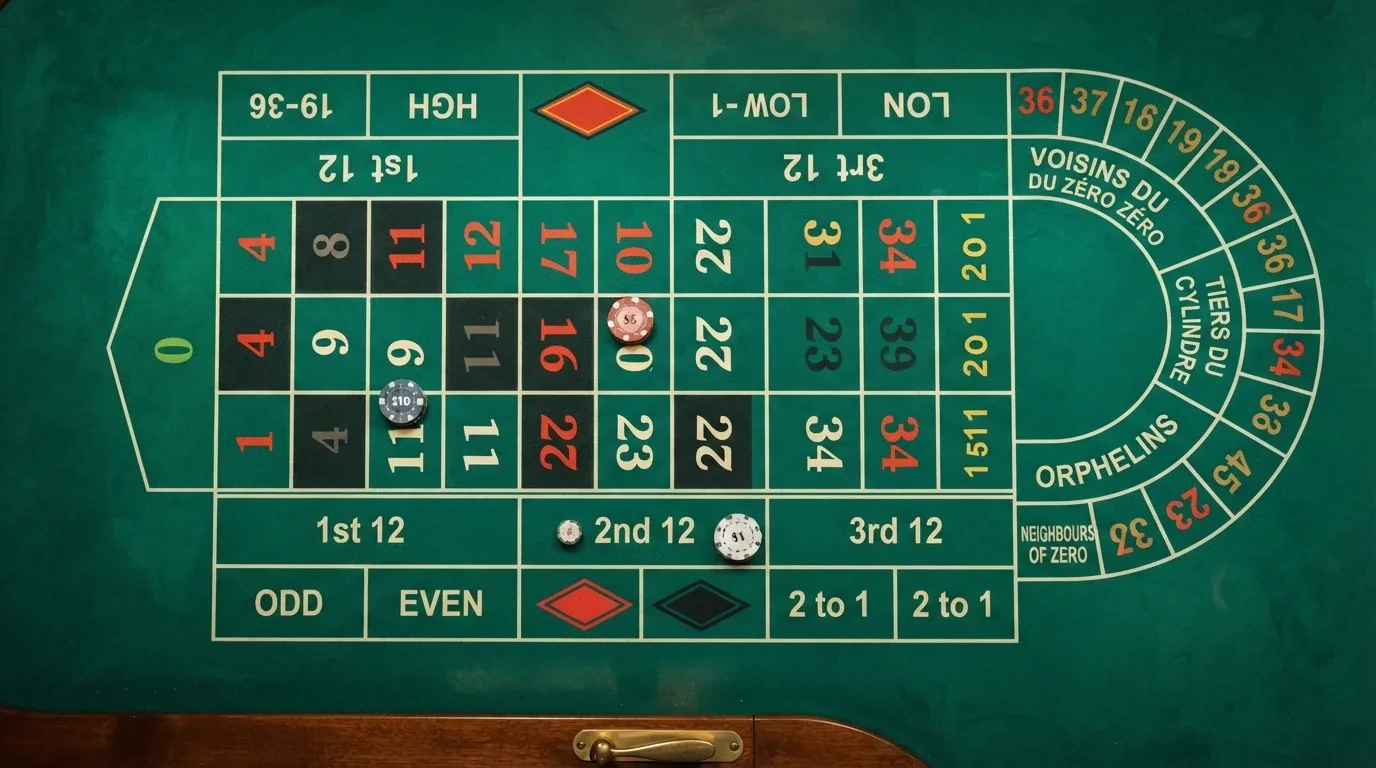
Inside bets are wagers placed on the numbered grid: a straight-up on a single number, a split between two adjacent numbers, a street across three, a corner across four, a six-line across two streets, a trio (0, 1, 2 or 0, 2, 3). Outside bets are wagers placed on the boxes around the grid: red or black, odd or even, high (19–36) or low (1–18), the three dozens (1–12, 13–24, 25–36), or the three columns. The racetrack — the curved oval that sits above or beside the grid — is for neighbour and section bets, which cover groups of numbers by their position on the wheel rather than on the grid.
A round runs from “place your bets” to “no more bets” in roughly twenty to thirty seconds. The dealer calls the end of betting, spins the wheel, and the round resolves. A Speed Roulette variant compresses the sequence; an Auto Roulette variant runs the wheel without a dealer, mechanically. The grid, the bets, and the payouts do not change with the pace.
European vs American Roulette: Why One Zero Changes Everything
A European roulette wheel has 37 pockets: numbers 1 to 36 plus a single zero. The house edge is 2.70%. An American roulette wheel has 38 pockets: numbers 1 to 36 plus a zero and a double zero. The house edge is 5.26%. The extra zero almost doubles the casino’s mathematical edge on every bet, and the only reason to choose the American wheel is a misplaced sense that “more pockets means more chances to win,” which the math does not support.
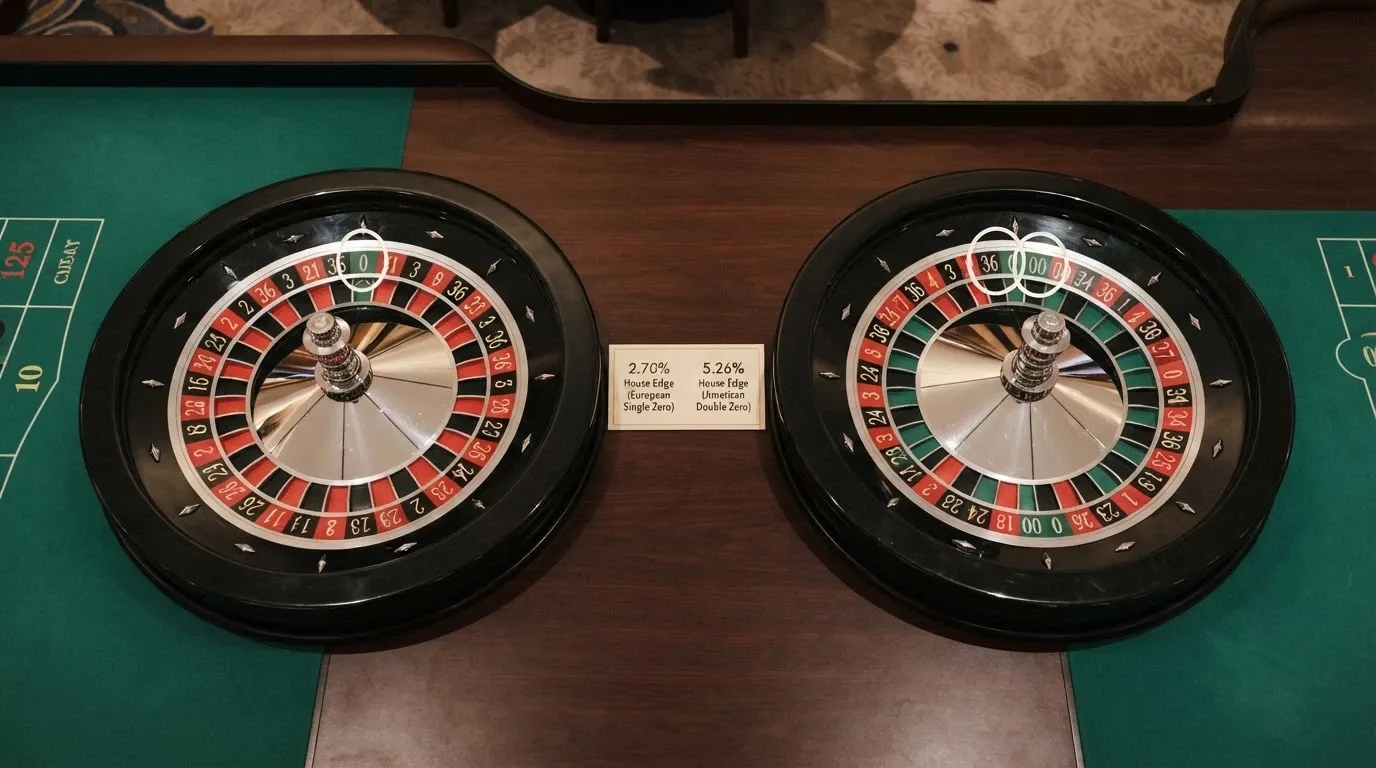
The difference compounds across a session. On a European wheel, $1,000 of total bets loses an expected $27.00. On an American wheel, the same $1,000 of total bets loses an expected $52.60. The player who always picks the European table keeps an extra $25.60 of their bankroll, on average, for every $1,000 they put through the wheel. Over a year of regular play, that is real money.
The Australian market is not short on American roulette tables — most international studios offer both, and a few offer exotic variants with bonus pockets and triple-zero wheels that take the edge higher still. A punter who values their bankroll should pick the European table as a default. Opting for other variants should be a considered decision, not a default choice.
Live Roulette Variants: Lightning, Speed and Auto Roulette
The variants on the live roulette floor change something about the format — the pace, the payouts, the random multipliers, the absence of a dealer. They do not change the underlying wheel, except where noted.
| Variant | House Edge | RTP | Spins per Hour | Key Feature |
|---|---|---|---|---|
| European Roulette | 2.70% | 97.30% | 25–35 | Single-zero standard wheel |
| American Roulette | 5.26% | 94.74% | 25–35 | Double-zero wheel |
| Lightning Roulette | — | 97.30% outside / 97.10% straight-up | 25–30 | Random multipliers 50x–500x on straight-up |
| Speed Roulette | — | — | 50+ | Compressed betting window |
| Auto Roulette | — | — | up to 120 | Mechanical wheel, no dealer |
| XXXTreme Lightning Roulette | — | — | 25–30 | Multipliers up to 2,000x |
The two anchor rows — European and American — carry the verified figures. The Lightning Roulette row takes its RTP from the game’s public specification: 97.30% on outside bets and 97.10% on straight-up bets, because the straight-up pays 29:1 instead of the standard 35:1 to fund the random multipliers that range from 50x to 500x. Speed, Auto, and XXXTreme Lightning are listed because they are the variants the player will meet, but their exact house edge and RTP depend on the underlying wheel and side-bet structure; the figures research confirmed are the spins-per-hour benchmarks and the XXXTreme multiplier ceiling of 2,000x. The honest reading of the table is that the verified data is thinner than the variants available. The variants exist; their specifications vary by operator; the player should check the in-game information screen before committing to a session.
The Odds, the House Edge and What They Mean for Your Money
The house edge is the casino’s cut on every bet, expressed as a percentage of total wagers. On a European wheel at 2.70%, the casino expects to keep $2.70 of every $100 wagered across enough spins for the law of large numbers to settle in. The edge is the same on every bet — red/black, single number, dozens, columns, splits, corners — because the edge lives in the zero, not in the payouts. The zero is not red or black, high or low, odd or even; it is the casino’s pocket.
The math on a single bet is the math on the long run. A straight-up on a single number pays 35:1 on a European wheel, and the probability of winning is 1 in 37. A red/black bet pays 1:1, and the probability is 18 in 37. In both cases, the expected return is 36/37 of the wager — which is 97.30%, or a house edge of 2.70%. On an American wheel, the expected return on every bet is 37/38 — 94.74%, or a house edge of 5.26%.
Set a $1 chip on a single number for one hour of Auto Roulette at 120 spins and the European wheel takes $3.24 of expected loss; the American wheel takes $6.31 for the same stake and pace. The figure is statistical — a long-run average across many spins, not a forecast for the hour the player actually plays. The house edge is the price of every spin, and the price does not vary by strategy, bet size, or mood.
Lightning Roulette’s RTP figures tell a similar story in a different shape. Outside bets at 97.30% match the standard European rate; straight-up bets at 97.10% are marginally worse than the standard European 97.30%, because the straight-up pays 29:1 rather than 35:1, and the missing six units per win fund the random multipliers. A straight-up that hits a 500x multiplier pays 500:1 instead of 29:1, and the expected value across all straight-up spins (including the multipliers) returns to the published 97.10% figure. The base game is worse for the player; the multiplier tail is what makes it interesting.
How to Play Step by Step
The sequence from login to first spin is short, and most of it is the casino’s onboarding rather than the player’s decision.
- Choose a live roulette table from the lobby. The lobby shows table limits, dealer language, current occupancy, and the variant (European, American, Lightning, Speed, Auto).
- Place your bets during the betting window. Click chip denominations, then click the grid. The timer at the bottom of the screen counts down to “no more bets.”
- Watch the dealer spin the wheel and drop the ball. The dealer announces “no more bets” at the end of the window.
- The result is displayed on the grid and credited to the balance. Winning bets light up; losing bets clear. The next round begins.
- Repeat or cash out. The balance is available for withdrawal through the cashier page, subject to the operator’s withdrawal terms and any active bonus conditions.
The sequence looks longer in writing than it feels in play. A standard round takes two to three minutes from start to finish; an Auto Roulette round takes thirty seconds.
Live Roulette on Mobile: The Same Tables, a Smaller Screen
Live roulette runs on any modern phone through the same HD stream the desktop sees. The screen is smaller; the betting interface is touch; the experience holds up, with a few trade-offs the player should know about before committing.
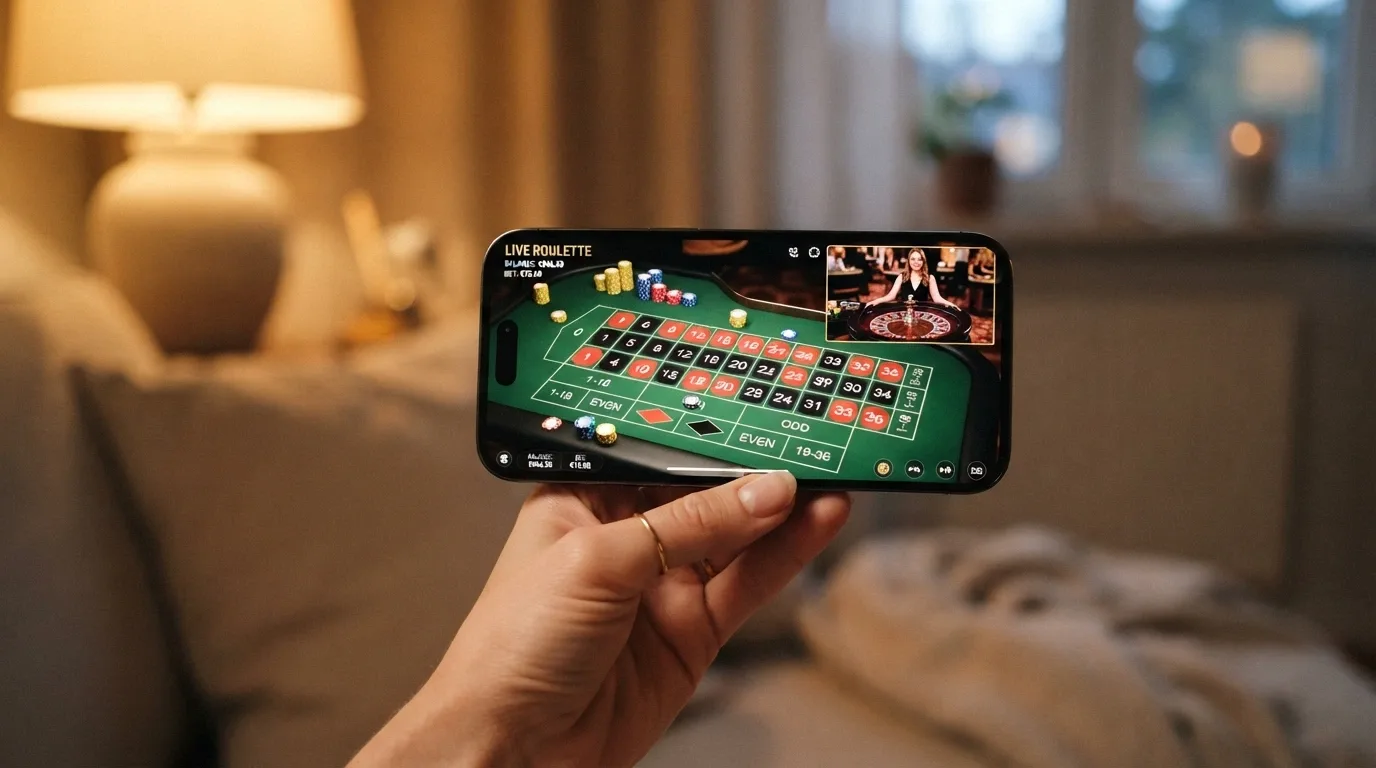
The mobile stream is the studio stream, repackaged for a smaller viewport. The dealer, the wheel, and the betting grid are all there; the multi-camera view that fills a desktop screen gets condensed into a single primary view on the phone, with the betting grid below. Top-tier sites keep the 1080p stream on mobile, and the result looks the way a live casino is supposed to look.
Mobile Apps vs Browser Play: What Works in Australia
Most offshore casinos do not appear in the Australian Apple App Store or the Google Play Store. The app stores restrict real-money gambling apps in Australia, and the offshore brands have largely not pursued the local app-store route. The standard access point is the mobile browser — Safari on iPhone, Chrome on Android — loading the operator’s website the same way a player would on a desktop.
The browser delivers the same tables without a download. The player signs in once, the lobby loads, the live games run. There is no installation, no update cycle, no storage cost on the phone. The downside is the lack of a homescreen icon for instant access, and the smaller URL bar at the top of the screen. The upside is the same account, the same balance, and the same games — no separate mobile-only product with a smaller lobby.
What You Lose (and Gain) Playing Roulette on a Phone
The trade-offs of a smaller screen are mostly at the edges of the betting interface. Neighbour bets on the racetrack require precise tapping — the curved layout of the wheel-bet area does not scale gracefully to a thumb-sized viewport, and a misclick on a neighbour bet can put a chip on the wrong number. The straight-up bets on the main grid are large enough to tap accurately; the corner and split bets are tight, and a thumb bigger than average may want to switch to landscape mode to give the grid more room.
The gains are the ones mobile brings to everything. A punter can play a thirty-minute session on the train, at lunch, on the couch. The session is shorter than the desktop equivalent, which is, for a punter who watches their bankroll, a feature as much as a limitation. Live roulette on a phone is the same product on a smaller screen, and the smaller screen is, for a disciplined player, its own form of limit.
How We Picked and Ranked These Live Roulette Casinos
The ten brands profiled in this guide were identified as holding significant Australian market share in 2026 — operators that Australian players are searching for and using, regardless of the legal status of the product. The baseline against which each was checked is the Interactive Gambling Act 2001 and the ACMA’s enforcement record. Every operator on the list fails that baseline. None holds an Australian licence; none can.
The ranking criteria for a genuine head-to-head would be: live roulette table count, English-speaking dealer availability, game provider quality (Evolution, Pragmatic Play Live, Ezugi, Vivo Gaming), welcome bonus value and terms, wagering multiple, withdrawal speed, payment routes, and the regulatory standing of the offshore licence (Curaçao, Anjouan, Malta Gaming Authority, and the rest). The picture this round of research produced does not fill that template. Volatile details — bonus amounts, wagering multiples, licence jurisdictions, table counts for most operators, English-speaking dealer rosters — were sought and not confirmed in a verifiable form.
The page is honest about the gap. The ten operators are listed because the market-share analysis identified them as significant Australian-traffic brands, and because the page is a map of the offshore market rather than a ranking. Where a verified figure exists, it is in the table or the operator profile; where it does not, the operator profile names what to check before depositing. That is the practical limit of what a research round can produce, and the reader is better served by an honest gap than by figures invented to fill one.
Is It Worth Playing Live Roulette at an Offshore Casino?
The legal reality is the first thing. Online casino is prohibited in Australia under the Interactive Gambling Act 2001, and every live roulette table an Australian player can access is offshore. The ACMA cannot license the activity and cannot protect the player who engages in it. The protections Australians rely on for licensed wagering — consumer law, complaints bodies, BetStop — do not apply at an offshore casino. A punter who deposits at one of the brands in this guide is, in legal terms, using a service the country says should not be on offer, with none of the consumer safeguards that come with a regulated product.
The reality underneath the legal reality is that Australians are playing anyway. The search traffic, the offshore operator investments, and the existence of this page all confirm it. The question is not whether Australians play live roulette at offshore casinos; it is what a player who decides to play should weigh.
The first thing to weigh is the licence. The operator should hold a real licence from a real jurisdiction — Curaçao, Anjouan, Malta Gaming Authority, the Isle of Man. The licence number should be on the operator’s footer, and it should be verifiable against the regulator’s register. The second thing is the bonus terms. A 35x wagering requirement on slots is industry-standard; 50x and above is a red flag; the game-weighting line should confirm that live roulette contributes something. The third is the payment route. PayID for fast AUD deposits, crypto for fast withdrawals, and a documented withdrawal time that matches the marketing.
The fourth is self-exclusion. BetStop — the National Self-Exclusion Register — has recorded 67,480 registrations as at 31 July 2026, of which 41,290 exclusions are still active. The register binds Australian-licensed wagering services only; an offshore casino is not connected, and a self-excluded person can still log in. For a punter who has registered with BetStop and wants the exclusion to hold, the offshore market is exactly the wrong place to play. For a punter who has not, the offshore market is exactly the place where the BetStop exclusion does not exist.
The fifth is the cost. About 2.1% of Australian adults — roughly 430,000 people — experience problem gambling; the Australian Institute of Health and Welfare put high-risk gambling at 1.8% in 2022. The house edge at a live roulette table is 2.70% on a European wheel and 5.26% on an American one, and it compounds across every spin. A punter who plays regularly is paying that edge, and the math does not care how good a system feels.
If play feels out of control, the National Gambling Helpline is 1800 858 858 — free, confidential, staffed 24 hours a day, 7 days a week. Gambling Help Online runs the chat and counselling service at gamblinghelponline.org.au. The services are free, confidential, and not connected to any operator. They are the one bet a punter should not think twice about making.
Frequently Asked Questions
How do I know if an online casino is safe for Australian players?
No online casino is licensed in Australia; the Interactive Gambling Act 2001 prohibits online casino games outright. A punter at any live roulette site uses an offshore operator with no Australian licence and no consumer protection here. Verify the offshore licence (Curaçao, Anjouan, Malta Gaming Authority), confirm the game provider, and check payout-dispute history on independent forums before depositing. The ACMA cannot recover your funds if anything goes wrong.
What is the minimum bet for live roulette tables?
Minimum bets vary by table and operator. Standard live roulette tables at offshore casinos typically start at $0.50 to $1 per spin, with VIP tables running higher. The exact minimum for any table is shown in the lobby before entry. Pick a low-limit table while learning; a $0.50 minimum keeps a session’s drawdown visible across dozens of spins.
How does BetStop self-exclusion work for online gambling?
BetStop is the National Self-Exclusion Register for Australian-licensed online and phone wagering services. One registration excludes the person from every licensed Australian operator simultaneously, with periods from three months to lifetime. As at 31 July 2026, 67,480 registrations were recorded with 41,290 exclusions active. BetStop does not cover offshore casinos; a self-excluded person can still log in.
Are there bonuses specifically for live roulette games?
Live-roulette-specific bonuses are uncommon. Most welcome offers are built for slots, and live roulette contributes a fraction of each bet toward wagering — often 10–20% — or is excluded entirely. The “live casino bonus” label is usually a slots bonus with a live-roulette weighting line buried in the terms. Read the eligible games list and weighting table before claiming; if live roulette is excluded, the bonus is not a bonus for a roulette player.
What payment methods can I use for live roulette in Australia?
Realistic payment routes at offshore live roulette sites include PayID (instant deposits from $10 AUD, withdrawals in 1–2 hours where supported), debit card, bank transfer, e-wallet (Skrill, Neteller, MuchBetter), and crypto (payouts in 1–4 hours). Crypto is banned for Australian-licensed wagering but common offshore. Credit cards are banned for online wagering in Australia under the 2024 ban.
No-Deposit Bonuses: Do Any Cover Live Roulette?
A no-deposit bonus — a small credit the casino hands over without requiring a deposit — is rare for live casino games in general, and rarer still for live roulette specifically. Most no-deposit offers are restricted to slots, where the casino can control game weighting cleanly. When a no-deposit bonus does extend to live games, it usually carries a tight max-cashout cap and a short validity window.
Of the ten operators profiled in this guide, no featured brand carries a confirmed no-deposit bonus for live roulette this round. The honest statement is also the most useful one: no checked operator currently offers a no-deposit bonus for live roulette, and a player who sees one advertised should read the terms — the maximum cashout, the eligible games, the expiry — before claiming. If the bonus is real, the terms will say so; if the terms are vague, the bonus is likely the bait.