
What Easy Withdrawal Actually Means at an Australian Online Casino
Easy withdrawal is the part of the online casino pitch that gets the most airtime and the least scrutiny. Australian players are sold “instant payouts” and “cash in minutes” by brands that, when an account is actually closed and a balance is actually withdrawn, often turn out to mean something slower, smaller or more conditional than the headline suggested. This page ranks ten offshore casinos Australians actually use by withdrawal experience, breaks down the payment rails that decide how fast money moves, and sets out — plainly — the legal position that makes every brand on this list unlicensed in Australia.

Current as of 24 November 2026. Licence claims, withdrawal limits and bonus terms were verified against each operator’s published terms page and cross-checked with third-party payout tests; legal references checked against the Interactive Gambling Act 2001 (as amended), ACMA enforcement data and the BetStop register.
Table of Contents
- What “Easy Withdrawal” Actually Means at an Australian Online Casino
- The 10 Easy-Withdrawal Casinos Australian Players Actually Use in 2026
- The Withdrawal Methods That Get Your Money Out Fastest
- Why That Welcome Bonus Shrinks Before You Can Cash Out
- The Pokies and Tables Where Australian Players Put Their Money
- Try Before You Bet: Free-Play and Demo Modes
- Online Casino Is Prohibited in Australia — Here’s What That Means for Your Money
- Staying in Control: Responsible Gambling Tools That Actually Work
- Cashing Out on the Go: Mobile Withdrawals
- How to Pick an Easy-Withdrawal Casino You Can Trust
- How We Evaluated Every Casino on This Page
- Your Money, Your Next Move
- Frequently Asked Questions
What “Easy Withdrawal” Actually Means at an Australian Online Casino
A payout is “easy” when three things line up. The casino approves it quickly. The rail you chose clears it fast. And no clause in the small print confiscates the result on the way out. Marketing tends to bundle those three as if they were one thing — “instant withdrawals” — and the test of any casino is which of them, on a real withdrawal, is actually true.
The reason the phrase matters to Australian players is the gap between the pitch and the receipt. Offshore casinos that target Australia compete on speed because the market is saturated and welcome bonuses are commodity. A brand that pays out in two hours instead of two days stands out. A brand that pays out in two hours when the cashier is automated but takes two days when a human reviewer needs to look at a first withdrawal is harder to spot until you have actually asked for your money. The “instant” word covers both cases in marketing copy and only the second case in practice.
There is no Australian consumer protection in any of this. The Interactive Gambling Act 2001, as strengthened by the 2017 amendment, prohibits online casino products to Australians and no licence exists for one. Every brand discussed below sits outside that system. The ACMA has ordered Australian ISPs to block more than 1,564 illegal gambling and affiliate websites since November 2019. None of the players using those sites have been prosecuted — the Act targets the provider — but none of them has an Australian complaints body to call if a payout is withheld either. The legal reality is covered in full in the section on the prohibition; the working assumption from here on is that this is the market the reader is in.
The Three Things That Make a Payout “Easy”
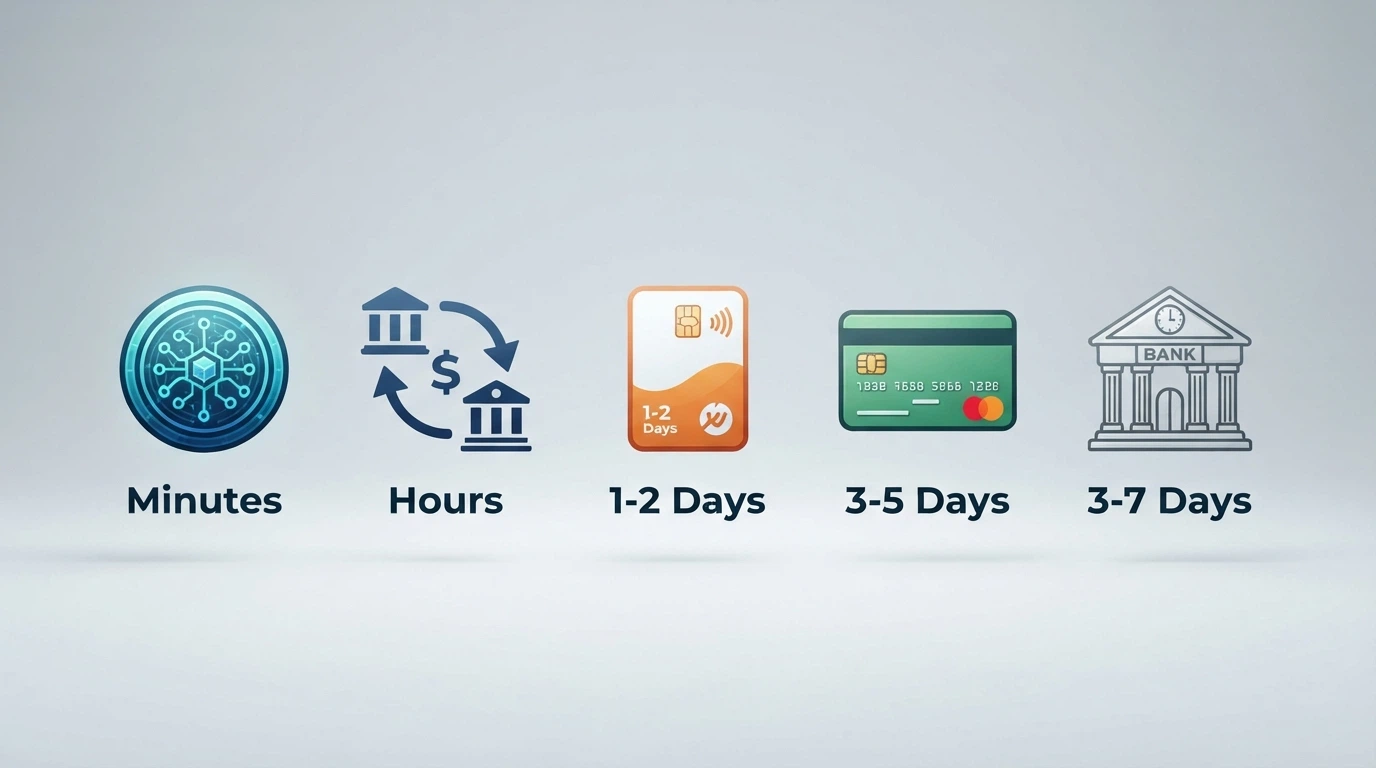
Speed splits into two stages that get conflated. There is the casino’s approval pipeline and there is the payment rail after approval. At casinos with an automated approval pipeline, processing takes five to thirty minutes. At casinos with a manual review, first withdrawals and larger amounts can sit for two to twenty-four hours, sometimes longer. That is the casino side. Then the rail does its own work: USDT on TRC20 settles in under five minutes, a PayID transfer clears in under sixty seconds, a Visa withdrawal takes one to four business days and a bank transfer can take three to seven. The fastest total time is the casino that approves fast on a fast rail. The slowest is a manual review on a bank transfer.
The range of methods available to Australians has narrowed in the last two years. Crypto and PayID remain the realistic fast options. Skrill and Neteller are increasingly restricted for gambling transactions tied to Australian players and are often excluded from welcome bonuses altogether. POLi shut down in September 2023. Visa and Mastercard withdrawals are still offered but take days, not hours, and credit cards have been banned as a deposit method for licensed Australian wagering since 11 June 2024 — the fact that an offshore casino accepts one from an Australian player tells you which side of the law it operates on.
The third dimension is what the terms let you actually withdraw. A A$500 bonus with a A$2,000 maximum cashout cap turns a A$5,000 win into a A$2,000 withdrawal, with the remaining A$3,000 voided on the withdrawal request. A weekly withdrawal cap of A$10,000 means a player who wins A$30,000 has to spread the payout across three weeks. A A$5 per-spin cap during wagering stretches the clear-down timeline and changes the math of “how long does it take.” None of these are visible on the headline bonus number. All of them are visible on the terms page that nobody reads.
Why Fast Payouts Matter More Than the Welcome Bonus
A casino that holds your money wipes out any bonus value. A A$500 matched deposit that takes fourteen working days to clear, with a weekly cap that splits the payout in two, and a cashout ceiling that voids half the win, is not a A$500 bonus. It is a delay, a partial loss and a marketing line.
The same logic applies to wagering requirements, only more so. A A$500 bonus with 35x wagering and a seven-day expiry requires A$17,500 of qualifying wagers cleared inside one week. At A$1 per spin on a pokie that contributes 100% toward wagering, that is roughly 2,500 spins per day — feasible, but only if you have the bankroll and the time. A 14-day window at the same multiplier halves the daily load. A 30-day window quarters it. The expiry window is the difference between clearing the bonus and forfeiting it.
The point is not that welcome bonuses are worthless. It is that the payout conditions sitting underneath them are worth more than the headline. A 200% match up to A$200 sounds generous until you read that the bonus carries a 40x playthrough on the bonus amount alone and the casino’s no-deposit cap is A$75. A “A$2,500 welcome pack” sounds substantial until the per-spin cap and the weekly ceiling are written into the same fine print. Withdrawal ease is the first filter, not the second, because nothing else matters if the money does not come out.
The 10 Easy-Withdrawal Casinos Australian Players Actually Use in 2026
The table below lists the ten offshore casinos that come up repeatedly in Australian-facing affiliate round-ups and that accept Australian players with real-money deposits and withdrawals. Every one of them is unlicensed in Australia — that is the legal reality for the whole category, and the section on the prohibition sets it out in full. The ranking below is by withdrawal experience: the published speed, the range of methods, the minimums and caps, and whether the operator’s terms page tells a reader what they need to know before depositing.
| Operator | Licence Status |
|---|---|
| RocketPlay | Offshore (no AU licence) |
| SkyCrown | Offshore (no AU licence) |
| Royal Reels | Offshore (no AU licence) |
| WinSpirit | Offshore (no AU licence) |
| Stake | Offshore (no AU licence) |
| Rainbet | Offshore (no AU licence) |
| Scream Casino | Offshore (no AU licence) |
| FairGO | Offshore (no AU licence) |
| Bizzo Casino | Offshore (no AU licence) |
| Rocket Casino | Offshore (no AU licence) |
Three of the ten — RocketPlay, SkyCrown and Royal Reels — have published withdrawal terms with enough specificity to compare directly. The other seven appear in AU-facing directories but publish less detail on the methods, minimums and caps a player needs before depositing. They are covered qualitatively below, and the read-the-cashier-page advice applies to all of them.
RocketPlay: High Withdrawal Caps and a Low Entry Point
RocketPlay’s withdrawal ceiling is the widest in the set: A$9,000 per transaction, A$18,000 per week and A$54,000 per month at the standard tier, with higher limits available for VIP players. The minimum is A$25 equivalent, low enough that a player withdrawing a small balance is not stuck waiting to accumulate a threshold they do not have. Deposits carry a 1x wagering requirement before withdrawal — a clean-and-straightforward rule that is worth noticing because some offshore brands stack wagering conditions that turn a withdrawal request into a clearance problem.
The welcome offer is a 200% match up to A$200 on a first deposit of A$25 or more, with 40x wagering on the bonus amount and 14-day validity. The maximum bet during bonus wagering is A$7.50; bonus validity is five days unless otherwise stated; and the no-deposit bonus maximum cashout is A$75 — small enough that the no-deposit path is more of a tryout than a route to a real balance.
RocketPlay supports bank transfer, e-wallets and crypto on the withdrawal side. The published terms do not specify per-method settlement windows, so the working assumption is the casino-side range covered in the methods section: automated approvals clear in five to thirty minutes, manual reviews take longer.
The verdict is numerical. RocketPlay is the right pick for a player whose priority is the ceiling rather than the headline. A$18,000 a week is high enough to absorb a five-figure win in one request rather than over a month. The 1x deposit wager rule keeps the withdrawal conditions clean. The 40x bonus playthrough and the A$7.50 bet cap are ordinary for the market — neither an outlier nor a concession.
SkyCrown: The Multi-Method Withdrawal Machine
SkyCrown publishes the most detailed per-method breakdown in the set. Minimum withdrawal is A$30 across every method. Crypto ceiling is A$15,000 per day, bank transfer ceiling A$10,000 per day and card ceiling A$5,000 per day. The published settlement windows are: Bitcoin, Ethereum, Litecoin and Tether all 0–24 hours; Visa and Mastercard 1–4 business days; Bank Transfer 2–6 business days. Neosurf and Paysafecard are deposit-only and do not appear on the withdrawal list.
Bonus funds carry a 40x playthrough. The welcome offer itself was not returned with enough specificity to quote here, so the bonus headline at SkyCrown should be checked at the operator’s own promotional page before depositing. The lobby is heavy on Pragmatic Play (around 350 titles) and Play’n GO (around 260), the two providers whose RTPs are most consistently published across the set.
The verdict is on reader-fit. SkyCrown suits a player who wants five payout rails with transparent ceilings and is willing to read the published windows. The card ceiling at A$5,000 per day is the limitation — anyone withdrawing a larger balance will need to split it across methods, or wait, or move to a higher-tier rail. For a player withdrawing under A$5,000 in fiat or up to A$15,000 a day in crypto, SkyCrown’s published terms are cleaner than most.
Royal Reels: The Biggest Welcome Pack With a Per-Spin Brake
Royal Reels runs a three-deposit welcome pack: 100% up to A$500 on the first deposit, 75% up to A$750 on the second and 100% up to A$1,250 on the third, totalling A$2,500 plus 50 free spins across the three. The wagering requirement is 35x on the bonus amount only, which is friendlier than the bonus-plus-deposit model some operators run. The per-spin cap during wagering is A$5 — tighter than RocketPlay’s A$7.50, so the clear-down math is slower even with a lower playthrough.
The weekly withdrawal cap at the standard tier is A$10,000. That sits below RocketPlay’s A$18,000 ceiling and limits a high-rolling player’s payout window to roughly two weeks for a five-figure withdrawal. The lobby is built on the same Pragmatic Play and Play’n GO backbone as SkyCrown — around 350 Pragmatic titles and 260 Play’n GO titles — so the games on offer are the same well-published catalogue.
The verdict is a comparison. Royal Reels is the bigger welcome pack than RocketPlay, but with a tighter per-spin brake and a lower weekly ceiling. For a player chasing a matched-deposit package who can live with the A$5 cap and the A$10,000 weekly split, the offer is competitive. For a player whose priority is payout flexibility over the welcome headline, RocketPlay’s ceiling reads better.
WinSpirit
WinSpirit appears in AU-facing affiliate round-ups and accepts Australian players, but the operator’s published withdrawal terms, minimums, caps and bonus conditions were not returned with enough detail to compare line by line. That is not the same as saying the brand does not publish them — it says the search did not return them. A player considering WinSpirit should treat that gap as the reason to read the cashier page before depositing, not a reason to skip the brand.
The Australian-facing presence and the AU-dollar denomination are useful signals that the operator has set up for this market, but the legal status is the same as every other brand on this list: offshore, no Australian licence, no BetStop coverage, no ACMA complaints body for a withheld payout. The section on the prohibition covers what that means in practice.
The verdict is a caveat. Until the operator publishes its terms in a form that can be verified, treat WinSpirit as a starting point for your own research, not a finished answer.
Stake
Stake is a crypto-native operator. The brand was built for digital-currency play and that is what it does best: deposits and withdrawals in Bitcoin, Ethereum, Litecoin and Tether, with the speed that implies. Crypto settles in a median of forty-two minutes in third-party tests, and that is the speed a Stake player should expect on a working day.
The trade-off is the Australian regulatory gap. Crypto has been banned as a payment method for licensed Australian wagering since 11 June 2024. The fact that Stake accepts crypto from an Australian player is not a problem with the player — the IGA does not prosecute individuals — but it confirms the operator sits outside the licensed system, with all that implies: no ACMA complaints recourse, no BetStop coverage, no Australian consumer protection if a balance is withheld. The credit-card and crypto payment ban for licensed operators is itself a tell.
The verdict is reader-fit. Stake is the right home for a crypto-native player who has already accepted the offshore trade-off and wants the speed that comes from a brand designed around digital-currency rails. For a fiat-first player, or for anyone who wants BetStop to bind the operator, Stake is the wrong address.
Rainbet
Rainbet appears in Australian-facing directories and accepts Australian players, but the operator’s published withdrawal terms, method list and bonus conditions were not returned this run. Like WinSpirit, that is a search gap rather than a verdict on the brand itself — the cashier page is the source of truth and should be read before any deposit.
The standard offshore caveats apply: no AU licence, no BetStop coverage, no Australian consumer protection. A player who values the brand’s catalogue or its promotions above the missing data should verify the withdrawal mechanics on the operator’s own page before committing funds.
The verdict is practical advice. Do not deposit before reading the cashier page. For offshore brands, the published numbers are the only numbers that count, and the absence of them in third-party round-ups is a reason to look yourself, not a reason to skip the check.
Scream Casino
Scream Casino targets Australian players through affiliate channels, but specific withdrawal terms — minimums, caps, per-method settlement windows — were not published in a form the search returned. The brand is offshore, unlicensed in Australia and outside BetStop. A player who has found the brand through an AU-facing round-up should treat the operator’s own withdrawal page as the source of record before depositing.
The verdict is a caveat. An AU-facing brand with limited published payout data is the case where the read-the-terms advice is the whole advice — there is nothing else to compare.
FairGO
FairGO is an offshore casino that has positioned itself around Australian players for years. The brand recognition is genuine. The published withdrawal data is thin — specific per-method minimums, caps and settlement windows were not returned in the third-party sources reviewed for this page. Like the other data-light operators on this list, the cashier page is the source of truth.
The legal status is unchanged from every other brand here: offshore, no Australian licence, no Australian consumer protection. A returning player who already knows the brand will not be surprised by that. A new player considering FairGO against a brand with published terms should give the edge to the brand that publishes them.
The verdict is a comparison. If you have already played at FairGO and liked it, the offshore reality has not changed and the brand familiarity is real. If you have not, start with a brand whose terms are published in detail.
Bizzo Casino
Bizzo Casino appears in AU-facing affiliate round-ups, accepts Australian players and runs the standard offshore welcome-bonus structure. Specific withdrawal terms — minimums, caps, method-by-method windows — were not confirmed in the third-party data this page is built on. A player considering Bizzo should treat the cashier page as the first stop and the welcome bonus as a question to verify against the bonus terms, not a number to take at face value.
The legal position is the same as every other entry in this table. Offshore, no AU licence, no BetStop, no ACMA complaints body. The standard caveats apply; the standard read-the-terms advice applies.
The verdict is a flat one-line. A brand on the AU-facing round-up list, but one whose withdrawal page should be your first stop — not the welcome bonus.
Rocket Casino
Rocket Casino has the most concrete small-print data point in the data-light cluster: a maximum cashout from free spins of A$75, with a fully verified account and at least one deposit required before withdrawal. That is a tight ceiling, and it tells a reader how Rocket Casino treats small promotional balances — as a tryout, not a route to a real payout. The rest of the withdrawal terms (minimums, weekly caps, per-method settlement windows) were not confirmed in this run.
The legal status is unchanged: offshore, no AU licence, no Australian consumer protection. A player evaluating Rocket Casino should treat the A$75 free-spin cap as the clearest data point on offer and read the cashier page for everything else.
The verdict is numerical. The A$75 cap on free-spin cashouts is the most concrete number on offer, and a useful warning of how tight the small print can be on a brand that markets a generous welcome.
How These Casinos Were Selected
The list above is built from the AU-facing affiliate round-ups that dominate the search results for fast-payout casinos, filtered to brands with confirmed Australian player access and at least one verified withdrawal method. Third-party payout tests narrowed the field further: Betsquare, for example, tested more than fifty sites to arrive at their fastest-payout list for Australians, with at least one brand verified end-to-end on a Big Bass Bonanza deposit-and-withdrawal test that cleared in one hour eighteen minutes via crypto. The ranking here is by withdrawal experience across the published criteria — speed, caps, methods, transparency of terms — not by bonus size or game count.
The full methodology is set out in the closing section of this page. What the operator list does not claim is completeness. The Australian-facing offshore market is wider than ten brands. These ten are the ones that consistently show up in the round-ups the search returns.
The Withdrawal Methods That Get Your Money Out Fastest
The method you pick is the biggest lever you control. The casino’s approval pipeline is the same for every method on a given operator; the rail does the rest. The table below ranks the five realistic withdrawal options for Australians by median settlement time, with the worst-case range and the best-fit use case.
| Method | Median Payout Time | Worst Case | Best For |
|---|---|---|---|
| Crypto (BTC, LTC, ETH, USDT) | 42 minutes | 4 hours | Largest balances, fastest rail, offshore only |
| PayID | 2 hours | 8 hours | Fiat at speed, domestic AU banks |
| E-wallets (Skrill, Neteller, eZeeWallet) | 6 hours | 18 hours | Mid-size balances, secondary fiat |
| Visa / Mastercard | 2 working days | 5 working days | Standard card fallback |
| Bank Transfer | 3 working days | 7 working days | Last resort, very large balances |
Two facts reframe the table. The first is that crypto and PayID are at the top by a wide margin, and the second is that crypto is no longer available for licensed Australian wagering at all — credit cards, credit-related products and digital currency were banned for licensed AU wagering from 11 June 2024 under the Interactive Gambling Amendment (Credit and Other Measures) Act 2023, with penalties of up to A$247,500 for operators that fail to enforce it. A casino that accepts crypto from an Australian player is, by definition, not licensed. The same applies to credit cards. PayID remains available on both sides because it sits inside the domestic banking rails, not the offshore payment network.
Crypto: The Fastest Rail With a Legal Asterisk
Crypto is the fastest payout method available at offshore casinos serving Australian players. CardPlayer’s tests recorded USDT on TRC20 and Solana settling in under five minutes; Ethereum and Litecoin within five to thirty minutes; and Bitcoin requiring three to six network confirmations that add thirty to sixty minutes on top of the casino’s approval time. The Betsquare test set produced a forty-two-minute median across BTC, LTC and USDT, with a worst case of four hours.
The legal asterisk is the 11 June 2024 ban. Crypto is prohibited as a payment method for any operator licensed in Australia. The fact that an offshore casino accepts it from an Australian player does not put the player at legal risk — the IGA targets the provider, not the user — but it confirms the operator sits outside the licensed system. Crypto at an Australian-facing casino in 2026 is, by construction, an unlicensed transaction. That is what makes it fast.
The choice of coin matters at the margin. USDT on TRC20 and Solana are the fastest for a player who wants settlement in minutes and is comfortable holding stablecoins. Bitcoin is the slowest crypto, but it is the most universally supported. Ethereum and Litecoin sit between them and are often cheaper on network fees than Bitcoin at busy times.
PayID: Australia’s Home-Grown Instant Rail
PayID is the fastest fiat option available to Australians. It settles on the New Payments Platform in under sixty seconds once the casino approves the withdrawal — every time, regardless of the operator. Every major Australian bank supports it: CBA, NAB, Westpac and ANZ all run PayID with daily limits around A$100,000. A PayID transfer is, at the rail level, instant.
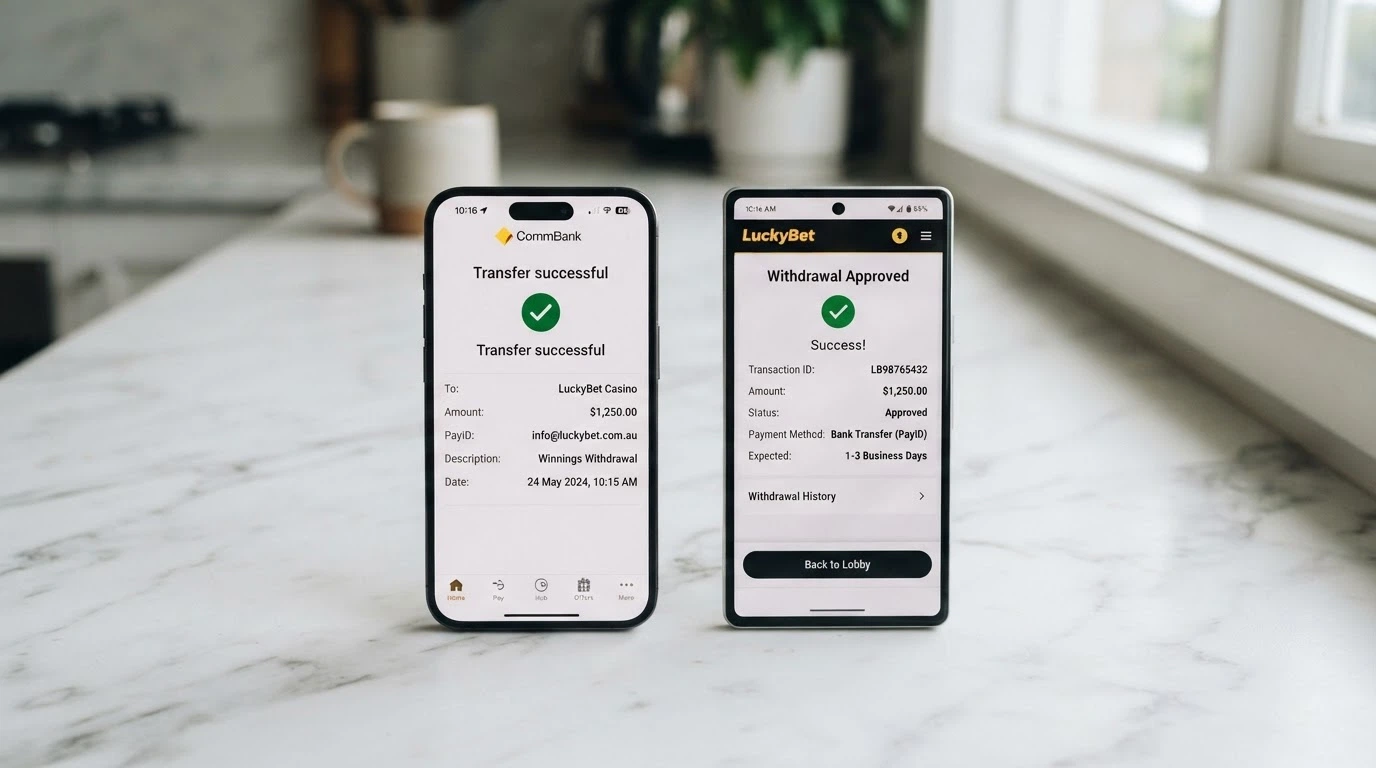
The bottleneck is the casino. The rail is not the slow part — the approval pipeline is. At a casino with automated approval, PayID lands in minutes. At a casino with manual review, the transfer still settles instantly once approved, but the approval itself can take two to twenty-four hours on a first withdrawal. The published “PayID in under an hour” figures assume automated approval.
POLi used to fill this role for Australians and shut down in September 2023. PayID is the equivalent domestic instant option, with the same bank-to-bank settlement logic underneath and broader coverage at the major banks. A player who wants speed in fiat without holding crypto should look for an operator that publishes both an automated approval window and a PayID option — the combination is what produces the under-one-hour experience.
E-Wallets, Cards and Bank Transfers: The Rest of the Pack
Skrill, Neteller and eZeeWallet sit in the middle of the table at a six-hour median and an eighteen-hour worst case. They are useful as a secondary fiat rail for players who already hold an e-wallet balance and want to keep gambling money separate from a main bank account. The complication for Australians is that Skrill and Neteller are increasingly restricted for gambling transactions tied to Australian players, and are often excluded from welcome bonuses altogether. An e-wallet deposit that does not qualify for the headline bonus is still a working deposit — just not at the advertised return.
Visa and Mastercard withdrawals take a median of two working days and a worst case of five working days, per the Betsquare test set. They are not a fast rail; they are a fallback for players whose only funding source is a card. Credit cards have been banned for licensed Australian wagering since 11 June 2024, so a debit card is the only legal route at a licensed operator — but offshore casinos will still accept credit cards from Australians because they are not bound by the ban.
Bank transfer is the slowest rail at a three-working-day median and a seven-working-day worst case. It is the right option only for a player moving a very large balance or one whose bank does not support PayID (a small minority of Australian banks). The ceiling at most operators is high enough to absorb a bank transfer comfortably; the cost is time.
Why That Welcome Bonus Shrinks Before You Can Cash Out
Welcome bonuses at offshore casinos are written to look larger than they are. The A$500 matched deposit, the A$2,500 welcome pack, the 200% up to A$200 — none of these numbers describe what a player keeps. They describe what a player turns over, with conditions. The wagering requirement, the game contribution weighting, the per-spin cap, the validity window and the cashout ceiling together decide whether the bonus pays out anything at all.

The standard range in 2026 for AU-facing offshore casinos is A$500 to A$7,500 in matched funds, twenty-five to three hundred free spins, minimum deposits of A$5 to A$30, and wagering requirements of 20x to 45x. Free spin values typically run A$0.10 to A$0.20 per spin, so three hundred free spins at A$0.10 each produces A$30 in bonus funds — a small number that does not match the headline impression of “three hundred free spins.” Pokies contribute 100% of each bet toward wagering requirements; table games usually contribute 10% or less. The maximum bet during wagering commonly runs A$3 to A$7.50.
The conditions turn the bonus from an asset into a liability when the player does not read them. A 7-day validity window with 35x wagering on a A$500 bonus requires A$17,500 of qualifying wagers in seven days — roughly 2,500 spins per day at A$1 per spin. A 14-day window halves that to about 1,250 spins per day. A 30-day window quarters it. The expiry window is the single biggest determinant of whether the bonus can be cleared at all.
Deposit Bonuses: The Headline Number vs What You Actually Keep
A worked example makes the gap concrete. RocketPlay’s first-deposit bonus is 200% up to A$200 on a deposit of A$25 or more, with 40x wagering on the bonus amount and 14-day validity. A A$100 deposit produces a A$200 bonus. The required turnover at 40x on the bonus alone is A$8,000. At a 96.5% standard RTP on a typical Pragmatic Play pokie — the configuration most commonly served at offshore casinos — that volume of play produces an expected loss of A$280. That is the bonus’s real cost, before any cashout cap is applied, assuming only the bonus amount is wagered.
Royal Reels’ welcome pack is larger on paper: A$2,500 plus 50 free spins across three deposits, with a 35x wagering requirement on the bonus amount only. The first deposit matches 100% up to A$500, the second 75% up to A$750, and the third 100% up to A$1,250. The per-spin cap during wagering is A$5, tighter than RocketPlay’s A$7.50. The expected cost across the three deposits at the same 96.5% RTP sits in the high hundreds of dollars per deposit — the headline A$2,500 is the upper bound of the matched funds, not the withdrawable amount.
Cashout caps do the rest. A A$2,000 maximum cashout cap on a A$500 bonus voids three thousand dollars of a five-thousand-dollar win on the withdrawal request. The bonus is paid in full; the win above the cap is not. The operator keeps the difference. Players who clear a bonus with a cashout ceiling should expect to lose any winnings above that ceiling, regardless of the size of the win.
Wagering Terms: The Fine Print That Decides Whether You Ever See the Money
The wagering multiplier is the headline number on the bonus. It is the one figure players tend to remember. The other three dials are quieter and matter more.
The game contribution weighting decides which games count toward clearing. Pokies contribute 100% of each bet; table games usually contribute 10% or less, and some games are excluded altogether. A player who runs the bonus through blackjack or roulette is grinding against a 90% reduction in clear-down speed. The same A$17,500 turnover at 10% contribution requires A$175,000 in table-game wagers — a number that breaks the math on most bonus sizes.
The per-spin cap during wagering runs A$3 to A$7.50 across the offshore market. A cap at A$5 stretches a 35x clear-down on a A$500 bonus to 3,500 spins minimum — at five seconds per spin, that is roughly 4.9 hours of continuous play, before accounting for losses. The cap is a speed brake, not a fairness mechanism: it prevents bonus abuse via single huge bets, but it also lengthens the timeline for ordinary players.
The expiry window is the dial that ends more bonuses than any other. Seven days is the tight end; thirty days is the long end. A seven-day window on a 35x playthrough is feasible only with a sizeable bankroll and dedicated play time. A fourteen-day window is realistic for most players. A thirty-day window is comfortable. Bonuses with seven-day expiries on 35x or higher wagering should be skipped unless the player is prepared to play through the full requirement inside one calendar week.
The Pokies and Tables Where Australian Players Put Their Money
The games Australians play at offshore casinos are dominated by two providers — Pragmatic Play and Play’n GO — whose titles appear across every brand on this page. The Royal Reels and SkyCrown lobbies run around 350 Pragmatic Play titles and 260 Play’n GO titles, which is enough to cover the most-played games at the offshore end of the market. Both providers publish RTPs on every title, which makes the math readable in a way that is unusual at offshore operators.

The table below lists the most-played pokies at AU-facing offshore casinos with confirmed RTP and, where research supports it, volatility and maximum win. Volatility is left as a dash where the source did not state it; a missing cell is more honest than a borrowed figure from another title.
| Slot Title | Provider | RTP | Volatility | Max Win |
|---|---|---|---|---|
| Gates of Olympus | Pragmatic Play | 96.50% | High | 5,000x |
| Big Bass Bonanza | Pragmatic Play | 96.71% | Medium-High | 2,100x |
| Sweet Bonanza | Pragmatic Play | 96.51% | — | 21,000x+ |
| Book of Dead | Play’n GO | 96.21% | High | 5,000x+ |
| Sugar Rush 1000 | Pragmatic Play | 96.53% | Very High | 25,000x |
| Gates of Olympus 1000 | Pragmatic Play | 96.50% | High | 15,000x |
| Lady Wolf Moon Megaways | — | 96.75% | Very High | 6,000x |
Pragmatic Play’s headline games sit at 96.5% on standard configuration. Some titles are available in lower-RTP variants (95.51% and 94.50% exist for Gates of Olympus, for example), and the variant the casino serves is set at the operator’s integration level rather than at the provider level. A player who cares about the RTP should check which configuration the specific casino is running before staking. Play’n GO RTPs are more consistent at 96.21% across most titles.
Live Dealer Tables and the Providers Behind the Lobby
Live dealer is the second-biggest draw at AU-facing offshore casinos, after pokies. The games run on provider-hosted streams — Pragmatic Play Live, Play’n GO Live, Evolution, Ezugi and a handful of others — and the player bets against a human dealer in real time. The catalogue covers blackjack, roulette, baccarat, game-show formats (Dream Catcher, Crazy Time and the like) and localised variants for the AU evening hours. Live casino is not the source of the big win numbers on this page; it is the format players use when they want a slower session and a human table.
Provider quality matters for two reasons at the withdrawal end. The first is RTP consistency: Pragmatic Play publishes its live-game RTPs in a way that lets a player verify them, and Play’n GO does the same for its slot catalogue. That consistency is what produces the 96.5% standard and the 96.21% baseline across the lobby. The second is payout reliability: a long-established provider with audited games is less likely to be the source of a disputed outcome than a smaller studio with no third-party testing.
The Royal Reels and SkyCrown lobbies run the deepest provider rosters in the featured set. Pragmatic Play’s ~350 titles and Play’n GO’s ~260 titles give those two casinos enough catalogue depth to cover most AU-facing search demand without stocking filler. The other seven operators on the list run smaller lobbies with less provider depth; the trade-off is usually bonus size or brand familiarity over catalogue.
Try Before You Bet: Free-Play and Demo Modes
Most offshore casinos serving Australian players offer a demo or fun-play mode on their pokies. The mechanics are straightforward: a player loads the game, the casino serves it with a play-money balance, and the player can run spins without staking real cash. No signup is required for the demo in most cases, and the same game logic, RTP and volatility run under the hood as in real-money play.
The use of demo mode is not “free money” or a path to a withdrawal. It is a way to test a casino’s catalogue before depositing. A player considering Royal Reels or SkyCrown can load Gates of Olympus in demo, run a few hundred spins, and see how the tumble mechanic and the multiplier symbols behave on that specific integration. A player who has heard about a high-volatility pokie but never played it can find out whether the bankroll swings are tolerable before staking cash on them.
The thing demo mode cannot tell a player is the withdrawal experience. The casino-side approval pipeline, the cashier page, the KYC verification flow and the payout rail all sit outside the game client. A casino that runs a clean demo can still withhold a payout. A casino that runs a rough demo can still pay out the same day. The two are independent. Demo mode is a useful filter for the catalogue; the cashier page and the terms are the source of truth for the payout.
Online Casino Is Prohibited in Australia — Here’s What That Means for Your Money
No online casino holds an Australian licence. That is not a market gap; it is a structural feature. The Interactive Gambling Act 2001 (IGA), strengthened by the Interactive Gambling Amendment Act 2017, makes it an offence to provide an online casino, online pokies or in-play sports betting to a person physically in Australia. The prohibition covers online casino games, online pokies and live in-play wagering on sporting events. There is no licence to apply for — none exists, federally or in any state or territory.
What is licensed in Australia is narrower. Wagering on races and sport placed before the event begins, lotteries and keno, all run through operators licensed by a state or territory — most commonly the Northern Territory Racing and Wagering Commission via Licensing NT, which is the de facto national licensor for online wagering. Land-based casinos (Crown, The Star and others) are state-licensed. Online casino is not.
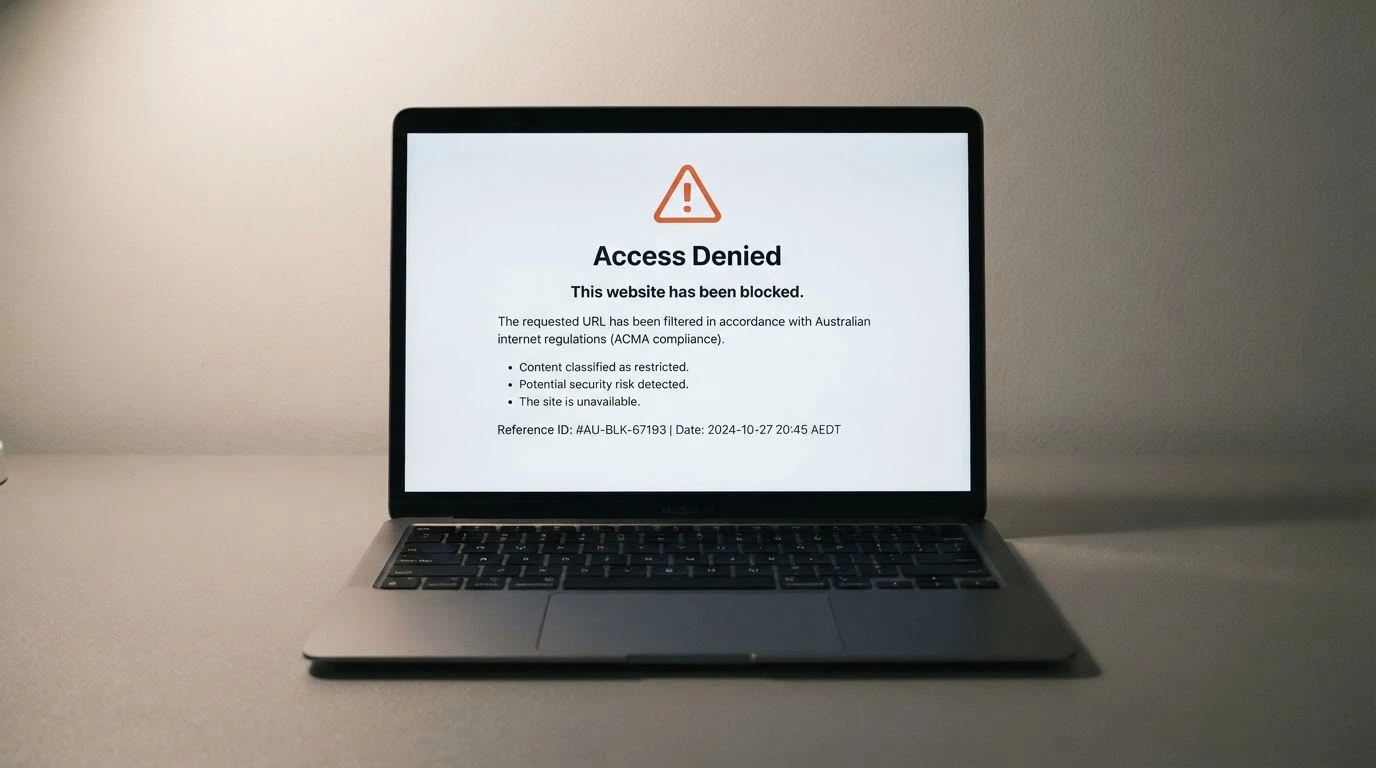
The player is not prosecuted. The IGA targets the provider. Australians using an offshore casino are not breaking the law themselves — but they have no Australian consumer protection. There is no ACMA complaints body for a withheld payout. There is no Australian regulator to escalate to if the operator closes the account and keeps the balance. The site can be DNS-blocked at any time, and the ACMA has ordered Australian ISPs to block 1,564 illegal gambling and affiliate websites since November 2019. More than 225 illegal services have withdrawn from the Australian market since enforcement was strengthened in 2017.
Offshore vs Licensed: The Two Worlds Australian Gamblers Navigate
The licensed Australian wagering market covers what is allowed under the IGA: pre-event race and sports betting, lotteries, keno. Operators like Sportsbet, TAB and bet365 hold Australian wagering licences and accept Australian players on those products. They are not online casinos. They do not offer pokies, blackjack, roulette or live dealer tables in the casino sense. They offer betting markets.
The offshore casino market covers what the licensed market does not: online pokies, live casino, table games, crash games and the rest of the casino catalogue. Every brand on the table earlier in this page operates in this market. None of them holds an Australian licence. None of them is connected to BetStop, the National Self-Exclusion Register, which has 67,480 registrations as at 31 July 2026 (41,290 still active; 78% of registrants under 40; 38% choosing lifetime exclusion). A player who has registered with BetStop can place a bet with a licensed AU wagering operator and be refused at the door; the same player can deposit at an offshore casino with no friction, because the operator is not bound by the register.
The practical difference comes down to three things: protection, recourse and payment rails. Licensed operators are required to honour consumer-protection law, offer an Australian complaints path and accept only the payment methods the IGA allows. Offshore operators offer none of those guarantees and accept payment methods (credit cards, crypto) that the licensed market is banned from taking. The faster rail and the bigger bonus at the offshore end of the market come packaged with the loss of every Australian protection mechanism.
What the 2026 Reform Changes — and What It Does Not
The Interactive Gambling Amendment (Gambling Reform) Bill 2026 passed Parliament on 19 August 2026 and its measures commence 1 January 2027. The reform tightens advertising and gives banks new powers, but it does not legalise online casino and it does not touch the offshore operators Australians already use.
From 1 January 2027, banks and payment providers gain express authority to block transactions to illegal gambling operators. The reform also caps wagering advertising at three ads per hour between 6:00 am and 8:30 pm, imposes a live-sport blackout from fifteen minutes before a live event until five minutes after it ends, bars athletes, celebrities and influencers from promoting wagering products, and bans direct marketing of inducements for fourteen days after sign-up and for three months after a person deregisters from BetStop. None of these provisions legalises online casino. None of them creates a new consumer-protection route for players using offshore brands.
The bank-blocking provision is the one with the most direct impact on offshore casino users. A bank can refuse to process a transaction to an illegal operator. That does not put the player at legal risk — the IGA still targets the provider — but it does mean a deposit or withdrawal that was working in 2026 may stop working in 2027. The brands on this list that accept PayID or bank transfer from major Australian banks are exposed to that change; brands that run on crypto rails are less exposed at the bank level, though they remain exposed at every other level.
Staying in Control: Responsible Gambling Tools That Actually Work
The numbers behind gambling harm in Australia are not abstract. Australians lost approximately A$32.2 billion on legal forms of gambling in 2023–24, which is the highest per-capita loss in the world at roughly A$1,521 per person. About 2.1% of Australian adults — around 430,000 people — experience problem gambling; the Australian Institute of Health and Welfare put high-risk gambling at 1.8% in 2022. Risky gambling increased from 13.7% in 2024 to 19.4% in 2025, by more than five percentage points. Approximately 5.9% of Australian adults reported being harmed by another person’s gambling in the past twelve months.

The offshore casino market sits outside the Australian responsible-gambling infrastructure. BetStop — the National Self-Exclusion Register, live since August 2023 — binds Australian-licensed wagering services only. Offshore casinos are not connected to the register and will keep taking deposits from a self-excluded Australian player. The credit-card and crypto ban for licensed wagering (in force since 11 June 2024) does not apply offshore. The advertising restrictions in the 2026 reform do not apply to operators that are not licensed in Australia in the first place.
What does work is the player’s own setup, applied before the first deposit. Customer-set deposit limits, time limits, reality-check prompts and self-exclusion functions exist at most offshore casinos — though the operator is not bound by them in the same way a licensed Australian wagering service is, and may not enforce them aggressively. The hard tool is the bank: a player who sets a weekly transfer limit at their own bank is bound by it regardless of what the casino does on its end.
The Tools That Keep You in Charge
Deposit limits are the first tool to set. Most offshore casinos allow a daily, weekly or monthly cap on deposits, and the limit should be set at account creation rather than after a losing session. A deposit limit that gets raised on request from the casino’s customer-support team is not a real limit; a limit that holds without a 24-hour cooling-off period is the version that does what it says.
Time limits and reality-check prompts sit alongside deposit limits. A reality check that flashes every thirty minutes with a running total of session time and net position is a small interruption that prevents the deeper end of a losing streak. A session-time limit that auto-logs the player out is more aggressive and works for the players who can stick to it.
Self-exclusion at an offshore casino is a request to the operator, not a registration with a regulator. A player who excludes at the casino level is asking the operator to refuse further deposits; the operator may honour the request or may not, and there is no Australian register to enforce it. The effective self-exclusion is at the bank (a transfer block on gambling merchants) and at BetStop (a registration that binds every Australian-licensed wagering operator). The combination covers most of the AU-licensed market; it does not cover offshore casinos, which is the gap a player needs to understand.
Where to Get Help in Australia Right Now
The National Gambling Helpline is 1800 858 858. It is free, confidential and staffed 24 hours a day, 7 days a week. The same number works across the country. Online chat and counselling are available through Gambling Help Online at gamblinghelponline.org.au, and additional support is available through Gambler’s Help, Lifeline on 13 11 14, and Healthdirect’s gambling-addiction resources.
BetStop registration is at betstop.gov.au. One registration excludes a person from every Australian-licensed online and phone wagering service — roughly 150 providers — for a minimum of three months and up to a lifetime. The limitation, set out in the section on the prohibition, is that offshore casinos are not bound by BetStop. A registration at BetStop is still worth doing because it covers the licensed market completely and removes the friction of registering with each operator individually.
Cashing Out on the Go: Mobile Withdrawals
Every casino on this page works on a phone browser. The mobile web experience covers deposits, play and withdrawals end to end. Native apps are uncommon for offshore operators targeting Australia — the App Store and Google Play restrict real-money gambling apps by region, and most offshore brands are not in the Australian app listings — so the browser is the default and the apps that exist tend to be web wrappers rather than native builds.
The withdrawal workflow on mobile is identical to desktop. The cashier page lists the same methods, the same minimums, the same caps and the same per-method settlement windows. KYC verification happens in the browser: ID upload, proof of address, sometimes a selfie check. The processing pipeline does not differentiate by device. A player who has cleared KYC on desktop and then logs in on mobile does not re-verify; the approval either runs automated or sits in the manual queue regardless of the device that originated the request.
The same method-speed hierarchy applies. Crypto and PayID lead on mobile as on desktop. Cards and bank transfers run the same slow lane. A player withdrawing a balance from a phone on a PayID-accepting casino with automated approval is looking at minutes, not hours, on a working day.
How to Pick an Easy-Withdrawal Casino You Can Trust
The decision framework below distils every section above into five checks a player should make before depositing a dollar. None of them are optional.
Payout-speed evidence. A real test from a third-party source is worth more than a marketing line. Betsquare tested more than fifty sites to produce their fastest-payout list for Australians, and at least one brand was verified end-to-end on a Big Bass Bonanza deposit-and-withdrawal test that cleared in one hour eighteen minutes. Casino marketing pages claim “instant withdrawal”; the test data tells the reader whether the claim holds.
Method availability that matches the player’s bank. A casino with a published PayID option and an automated approval pipeline is a different proposition from a casino that accepts only crypto and processes manually. The match between the casino’s published methods and the player’s actual bank account decides what the fastest realistic option is.
Withdrawal caps that do not trap a big win. A A$10,000 weekly cap splits a five-figure payout across two weeks. A A$2,000 cashout cap on a bonus voids three thousand dollars of a five-thousand-dollar win. The cap and the bonus ceiling should both be read before the deposit, not after the win.
KYC readiness. Incomplete KYC is the number one cause of withdrawal delays. A player who has ID, proof of address and any other documentation the casino asks for ready at signup clears the verification step in one pass. A player who uploads a partial document set and waits to be asked for the rest burns three to seven days on a withdrawal that should have been hours.
Cross-reference to the legal reality. Every brand on this page is offshore and unlicensed in Australia. A player who accepts that — including the absence of Australian consumer protection and the absence of BetStop coverage — is making the choice the section on the prohibition describes. A player who does not accept it should not be depositing at an offshore casino at all.
Red Flags That Signal a Withdrawal Headache
A casino that does not publish withdrawal timeframes or caps is the first red flag. If the cashier page does not list per-method settlement windows or the terms page does not state weekly and monthly caps, the player is being asked to deposit on faith. Faith is not a withdrawal method.
Bonus terms that hide behind a login wall are the second. A welcome offer with the headline on the homepage and the wagering multiplier, the per-spin cap, the game contribution weighting and the cashout ceiling hidden behind an account registration is an offer that depends on the player not reading it. The casino benefits from the unread terms; the player does not.
Vague payout claims are the third. “Instant withdrawals” with no method-specific data, “fast payouts” with no per-rail settlement window, “same-day cashout” with no explanation of which methods qualify — these are marketing lines that cover every case from genuinely fast to “we’ll get to it.” A player comparing two casinos can rule out the vague one by asking a single question: which methods, how fast, what’s the cap.
The fourth is a brand that dodges KYC questions. Incomplete KYC is the number one cause of withdrawal delays; a casino that does not publish a clear list of required documents, or that asks for additional verification on every withdrawal without explanation, is signalling that the verification step will be a friction point. The ACMA’s Q4 2025 enforcement data recorded 483 enquiries and complaints investigated, 69 IGA breaches found, 10 formal warnings issued and 133 matters referred for enforcement action. A brand on the wrong end of that list is one a player should not be depositing with.
The fifth is the absence of crypto or PayID support in 2026 at an Australian-facing offshore casino. Both rails are widely available in this market. A casino that does not offer either is signalling either an outdated banking integration or an operator that has chosen not to support the fastest methods Australian players use. Neither is a positive signal.
How We Evaluated Every Casino on This Page
The ranking and the comparison table at the top of this page are built from the operator’s own terms pages, third-party payout tests from CardPlayer and Betsquare, ACMA public enforcement data, the Interactive Gambling Act 2001 (as amended) and Australian regulator publications. Operator-specific withdrawal data came from each operator’s published cashier or terms page; where the operator did not publish a number, that gap is marked in the prose rather than filled with a guess.
The criteria, in order of weight applied to the ranking, were: withdrawal speed by method, withdrawal caps and minimums, method availability for Australian players, transparency of bonus terms, and provider quality and RTP publishing. The ranking is by withdrawal experience across those criteria, not by bonus size or game count. No weightings or percentages were assigned; the ranking reflects the editorial judgement that a fast, transparent payout is worth more than a larger welcome headline with tighter conditions underneath.
The evaluation basis included a check against the IGA prohibition and ACMA enforcement data. No operator on this page holds an AU licence, and that is stated on the table and reiterated in the section on the prohibition. The seven operators in the data-light cluster (WinSpirit, Stake, Rainbet, Scream Casino, FairGO, Bizzo Casino and Rocket Casino) were included because they appear in AU-facing round-ups and accept Australian players; the gap in their published data is flagged in each write-up rather than papered over.
Your Money, Your Next Move
The page has given the reader the numbers, the methods and the legal reality. The decision is theirs.
The core takeaway is the order of priority. Withdrawal ease is the first filter, not the second. A casino that takes fourteen working days to clear a withdrawal, or that voids half a bonus win on a cashout cap, is worse than a casino with a smaller welcome bonus and a cleaner payout. The published method, the published speed and the published caps should be read before any deposit, not after any win.
The legal reality is plain. Every brand on this page is offshore, unlicensed in Australia and outside BetStop. Using one means no Australian consumer protection, no ACMA complaints body and no recourse if the operator refuses a payout or closes the account. The 2026 reform gives banks new blocking powers from January 2027 but does not legalise online casino. The credit-card and crypto payment ban for licensed wagering is itself a tell: a casino accepting either from an Australian player is operating outside Australian rules.
The practical checklist is short. Read the cashier page and verify KYC requirements before depositing. Read the bonus terms and look for the wagering multiplier, the per-spin cap, the contribution weighting and the cashout ceiling. Set a deposit limit at account creation and consider a bank-level transfer block on gambling merchants. If the player is in a position where any of this feels uncomfortable, the National Gambling Helpline is 1800 858 858, free, confidential and staffed 24/7.
No operator is recommended to the reader. The choice between RocketPlay, SkyCrown, Royal Reels and the seven data-light brands is a choice between ceiling, catalogue, method flexibility and published transparency. The reader’s own method and cap priorities decide which matters most.
Frequently Asked Questions
What happens to my money if an offshore casino site gets blocked in Australia?
The site can be DNS-blocked at any time by order of the ACMA; more than 1,564 illegal gambling and affiliate websites have been blocked since November 2019. Blocking does not refund balances, does not close accounts at the operator and does not give the player an Australian complaints path. A player with a balance on a blocked site has the same recourse they had before the block — the operator’s own customer support and the payment rail they deposited through.
Is crypto safe to use for casino withdrawals in Australia?
Crypto is the fastest withdrawal rail at offshore casinos — USDT on TRC20 and Solana settle in under five minutes in third-party tests — but it is banned for licensed Australian wagering from 11 June 2024. A casino accepting crypto from an Australian player is by construction outside the Australian rules, with all the protection gaps that implies. The player is not prosecuted for using it, but there is no Australian regulator to escalate to if the payout is withheld.
Why does KYC verification delay my casino withdrawal?
Incomplete KYC is the number one cause of withdrawal delays at online casinos. Operators are required to verify the player’s identity before processing a withdrawal, and a partial document set triggers a back-and-forth that adds days. Uploading ID, proof of address and any other required documents at signup — rather than on first withdrawal — clears the verification step in one pass.
Do I have to pay tax on casino winnings in Australia?
Betting and gambling winnings are not assessable income under section 6-5 of the ITAA 1997, and losses are not deductible, unless the person is carrying on a business of betting or gambling (ATO criteria in IT 2655). No Australian case has held the winnings of an ordinary punter assessable. Offshore casino winnings fall under the same general rule. Professional-level play is a separate question, and a tax adviser is the right answer for any player whose activity crosses into business scale.
How quickly does PayID actually land in my bank account?
A PayID transfer settles on Australia’s New Payments Platform in under sixty seconds once the casino approves the withdrawal. The bottleneck is the casino’s approval, not the rail. At a casino with automated approval, PayID lands in minutes; at a casino with manual review, the approval itself can take two to twenty-four hours on a first withdrawal, after which the rail settles instantly.