
Live baccarat for Australian players: how it actually works in 2026
A live baccarat online casino in 2026 is, for an Australian player, an offshore operation. No Australian licence exists for online casino games — not federally, not in any state or territory — so every brand an Australian can reach for a streamed baccarat hand runs from Curaçao, Malta, Anjouan or somewhere quieter still. This page ranks the ten offshore operators most Australian players encounter, walks through the rules and the variants that change the math, names the bonus terms that catch table-game players out, and lays out what the Interactive Gambling Act 2001 actually says about the activity. It is a comparison of what each operator delivers — and what each one costs the person who sits down at the table.
Information current as of 24 November 2026, checked against the ACMA’s blocked-list register and the published terms pages of the operators named.
Table of Contents
- A live baccarat online casino is not the same as walking onto a gaming floor
- Why live dealer baccarat beats a computer dealing cards
- Australia’s live baccarat sites ranked: what each offshore operator actually delivers
- The law Australian live baccarat sites never mention — and why it matters
- How baccarat works: why the banker bet wins more often than you think
- The baccarat table, its variants and what changes the odds
- Why your live baccarat bonus is smaller than it looks
- Getting paid: why your baccarat withdrawal takes longer than your deposit
- Real-money play vs free baccarat: what the demo hides
- Live baccarat on mobile: the same table, a smaller screen
- How we selected and ranked these live baccarat sites
- So should you play live baccarat at an offshore casino? The honest answer
- Frequently asked questions about live baccarat in Australia
A live baccarat online casino is not the same as walking onto a gaming floor
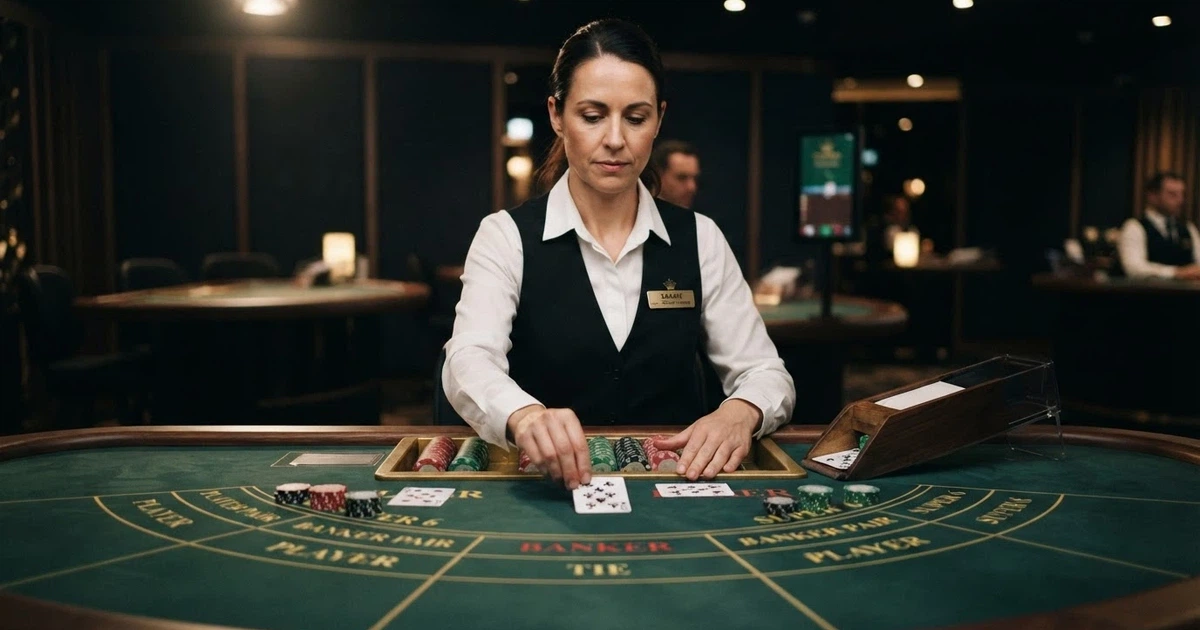
Baccarat is one of the older card games still dealt in a casino, and in a physical venue the table is unmistakable: a green felt, three betting areas, a dealer in a waistcoat pulling cards from a wooden shoe. Online, the game keeps the same shape but loses the room. The player is no longer part of a crowd watching a dealer in real time. They are alone in front of a screen, betting on outcomes decided by a software random number generator or by a camera trained on a dealer in a studio somewhere else in the world. That second format is what the industry calls live dealer baccarat, and it is the format every Australian-facing operator now leads with.
The change matters more than it looks. A computer-dealt hand runs through an RNG that has been tested and certified by a third-party lab, and a curious player can read the published return-to-player percentage to four decimal places. A live dealer hand runs through a physical shoe, with cards drawn in front of a camera and a results panel that updates in real time. The published RTP is the same — the math is the math — but the experience of watching cards come out of a shoe is not the same as the experience of watching a server tell you a hand has been resolved. Most Australian-facing operators have decided, with their budgets, which experience they expect their players to want. They have invested in the live studios, not the RNG tables.
For the player, the practical consequence is straightforward: live dealer baccarat is now the default online format, and the discussion of “online baccarat” in 2026 is mostly a discussion of live baccarat. The computer-dealt version still exists, and some operators carry it as a low-overhead backup, but the comparison page readers actually want is between two live lobbies — or between the lobby of one operator and the lobby of another.
What baccarat actually is — the three-bet card game
Baccarat is, at heart, a guessing game with three options. The player bets on the Banker hand, on the Player hand, or on a Tie — the two hands are dealt according to fixed drawing rules, the closer one to nine wins, and the house pays out accordingly. That is the whole of it. There is no decision to make after the bet is placed. The player does not draw, hit, stand or split. The dealer — or the software — does it all.
What makes the game worth understanding is the math. The Banker bet wins 50.68% of non-tie hands and pays 0.95 to 1 after a 5% commission is taken; its return to player is 98.94%, the highest of any standard wager on the felt. The Player bet wins 49.32% of non-tie hands and pays 1 to 1 with no commission, for a return of 98.76%. The Tie bet pays 8 to 1 or 9 to 1 depending on the table, but its return sits in the mid-80s — a house edge of more than 14% in most variants. The Banker bet is not glamorous. It is the bet a person makes when they want the lowest house edge the casino offers.
That is the rules primer and the only one the reader needs. The drawing table — when the Player stands on 6 or 7, when the Banker takes a third card, the edge cases at totals of 5 and 6 — is a curiosity, not a strategy. The fixed rules mean the Player and Banker hands are decided by the dealer’s hand, not the player’s choices. Every system ever sold to a baccarat player — every progression, every pattern, every “follow the shoe” — is operating on the only variable a player can actually move: how much they bet, on which of three outcomes.
Why live dealer baccarat beats a computer dealing cards
Live dealer baccarat is the standard for Australian-facing play in 2026 because it solves two problems at once: trust and presentation. A streamed table with a real dealer and a real shoe answers the question every sceptical online player eventually asks — is this hand really random? — by showing the hand being dealt. The card leaves the shoe, the camera watches it, the screen resolves. The player who wants to count cards in real time can. The player who just wants to see the hand being resolved can too. The marketing word for this is “transparency”. The honest word is “reassurance”, and reassurance is what most people want when real money sits behind a chip stack on the screen.
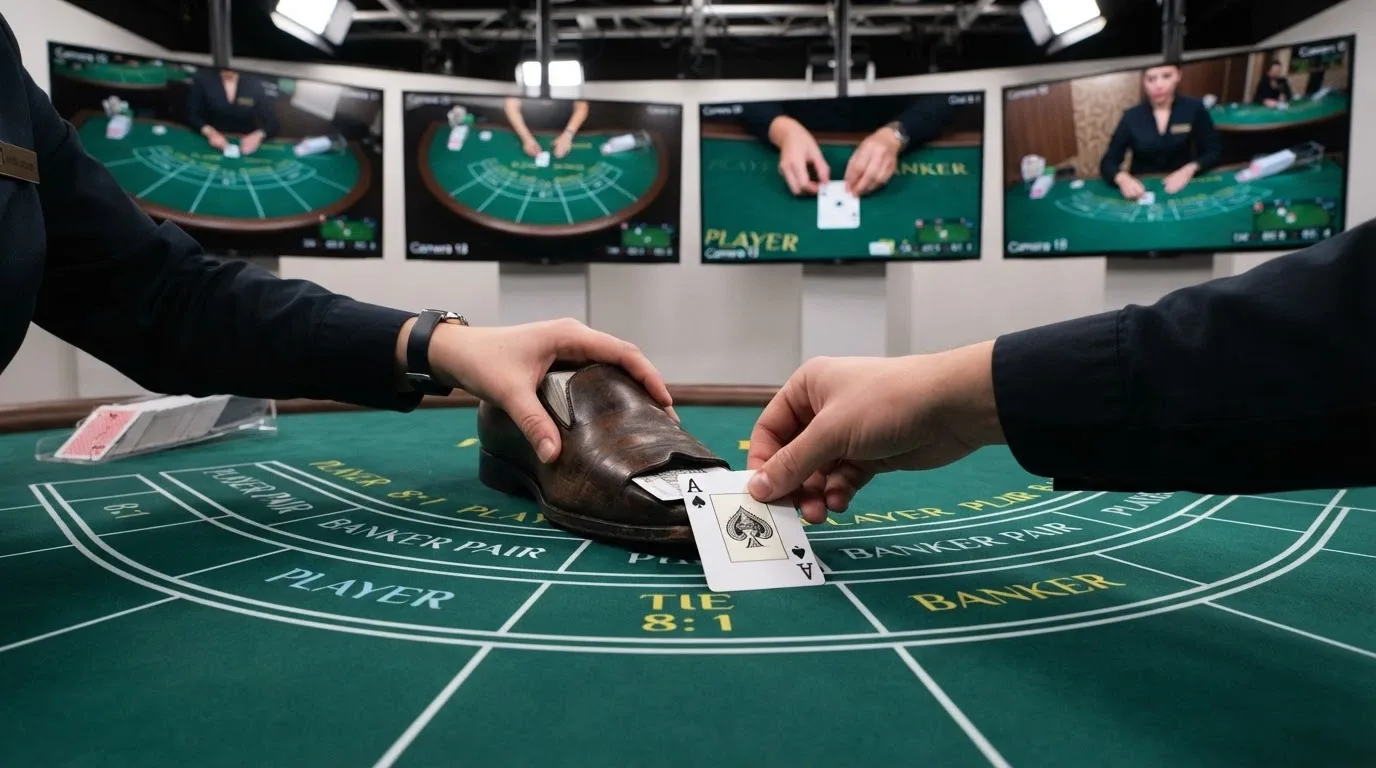
The competing format is RNG baccarat: software generates a hand, the result appears, the next bet is offered. It is faster, often cheaper to operate, and certified by the same testing labs that certify slot games. Most players who try both prefer the live version for the reasons above, and the operators that matter to Australian players have built their live dealer lobbies accordingly. A live dealer lobby at one of the larger offshore brands will carry hundreds of tables from multiple studios — Evolution Gaming, Pragmatic Play Live, Lucky Streak, Platipus Live, Winfinity, ICONIC21 — each one streaming from a physical studio with multiple camera angles, on-screen statistics and a chat box the dealer can read.
The result is a product that looks and feels closer to the casino floor than any computer-dealt game ever has, and that is exactly the comparison the operators want the player to make. The Australian-facing market has, in effect, voted with its screen time. Live is where the product lives.
What “live” actually means: a real dealer, a real table, a real shoe
A live baccarat table is a physical table in a studio, run by a real dealer, dealing real cards from an eight-deck shoe. Multiple cameras cover the action — usually a wide shot of the table, an overhead shot of the layout, and a close-up of the shoe for the draw — and the stream is fed to the player’s browser or app in real time. There is no pause button on the dealing. The hand takes the time a hand takes.
The shoe itself is a piece of equipment the operator takes seriously. Eight standard decks are shuffled and loaded before play begins, and the shoe is replaced (or the cards re-shuffled) at intervals that vary by studio. The cards are dealt face up on the felt according to the fixed drawing rules. The Player and Banker hands resolve, the losing bets are cleared, the winners are paid, and the next round begins. The dealer handles the pace, calls the result, and chats with the players who type into the table’s chat box. The player chooses the bet size, places the chip, and watches the result.
The on-screen overlay carries what the felt cannot. Each table shows a statistics panel — recent results, often formatted as the bead plate and big road that baccarat players have used for decades — and a real-time bet distribution that shows what percentage of the table is on Banker, Player or Tie right now. Side bets are visible too: Player Pair, Banker Pair, Perfect Pair, Either Pair, Player Bonus, Banker Bonus, plus the variants’ own proposition bets (Lightning multipliers, Mega multipliers, Golden Wealth multipliers). The point is not that these features change the math. The point is that the player can see everything the table is doing, in real time, on the same screen.
Live baccarat table limits: from spare change to VIP rooms
The stake spread on live baccarat runs from A$0.10 at the standard tables to A$25,000-plus at the VIP rooms, and the gap says more about the market than the marketing does. The bottom of the range exists because the studios want casual players at the table — a player who might bet a dollar a hand and stay for an hour is exactly the kind of player a live casino is built to entertain. The top of the range exists because high-roller play is where the studio’s cut is largest: VIP rooms in private studios accept wagers of A$50,000 and above, and the operators with the deepest lobbies run fifty or more concurrent tables, including dedicated Aussie-hosted games scheduled for AEST evenings.
The practical upshot for an Australian player is choice. A punter who wants to play a hundred hands at twenty cents each can. A punter who wants to sit at a private room and put ten thousand dollars on the next Banker hand can do that too — usually at a different operator. The cluster of brands that reaches Australian players splits roughly along stake size: the mainstream offshore brands carry Evolution Gaming and Pragmatic Play Live tables that range from A$0.10 to A$25,000, and a smaller set of high-roller-focused brands carry private-room tables that go higher still. Most readers fall into the first group, and the table spread at the mainstream brands is what matters for them.
Live baccarat vs standard online baccarat: what the RNG version hides
RNG baccarat is mechanically identical to the live version: the same drawing rules, the same bet types, the same RTP figures on each wager. The difference is what the player sees. The RNG version resolves in roughly a second, displays the result, and offers the next bet. There is no shoe to watch, no dealer to read, no chat to type into. For a player who already trusts the platform, that is a feature: faster rounds, fewer seconds between hands, more bets per minute. For a player who does not trust the platform, the RNG version leaves the original question unanswered — is this hand really random? — without any visual evidence to put beside it.
That is why Australian-facing casinos invest in live studios rather than RNG tables. The live product is not faster, not cheaper to operate, and not better-paying. It is more convincing, and in a market where the operator is unlicensed and the player is unprotected, convincing matters. The casino’s brand has to do the work the regulator’s licence would do in a different market, and a real dealer dealing real cards is a stronger brand asset than a certification report from a testing lab. The casino knows this. The player should know it too.
Australia’s live baccarat sites ranked: what each offshore operator actually delivers
The table below lists the ten offshore operators Australian players most commonly encounter when searching for live baccarat. Every brand named is unlicensed in Australia — online casino cannot be licensed in Australia — and the licence column shows what each one claims elsewhere. No row in this table represents an Australian-licensed brand, because no such brand offers online casino games.
| Operator | Live baccarat tables | Licence / regulatory status |
|---|---|---|
| SkyCrown | 500+ (Evolution, Pragmatic Play Live, ICONIC21, Lucky Streak, Platipus Live, Winfinity) | Curaçao — offshore, no Australian licence |
| Stake | Evolution Gaming, Pragmatic Play Live | Curaçao — offshore, no Australian licence |
| Rocket Play | Evolution Gaming, Pragmatic Play Live | Rocketplay.com.au on ACMA blocked list — offshore, no Australian licence |
| Royal Reels | — | Offshore, no Australian licence |
| WinSpirit | — | Offshore, no Australian licence |
| Rainbet | — | Offshore, no Australian licence |
| Scream Casino | — | Offshore, no Australian licence |
| Bizzo Casino | — | Offshore, no Australian licence |
| Rocket Casino | — | Offshore, no Australian licence |
| FairGO | None — live dealer games not offered | Curaçao sub-licence (Deckmedia N.V.) — offshore, no Australian licence |
The table’s biggest gap is honest. The plan behind this page could confirm live baccarat tables, providers, licences and bonus terms in detail for SkyCrown, FairGO and partially for Stake. For the other seven brands the confirmation stopped at “offshore, no Australian licence, runs an Australian-facing site”. That is the depth of what is publicly verifiable right now, and a reader deserves to see the gap rather than have it filled with something invented. The operator write-ups below carry what the table cannot — what each brand does well, what it costs the player, who it suits.
SkyCrown
SkyCrown is the live baccarat operator with the deepest table selection in the offshore Australian-facing market, and the depth shows in the lobby: more than five hundred live tables from five studios, including Evolution Gaming and Pragmatic Play Live at the top end and Lucky Streak, Platipus Live and Winfinity filling out the catalogue. Table limits run from A$0.10 at the standard tables to VIP-exclusive rooms above A$25,000 per hand, and the operator runs dedicated Australian-hosted tables during AEST evenings, which matters more than it sounds: an Australian player joining at 8 pm Sydney time is not playing at 4 am against a sleepy dealer in another time zone.
The bonus structure splits cleanly in two. The welcome package is up to A$8,000 plus four hundred free spins across four deposits, with forty-times wagering on deposit plus bonus — and live casino play does not contribute to that wagering. A baccarat player cannot clear it. The cashback offer, by contrast, was built for live play. Ten per cent weekly cashback on live casino losses, up to A$1,500, credited as real cash every Wednesday with zero wagering requirement, minimum qualifying loss A$150, minimum cashback A$15. The mechanism is the inverse of a welcome bonus: there is no wagering to clear because there is nothing to claim in advance, and the cashback reads as money the player has already lost rather than money the casino is offering.
The verdict is straightforward. SkyCrown suits the Australian live baccarat player who already knows what they want from an offshore operator — a wide table range, real providers, AUD denominated, and a bonus model that does not punish table-game play. The welcome bonus is not for baccarat players. The cashback is.
Stake
Stake is the crypto-native operator on the list, and its position in the live baccarat market is the position crypto-native operators usually occupy: the player deposits in Bitcoin, Ethereum or one of the other coins Stake supports, plays the same Evolution Gaming and Pragmatic Play Live tables the rest of the offshore market carries, and cashes out in the same crypto. The operator runs on a Curaçao licence and the welcome offer is not a conventional bonus — Stake typically runs a rakeback and lossback model rather than a matched deposit, which is the bonus shape that suits baccarat players for the reasons laid out in the bonus section below.
The verdict is conditional on the reader. For an Australian player who already holds crypto and wants a fast deposit and a fast withdrawal, Stake is the obvious fit among the offshore brands listed here. For an Australian player who does not hold crypto, Stake is harder to use than a PayID-friendly brand and offers no live-baccarat-specific advantage. The crypto context also matters for the regulatory section: crypto is a banned payment method for online wagering in Australia, and that ban says something about an operator’s relationship to the Australian regulatory system.
Rocket Play
Rocket Play is in the ranking because Australian players encounter it, and because Rocketplay.com.au sits on the ACMA’s blocked list of prohibited interactive gambling services. The blocked list is the regulator’s clearest signal that a domain is being treated as an illegal gambling service under the Interactive Gambling Act 2001, and a domain on the list can be shut off at the DNS level at any time. A player with a balance in their Rocket Play account when the block lands is a player with a balance they may not be able to withdraw.
The live baccarat offering at Rocket Play, what research was able to confirm, runs on Evolution Gaming and Pragmatic Play Live — the same studio pair that powers most of the offshore market. The licence, the welcome bonus and the wagering terms were not confirmed for this page, and the blocked-list status is the more important fact regardless. The verdict is one line: a domain the regulator has blocked is a domain a player should not be signing up to.
Royal Reels
Royal Reels presents to Australian players as an offshore brand with an Australian-facing site, and that is the depth of what research could confirm in this round. The live baccarat lobby, the licence under which the operator runs, the welcome offer and the wagering terms were not verified. The brand’s public-facing site shows live baccarat tables in its lobby, and a player who reaches the site will find the standard offshore product — but the specifics are not the kind of specifics this page can put a number on.
A reader who is choosing between Royal Reels and a confirmed operator like SkyCrown is choosing between a brand with verified terms and a brand without them, and the calculus favours the verified brand for the same reason any contract favours the contract with terms. The verdict is a caveat rather than a verdict: an offshore operator whose live baccarat offering the reader can see, but whose underlying licence and bonus terms this page could not verify.
WinSpirit
WinSpirit is another offshore brand with an Australian-facing site, and like Royal Reels the depth of what research could confirm stops at “offshore, no Australian licence, live baccarat tables visible on the site”. The brand positions itself in the offshore Australian market and runs the standard format. The specifics — licence jurisdiction, provider list, welcome bonus, wagering — are not the specifics this page has numbers for.
The verdict here is transparent: the information confirmed for this page is limited to the offshore status and the lobby content, leaving the bonus and licence details unverified. This status is the primary factor for the reader to weigh before depositing.
Rainbet
Rainbet sits in the same bracket as Royal Reels and WinSpirit: an offshore brand with an Australian-facing site, a live baccarat offering visible on its public-facing lobby, and the specifics — licence, providers, bonus terms — not confirmed for this page. The reader who lands here from a search result and reads down to Rainbet will not find a number they did not already have, and that is the honest outcome of a research round that could not confirm the specifics.
Rainbet remains in the same unverified bracket, providing the same offshore experience without the confirmed details needed for comparison. A reader assessing this brand must weigh the lack of verified terms against the established transparency of fully confirmed operators.
Scream Casino
Scream Casino is the same shape as the previous three: offshore, Australian-facing, live baccarat in the lobby, and the underlying terms not confirmed. The page lists it because Australian players encounter it, not because research could confirm what sits behind the front end.
The verdict is the same caveat. A reader who arrived at this page from a Scream Casino affiliate link has been told where the brand sits in the offshore market; they have not been told whether the bonus terms, the licence jurisdiction or the provider list match the operators that could be confirmed.
Bizzo Casino
Bizzo Casino is another entry in the unconfirmed bracket: offshore, Australian-facing, live baccarat visible on the lobby, and the specifics — licence, providers, welcome bonus, wagering — not verified in this round. The brand’s positioning in the offshore market is its public-facing proposition, and that is what the page can pass on.
A reader who lands on Bizzo Casino from this ranking and finds a different offer to the one described here has not been misled by this page — the page describes what research could confirm, and what it could not.
Rocket Casino
Rocket Casino closes the unconfirmed cluster: offshore, Australian-facing, live baccarat in the lobby, licence and bonus terms not verified for this page. The brand is in the market and the page lists it for completeness; the specifics a reader would want before depositing are not on this page.
The verdict here is the same honest gap. This is a brand an Australian player can reach, and this is what the page could confirm about it. What sits beneath the lobby front end is not what the page is in a position to describe.
FairGO
FairGO is included because Australian players encounter it, and because it is the one operator in the ranking that does not offer live dealer games of any kind. FairGO runs on RTG (RealTime Gaming) software under a Curaçao sub-licence held by Deckmedia N.V., and its catalogue is pokies and table games without a live dealer section. There is no live baccarat lobby at FairGO because there is no live dealer lobby at all.
The welcome offer is the standard RTG-style structure: a hundred per cent match up to A$200 on each of the first five deposits, totalling up to A$1,000, with thirty-times wagering on deposit plus bonus and an A$10 maximum bet while the bonus is active. For a slots player that is a reasonable offer. For a baccarat player it is irrelevant, because the games the bonus is built around are not the games the player wants to play. The verdict is one the page makes cleanly: FairGO does not offer live baccarat, has never offered live baccarat, and a reader who arrived here looking for live baccarat should not sign up to FairGO expecting to find it.
The law Australian live baccarat sites never mention — and why it matters
Every site in the ranking above is offshore, and the reason every site is offshore is the Interactive Gambling Act 2001. The Act prohibits the provision of online casino games — including live baccarat, online pokies and any other casino-style game played for money over the internet — to a person in Australia. There is no federal licence for online casino and there is no state or territory licence either. The product the page is about cannot be legally offered in Australia, and every operator that offers it is breaking Australian law by offering it.
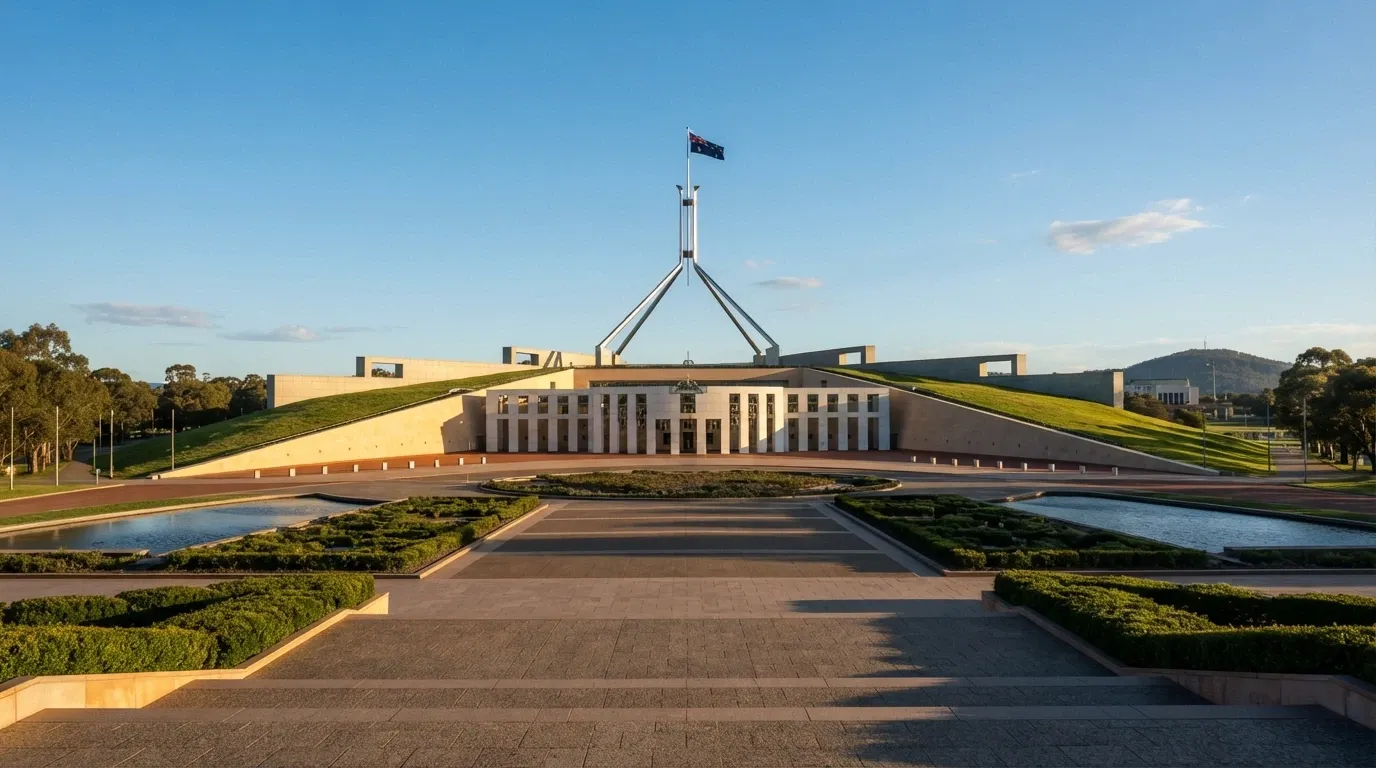
The enforcement is real, even if it has not reached a single individual player. The Australian Communications and Media Authority (ACMA) is the federal regulator that investigates complaints, issues formal warnings, commences civil penalty proceedings and directs Australian ISPs to block illegal sites. Since the first blocking request in November 2019, the ACMA has had 1,788 illegal gambling and affiliate websites blocked by Australian ISPs as of August 2026. Over 230 illegal gambling services have pulled out of the Australian market since the ACMA began enforcing the new rules in 2017. The blocked list was last updated on 10 July 2026.
None of that changes the most important point: the IGA targets the provider, not the individual player. Section 15 of the Act makes providing a prohibited interactive gambling service the offence. An Australian who plays at an offshore casino is not prosecuted. The legal exposure is the operator’s, not the player’s. That is what makes the offshore market possible, and that is what every offshore operator relies on when it accepts an Australian deposit.
What follows is not a defence of the offshore market. It is the legal picture an Australian player should hold in their head before they sign up: the product is prohibited, the provider is breaking the law by offering it, and the player is not prosecuted for using it. Each of those three facts is true, and each one is doing different work.
What the Interactive Gambling Act actually says about online baccarat
Section 15 of the Interactive Gambling Act 2001 prohibits the provision of a “regulated interactive gambling service” to a person in Australia, where a regulated service includes online casino games. The provision is the offence — supplying the service to an Australian customer — and the penalty regime runs from formal warnings through civil penalty proceedings to injunctions. The Act was substantially strengthened in 2017, when the Interactive Gambling Amendment Act 2017 closed the loophole that had allowed some offshore operators to argue their services were not “provided” in Australia.
What the Act does not prohibit is gambling that is licensed at the state or territory level. Wagering on races and sport placed before the event begins, lotteries and keno are all permitted and licensable, with the Northern Territory Racing and Wagering Commission (NTRWC) administered through Licensing NT operating as the de facto national licensor. Online sports betting at an Australian-licensed brand (Sportsbet, Bet365, Ladbrokes, TABtouch, PointsBet, Neds) is therefore legal. Live baccarat at any of those same brands is not, because none of them offers online casino games. The minimum age for any commercial gambling activity in Australia is 18.
The land-based casino licence is a separate point that the offshore operators like to blur. Crown Melbourne, The Star Sydney and the other state-licensed casinos exist and operate legally. They do not offer online casino games to Australians under that licence, because the licence does not cover online casino. Any offshore operator that points to “Australian casino heritage” or “operated by the same group as Crown” is selling a brand association that does not include an online casino licence, because no such licence exists.
What you lose when you play at an offshore baccarat site
The legal analysis above explains why the offshore market exists. The practical analysis explains what it costs the person using it. There are four concrete losses, and they stack.
First, BetStop — the National Self-Exclusion Register — does not reach offshore casinos. BetStop went live in August 2023, and one registration excludes a person from every Australian-licensed online and phone wagering service in a single step. As at 31 July 2026, 67,480 people had registered with BetStop, of whom 41,290 exclusions were still active; 78% of registrants were under 40 and 38% had chosen lifetime exclusion. None of those registrations reach an offshore casino. A self-excluded Australian who tries to enforce their own exclusion by closing every account can still deposit at Stake, WinSpirit or any of the other brands in this ranking, because the operator is not connected to the register.
Second, there is no Australian complaints body to recover money when an offshore operator refuses a withdrawal. The ACMA can investigate the operator and can direct an ISP to block the site, but neither action puts money back in a player’s account. The state and territory gambling regulators do not cover offshore operators. The operator’s own licensing regulator — typically Curaçao — sits behind a complaint process that runs in months rather than days and that resolves disputes on the operator’s home turf.
Third, the site itself can be blocked at any time, with a balance still on it. The ACMA’s blocked list, last updated 10 July 2026, is a live document; Rocketplay.com.au is already on it, and a domain can be added to the list with effect from the next ISP refresh. A player who holds a balance at a blocked domain has a balance at an address Australian ISPs will no longer route to. The withdrawal process the player would normally use may still work, depending on the operator’s payment stack, but the player has lost the easy route.
Fourth, the credit-card and crypto ban does not apply. Australian-licensed wagering operators have been banned from accepting credit cards, credit-related products and digital currency since 11 June 2024, under the Interactive Gambling Amendment (Credit and Other Measures) Act 2023. An offshore operator that accepts Bitcoin from an Australian player is signalling, by that single fact, that it is not connected to the Australian regulatory system. The crypto payment route is faster and more private than a bank transfer — that is why some players prefer it — and the same feature is exactly what makes the operator outside the regulator’s reach.
The 2026 gambling reform: what changes on 1 January 2027
The Interactive Gambling Amendment (Gambling Reform) Bill 2026 passed Parliament on 19 August 2026, and its measures commence on 1 January 2027. This is law with a start date — not a consultation paper, not a draft, not a “we are considering”. The reform is binding from 1 January 2027 onwards, and the major provisions that affect live baccarat players are these.
First, banks and payment providers gain express authority to block transactions to illegal gambling operators. A debit card transaction to a domain on the ACMA’s blocked list — or to any operator the bank identifies as an illegal gambling service — can be refused at the bank’s discretion, not just at the payment processor’s. The mechanism is designed to make the deposit route harder without making the player a criminal, and the practical effect is that a player who has been depositing easily today may find the deposit declined tomorrow.
Second, direct marketing of inducements is prohibited for fourteen days after a customer signs up, for three months after a customer deregisters from BetStop, and indefinitely for customers identified as at risk of gambling-related harm. An offshore casino that emails a “we miss you, here’s a bonus” message to a player three days after they closed their account is breaking the new rule from 1 January 2027 onwards, regardless of where the operator is incorporated.
Third, the penalty for an operator that fails to enforce the credit-card and crypto ban is up to A$247,500 per breach. The Interactive Gambling Amendment (Credit and Other Measures) Act 2023 took effect on 11 June 2024, and the penalty is the lever the regulator pulls when the ban is not enforced. For an offshore operator the penalty is largely theoretical — ACMA cannot fine a Curaçao company — but for an Australian-licensed operator it is the reason the deposit methods have been re-engineered.
Fourth, the wagering advertising rules tighten considerably. No more than three wagering ads per hour between 6 am and 8.30 pm; live-sport blackout fifteen minutes before to five minutes after the event; radio ads barred during school times; broadcasting sporting odds banned; online ads only to logged-in, age-verified users with opt-out; no ads inside sports venues or on player uniforms; athletes, celebrities and influencers barred from promoting wagering products. The ad rules apply to licensed Australian wagering operators, not to offshore casinos — the offshore casinos were already advertising illegally — but the public-facing volume of wagering ads in Australian media is the metric that will visibly change from 1 January 2027 onwards.
Problem gambling in Australia: the numbers behind the screen
The responsible-gambling content on this page is not optional. The same dataset that justifies writing about live baccarat also justifies writing about what live baccarat can do to the people who play it.
Roy Morgan Research, in the August 2025 release covering July 2024 to June 2025, estimated 622,000 Australian adults as “problem gamblers” — 2.9% of the adult population, up 111,000 or 22% year-on-year. The incidence rate has climbed across three years: 1.9% in 2022-23, 2.4% in 2023-24, 2.9% in 2024-25. The Australian Institute of Health and Welfare had earlier put the figure at 2.1% of adults (about 430,000 people) in 2022. The headline number is moving in the wrong direction.
The ANUpoll survey from the POLIS Centre at the Australian National University, January 2025 (n=3,387), found overall gambling participation had declined to 58.8% of adults, but risky gambling as measured by the Problem Gambling Severity Index had increased from 13.7% in 2024 to 19.4% in 2025. Online gambling accounted for 56.1% of individuals who had gambled in the past twelve months, with sports and race betting the most online-heavy activities. The picture is fewer Australians gambling, more of those who do gambling in ways the clinical screen flags as risky.
The harm extends past the gambler. A model-based estimate published in the Journal of Gambling Studies in 2026 put the number of Australians affected by another person’s gambling at approximately 1.66 million, including 280,000 children aged 5 to 17. The POLIS survey put the share of adults reporting harm from another person’s gambling in the past twelve months at 5.9%. The person with the live baccarat problem is not always the only person paying for it.
The help infrastructure exists, and a reader who is reading this page and recognising their own situation in any of the figures above should know what is available before they deposit another dollar. The National Gambling Helpline is 1800 858 858 — free, confidential, staffed twenty-four hours a day. Gambling Help Online, at gamblinghelponline.org.au, offers live chat and counselling. BetStop, the National Self-Exclusion Register, is at betstop.gov.au and binds every Australian-licensed wagering service in a single registration — note, again, that BetStop does not reach offshore casinos. The limitation matters: a player who self-excludes today has closed the door at Australian-licensed brands, and the offshore brands remain open unless the player closes those accounts themselves.
How baccarat works: why the banker bet wins more often than you think
The rules of baccarat are short. The house deals two hands — one called Player, one called Banker — and each hand receives two or three cards according to a fixed drawing table. The hand closest to nine wins, with face cards counting as zero and aces counting as one. The player bets on which hand wins, or on a tie. There is no decision to make after the bet is placed.
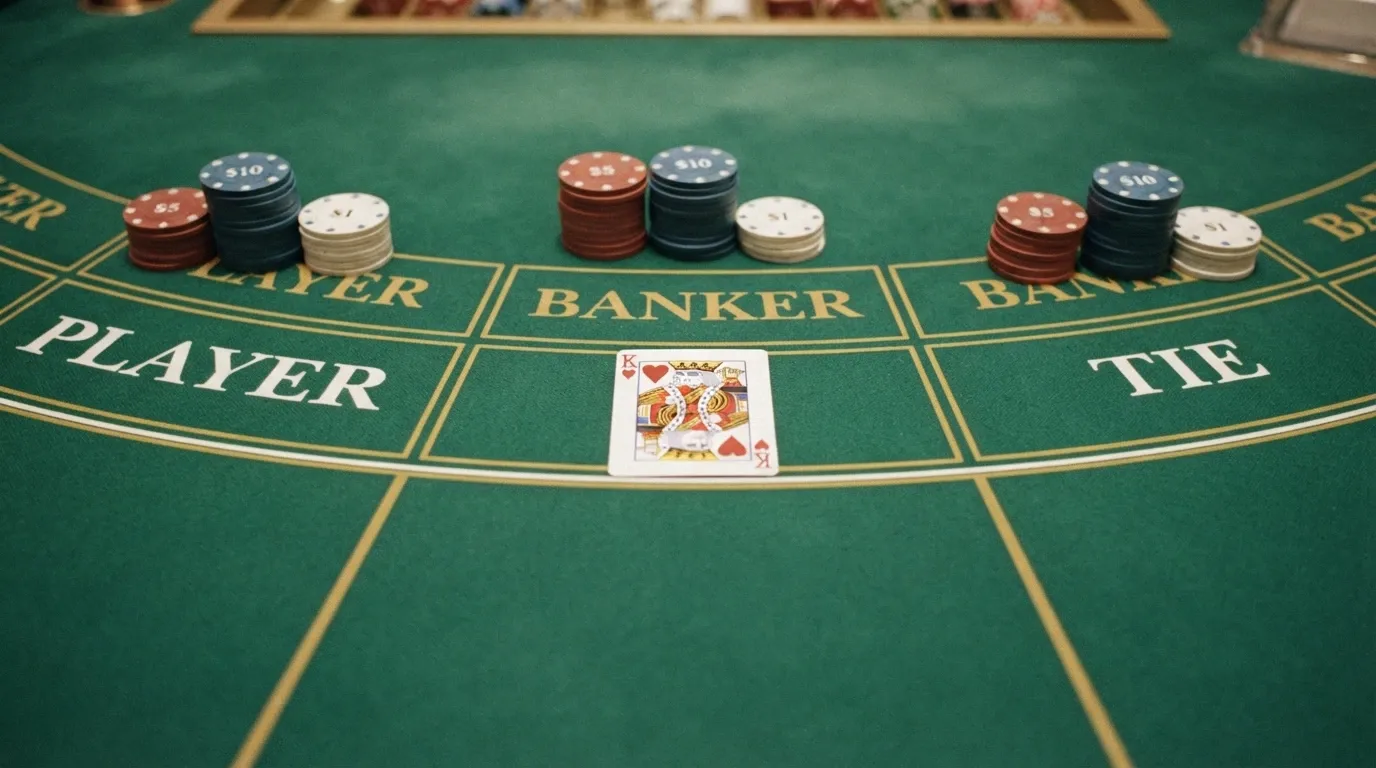
What matters is the math under the rules. The Banker bet wins 50.68% of non-tie hands; the Player bet wins 49.32%. The 5% commission the house takes on Banker wins is the cost of the better probability, and after the commission the Banker bet returns 98.94% of every dollar wagered over the long run. The Player bet returns 98.76%, with no commission but a lower win rate. The Tie bet pays 8 or 9 to 1, returns around 85%, and is a worse proposition than either main bet by a margin that no payout structure closes.
That is the entire rules primer a baccarat player needs. The drawing table — when the Player draws a third card, when the Banker does, the edge cases at totals of 5 and 6 — is fixed. It does not depend on the player’s choice. Every “system” ever offered to a baccarat player is acting on the only variable the player actually controls: how much they bet, on which of three outcomes.
The three bets: banker, player and the tie you should almost never take
The Banker bet is the mathematically strongest position on the felt. It wins more often than it loses, and the 5% commission on wins is the price of that edge. The expected return per A$100 wagered on Banker, over many hands, is A$98.94. A$1.06 per A$100 stays with the house. That is the lowest house edge of any standard bet at the table.
The Player bet pays even money with no commission, and the trade-off is the lower win probability. The expected return per A$100 wagered on Player is A$98.76. The difference between Banker and Player is small in absolute terms — A$0.18 per A$100 over the long run — but it is consistent, and a player who sits at a table for two hundred hands has paid for the difference in commission they did not bother to save. The Player bet is the bet for someone who refuses to pay commission on principle. The math does not agree with the principle.
The Tie bet is the bet a person stops making once they see the return. At 8-to-1 the Tie bet returns about 85.6%, depending on the variant; at 9-to-1 it returns closer to 89%, but most tables pay 8-to-1 on tie and 9-to-1 on specific tie outcomes. Either way the house edge is north of 14%. A player who bets A$10 on Tie once per hundred hands, at a table running five hundred hands an hour, is donating more than A$5 an hour to the house on those bets alone. The Tie bet is the bet the table is built to collect.
No Commission Baccarat is the variant that flips the commission structure: the Banker bet pays 1 to 1 instead of 0.95 to 1, except when the Banker wins with a total of 6, in which case it pays 0.5 to 1. The return to player stays at 98.94%, the same as standard baccarat. The difference is the player does not have to track commission owed at the end of a session — the dealer or the software settles it hand by hand. A player who finds the commission awkward prefers this variant; a player who likes to know their exact expected return on a single hand prefers the standard version.
Baccarat strategy: why there is no system that beats the house edge
Every betting system sold to a baccarat player — Martingale, Fibonacci, Labouchere, “follow the shoe”, “bet the streak” — is a system that acts on stake size, not on outcome probability. Each hand at the table is independent. The Banker bet has a 50.68% chance of winning on hand one, and the same 50.68% chance on hand one hundred. The shoe does not “owe” a Player win because the Banker has won the last five. The felt does not know what happened on the last hand.
That is the gambler’s fallacy, and it is the fallacy every pattern-recognition system on the scoreboard is built to exploit. The scoreboard shows the last twenty or thirty results as a sequence of red and blue circles, and the player’s eye finds patterns the math does not support. The casino knows this. The scoreboard is on the screen because the casino wants the player to bet on the next hand based on what the last hand did, and the math says the next hand does not care.
What bankroll management actually does, for a baccarat player, is limit how badly the session can end. A player who sits down with A$500, decides to bet A$5 a hand, and stops after losing A$200 has a session that costs them at most A$200. A player who decides to chase losses with a Martingale progression has a session that can cost them the entire stake in seven or eight bad hands — and bad hands come in clusters, because random sequences are not “fair” over short windows. The Martingale does not beat the house edge. It concentrates the variance into larger bets, and the variance is what the player cannot afford.
The right strategy for baccarat is the boring one: bet the Banker because the math favours it, decide your stake per hand before you sit down, decide your stop-loss before you sit down, and stop when you reach either number. The table will not reward a clever system. It will reward a player who knows what the system is worth and acts accordingly.
The baccarat table, its variants and what changes the odds
The standard live baccarat table is a green felt with three marked areas — Player, Banker, Tie — and a side-bet panel for the proposition wagers. The dealer stands behind the shoe, deals the cards face up according to the fixed drawing table, and the round resolves in roughly thirty to forty seconds. The studio overlays the layout with statistics from previous hands, the bet distribution in real time, and the chat box the dealer can read. That is the table most players picture when they picture live baccarat, and the table most offshore operators carry at the bottom of their live lobby.

What changes between operators — and between tables at the same operator — is the variant. Speed Baccarat compresses the round to twenty-seven seconds. No Commission Baccarat removes the 5% commission on Banker wins and replaces it with a half-payout when the Banker wins on 6. Lightning Baccarat and the multiplier variants add random multipliers to winning hands and a fee on every stake to pay for them. Bac Bo replaces cards with dice. Each variant changes the math, the pace or the proposition, and the table below lays out how.
The live baccarat table: layout, shoe and the dealer’s role
The standard table seats an unlimited number of players at the same betting interface, with each player’s chips stacked in front of their own betting area on the screen. The dealer’s actions are the same actions a real-table dealer performs: shuffle (or have the shoe pre-loaded), deal one card to Player, one to Banker, a second to each, then follow the drawing table for any third card. The cameras cover the shoe and the felt from multiple angles; the player can usually toggle between a wide shot of the table and a close-up of the cards being drawn.
The shoe carries eight decks, and the shoe is the piece of equipment the player can see the dealer working with throughout the session. Some studios swap the shoe at intervals — every eight-deck load is roughly four hundred hands — and some studios re-shuffle between sessions. The deck count matters for the math: more decks mean a slightly higher house edge on the side bets, but no change to the main bet’s RTP. The side bets — Player Pair, Banker Pair, Perfect Pair, Either Pair, Player Bonus, Banker Bonus — are the bets the table is set up to encourage. They pay more than the main bets and they return less.
The dealer handles the social layer of the table. Players type into the chat box; the dealer reads and replies; the banter ranges from perfunctory to genuine depending on the studio. The dealer does not see the bets and cannot influence the hand. The shoe is the only thing that decides.
Speed, Squeeze, No Commission, Lightning: the variants that change the game
| Variant | RTP (Banker bet) | Key mechanic | Fee |
|---|---|---|---|
| Speed Baccarat | 98.94% | Rounds of approximately 27 seconds | — |
| No Commission Baccarat | 98.94% | Banker pays 1:1, except 0.5:1 on a winning Banker 6 | — |
| Lightning Baccarat | 98.76% | Random multipliers up to 512x on winning hands | 20% lightning fee |
| Golden Wealth Baccarat | 98.85% | Multipliers up to 262,144:1 on Tie | 20% fee |
| Mega Baccarat | 98.79% | Multipliers 2x–100x, max 800:1 on Tie | — |
| Prosperity Tree Baccarat | 98.89% | Multipliers up to 3,645:1 on Tie | 20% fee |
| Bac Bo | 97.85% | Dice-based variant, max 88x win | — |
| First Person Bac Bo | 98.87% | RNG version, low volatility, max 88x win | — |
The table’s headline is the RTP column. Speed Baccarat, No Commission Baccarat and the standard variant all return 98.94% on the Banker bet — the player who wants the lowest house edge and the fewest surprises sits at one of these tables. The multiplier variants sacrifice RTP for the chance at a big payout: Lightning Baccarat returns 98.76%, Mega Baccarat 98.79%, Golden Wealth Baccarat 98.85%, Prosperity Tree Baccarat 98.89%. The 20% fee on the multiplier tables is the cost of the random multiplier feature, and the player pays it on every stake whether or not the multiplier lands.
Lightning Baccarat is the variant the marketing leads with, and the marketing word is “random multipliers up to 512x”. The math behind the marketing is that the multiplier triggers on roughly one in five hands, the average multiplier value is small, and the 20% fee has already been collected. A player who bets A$10 on Banker with a 4x multiplier lands A$40 instead of A$9.50; a player who bets A$10 on Banker without a multiplier lands A$9.50 minus the A$2 fee. The variant is built for the multiplier hands. The non-multiplier hands are the cost of being at the table.
Bac Bo is the variant that swaps cards for dice. Two dice each are rolled for Player and Banker, the totals are compared, and the closest to nine wins. The Player/Banker RTP is 97.85% — lower than standard baccarat, because Bac Bo’s proposition structure favours the side bets — and the max win of 88x sits on the tie outcomes with specific dice combinations. First Person Bac Bo is the RNG version, released by Evolution in March 2025, with a 98.87% RTP on the main bet and a low-volatility profile the studio describes as “calmer” than the live game. Pragmatic Play Live also carries Speed Baccarat (98.94%, A$1 minimum, A$10,000 maximum) and a standard Baccarat table (98.94%, A$1 minimum, A$15,000 maximum), both at the same RTP as the Evolution equivalents.
The scoreboard and the patterns that mean nothing
The scoreboard — the bead plate, the big road, the big eye boy, the small road, the cockroach road — is the visual overlay every live baccarat studio puts on the table. It records the last twenty or thirty results as a sequence of circles, colour-coded for Banker wins, Player wins and ties, and arranges them into patterns the eye recognises. A “streak” of four Banker wins is visible as a column of red. A “chop” of alternating wins is visible as a row of red-blue-red-blue. The pattern is on the screen because the player looks for patterns, and the player looks for patterns because the player wants to bet on the next hand.
The pattern means nothing. Each hand at the table is independent. The probability of Banker winning the next hand after four Banker wins in a row is the same 50.68% it would be after four Player wins, after a chop, after a tie, or after a fresh shuffle. The scoreboard shows what has happened. It does not show what will happen. The studio displays the scoreboard because the scoreboard sells the illusion of prediction, and the illusion is what keeps the player at the table. The math does not need the scoreboard. The player does, and the casino knows it.
Why your live baccarat bonus is smaller than it looks
A baccarat player who claims a welcome bonus at an offshore casino is usually claiming a bonus built for a slots player. The terms page reflects that: wagering contribution from live table games at Australian-facing casinos typically sits at 10 to 15%, sometimes at zero. A bonus advertised as “100% up to A$500 with 40x wagering” sounds like a one-thousand-dollar match. The math is different when live play contributes a tenth of the wagering required, and the math is brutal when live play contributes nothing.
SkyCrown’s welcome package illustrates the gap cleanly. The offer is up to A$8,000 plus four hundred free spins across four deposits, with forty-times wagering on deposit plus bonus. The first deposit tier is a 120% match up to A$1,200 plus 125 free spins. For a slots player the offer is straightforward: deposit A$1,000, receive A$1,200 in bonus, wager A$88,000 on slots at the standard 100% contribution, and the bonus clears. For a live baccarat player the offer does not work the same way: SkyCrown’s terms specify that live casino play does not contribute to welcome bonus wagering, so the A$88,000 has to be cleared on slots before the bonus becomes cash. A baccarat player who tries to clear the bonus at the live table will finish the session with the bonus amount still locked.
The honest model for a live baccarat player is the cashback offer rather than the matched deposit. SkyCrown’s 10% weekly live casino cashback, up to A$1,500 with zero wagering, is built for the table-game player who is going to lose some of what they deposit and would prefer the loss to be partially returned as cash. A matched deposit with forty-times wagering and zero live contribution is a bonus the baccarat player cannot use. A weekly cashback with zero wagering and live casino eligibility is a bonus the baccarat player can actually benefit from.
Why table-game players get a fraction of the bonus a slots player does
Wagering contribution is the percentage of every wager that counts toward clearing a bonus. Slots almost always contribute 100% — every dollar wagered on a slot counts as a dollar toward the requirement. Live table games contribute a fraction of that, typically 10 to 15%, because the house edge on a table game is lower and the operator does not want the bonus cleared quickly. The effective wagering multiple on the bonus is the inverse of the contribution rate: a 40x wagering requirement with 10% contribution is a 400x requirement on baccarat, which means a player would have to wager four hundred times the bonus amount at the live table to clear the same bonus a slots player clears in forty times.
Run the numbers on the SkyCrown welcome bonus at its first-deposit tier, on the assumption a player could wager through it on baccarat with the Banker bet. The bonus amount is A$1,200, the wagering factor is forty, and the required turnover is A$48,000. With the Banker bet RTP at 98.94%, the expected loss on that turnover is A$48,000 multiplied by 0.0106 — the house edge — which gives A$508.80 in expected cost. That is the real price of the bonus on the assumption the player can wager through it. SkyCrown’s terms exclude live play from contributing, so the player cannot do this — but the calculation shows what a “free” A$1,200 actually costs the player who clears it on baccarat: just over A$500 in expected loss.
Scaled up to the headline bonus of up to A$8,000 across four deposits, the expected turnover at forty-times the bonus amount is A$320,000 and the expected loss on the Banker bet is A$320,000 multiplied by 0.0106 — A$3,392 in expected value the bonus would cost the player if it could be cleared at the live table. The headline says “up to A$8,000”. The honest number, on the assumption live play contributed, is “and you can expect to give back around A$3,400 in expected losses to claim it”. The cashback alternative returns ten per cent of weekly live losses up to A$1,500 with zero wagering, which is to say the player who loses A$5,000 in a week gets A$500 back in cash on Wednesday with nothing to clear. The two bonus structures are not the same kind of offer. The cashback is the one that works for live baccarat.
The expected loss is a statistical estimate — an average over many spins under the stated assumptions — not a guaranteed outcome for any single player. A player who clears the bonus on a winning streak comes out ahead; a player who clears it on a losing streak comes out behind; the average across all such players is the expected loss above. The bonus promises no win, no payout and no return.
Getting paid: why your baccarat withdrawal takes longer than your deposit
Depositing at an Australian-facing live baccarat site is faster than withdrawing for one simple reason: the operator wants the deposit and does not want the withdrawal. A debit card deposit clears in seconds. A PayID transfer is instant. A bank transfer settles overnight. The same operator, on the withdrawal side, runs the deposit route in reverse — sometimes with a 24-to-72-hour pending period before the withdrawal is even approved, and another settlement window after that. A player who deposits on Monday and tries to withdraw on Tuesday may not see the money until Friday. The deposit side of an offshore casino is built for conversion. The withdrawal side is built for the operator’s cash flow.

The legal context for Australian players is the credit-card and crypto ban, effective since 11 June 2024. The Interactive Gambling Amendment (Credit and Other Measures) Act 2023 prohibits the use of credit cards, credit-related products and digital currency as payment for online wagering, with a penalty of up to A$247,500 for operators that fail to enforce the ban. The legal deposit routes for Australian-licensed wagering are debit card, bank transfer, PayID/Osko and BPAY — the same methods the person uses for any other online purchase. Crypto and credit cards are out.
An offshore casino that accepts Bitcoin or Ethereum from an Australian player is therefore signalling, by that single fact, that it is not operating under the Australian regulatory system. Some players prefer the crypto route for the speed and the privacy, and the offshore operators are happy to take it for the same reasons. The ban is a clear boundary the licensed market observes and the unlicensed market ignores. A reader choosing between a crypto-accepting offshore brand and a PayID-friendly Australian-licensed wagering brand is choosing between speed and regulatory cover.
PayID, bank transfer and the deposit methods that actually work
PayID and Osko are the fastest AUD deposit routes for an Australian player. PayID links a bank account to a piece of identifying information — a phone number, an email, an ABN, an organisation ID — and transfers settle in near-real-time through the Osko network. A PayID deposit to an Australian-licensed wagering operator takes seconds. The same deposit at an offshore casino depends on whether the operator has wired its payment stack to accept PayID, and many have not.
Bank transfer is the fallback for larger amounts. A same-day bank transfer is reliable and the fees are usually absorbed by the operator; an overseas bank transfer is slower and may carry correspondent-bank fees that the player pays. AUD-denominated sites avoid the conversion fee entirely. USD-only sites charge the player between two and four per cent per transaction to convert AUD into USD before the deposit clears, which is a meaningful drag on a bankroll over time.
Debit card is the route most players default to, and the one most operators support. A debit card deposit clears instantly, and the operator does not pay the credit-card processing fees it would have paid under the old credit-card regime. The A$247,500 penalty for accepting credit cards is the reason licensed operators no longer accept them, and the reason most offshore operators also decline them — the cost of the penalty, applied to an Australian-facing operator, is more than the revenue the credit-card channel would bring.
Why crypto and credit cards are banned — and what that tells you about an operator
The 2024 credit and crypto ban came into effect on 11 June 2024, and it covers credit cards, credit-related products and digital currency for online wagering. The Act closed a loophole that had let players run up credit-card debt on gambling deposits, and it addressed the policy concern that an anonymous, irreversible payment method like Bitcoin was being used to bypass consumer protections that the debit-card and bank-transfer routes provide. The penalty for an operator that fails to enforce the ban is up to A$247,500 per breach, and the regulator has shown it will apply the penalty.
For an offshore casino accepting crypto from Australian players, the read is straightforward. The operator is not connected to the Australian regulatory system, and the payment method it offers is one the regulator has explicitly banned for licensed Australian wagering. The crypto route is faster than a bank transfer and more private than a PayID. It is also the route the regulator considers high-risk enough to prohibit. A player who values the regulatory cover that comes with a licensed Australian brand cannot use crypto at that brand; a player who values the speed and privacy of crypto cannot use a licensed Australian brand. The two markets do not overlap, and that is by design.
Real-money play vs free baccarat: what the demo hides
Most live baccarat operators carry a free-play or demo mode for selected RNG games. The demo mode shows the table, the bets, the results, and lets the player click chips onto the felt without risking real money. It is a useful way to learn the layout. It is not a useful way to learn the game.
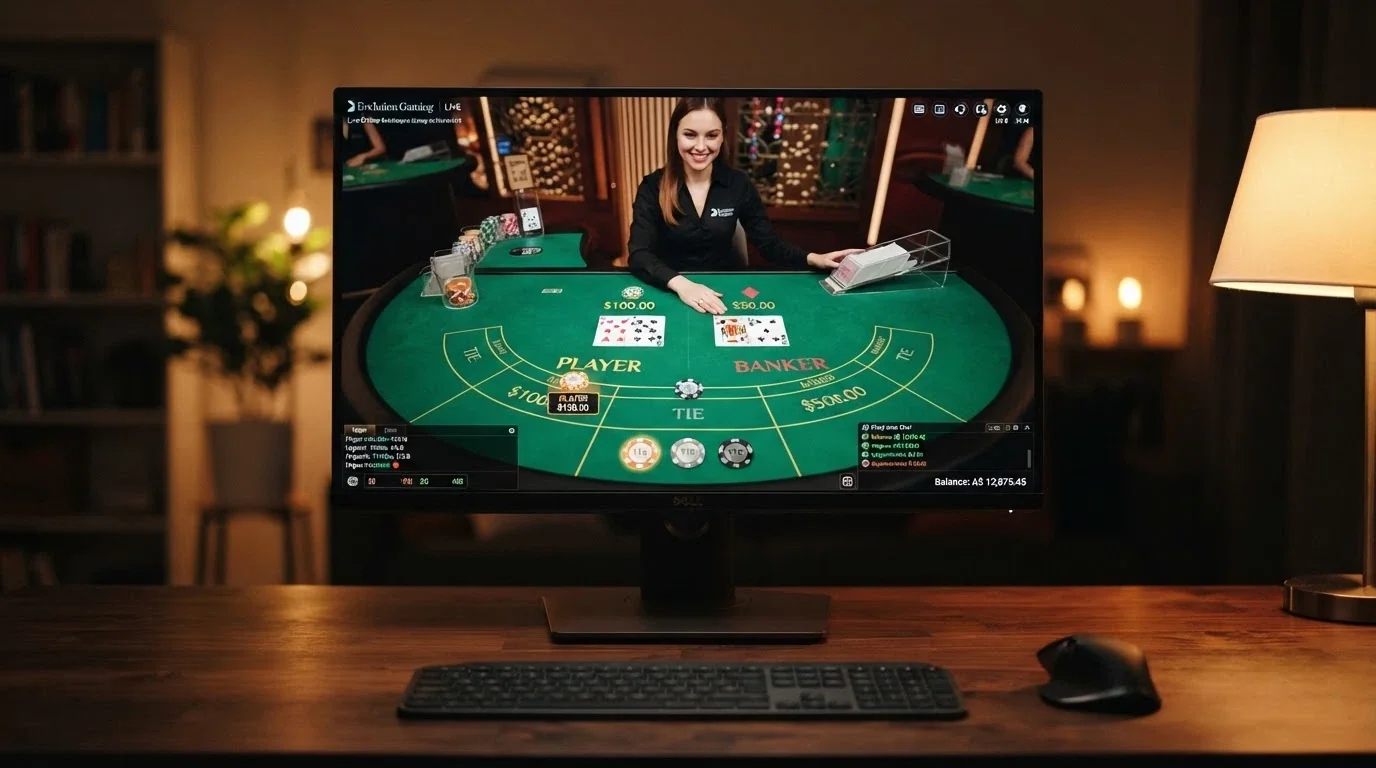
The reason is the part of baccarat that matters most — the part the demo skips — is the part where the player’s decisions have consequences. A player who bets A$5 on Banker in demo mode loses A$5 of pretend money. The hand resolves the same way. The next decision is identical. There is no difference in the game itself; the difference is what the player is feeling, and what the player is feeling is what the game tests. A player who bets A$500 on Banker at a real-money table is making a different decision than a player who bets A$5 in demo mode, because the loss of A$500 is a loss that matters. The decision-making process at the live baccarat table is not the same decision-making process at the demo table.
The free-play mode is honest about its own limits: it does not simulate a real bankroll, it does not simulate a withdrawal process, and it does not simulate the variance of a real session. A player who tries baccarat in demo mode and concludes “I have a system” has not tested the system against the bankroll that will be at risk when the system runs for real. The demo is the practice room. The real table is the test.
What playing live baccarat for real money actually feels like
A real-money live baccarat session starts with a deposit, runs through a real-money bet-and-watch loop, and ends — for most players — at a withdrawal screen. The deposit side is fast and the operator wants it to be fast. A PayID deposit clears in seconds. A debit card deposit clears in seconds. The player lands in the lobby with a balance on the screen and the live baccarat tables one click away.
The session itself is paced by the dealer, not the player. A standard live baccarat round takes thirty to forty seconds from bet placement to payout. Speed Baccarat compresses the round to twenty-seven seconds; No Commission Baccarat runs at the standard pace with a different payout structure; Lightning Baccarat and the multiplier variants run at the standard pace with the multiplier reveal as the additional beat. The player is not in control of the pace. The player is in control of the bet size, the bet selection, and the decision to keep playing or stop.
The withdrawal is where the session’s friction lives. Most operators impose a pending period between the withdrawal request and the operator’s approval — typically 24 to 72 hours — and another settlement window after approval. The player who deposited on Monday and won enough to withdraw on Tuesday may not see the money until Friday. AUD-denominated sites save the 2-to-4% currency conversion fee the player would otherwise pay, and that saving is the part of the operator choice that compounds over many sessions. A player who plays ten sessions of A$500 a session at an AUD site has saved between A$100 and A$200 in conversion fees against a USD-only operator. The math on operator choice is not glamorous, but it is the math that runs every session.
Live baccarat on mobile: the same table, a smaller screen
Two-thirds of live casino test sessions tracked by industry reviewers in 2026 happened on a phone, not on a desktop. The mobile share of live baccarat play has crossed the line where the desktop is the secondary device, and the operators with the deepest mobile live lobbies are the operators that have invested in mobile-first studio interfaces — landscape orientation, touch-optimised bet panels, and a chat window the player can fold away when they want a clear view of the shoe.
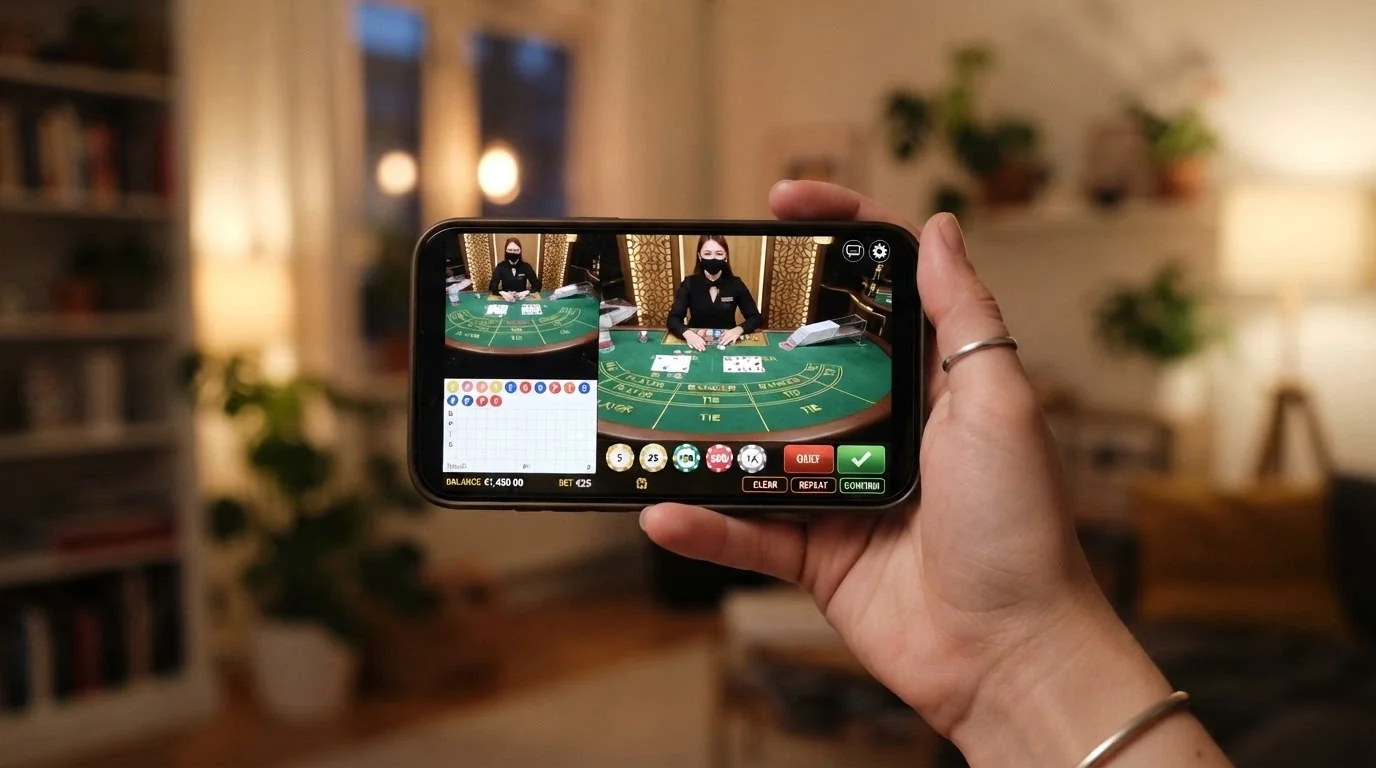
The live baccarat table on a phone is the same table as on a desktop. The studio streams the same footage, the shoe deals the same cards, the statistics panel updates with the same results. What changes is the bet panel: chip selection, bet placement, the side-bet toggles, and the chat input are all redesigned for touch, and a player who has used a well-built mobile live baccarat interface will not feel they have lost anything from the desktop version except screen real estate. The bet limits are typically the same; the round pace is the same; the dealer cannot tell which device the player is on.
The mobile UX varies more than the desktop UX across operators. The mainstream offshore brands — the ones with their own apps or with fully responsive mobile sites — carry their full live lobby on a phone. The smaller offshore brands sometimes offer a desktop-first live lobby that scales awkwardly on a phone, with chip buttons that are hard to hit and chat windows that cover the felt. For those prioritising mobile play, testing the lobby interface before committing funds is a sensible precaution to ensure the controls and chat window meet their needs.
Playing live baccarat on a phone: the operators, the layout and the data
The mobile live baccarat layout is, at the well-built operators, landscape orientation with the felt taking the top two-thirds of the screen and the bet panel along the bottom. Chip selection is a horizontal scroll of denominations; bet placement is a tap on the relevant area of the felt; the side-bet panel is a fold-out drawer that the player opens when they want it. The chat box is usually a small icon in the corner that opens into a full chat panel when tapped. The statistics overlay is usually toggleable — the player who wants to bet on the next hand without the scoreboard can hide it.
The data on mobile play is straightforward: 67% of test sessions at the major Australian-facing live casino sites happened on phones, and the top-performing operators answered live chat within ninety seconds while the worst took forty-seven minutes. The chat response time is the operational metric that distinguishes a mobile-first operator from a desktop-first operator with a mobile site. A player who has a withdrawal question at 11 pm on a Saturday night wants an answer in two minutes, not in forty.
How we selected and ranked these live baccarat sites
The ten operators ranked above are the offshore brands an Australian player most commonly encounters when searching for live baccarat. The selection drew on the Australian-facing operators index — a market-share shortlist of the brands actively acquiring Australian traffic — and on the search-result set for the head term, which is dominated by Australian-facing comparison sites (LiveDealers.com, Casinozoid, AustralianGamblers, NewCasinosAustralia, LiveCasinoComparer, PokiesAustralia, Slotozilla AU, OnlineGamblingAUS, PokerTube AU). The criteria applied to order the ranking were live baccarat table availability, the studios that supply the live lobby, licence transparency where verifiable, and the bonus terms where confirmable from the operator’s published terms page or from a third-party review.
The criteria were applied qualitatively, not numerically. No weighting scheme was imposed on the four factors. The verification round this page draws on was able to confirm the live baccarat studios and table counts for SkyCrown, the licence and bonus structure for FairGO, and partial provider confirmation for Stake and Rocket Play. For the remaining six operators the page records what was verifiable — that the operator runs an Australian-facing site with a live baccarat lobby — and does not invent figures for the gaps.
The regulatory reference point throughout was the ACMA’s blocked-list register and the published terms pages of each named operator. No Australian register covers online casino operators, because the product is prohibited. Where a licence is named in the ranking, it is the licence the operator claims on its own site or that third-party reviews have published — not a licence verified against an Australian register. A reader who treats the ranking as a comparison of verified offers rather than as a comparison of what is publicly known about each operator is reading the page the way it is meant to be read.
So should you play live baccarat at an offshore casino? The honest answer
The legal position is unambiguous. Online casino is prohibited in Australia under the Interactive Gambling Act 2001, and no Australian licence exists for the product. Every brand in the ranking above is offshore, and every brand accepts Australian deposits from an unlicensed position. The player is not prosecuted for playing, because the Act targets the provider under section 15. The provider’s position is illegal even when the player’s is not.
The practical protections absent from the offshore route are real and worth naming. There is no BetStop coverage — a self-excluded Australian can still deposit. There is no Australian complaints body to recover a refused withdrawal. The site can be blocked at the DNS level at any time, with a balance still on the account. The credit-card and crypto ban does not bind the offshore operator, which means the payment route the player uses is the route the regulator has flagged as high-risk. None of these losses is theoretical, and each one compounds the others when something goes wrong.
The cost of playing is the house edge, and the house edge on baccarat is one of the lowest in the casino. The Banker bet returns 98.94% of every dollar wagered over the long run — A$1.06 per A$100 stays with the house. The Player bet returns 98.76%. The Tie bet returns around 85%. A player who bets A$10 on Banker for two hundred hands at a standard table has expected to lose about A$21 over the session, before counting any bonus or cashback that applies. The session will not end at exactly A$21 — variance will move it — but the average across many sessions is the A$21 number, and a player who treats that number as the budget for an evening is treating the table honestly.
The responsible-gambling resources on this page exist because the dataset behind them justifies them. The 622,000 Australian adults Roy Morgan classified as problem gamblers in 2025 are not a separate population from the people who read comparison pages like this one. The National Gambling Helpline at 1800 858 858, Gambling Help Online at gamblinghelponline.org.au and BetStop at betstop.gov.au are the three services every Australian player should have in their phone before they deposit a dollar at any operator, licensed or offshore. The page’s job has been to describe the offshore market as it actually is. The reader’s job is to decide whether the cost described above is a cost they are willing to pay, and whether the help services above are services they need before they pay it.
Frequently asked questions about live baccarat in Australia
Is it legal to play live baccarat at an online casino in Australia?
Online casino is prohibited under the Interactive Gambling Act 2001, and no Australian licence exists for the product. Every operator an Australian can reach for live baccarat is offshore and unlicensed in Australia, and the provider — not the player — is the party the Act targets under section 15. Playing at an offshore casino is not prosecuted for the individual player, but the legal protections an Australian would normally expect from a licensed operator — complaints recovery, self-exclusion coverage, payment safeguards — are not available through the offshore route.
Can I play live baccarat for real money on my mobile in Australia?
Yes. Live baccarat tables are mobile-optimised at the major offshore operators, and roughly two-thirds of live casino sessions tracked by industry reviewers in 2026 happened on a phone rather than a desktop. The same studios — Evolution Gaming, Pragmatic Play Live, and others — stream the same tables to mobile and desktop; what changes is the bet panel and the chat layout, both redesigned for touch. The legal position does not change with the device: a mobile deposit to an offshore casino is the same unlicensed transaction as a desktop deposit.
What live baccarat variants can I play?
Standard Punto Banco at 98.94% RTP on the Banker bet, Speed Baccarat at the same RTP with twenty-seven-second rounds, No Commission Baccarat with a different payout on Banker wins of 6, Lightning Baccarat with random multipliers up to 512x and a 20% fee, Golden Wealth Baccarat with multipliers up to 262,144:1 on Tie, Mega Baccarat with multipliers up to 100x, Prosperity Tree Baccarat with multipliers up to 3,645:1 on Tie, and the dice-based Bac Bo at 97.85% RTP. The variants change the pace, the payout structure, or the proposition — and the RTP shifts with them, from 97.85% at Bac Bo up to 98.94% at the standard table.
What happens if an offshore casino refuses to pay my winnings?
The Australian regulator cannot compel an offshore operator to pay. The ACMA can investigate and can direct Australian ISPs to block the site, but neither action returns money to a player’s account. The operator’s home regulator — typically Curaçao — runs a complaint process that takes months and resolves on the operator’s home turf. The practical answer is that an Australian player with a withdrawal dispute at an offshore casino has limited formal recourse, and the protection that would normally come from a domestic licence is not available through the offshore route.
Where can I get help for a gambling problem in Australia?
The National Gambling Helpline is 1800 858 858 — free, confidential, available twenty-four hours a day. Gambling Help Online, at gamblinghelponline.org.au, offers live chat and online counselling. BetStop, the National Self-Exclusion Register at betstop.gov.au, lets a person exclude themselves from every Australian-licensed wagering service in a single registration; BetStop does not reach offshore casinos, so a person who self-excludes still needs to close any offshore accounts separately. The 2024-25 dataset behind the responsible-gambling section of this page — 622,000 Australian adults classified as problem gamblers, risky gambling up to 19.4% of adults — is the reason those three services sit on a page about live baccarat, and the reason a reader who recognises their own situation in any of those numbers is encouraged to use them.