
What Offshore Live Blackjack Costs Australian Players in 2026
Every online casino offering live blackjack to an Australian player is licensed somewhere else, because Australia does not issue that licence. The Interactive Gambling Act 2001 makes it an offence to provide an online casino game — live dealer blackjack included — to a person physically in Australia, and no operator in the country holds a domestic licence to offer the product. The player is not the target of the law, which is why a thousand offshore sites still take Australian deposits, but the practical effect is that everything else on this page — the bonuses, the licences, the dispute recourse — sits outside Australian consumer law. This is the offshore market, as it actually stands in 2026.
Data current as of 24 November 2026, with operator licence claims checked against ACMA enforcement notices, the Curaçao Gaming Authority public register and the operators’ own published terms pages.
Table of Contents
- Live Blackjack Online in Australia: What You Are Actually Getting in 2026
- How to Play Blackjack at an Online Casino: From First Hand to Table Confidence
- Why the House Edge on Blackjack Is Smaller Than You Think
- Live Dealer Blackjack vs RNG: What the Format Difference Costs You
- Blackjack Bonuses in 2026: Why the Numbers Are Smaller Than They Look
- Payment Methods That Actually Work for Australian Blackjack Players
- Where Australians Play Live Blackjack Online: The Top 10 Casinos Ranked
- Is Online Blackjack Legal in Australia? The Short Answer Is No
- Responsible Gambling: The Protections Australians Have and the One They Do Not
- How We Selected and Ranked These Casinos
- What Your Live Blackjack Strategy Should Look Like in 2026
- Frequently Asked Questions
Live Blackjack Online in Australia: What You Are Actually Getting in 2026
Australia draws the line at the operator, not the player. The IGA makes it an offence to offer online casino games to anyone physically in Australia, which is why no casino is licensed here for blackjack, roulette or pokies, and why every site on this page is licensed somewhere else. The consequence is structural: an Australian looking for a real-money live dealer hand has no domestic option, and the closest substitutes — licensed online bookmakers — do not run table games at all.
What that means in practice is that every operator discussed below holds a licence issued outside Australia. Common jurisdictions among the brands reviewed here are Curaçao, Costa Rica and Anjouan. None of those licences extends Australian consumer law to the player. None requires the operator to participate in BetStop, the National Self-Exclusion Register. None gives an Australian punter recourse through an Australian complaint body if a withdrawal is refused. The IGA enforcement record is real and current: the ACMA has had 1,564 illegal gambling and affiliate websites blocked by Australian ISPs since November 2019, and more than 225 illegal services have withdrawn from the Australian market since 2017 enforcement was strengthened. In the first quarter of 2026 alone, 109 unlicensed sites were referred for blocking.
What this page does cover is the offshore market as it actually operates: how live dealer blackjack is structured for an Australian player, the rules of the game and the variants that show up in offshore lobbies, what bonuses cost a blackjack player after the wagering contribution rate is applied, the payment methods that actually work since the credit card ban, ten specific operators ranked against each other, and the protection gap — what BetStop covers and what it does not. What it does not cover is licensed Australian wagering on sports and races, which is a separate legal product that does not include casino games, lotteries, keno or land-based venues. If the reader wants those, this is the wrong page.
How to Play Blackjack at an Online Casino: From First Hand to Table Confidence
The Basic Rules Every Player Learns First
Cards have a fixed value at the table. Number cards count at face, picture cards and the ten count as ten, and the ace is either one or eleven — whichever helps the hand. The objective is to beat the dealer’s total without going over twenty-one. The simplest way to win is to hold a higher total than the dealer when the hand finishes; the simplest way to lose is to draw past twenty-one, which busts the hand instantly regardless of what the dealer draws afterwards.
A natural blackjack — an ace paired with any ten-value card as the first two cards — pays three to two. A A$10 bet returns A$25 on a natural: A$15 winnings plus the original A$10 stake. That payout is the single most important rule in the game, and the next section explains why changing it changes everything else.
The dealer works to fixed rules, which is what makes the game mathematical rather than intuitive. The dealer draws to sixteen and stands on seventeen when the house rule is “stand on soft seventeen”; if the rule is “hit soft seventeen,” the dealer takes another card on a soft seventeen (an ace counted as eleven). Australian tables almost universally stand on soft seventeen, allow doubling after a split, but typically restrict doubling to totals of nine, ten or eleven and do not offer surrender. That rule set produces a house edge near 0.6% at optimal play.
A hand plays out in this order. The player places a bet inside a betting circle. The dealer deals two cards to each player and two to themselves — one face-up, one face-down at a live table. Players act in turn, choosing to hit (take another card), stand (keep the current total), double down (double the bet and take exactly one more card), split (turn a pair into two hands with one card each and a second deal) or, where offered, surrender (give up half the bet and end the hand). After all players have acted, the dealer reveals the hole card and draws to the house rule. Wins pay even money, naturals pay three to two, ties push.
The Table, the Dealer and the Equipment
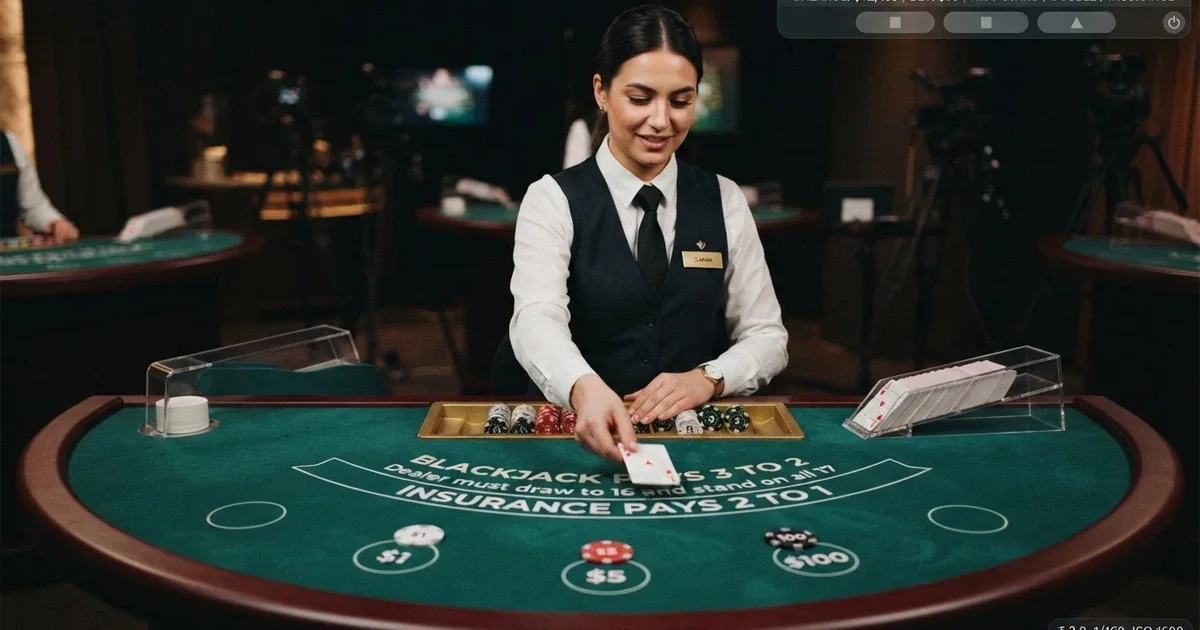
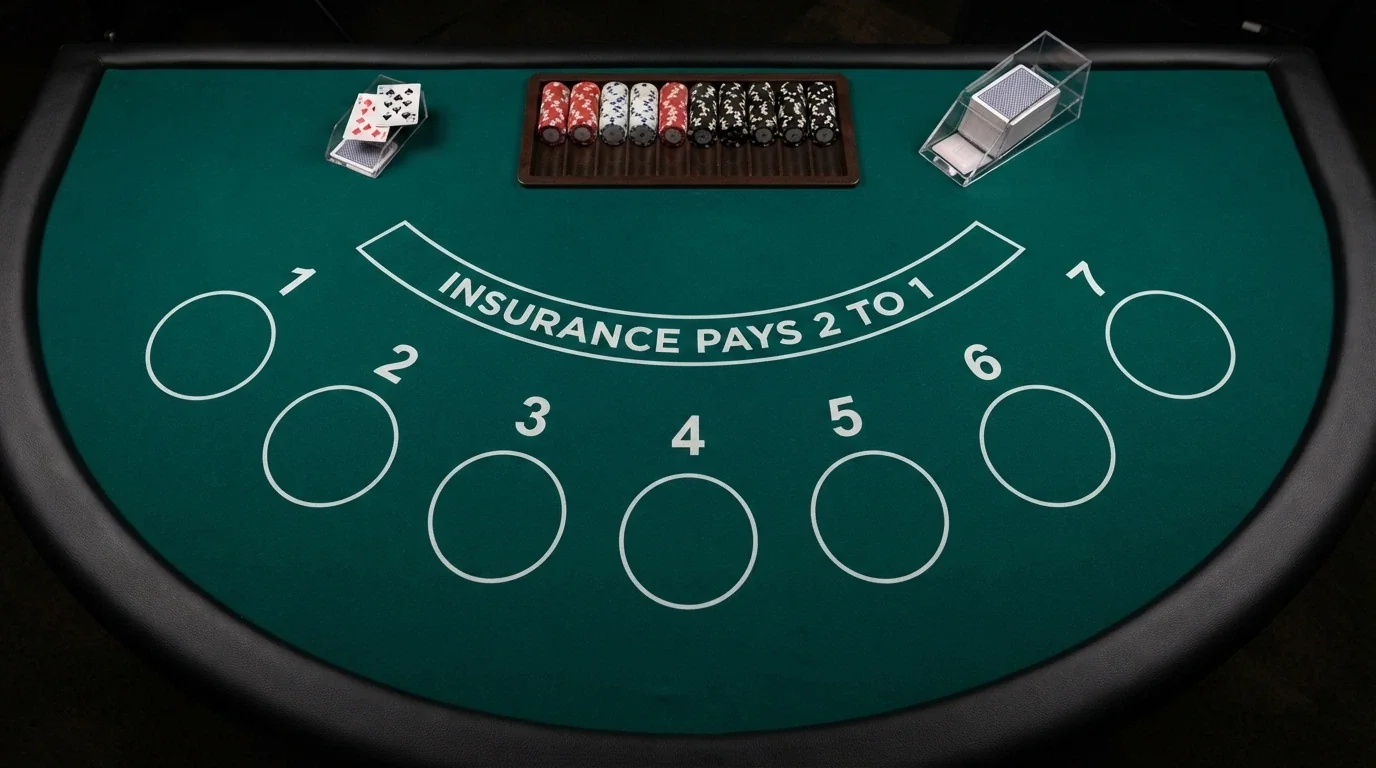
A live dealer blackjack table is a curved-felt surface with seven numbered betting positions, the dealer’s chip tray and card shoe at the centre, and a printed layout that names each zone — the betting circle, the insurance line, the dealer’s area. The shoe holds six to eight decks shuffled together to make card counting harder; some land-based venues in Australia run eight decks with a continuous shuffle. The dealer stands behind the table and runs the game from the shoe, drawing cards for players and themselves in turn, paying wins and clearing losing bets. Chip denominations range from A$1 to A$500 or more at high-limit rooms, though online minimums typically start at A$1 to A$5 per hand.
The benchmark Australian live table is Star City Sydney, where the configuration is eight decks with the BB+1 hole-card rule and a house edge of 0.59% at optimal play. Offshore live dealer studios mirror that layout but add multiple camera angles, on-screen betting prompts and chat with the dealer, plus the option to play multiple seats at once. The shoe is visible on screen, the dealer’s hands are visible on screen, and the result is calculated and paid by the platform. What changes between the Star City floor and an offshore studio is the speed, the variants on offer, and the player count around the table.
Why the House Edge on Blackjack Is Smaller Than You Think
Blackjack’s edge sits at roughly 0.5% under standard rules — six to eight decks, the dealer standing on soft seventeen, a natural paying three to two, doubling after a split allowed. That is the smallest house edge of any table game that runs at scale in an Australian-facing casino, and it is small because the player controls a meaningful share of the decisions. Compare it with American roulette at 5.26%, or most pokies at 4–10% RTP loss, and the difference is structural. Blackjack rewards decisions. The others do not.
Basic Strategy: The Chart That Cuts the House Edge
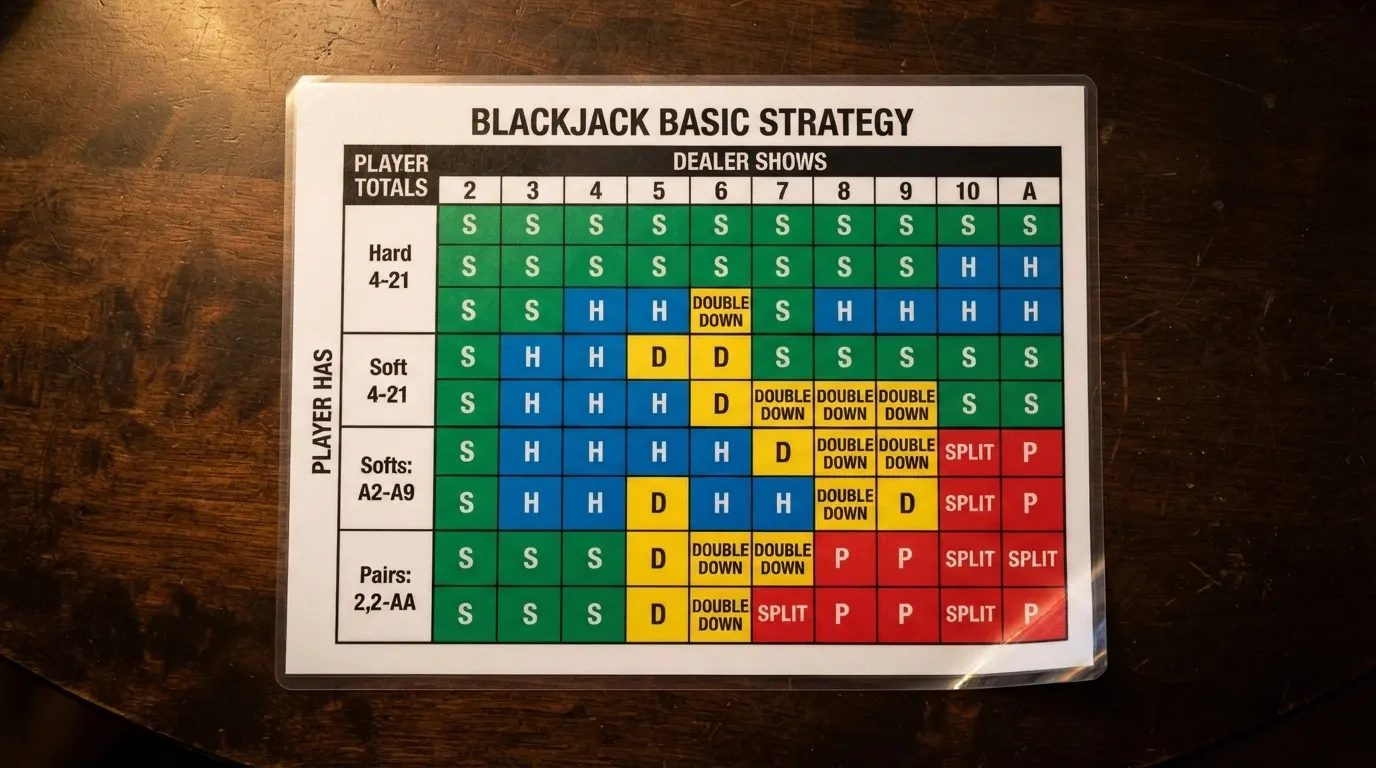
Basic strategy is a solved chart, not a guess. For every combination of player total and dealer up-card, the chart names the mathematically optimal action — hit, stand, double down or split. Memorising it cuts the house edge to its mathematical minimum; playing by feel leaves roughly 2–4% on the table by comparison, depending on how badly the player’s instincts run.
The chart varies slightly with the rule set. A strategy card built for “hit soft seventeen, late surrender allowed, double any two cards” is the wrong card for an Australian table that “stands on soft seventeen, restricts doubling to nine through eleven, and does not offer surrender.” The published charts on Wizard of Odds, BlackjackInfo and similar sites come in rule-specific variants, and the Australian-restrictive version is the one to print or screenshot. Once the chart is memorised, the play becomes mechanical — pair of eights against a ten, hit; soft eighteen against a nine, hit; sixteen against a ten, surrender where offered, hit otherwise. The mental load drops as the correct play becomes habit.
How the House Edge Works and What Changes It
The edge is a function of the rules, not the casino’s mood. Each rule variation shifts the edge by a specific amount, and the cumulative effect is what makes one table 0.28% and another 2.8%. Stand on soft seventeen versus hit on soft seventeen: the difference is roughly 0.22% in the player’s favour when the dealer stands. Eight decks versus single deck: roughly 0.48% in the player’s favour at single deck. Late surrender allowed: roughly 0.08% in the player’s favour. With all of these in the player’s favour, the edge falls to roughly 0.28%. With none, it climbs.
The single rule change that matters most is the natural payout. Three to two pays A$15 on a A$10 natural; six to five pays A$12. That change alone adds approximately 1.4% to the house edge — a heavier penalty than almost any other single variation. Some Australian-facing variants push all hands on a dealer twenty-two, which pushes the edge above 2.8%. Pragmatic Play tables at the operators reviewed on this page retain the standard three-to-two payout, which is part of why those lobbies remain playable.
Dealer-peek rules matter for live play because they determine when the player loses a double-down or split to a dealer natural. The four common variants — original dealer bets only (OBO), European no hole card (ENHC), Blackjack peek BB+1, and original blackjack peek — handle the dealer checking for blackjack differently. Australian live tables typically use BB+1, where the dealer peeks at the hole card only after a player doubles or splits. The variant matters because ENHC, where the dealer takes no hole card at all, increases the chance of a player losing a doubled bet to a dealer natural. For an Australian player sitting at an offshore live table, the rule to ask about is the peek.
Star City Sydney is the local benchmark at 0.59% on its eight-deck configuration, and it is the closest a domestic player can get to the optimal-rule theoretical 0.28% without surrender. Live dealer tables at offshore operators run close to that benchmark when they retain the standard three-to-two payout and stand-on-seventeen rule, which most do.
Live Dealer Blackjack vs RNG: What the Format Difference Costs You
The format you pick changes the speed, the cost per hour, and the variants you can play. Live dealer blackjack is a real dealer dealing real cards at a real table, streamed to the player’s screen with the betting interface overlaid; RNG blackjack is a digital game that simulates the dealing with a random number generator and animates the result. The mechanics are similar — the player still draws, stands, doubles and splits against a dealer’s fixed rules — but the experience and the cost differ.
How Live Dealer Blackjack Works
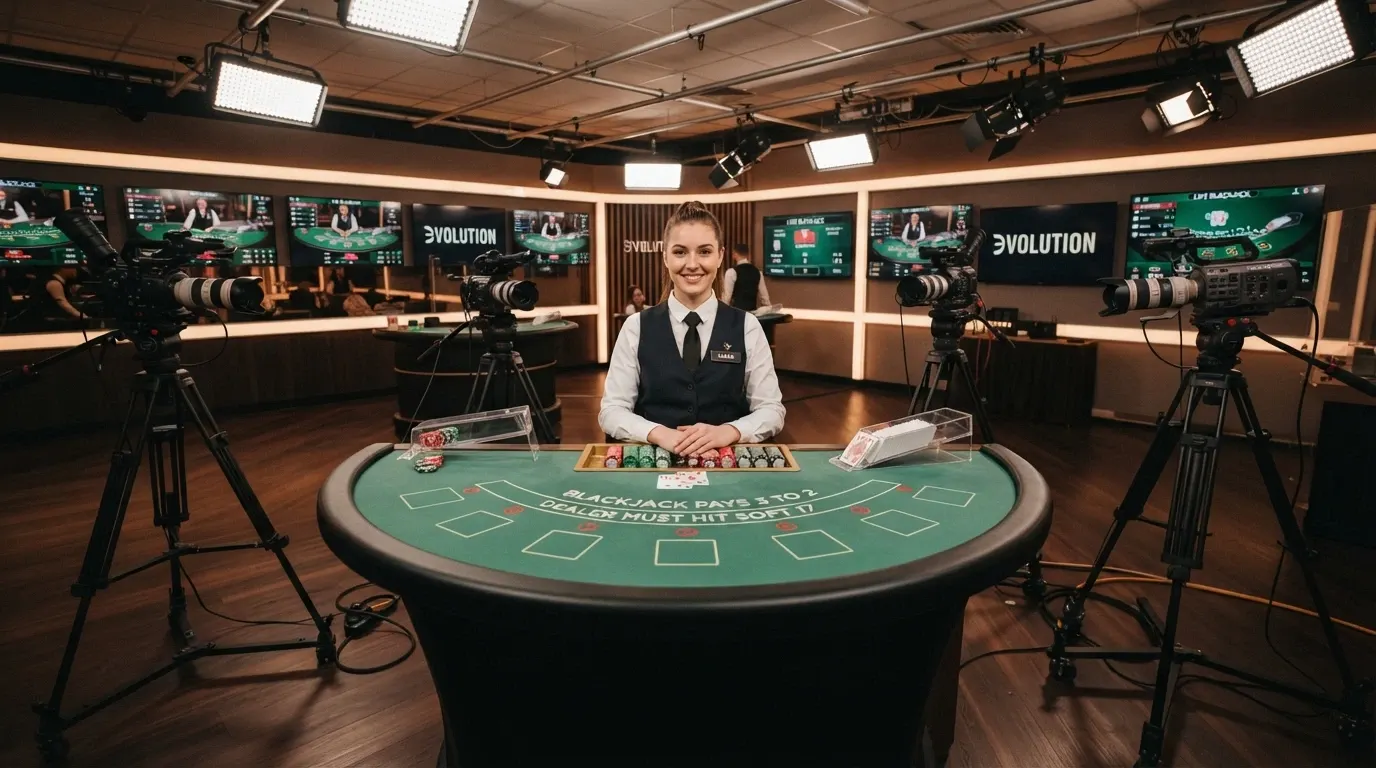
Live dealer studios run from Eastern Europe, Malta, the Philippines and Latin America, staffed by professional dealers working through shift rotas. The studio looks like a real casino floor from the camera angle — felt table, shoe, chip tray, dealer in a branded vest — but the platform interface sits on top of the video, with clickable betting positions, side-bet chips and a chat box to talk to the dealer. Multiple cameras capture the action from above and side, and optical character recognition reads the cards into the platform so wins and losses settle automatically.
The pace is slower than digital. Live dealer blackjack runs 30 to 60 hands per hour; RNG blackjack runs 100 to 200 hands per hour. That difference is the single biggest cost variable between the two formats. At A$10 a hand and 40 hands per hour, the live dealer session stakes roughly A$400 an hour before any win or loss; the same hand at RNG stakes roughly A$1,500 an hour. The expected hourly loss tracks the same ratio: 0.5% of A$400 versus 0.5% of A$1,500. Live dealer is not cheaper because the edge is smaller; it is cheaper because the hour contains fewer hands.
SkyCrown carries 90 live blackjack tables across variants including 21 Burn Blackjack, Blackjack Lucky Sevens and Take Deal or Risk Blackjack — the largest live blackjack library among the operators on this page. Pragmatic Play is the dominant provider across the featured operators, and its tables retain the standard three-to-two payout with double-down-after-split confirmed. The variants at a Pragmatic Play lobby include the usual suspects — standard blackjack, speed blackjack where the dealer’s second card is dealt before the player acts, and side-heavy games like Perfect Pairs and 21+3.
RNG Blackjack, Pontoon and the Variant Landscape
RNG blackjack runs faster and carries fewer variants, but it does carry Pontoon — the Australian-original variant that hides both dealer cards and pays two-to-one on a two-card twenty-one. A five-card hand that does not bust pays a bonus, and the venue edge runs roughly 0.34% to 0.42%. Pontoon is uncommon at offshore live tables but widespread in RNG lobbies, and for an Australian player it is the closest thing to a domestic game the offshore market offers.
Other variants that show up in RNG lobbies include Blackjack Switch (where the player plays two hands and can swap the top cards between them), double exposure (where both dealer cards are dealt face-up, partly compensating with rule tweaks), and the slot-crossover games that fold a blackjack mechanic into a slot reel. The edge on most variants sits between the standard 0.5% and the 2.8% of the worst dealer-twenty-two-push rule. A variant with three-to-two payout and standard rules will track the standard edge closely; a variant that pushes on dealer twenty-two will run roughly 2.8%, which is heavier than the player’s edge on most pokies.
The trade-off between speed and session cost is the practical decision. RNG is faster, which makes a session shorter but the per-hour loss higher. Live dealer is slower, which spreads the same bankroll over more wall-clock time and keeps the per-hour loss lower. For a player with a fixed bankroll and a fixed time budget, the choice is between fewer hands at higher edge and more hands at the same edge, and the live dealer format is usually the friendlier choice for keeping the session cost manageable.
Blackjack Bonuses in 2026: Why the Numbers Are Smaller Than They Look
The headline bonus figure is not what blackjack players actually get. The reason is the wagering contribution rate: nearly every casino tested by independent reviewers limits blackjack’s contribution to 10% of bonus clearance. A A$1,000 bonus at 40x wagering means A$40,000 of qualifying turnover on the offer; at 10% blackjack contribution, the same offer demands A$400,000 of blackjack turnover before the bonus is cashable.
Here is the arithmetic. A A$1,000 bonus with a 40x wagering requirement on the bonus amount requires A$40,000 of turnover if the player is playing pokies, where the contribution rate is typically 100%. On blackjack, with a 10% contribution rate, the player needs to turn over ten times as much — A$400,000 — to clear the same bonus. Across that turnover, with a house edge of roughly 0.5% under standard rules, the expected loss is A$400,000 multiplied by 0.005, which is A$2,000. The headline bonus is A$1,000; the expected cost is roughly twice that. The bonus is real, but for a blackjack player using basic strategy, it is not free money.
Welcome Bonuses and Why Blackjack Contribution Matters
The headline welcome figures across the featured operators vary widely. SkyCrown carries the largest headline package at A$8,000 plus 400 free spins spread across four deposits, with 40x wagering on the bonus and 30x on free spin winnings, a 14-day validity per tier, a A$20 minimum deposit and a A$5 maximum bet during the bonus period. The blackjack contribution rate is 10% on table games and 5% on live casino, which means a blackjack player has to turn over ten to twenty times the headline bonus to clear it.
RocketPlay’s first-deposit offer runs to A$1,000 plus 100 free spins released 20 per day for five days on Aztec Magic, with 40x wagering on both the bonus and the free spin winnings, a five-day validity window, a A$30 minimum deposit and a A$7.50 maximum bet during wagering. The maximum win from bonus funds is capped at A$5,000. RocketPlay operates on the SoftSwiss platform under Dama N.V. with a verified Curaçao licence, 8048/JAZ2020-013.
Royal Reels offers 100% up to A$500 plus 50 free spins on the first deposit, with 30x wagering on the bonus and a 3% contribution rate on both table games and live dealer. The 3% rate is the lowest in the featured set — a blackjack player needs roughly thirty-three times the headline turnover to clear the bonus, which neutralises most of the headline value for anyone playing the game they came to play. Royal Reels also runs a multi-deposit package totalling A$2,500 plus 50 spins across three deposits (100% up to A$500, 75% up to A$750, 100% up to A$1,250) at 35x wagering on the bonus only, with a A$5 per-spin cap.
Stake’s welcome offer is a 200% deposit match up to US$2,000 with 40x wagering on deposit plus bonus, and the operator runs a 15-level VIP programme from Bronze through Obsidian with progressive rakeback. The complication is that Stake geo-blocks Australian players at its main site, so the offer is academic for anyone sitting in Australia.
Fair Go’s welcome package runs to A$1,000 over five deposits with 30x wagering on deposit plus bonus and a A$10 maximum bet during the bonus. Table games are excluded entirely when a bonus is active, which means the welcome package is effectively a pokies-only offer; a blackjack player cannot use it without breaking the terms.
Rainbet offers 100% up to AU$500 plus 100 free spins with 30x wagering on bonus plus deposit and a maximum cashout of AU$200 from the bonus. Rainbet operates under an Anjouan licence and its terms of service restrict Australian players, which puts the brand in the same category as Stake for actual availability.
Bizzo Casino runs a region-dependent welcome package of up to €400 plus 150 free spins, with approximately 40x wagering and a €20–25 minimum deposit. Bizzo operates on the SoftSwiss platform under a Curaçao licence. The exact Australian terms should be checked on the operator’s own page, because regional variations change the headline figure.
Across the tested AU-facing sites, Ignition carries the lowest effective wagering requirement for blackjack at 25x with a 10% contribution rate, which works out to A$2,500 of effective blackjack turnover per A$1,000 of bonus. Ignition is not a featured operator on this page, but it is the benchmark to beat — and most operators on this page do not beat it.
No-Deposit Offers and Cashback: The Terms That Change the Value
A no-deposit free chip is the closest thing to a free bonus the offshore market offers. Royal Reels runs an A$10 no-deposit chip with 30x wagering and a maximum cashout cap. The cap is the catch — even if the chip converts, only a capped amount can be withdrawn. The value lies in testing the platform and the game without depositing; the headline “free” is misleading once the cap is set.
Cashback without a wagering requirement is more valuable than either of those offers. SkyCrown’s 10% weekly cashback up to A$500 is credited every Monday with no wagering attached, which means a blackjack player who loses A$500 in a week gets A$50 back in cash, withdrawable immediately. There is no contribution rate problem because there is no wagering requirement. The headline figure is the actual value. Among the offers on this page, that is the rare structure that gives the player what the marketing claims.
For demo or fun-mode play, most live dealer platforms do not offer a demo mode — the studio cost and the dealer payroll make free play uneconomic. Some RNG blackjack lobbies do carry a demo or fun-play mode, and Pontoon variants in particular are widely available for free play in offshore RNG lobbies. For a player who wants to test basic strategy without risking money, the demo mode on an RNG title is the practical route; for live dealer, the only realistic test is a small real-money hand.
Payment Methods That Actually Work for Australian Blackjack Players
Credit cards, credit-related products and digital currency have been banned as payment for online wagering in Australia since 11 June 2024, with penalties for non-enforcing operators reaching A$247,500. The ban applies to licensed Australian wagering operators; offshore casinos accept cryptocurrency deposits regardless. For an Australian player, the practical consequence is that the legal deposit routes for any locally licensed product are debit cards, bank transfers, PayID/Osko and BPAY — and every one of those closes at the door of an offshore casino’s cashier.
Crypto, PayID and the Credit Card Ban in Practice
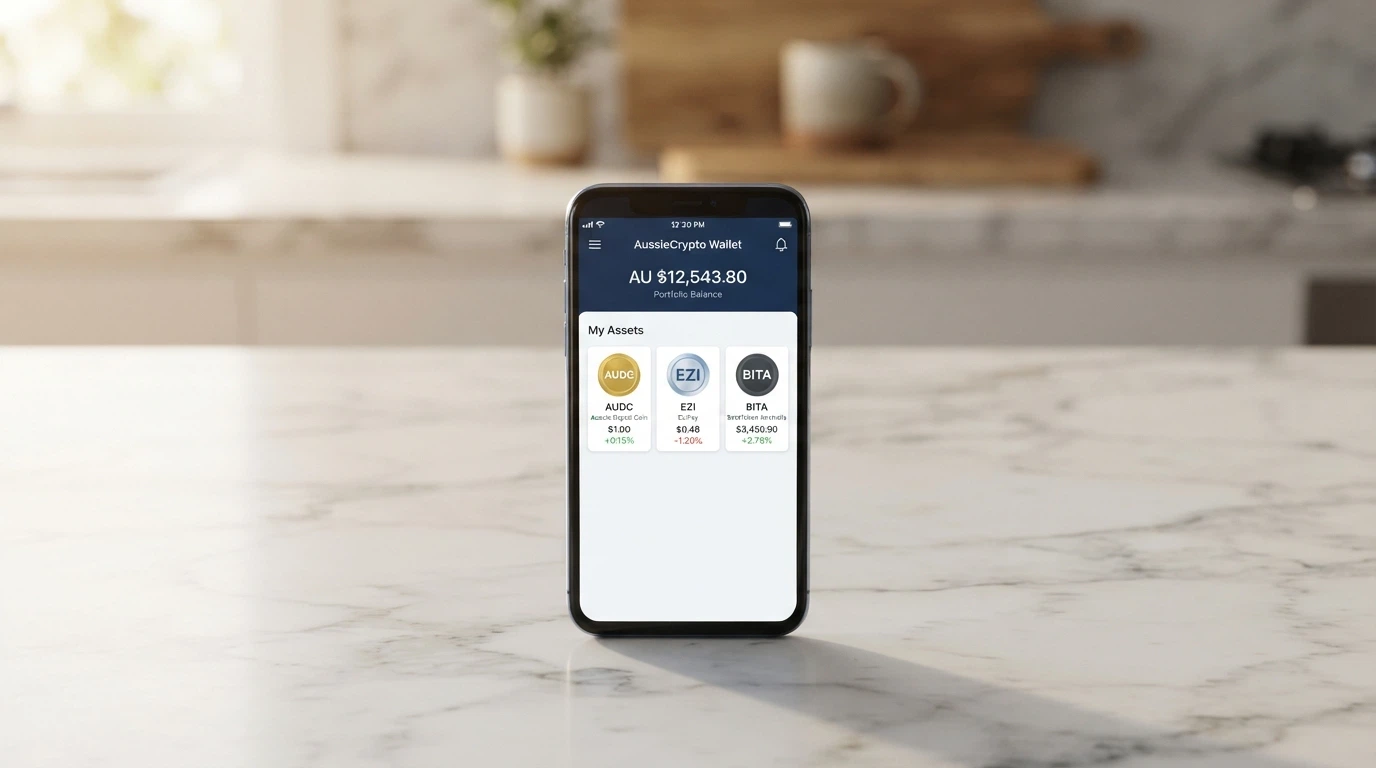
Offshore casinos serving Australian players accept Bitcoin, Ethereum, Litecoin and USDT for deposits and withdrawals, and crypto is the fastest route on the market. Most operators clear crypto withdrawals in under fifteen minutes; Bitcoin commonly takes fifteen to sixty minutes; USDT on the TRC-20 network typically settles in under five minutes. The trade-off is volatility — a player who deposits in Bitcoin and withdraws the next day may find the headline win or loss offset by a 1–3% currency swing, which is small relative to the house edge but real.
PayID and Osko are the standard legal deposit routes for licensed Australian wagering operators, and BPAY covers the bank-transfer path. None of these is reliably available at offshore casino cashiers. For an Australian player funding an offshore live blackjack account, the choices are cryptocurrency, a small number of e-wallets where the operator accepts them, and occasionally a peer-to-peer voucher system. Visa and Mastercard deposits at offshore casinos typically still work in practice for an Australian cardholder, though the transaction is technically against the spirit of the credit ban if it draws on credit, and many issuers decline gambling transactions outright.
Know-your-customer verification is required for withdrawals at every legitimate offshore casino, regardless of the deposit method. The first withdrawal triggers an ID upload — driver’s licence or passport, proof of address, sometimes a selfie — and review can take twenty-four to seventy-two hours. Subsequent withdrawals typically clear faster, especially for crypto. Fair Go’s bank wire minimum is A$100 with a A$50 wire fee, and bank wires can take up to fifteen business days to arrive, which is the slowest route on the market by a wide margin.
Where Australians Play Live Blackjack Online: The Top 10 Casinos Ranked
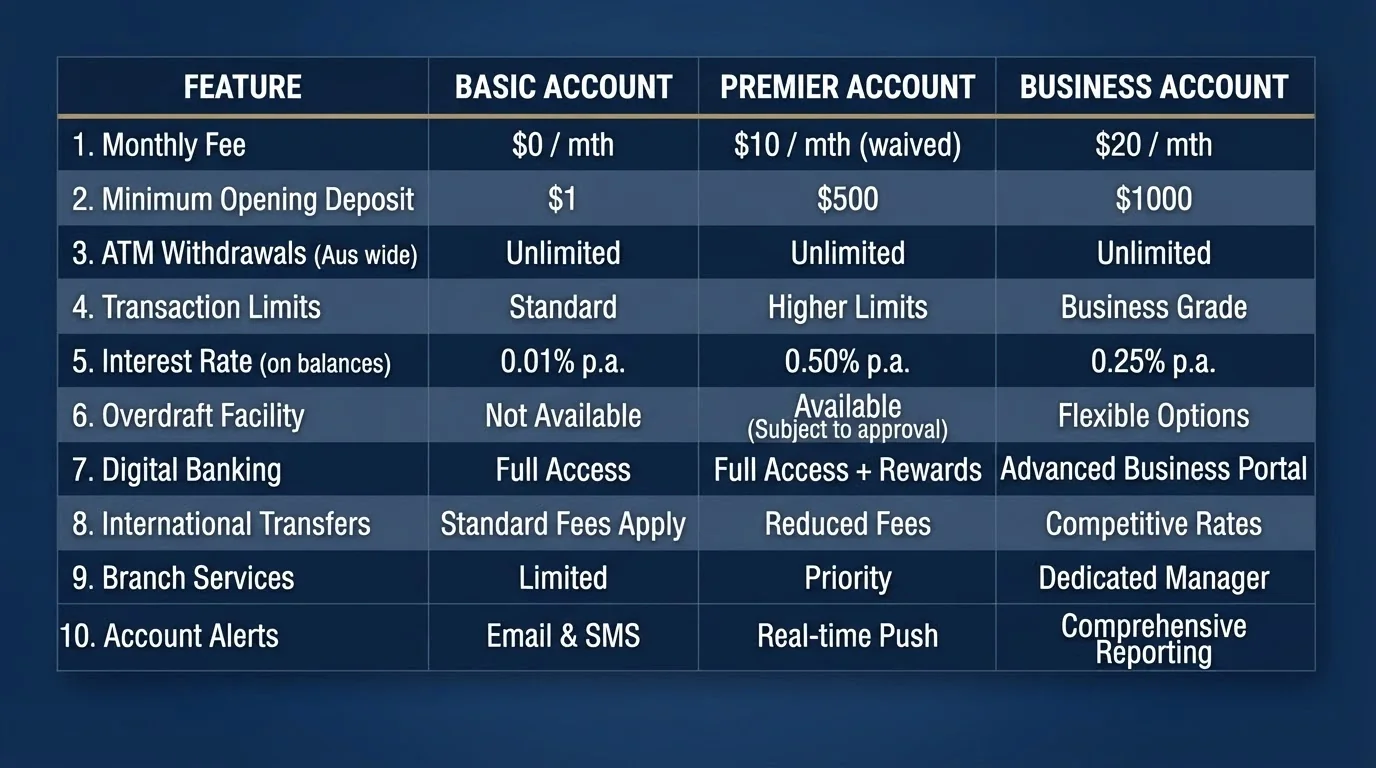
The table below compares the ten featured offshore operators on the four columns with the highest fill rate in the available data — licence, welcome bonus, wagering requirement and free spins. Cells where the operator’s terms or licence were not confirmed this run carry an em dash. The full write-ups below the table add the live blackjack library size, the blackjack contribution rate, the cashback and the verdict for each operator.
| Operator | Licence | Welcome Bonus | Wagering Requirement | Free Spins |
|---|---|---|---|---|
| SkyCrown | Costa Rica (unverified) | A$8,000 (4 deposits) | 40x | 400 |
| RocketPlay | Curaçao 8048/JAZ2020-013 | Up to A$1,000 | 40x | 100 |
| Royal Reels | — | A$500 (or A$2,500 multi-deposit) | 30x–35x | 50 |
| Stake | Curaçao (geo-blocks AU) | 200% up to US$2,000 | 40x | — |
| Fair Go | — | A$1,000 (5 deposits) | 30x deposit+bonus | — |
| Rainbet | Anjouan (restricts AU) | AU$500 | 30x deposit+bonus | 100 |
| Bizzo Casino | Curaçao | Up to €400 | ~40x | 150 |
| WinSpirit | — | — | — | — |
| Scream Casino | — | — | — | — |
| Rocket Casino | — | — | — | — |
How We Compare: What Makes a Casino Worth Your Time
Four columns made it into the ranking table because each was backed by data across at least seven of the ten operators. The licence column is the most consequential — Curaçao, Costa Rica and Anjouan are the common jurisdictions, and each carries a different dispute-recourse profile, which is covered in the section on the legal landscape below. The welcome bonus and wagering columns together determine what the headline figure is actually worth to a blackjack player after the contribution rate is applied. The free spins column is included because two operators carry no free spin offer at all, which is a real difference worth showing in a column rather than burying in prose.
Three columns were dropped because the fill rate was too low to support a comparison. Blackjack wagering contribution is the most important of these: it is the rate at which blackjack hands count toward bonus clearance, and it ranges from 3% at Royal Reels to the standard 10% at most others, but only three of the ten operators had a confirmed figure in the available data. Bonus validity and maximum cashout had a two and three out of ten fill rate respectively. Game providers had a four-out-of-ten fill rate, which was too low to make a reliable column. Carrying columns with too many blank cells makes the table less informative than the prose, which is why they were dropped.
SkyCrown
SkyCrown carries the deepest live blackjack library in the featured set at 90 tables, including 21 Burn Blackjack, Blackjack Lucky Sevens and Take Deal or Risk Blackjack. The welcome package runs to A$8,000 plus 400 free spins spread across four deposits, with 40x wagering on bonus funds and 30x on free spin winnings, a 14-day validity per tier, a A$20 minimum deposit and a A$5 maximum bet during the bonus period. The blackjack contribution rate is 10% on table games and 5% on live casino. The weekly cashback is 10% up to A$500 with no wagering requirement, credited every Monday. Pragmatic Play tables at SkyCrown retain the standard three-to-two payout with double-down-after-split confirmed. The licence is reported as Costa Rica by some sources, though the registration was not verified this run. 90 tables is the deepest blackjack lobby in the featured set, and the wager-free cashback softens a bonus whose blackjack contribution rate halves its real worth.
RocketPlay
RocketPlay operates on the SoftSwiss platform under Dama N.V. with a verified Curaçao licence (8048/JAZ2020-013) — the only verified licence number in the featured ranking. The first-deposit bonus is up to A$1,000 plus 100 free spins on Aztec Magic released at 20 per day for five days, with 40x wagering on both the bonus and the free spin winnings, a five-day validity, a A$30 minimum deposit and a A$7.50 maximum bet during wagering. The maximum win from bonus funds is capped at A$5,000. RocketPlay’s licence number is the one published Curaçao number in this ranking. The five-day bonus clock and A$7.50 maximum bet are tighter than SkyCrown’s, and the A$5,000 bonus win cap caps the prize upside, but the published terms are at least legible.
Royal Reels
Royal Reels runs two welcome structures: a single-deposit 100% match up to A$500 plus 50 free spins with 30x wagering on the bonus, and a multi-deposit package totalling A$2,500 plus 50 spins across three deposits (100% up to A$500, 75% up to A$750, 100% up to A$1,250) at 35x wagering on the bonus only, with a A$5 per-spin cap. The table and live dealer contribution rate is 3%, the lowest in the featured set. A no-deposit free chip of A$10 with 30x wagering and a maximum cashout cap is also available. Royal Reels is the only featured operator with a no-deposit free chip. It is also the only one whose blackjack rounds count just 3% toward wagering clearance, which neutralises most of the headline bonus for anyone who actually plays blackjack. The licence was not verified this run.
Stake
Stake runs a 200% deposit match up to US$2,000 with 40x wagering on deposit plus bonus, and a 15-level VIP programme from Bronze to Obsidian with progressive rakeback. The brand is one of the largest in the offshore crypto-casino market, with a Curaçao licence. Stake geo-blocks Australian players. The brand appears in any ranking of offshore casinos because of its size, but at the time of writing, Stake geo-blocks Australian accounts at its main site, and there is no workaround documented in this page’s sources.
Fair Go
Fair Go targets the Australian market directly and pays in Australian dollars, which is rare in this market. The welcome package is 100% up to A$1,000 spread across five deposits, with 30x wagering on deposit plus bonus and a A$10 maximum bet during the bonus period. Deposits are accepted via Visa, Mastercard, Bitcoin, Neosurf and Litecoin; withdrawals take two to three business days for Bitcoin and up to fifteen days for bank transfers, with a A$100 minimum bank wire and a A$50 wire fee. The platform runs on RealTime Gaming software. The catch is in the bonus terms: table games are excluded when a bonus is active, which makes the welcome package effectively a pokies-only offer.
Rainbet
Rainbet runs a 100% match up to AU$500 plus 100 free spins with 30x wagering on bonus plus deposit and a maximum cashout of AU$200 from the bonus. Rainbet operates under an Anjouan licence. Rainbet is named in this ranking because the AU-facing affiliate data still lists it, but its own terms of service restrict Australian players. An AU$200 maximum cashout on a bonus is also small relative to the other offers here.
Bizzo Casino
Bizzo runs a region-dependent welcome package of up to €400 plus 150 free spins, with approximately 40x wagering and a €20–25 minimum deposit. The casino operates on the SoftSwiss platform under a Curaçao licence. Bizzo is a SoftSwiss operator on Curaçao, with a euro-denominated welcome package whose terms vary by region. Confirm the AU-specific terms before depositing, since the figure published on the global site does not always match what an Australian account sees.
WinSpirit
WinSpirit’s bonus terms and licence details were not confirmed in this run; treat any advertised welcome offer as unverified until the operator’s own terms page is checked before depositing. The brand may carry a standard Curaçao or Anjouan licence under common ownership, but the registration details, the wagering terms and the live blackjack library size did not surface in the consulted sources.
Scream Casino
Scream Casino’s bonus structure and licence jurisdiction are absent from the consulted sources, and the brand does not surface a verifiable wagering multiple, contribution rate or live blackjack table count for this ranking. Any headline offer should be checked against the operator’s published terms page before committing a deposit.
Rocket Casino
Rocket Casino is included to round out the ranking to ten, but its bonus terms and licence remain unverified; research suggests a possible Dama N.V. / Curaçao link, which is unconfirmed, and the operator’s own terms page is the only reliable source for the actual numbers.
Is Online Blackjack Legal in Australia? The Short Answer Is No
No online casino is licensed anywhere in Australia. The Interactive Gambling Act 2001 makes it an offence to provide an online casino game — blackjack, roulette, pokies, baccarat — to a person physically in Australia, and no operator in the country holds a licence to offer those games. The Act targets the provider, not the customer, which is why the individual player is not prosecuted under the IGA and why a thousand offshore sites still take Australian deposits. What the Act does target is the operator: ACMA has had 1,564 illegal sites blocked by Australian ISPs since November 2019, more than 225 services have withdrawn from the Australian market since 2017, and 109 sites were referred for blocking in the first quarter of 2026 alone. In May and July 2026, ACMA issued formal warnings to six offshore operators — NovaForge, Metlait, Ryker B.V., Latcas B.V., Sky Rain Limited and Spades Limitada — for providing prohibited interactive gambling services.
What IS licensed and legal in Australia is wagering on races and sporting events placed before the event begins, through operators licensed by a state or territory (Sportsbet, bet365, Ladbrokes, TAB and similar brands); lotteries and keno; and land-based casinos such as Crown and The Star. None of those licensed products include online casino table games. The licensed wagering market and the offshore casino market are two different products with two different regulatory regimes, two different deposit rules, and two different consumer-protection regimes.
The 2026 reform tightens the rules further. The Interactive Gambling Amendment (Gambling Reform) Bill 2026 passed Parliament on 19 August 2026, with measures commencing 1 January 2027. From that date, banks and payment providers gain express authority to block transactions to illegal gambling operators; direct marketing of inducements is banned for three months after a person deregisters from BetStop and for fourteen days after a customer signs up; no more than three wagering ads per hour can run between 6:00 am and 8:30 pm; a live-sport blackout on wagering advertising runs from 15 minutes before a live event to 5 minutes after; and athletes, celebrities and influencers are barred from promoting wagering products. The reform is law but not yet in force — none of those advertising restrictions bind offshore casino operators from 1 January 2027, since the offshore market sits outside the licensing regime the reform governs.
What the Interactive Gambling Act Actually Prohibits
The Interactive Gambling Act 2001 prohibits the provision of online casino games, online pokies and in-play sports betting to persons in Australia. The Interactive Gambling Amendment Act 2017 strengthened the prohibition, closed the loopholes that offshore operators had been using to target Australian customers, and gave ACMA enforcement and site-blocking powers. ACMA investigates complaints, issues formal warnings and civil penalty proceedings, refers operators for blocking, and directs Australian ISPs to block illegal sites at DNS level.
The enforcement record is current. ACMA had 1,564 illegal gambling and affiliate websites blocked by Australian ISPs as at March 2026, more than 225 services have withdrawn from the Australian market since 2017, and 109 sites were referred for blocking in the first quarter of 2026 alone. The warnings issued in May and July 2026 to six offshore operators are the most recent formal action visible in the public record. On 6 July 2026, ACMA also issued a formal warning to a mixed martial arts athlete for promoting prohibited interactive gambling through sponsored Instagram posts, which is a hint of where the next enforcement priority sits.
The individual player is not prosecuted. That is the one unambiguous protection the IGA gives an Australian punter. There is no Australian case in which an ordinary punter has been charged under the IGA, and the Act’s language targets the provider throughout. The practical consequence is that the law affects where an Australian can play, not whether the player can play — but where is a meaningful constraint, since every operator on this page is offshore by definition.
Licensed vs Offshore: What Each Tier Gives the Player
The two tiers — Australian-licensed wagering and offshore casino — give the player two different products with two different safety nets. The table below compares them across seven dimensions of protection.
| Aspect | Licensed AU Wagering | Offshore Casino |
|---|---|---|
| Casino table games offered | No | Yes |
| BetStop self-exclusion | Yes | No |
| Credit card deposits | Banned since 11 June 2024 | At operator’s discretion |
| Cryptocurrency deposits | Banned since 11 June 2024 | Commonly accepted |
| Australian dispute body | State/territory regulator | None |
| Tax on winnings (punter) | Not assessable | Not assessable |
| Recourse if site blocks or refuses withdrawal | Available through regulator | None in Australia |
The licensed AU wagering column excludes the online casino product entirely — the cell is empty by design, because the legal product is wagering on sports and races. The offshore casino column excludes the Australian protection regime entirely — every row that says “no” or “commonly accepted” reflects the gap between an offshore operator and the local regulator. The punter’s tax position is the one row where the two tiers converge: under section 6-5 of the ITAA 1997, gambling winnings are not assessable income for an ordinary Australian punter, and losses are not deductible under section 8-1, regardless of where the bet was placed.
Responsible Gambling: The Protections Australians Have and the One They Do Not
BetStop, the National Self-Exclusion Register, launched on 21 August 2023 and is the strongest consumer-protection tool Australia has built for online wagering. It covers all approximately 150 licensed Australian wagering providers, both online and phone, and excludes anyone who has registered from placing a bet with those operators for the duration of the exclusion. As at 31 July 2026, BetStop had 67,480 registrations, of which 41,290 exclusions were still active. Seventy-eight per cent of registrants were under forty, and 38% had chosen lifetime exclusion. The minimum exclusion is three months; the maximum is lifetime.

BetStop does not cover offshore casinos. An offshore casino is not licensed in Australia, is not connected to the register, and will continue taking a self-excluded person’s money. That is the gap, and it is the central protection failure of the offshore market reviewed on this page. Every casino on this page sits outside BetStop by definition.
The harm the gap leaves behind is real. As of March 2026, 13.0% of the Australian adult population — roughly 2.86 million people — were experiencing gambling harm from their own gambling, and 15.1% (3.32 million) were experiencing harm from their own or someone else’s gambling, per the Roy Morgan Gambling Harm Index. The ANUpoll reading for 2025 puts risky gambling at 19.4%, up from 13.7% in 2024 — almost doubling since the COVID-19 lockdowns, and 56.1% of those who gambled mainly participated online. About 2.1% of Australian adults — roughly 430,000 people — experience problem gambling per the AIHW. Australians lose approximately A$25 billion on legal forms of gambling each year.
How to Get Help and Why You Need Your Own Limits
The help infrastructure exists and is well-resourced. The National Gambling Helpline is 1800 858 858 — free, confidential and available 24/7 across the country. Online counselling and chat are available through Gambling Help Online, also 24/7. Self-exclusion from licensed wagering operators is available through BetStop, with exclusion periods from three months to lifetime.
For a player at an offshore casino, the only practical guardrail is self-imposed. Deposit limits, session time limits, loss limits and time-out periods are available in the responsible-gambling menu of every legitimate offshore casino, but they are the player’s own to set and the player’s own to enforce. BetStop cannot do that work for an offshore account. The 2027 reform tightens the rules around licensed operators — banning direct marketing of inducements for three months after BetStop deregistration, capping ads at three per hour, banning athlete and celebrity promotion — but those rules govern licensed wagering, not offshore casino.
If gambling has stopped being recreational, the practical first step is the helpline. The number is 1800 858 858 and the online service is Gambling Help Online, free, confidential and staffed around the clock.
How We Selected and Ranked These Casinos
The data for this ranking was drawn from publicly available sources: the ACMA public register and enforcement notices, the operators’ own published terms pages where available, and a set of affiliate sites that publish AU-facing casino data. The Curaçao Gaming Authority public register was used to verify the Curaçao licence number carried by RocketPlay. Operator pages were the primary source for the per-operator bonus terms, contribution rates and validity windows.
The ranking was ordered by live blackjack offering first, then by licence verification, then by bonus quality after the contribution rate was applied. The live blackjack offering was the strongest differentiator — SkyCrown’s 90-table library sits well above the rest of the field, and a deep live lobby is the single most useful feature for a player looking to play rather than chase bonuses. The bonus quality ranking was driven by contribution rate and validity rather than headline figure, since a A$1,000 bonus at 40x with 10% contribution is worth less to a blackjack player than a A$200 bonus at 25x with the same contribution.
The limits of this review are worth stating openly. Three of the ten operators — WinSpirit, Scream Casino and Rocket Casino — had no bonus terms or licence details confirmed in this run’s searches, which is why those rows in the table carry em dashes. Two operators — Stake and Rainbet — actively restrict or geo-block Australian players, and their inclusion is to flag the absence of Australian access rather than to recommend the brands. Licence jurisdictions were verified where available, but several operators do not disclose their licence publicly in the data sources consulted. The featured set is not the entire offshore market; it is a snapshot of ten brands drawn from the AU-facing affiliate data at the time of writing.
What Your Live Blackjack Strategy Should Look Like in 2026
The legal reality sits in the foreground: every operator on this page is offshore and the player carries the risk. The Australian consumer protection regime, the BetStop register, the state-based dispute bodies and the ACMA complaint route do not extend to any casino reviewed here. The headline bonuses are not what a blackjack player gets, because the 10% wagering contribution rate multiplies the headline turnover requirement tenfold and the expected loss on the resulting turnover exceeds the bonus for any player using basic strategy. The protection gap is concrete — BetStop does not touch any casino on this page, and an Australian self-excluded from licensed wagering remains free to deposit at every brand in the ranking.
The strategy that follows from those three facts is straightforward. Use basic strategy on every hand, because the 0.5% house edge it produces is the smallest edge on the casino floor and is halved again by the rare surrender or single-deck variant. Prefer live dealer over RNG for a fixed bankroll, because the slower pace spreads the same stake over more wall-clock time and keeps the per-hour loss manageable. Read the bonus terms before depositing, and check the contribution rate: 10% means a ten-times turnover multiplier; 3% means a thirty-three-times multiplier, which is effectively unreachable on a welcome offer. Set personal deposit limits, session limits and loss limits in the responsible-gambling menu, because no external body will set them for an offshore account. Use a Curaçao- or Costa Rica-verified operator where the licence number is published, since at least the basic anti-money-laundering and responsible-gambling thresholds have been met. And call 1800 858 858 or visit Gambling Help Online if gambling stops being recreational.
The course of action is the same regardless of which operator the reader picks: play only what can be afforded to lose, since the house edge compounds; pick an operator with a verifiable licence and a transparent bonus term sheet; understand the wagering contribution rate before claiming any bonus; and use the helpline and self-exclusion tools if the gambling stops being a game. Every operator on this page will still be there tomorrow. The protection gap, by contrast, is a feature of the market and not a problem that will solve itself.
Frequently Asked Questions
What are the actual odds of winning at live blackjack?
Under standard rules — six to eight decks, dealer stands on soft 17, 3:2 payout on a natural, double after split allowed — a player using basic strategy faces a house edge of roughly 0.5%. That is the casino’s long-run commission, not a per-hand guarantee, and roughly 49% of individual hands end in a player win or push. The edge is structural, not random.
Can I use PayID or Bitcoin to deposit at an online blackjack casino in Australia?
For licensed Australian wagering operators, PayID and Osko are the standard legal deposit route. For offshore casinos, Bitcoin, Ethereum, Litecoin and USDT are the common methods — withdrawals typically clear in 15–60 minutes, with USDT on TRC-20 often under five. Credit cards are banned for any online wagering in Australia since 11 June 2024.
How does BetStop self-exclusion work, and does it cover offshore casinos?
BetStop, the National Self-Exclusion Register, launched on 21 August 2023 and covers all approximately 150 licensed Australian wagering providers, with self-exclusion periods from three months to lifetime. The register does not bind offshore casinos, which sit outside the Australian licensing framework entirely — a self-excluded person remains free to deposit at any site listed on this page.
Do I pay tax on gambling winnings as an Australian punter?
No. Under section 6-5 of the ITAA 1997, gambling winnings are not assessable income for an ordinary Australian punter, and losses cannot be deducted under section 8-1. The rule applies whether the game is blackjack at an offshore casino or a wager placed with a licensed bookmaker. No Australian case has held an ordinary punter’s winnings assessable, unless betting is carried on as a business.
What does a Curaçao gaming permit actually give a player?
A Curaçao licence (most commonly issued by the Curaçao Gaming Authority under the 8048/JAZ framework, like RocketPlay’s 8048/JAZ2020-013) confirms the operator has met basic anti-money-laundering and responsible-gambling requirements and is permitted to offer games from approved providers. It does not extend Australian consumer law to the player, does not require participation in BetStop, and does not give recourse through an Australian dispute body. Disputes go through the Curaçao framework, which most players never use.